Summer in Hokkaido by Camper Van: 20 Roadside Stations for Overnight Stays and a 7-Night Route [2026]
Top 20 Michi-no-Eki (roadside stations) in Hokkaido for summer camper van overnight stays, organized by region.
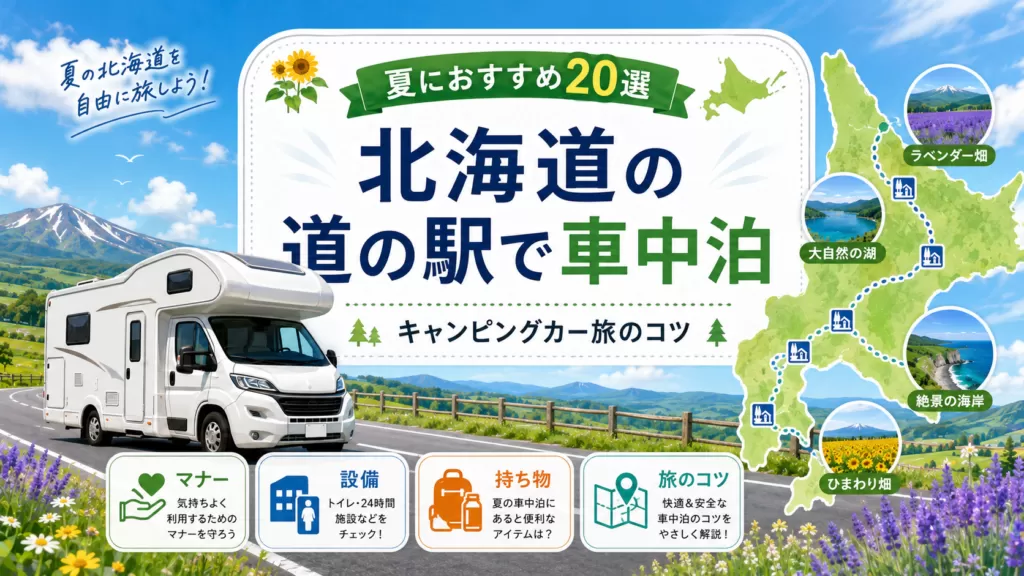
Hokkaido has 128 roadside stations (Michi-no-Eki), spaced every 50–80 km along major national highways. Most offer 24-hour restrooms and free parking, making them ideal rest stops for camper van trips. This guide covers 20 top stations for summer 2026 van life, organized by region, along with etiquette rules, how to use your camper’s equipment, a 7-night 8-day model route, cost estimates, and a packing checklist.
You can rent a campervan for this trip.
- Guide price (Moving Inn, New Chitose Airport, per night, tax included): HIACE van conversion from ¥22,000, Cresson Journey cab-over camper from ¥30,800. 20–30% off when booked 60–90 days ahead (official rate table, checked 15 Oct 2026)
To check how each roadside station officially treats overnight stays, see which Hokkaido roadside stations allow van-sleeping, and how to check the official rules.
Tap a dot on the map to see its name here.
Names are hidden because there are many dots. Tap a dot to see its name and a link to where it appears in this article. 1 places whose location could not be confirmed are not shown. Dot positions are based on each facility’s address or officially published location. Lakes and expressways are from OpenStreetMap data.
Why Roadside Stations Are Perfect for Summer Van Life in Hokkaido
Summer in Hokkaido brings daytime highs of 25–28°C and cool nights of 15–20°C, so sleeping comfortably with just a cracked window is common — no air conditioning needed. Unlike the humid nights of Honshu, Hokkaido nights are genuinely refreshing. With 128 Michi-no-Eki — among the most in Japan — you can find a stop every 50–80 km even on long stretches like National Route 40 (Asahikawa to Wakkanai) or the coastal road from Kushiro to Shiretoko. Another bonus: morning farm stands. Popular stations stock freshly harvested corn and melon by 8 a.m., and buying before tour buses arrive at 10 a.m. is the smart move. The freedom to choose each night's stop based on weather and energy perfectly suits Hokkaido's long-distance driving style.
Van Life Etiquette at Roadside Stations (Rules & Gray Areas)
The key principle: overnight stays at Michi-no-Eki are tolerated as "rest stops during long-distance travel," not as campgrounds. The Ministry of Land, Infrastructure, Transport and Tourism has explicitly stated that consecutive overnight stays and camping activities are not intended uses. Understanding this distinction prevents most problems. In summer, when visitor numbers peak, a single camper's bad behavior has led some stations to post "overnight stays prohibited" signs. Keep the following rules and gray areas in mind.
- No consecutive nights: Limit yourself to one night per station. For longer stays, move to an RV park or campground (¥500–3,000/night).
- No idling: The most-complained-about behavior. Use your sub-battery and FF heater for climate control.
- No camping setup: Setting up tables, chairs, tarps, or cooking outside — or running a generator — is prohibited.
- Pack out all garbage: Station trash cans are for shop customers. Store trip waste in the vehicle and dispose at an RV park or coin laundry with proper facilities.
- No gray-water dumping: Never drain tanks in the parking lot or restrooms. Use designated dump stations only.
- Gray area guideline: Arriving at dusk and leaving by morning is acceptable rest. Claiming a spot from morning and staying all day is effectively camping.
Top 20 Roadside Stations by Region (Central, South, North, East Hokkaido)
These 20 stations are chosen for spacious parking, 24-hour restrooms, and accessibility for full-size cab-over campers. Each has fuel and a bath facility within 50 km. On summer weekends many stations see traffic past 10 p.m., so if you prefer quiet, look for stations one road back from the main highway.
Central Hokkaido (30 min–2 hrs from New Chitose Airport)
- Michi-no-Eki Salmon Park Chitose (Chitose): 15 min from the airport. Ideal for the first or last night. Riverside morning walks along the Chitose River are a highlight.
- Michi-no-Eki Utonai-ko (Tomakomai): 1-minute walk to the lake. Best birdwatching 5–7 a.m. Gateway to Shikotsu Lake and Noboribetsu.
- Michi-no-Eki Boyo Nakayama (Kimobetsu, Nakayama Pass): At 835 m elevation, summer nights drop to around 13°C. Get the famous age-imo (fried potato) during shop hours.
- Michi-no-Eki Toyako (Toyako): Overlooks Lake Toya from a hillside. In summer, catch the long-run fireworks (8:45 p.m., ~20 min) from the lakeside and return on foot.
- Michi-no-Eki Rusutsu (Rusutsu): Midpoint between Niseko and Toya. Fresh corn is available at the neighboring farm stand from early morning in July–August.
Southern Hokkaido (Hakodate Area)
- Michi-no-Eki Nanairo Nanae (Nanae): 30 min by car to Hakodate. 10 min to Onuma Quasi-National Park for early-morning walks.
- Michi-no-Eki Shikabe Kanketsusen Park (Shikabe): Features a geyser erupting every ~10 minutes and a foot bath. Note that the seafood restaurant closes at lunch.
- Michi-no-Eki Jomon Roman Minamikayabe (Hakodate): Adjacent to the World Heritage Ohfune Site. Dark and quiet at night — ideal for sleeping.
- Michi-no-Eki Misogi no Sato Kikonai (Kikonai): Brand-new facilities next to the Shinkansen station. Good pre-stop before heading south to Matsumae or Esashi.
- Michi-no-Eki Kaminokuni Monju (Kaminokuni): Hilltop station facing the Sea of Japan. Watch the summer sunset (around 7 p.m.) from your camper window.
Northern Hokkaido (Asahikawa, Furano, Wakkanai)
- Michi-no-Eki Asahikawa (Asahikawa): Urban station with grocery stores, gas, and a coin laundry within walking distance. Great base for Asahiyama Zoo.
- Michi-no-Eki Biei "Oka no Kura" (Biei): 10 min to the Patchwork Road. Visit the rolling hills by 6 a.m. in mid-July to early August to beat lavender-season crowds.
- Michi-no-Eki Minami Furano (Minami Furano): 5 min from Lake Kanayama. Key transit point for crossing Shihoro Pass to Eastern Hokkaido.
- Michi-no-Eki Nakagawa (Nakagawa): A vital rest stop on Route 40 between Otoineppu and Wakkanai. Very quiet at night.
- Michi-no-Eki Wakkanai (Wakkanai): Attached to Japan's northernmost JR station. Cape Soya is 30 min away; the Rishiri/Rebun ferry terminal is 5 min.
Eastern Hokkaido (Kushiro, Shiretoko, Okhotsk)
- Michi-no-Eki Akan Tancho no Sato (Kushiro): On-site hot spring "Akai Beret" lets you bathe then sleep. 40 min to Kushiro Marsh.
- Michi-no-Eki Mashu Onsen (Teshikaga): Free foot bath. Lake Mashu and Lake Kussharo each 20 min away; leave by 6 a.m. to catch the morning mist on Mashu.
- Michi-no-Eki Shiretoko Rausu (Rausu): Whale-watching boats depart right in front. Sperm whale sightings peak in summer.
- Michi-no-Eki Saroma-ko (Saroma): Famous sunset spot on Lake Saroma. Minimal streetlights — on clear nights the Milky Way is visible to the naked eye.
- Michi-no-Eki Onneyu Onsen (Kitami, Rubeshibe): Walking distance to Onneyu hot spring district. Handy midpoint between Sounkyo Gorge and Abashiri.
How to Make the Most of Roadside Stations with a Camper Van
The biggest difference from a regular car overnight stay is the ability to run electricity, heat, and water with the engine off. At no-idling stations, this equipment gap directly translates to comfort. Confirm these three features when booking your rental.
- FF Heater: A fuel-burning heater that warms the interior without running the engine. Even in August, high passes and inland Eastern Hokkaido drop to 10–13°C at night. Fuel consumption is roughly 0.5 L per night.
- Sub-battery: Charges while driving; powers lights, refrigerator, phone charging, and ventilation fans when parked. A 100Ah battery handles one night easily. For multi-night trips, recharge at an RV park electric hookup (¥1,500–3,000/night).
- Fresh/gray water tanks: A vehicle with a sink allows cooking and washing up inside — compatible with the no-outdoor-cooking rule. Note that Michi-no-Eki do not offer water refills; top up at RV parks or campgrounds (roughly 20 L). Gray water must be drained only at dump stations.
The basic food strategy: pick up supplies at the farm stand and station restaurant before dark, then eat inside. Minimal cooking means less waste and fewer etiquette concerns. From summer into autumn, you can also build the harvest itself into your itinerary instead of just buying produce — see our Harvest Experiences by Campervan Guide.
7-Night 8-Day Model Route Using Roadside Stations
A round-trip from New Chitose Airport covering Central → North → Eastern Hokkaido, approximately 1,500 km total. Daily driving is capped at 150–200 km to allow sightseeing time. No consecutive nights at the same station; two nights are spent at RV parks for battery recharging, waste disposal, and water refill.
- Day 1: Pick up at New Chitose Airport → Lake Shikotsu → Michi-no-Eki Utonai-ko (approx. 60 km)
- Day 2: Via Shimukappu to Furano. Farm Tomita → Michi-no-Eki Minami Furano (approx. 180 km)
- Day 3: Biei hills → Asahiyama Zoo → RV park in Asahikawa (recharge & water refill, approx. 90 km)
- Day 4: Sounkyo Gorge → Sekihoku Pass → Michi-no-Eki Onneyu Onsen (approx. 160 km)
- Day 5: Abashiri Prison Museum (1.5–2 hrs) → Michi-no-Eki Saroma-ko for sunset → overnight same station (approx. 120 km)
- Day 6: Shiretoko Shari → Shiretoko Goko Lakes → Michi-no-Eki Shiretoko Rausu (approx. 170 km)
- Day 7: Lake Mashu → Lake Akan → RV park near Kushiro (approx. 180 km)
- Day 8: Via Obihiro to New Chitose Airport drop-off (approx. 300 km, two rest stops)
Cost Estimate (Rental + Travel Expenses)
Sample budget for 7 nights, 8 days with 2 adults + 2 children in summer. Camper van rental ranges from ¥15,000–55,000/night depending on vehicle type; a family-sized cab-over camper typically runs ¥25,000–35,000/night in peak season. With free Michi-no-Eki stays and RV parks at just ¥1,500–3,000/night, the total comes in well below booking two hotel rooms (often ¥20,000+ × 2). Fuel for ~1,500 km is estimated at ¥30,000–50,000. In fuel-scarce northern and eastern Hokkaido, fill up whenever the tank reaches half.
- Rental (cab-over camper, 7 nights): ¥175,000–245,000
- Gasoline (~1,500 km): ¥30,000–50,000
- 2 RV park nights + 6 bath visits: approx. ¥10,000
- Food (farm stands & restaurants): ¥40,000–60,000
- Total estimate: ¥260,000–370,000 (¥65,000–92,500 per person for 4 people)
Bookings fill up 3–4 months ahead for mid-July through the Obon holiday in August. Reserve by May at the latest if you want vehicle choice.
Summer Van Life Packing Checklist
Most rental campers include bedding and cookware — confirm the equipment list when booking and only bring what's missing. The key Hokkaido-specific challenge is the day-summer/night-autumn temperature swing and insects. Even in August, nights can dip below 15°C in some areas, so a fleece is genuinely useful. For bugs, use a strong DEET repellent, especially in Eastern Hokkaido's wetlands; long sleeves and socks add extra protection.
- Sleep: Eye mask & earplugs (for busy stations), insect-screen window covers if the van lacks screens, blackout sunshades
- Temperature: Fleece or light down jacket, summer sleeping bag + thin blanket, USB fan
- Insects: DEET 30% spray, battery-powered mosquito repeller (for indoor use), sting-extraction tool
- Power & lighting: Power bank (20,000mAh+), headlamp, cigarette-socket USB charger
- Hygiene: Odor-blocking garbage bags (bring plenty — all trip waste stays in the van), wet wipes, portable toilet (1–2 for traffic jams or remote passes)
- Bathing: 2 towels, onsen kit (nearby bath facilities typically ¥400–700)
- Drinking water: Several 2 L bottles (separate from the fresh-water tank)
- Driving: Polarized sunglasses for low morning/evening sun, itinerary avoiding driving after dark when wildlife collisions spike
Summary
Hokkaido summers offer cool 15–20°C nights perfect for sleeping, and the network of 128 roadside stations lets you travel flexibly without advance accommodation bookings. The core rules are simple: one night per station, no idling, no outdoor camping gear, and pack out all waste and gray water. A camper van equipped with an FF heater and sub-battery turns these constraints into a comfortable and affordable adventure. Peak-season vehicles sell out 3–4 months in advance — lock in your booking as soon as your itinerary takes shape.
Compare Hokkaido Camper Van Rentals
Browse and compare rental companies by price, vehicle type, and pickup location — including models with FF heaters and sub-batteries.
Compare Rentals & Prices →
![Hokkaido Winter Trip: Shoes & Packing List [2026] – 2,060 Sapporo Fall Transports and a Pre-Departure Checklist](https://hokkaido-campingcar.jp/wp-content/uploads/2026/10/hokkaido-winter-trip-shoes-packing-eyecatch-768x432.webp)
![Snow Cancels Your New Chitose Airport Flight? Rebooking Rules and Campervan Rental Delays [2026]](https://hokkaido-campingcar.jp/wp-content/uploads/2026/10/new-chitose-airport-snow-cancellation-eyecatch-768x432.webp)