Complete Guide to RV Parks in Hokkaido | Recommended Facilities, Prices & Booking Tips [2026 Edition]
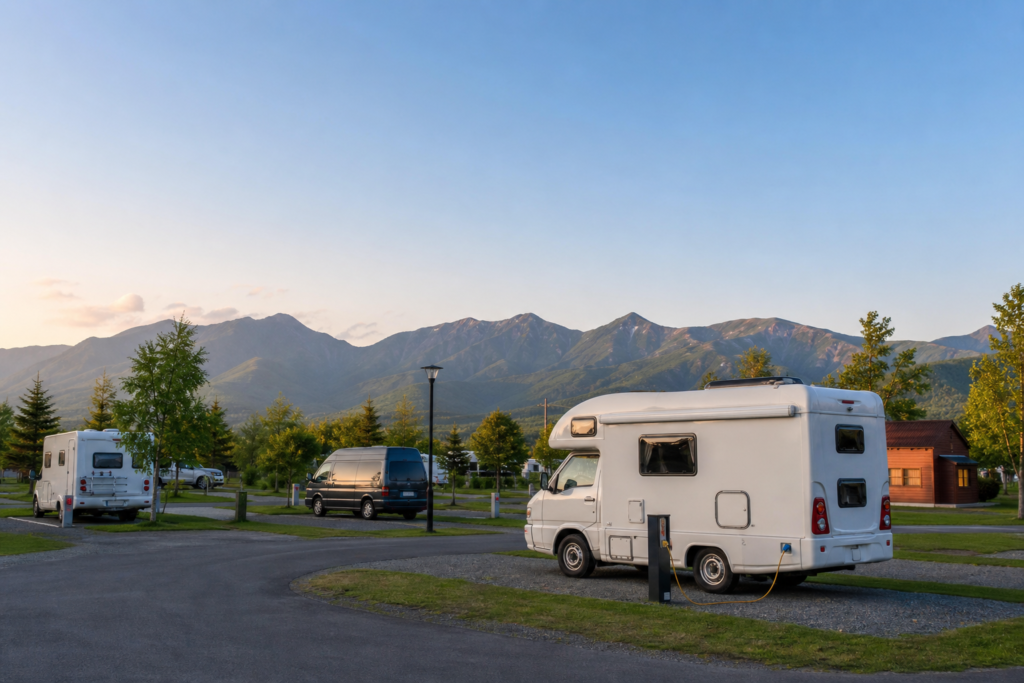
If you are touring Hokkaido in a campervan, RV parks are one of the most reliable options available. With dedicated pitches equipped with power hookups, water, and dump stations, they are a completely different experience from roadside rest-area car parks or regular campgrounds. This guide covers everything from the basics of RV parks to area-by-area facility recommendations, typical pricing, and booking tips.
Whether you are renting a campervan for the first time or a repeat visitor who comes to Hokkaido every year, thinking about RV parks from the perspective of “where do I reset my resources?” makes itinerary planning much easier. Use this as a backbone for building your trip.
What Is an RV Park? How It Differs from Michi-no-Eki and Regular Campgrounds
An RV park is a campervan-exclusive overnight facility certified by the Japan RV Association (JRVA). It is not simply “a place to park and sleep” — it provides dedicated pitches with the infrastructure campervans need: power connections, water supply and drainage, and waste disposal.
How It Differs from Michi-no-Eki (Roadside Stations)
Michi-no-Eki are fundamentally rest facilities and do not officially permit overnight stays. You can use the toilets, but power hookups and dump stations are not available. RV parks, by contrast, are designed with overnight stays in mind, so nighttime usage rules are clear and the environment causes less nuisance to neighbours.
How It Differs from Campgrounds
Typical campgrounds are set up for tents and barbecues. Even if they have grass pitches and cooking areas, external power hookups (30A/50A outlets) for campervans are rarely available. RV parks put campervans first, so external power standards and parking space dimensions are designed with the vehicle in mind.
Main Facilities at RV Parks
- External power (AC100V · 30A or 15A)
- Water point (fresh water top-up)
- Dump station (grey water and toilet cassette disposal)
- Rubbish area (usually with sorting)
- Toilet and shower block (varies by facility)
- Wi-Fi (at some facilities)
Not every facility has all of the above. Always check the official website or call ahead before booking.
Area-by-Area Recommended RV Parks in Hokkaido
RV parks are scattered across central, southern, eastern, and northern Hokkaido. The following are representative facilities confirmed as of June 2026. Prices and facilities may change, so check directly with the facility when booking.
Central Hokkaido (Do-o)
RV Park Tomakomai-ko Futomi (Tomakomai City)
Located close to the ferry terminal, this site lets you check in directly after arriving by ferry from Honshu. Power and toilets are available, making it an excellent starting point for your trip. Tomakomai is also about 40 minutes by car from New Chitose Airport, easily reachable right after picking up your rental campervan.
RV Park Hokkaido Iwamizawa (Iwamizawa City)
Conveniently close to the Iwamizawa IC on the Do-o Expressway, this facility works well as a stopover between Sapporo and Asahikawa. It supports power pitches and fresh-water top-ups, ideal when you want to reset your tanks mid-journey.
Eastern Hokkaido (Do-to)
RV Park Bihoro (Abashiri-gun, Bihoro-cho)
Positioned as a base for visiting Bihoro Pass and Lake Kussharo. In eastern Hokkaido, where distances between facilities are long, having a midway point for power top-ups and waste disposal is invaluable. Many travellers combine it with day-use hot springs nearby instead of using the on-site shower.
RV Park Engaru (Monbetsu-gun, Engaru-cho)
A useful base for the Okhotsk coast, Lake Saroma, and the Shiretoko Peninsula. The area is quiet at night, a comfortable environment for families too.
Northern and Southern Hokkaido
The number of JRVA-certified RV parks is growing in northern Hokkaido (around Wakkanai and Asahikawa) and southern Hokkaido (around Hakodate and Oshamanbe). That said, northern Hokkaido has fewer facilities and some simple overnight-parking spots are mixed in with certified parks. Use the JRVA official site RV Park Search to confirm the latest certified list.
Up-to-date Hokkaido RV park information is maintained on the JRVA official website.
4 Checkpoints When Choosing a Hokkaido RV Park
Deciding based only on name and location can lead to surprises like “no power on arrival” or “no dump station.” Always verify these four points before booking.
- Power availability and amperage: Many facilities have a mix of powered and non-powered pitches. State clearly at booking that you want a “powered pitch.”
- Parking space dimensions: Some sites cannot accommodate cab-over campervans over 6 m long. A quick phone call asking whether a large cab-over fits prevents problems.
- Dump station availability: Especially important for vehicles with cassette toilets. Without one, you will need to find a separate disposal site every few days.
- Check-in time and late-night arrival policy: If your ferry arrives at night, confirm whether you can park outside check-in hours. For unmanned sites, ask about key pick-up procedures too.
RV Park Pricing and Facilities (Power, Shower, Dump)
As of June 2026, Hokkaido RV parks typically charge 1,500 to 3,000 yen per night. Prices vary by location, facilities, and season.
Rough Price Breakdown
- Non-powered pitch: approx. 1,500 to 2,000 yen
- Powered pitch (AC100V · 15A): approx. 2,000 to 2,500 yen
- Powered (30A) + water + dump included: approx. 2,500 to 3,000 yen
- Extra facilities (shower, laundry etc.): often charged separately (200 to 500 yen per use)
These are rough guides. Prices may rise by around 20% during peak season (July to August). Some facilities offer multi-night discounts.
Power Facility Checklist
Check in advance whether your campervan external power cable is rated 15A or 30A — facilities differ. If you only have a 30A cable, you may need an adapter at a 15A-only site.
What Is a Dump Station?
A dump station is the facility for emptying a campervan toilet cassette or grey-water tank. Vehicles with cassette toilets need to remove the cassette every few days and pour the contents into a dedicated drain. Without a dump station at the RV park, you will have to find an alternative disposal site.
If you plan a longer trip (5 nights or more), check your map in advance to confirm that dump-station-equipped RV parks are included along your route.
Compare Hokkaido Campervan Rentals
Compare prices, vehicle types, and bases using New Chitose Airport as your hub.
Compare rental companies and prices →How to Book an RV Park and Key Points to Note
Booking methods vary by facility. There are broadly three patterns: phone-only, online booking, and booking via Nap-camp.
Types of Booking
Phone booking
Common at small, owner-operated sites. Same-day calls may be accepted, but popular sites can be fully booked weeks ahead in peak season. Phone reception hours are limited, so call during the day.
Online booking
Some facilities use their own booking forms or camping reservation portals. Online booking usually means credit-card payment and a simpler process.
Nap-camp
A reservation service specialising in camping and overnight stays. Many certified RV parks are listed, with real-time availability. Booking multiple nights before your trip makes itinerary planning much easier.
Items to Confirm at Booking
- Power availability and amperage (15A / 30A)
- Vehicle length and height limits (essential for larger cab-overs)
- Check-in and check-out times
- Pet policy
- Dump station availability
- Cancellation policy (Hokkaido weather can disrupt itineraries)
Peak Season Notes
July and August are peak season for campervan travel in Hokkaido. Popular RV parks can fill up on weekends a month in advance. Securing at least your main overnight stops early reduces the risk of your itinerary falling apart.
In contrast, late September to October sees availability open up and some facilities lower their prices. The autumn foliage season makes this an excellent and under-rated time to visit Hokkaido.
RV Park Etiquette
RV parks are often located closer to residential areas and tourist spots than campgrounds, so etiquette awareness really matters. Generator use is banned or time-restricted, and extended engine idling is prohibited at most sites due to noise and exhaust. Having external power is precisely why you should connect to it and turn the engine off.
Always sort and dispose of rubbish according to the facility rules. At take-your-rubbish-home sites, do not dump large quantities in convenience-store or Michi-no-Eki bins. Check the rubbish rules at booking or on arrival.
How to Combine Campervans and RV Parks Effectively
Weaving RV parks into your itinerary dramatically improves comfort on a Hokkaido circuit or eastern Hokkaido drive. The key is factoring “power, water, and dump” resource management into your planning.
Planning Your Route: The 3-Night Cycle
Most campervans hold enough fresh water for 2 to 3 days and cassette toilets last 3 to 4 days at full. A realistic cycle is therefore “include an RV park every 2 to 3 nights for a reset.” In between, keep costs down by staying at Michi-no-Eki or free auto campgrounds.
Kuresso Journey and RV Parks — a Good Match
Moving Inn, operating out of New Chitose Airport, rents the cab-over “Kuresso Journey,” which comes standard with a hot-water shower, cassette toilet, FF heater, and fridge. Plugging into an RV park powered pitch means the shower runs hot and the fridge stays on all night — you can sleep without ever using the communal shower block.
Without external power, the fridge relies on the sub-battery and anxiety builds over multi-night stays. Connected to an RV park supply, it runs stably overnight. Hokkaido summers are often cool, but temperatures can drop on inland eastern nights, so having power means you can run the FF heater without worry.
Because the Kuresso Journey is a full-sized cab-over (approximately 6 m long), we recommend confirming parking space length in advance. Most JRVA-certified facilities accommodate standard campervan sizes, but adding the question at booking is a simple precaution.
RV Parks vs Michi-no-Eki — How to Use Each
Hokkaido has many Michi-no-Eki and plenty of travellers who overnight there for free, but officially these stations only tolerate brief rest stops, not multi-night stays or long-term use. To avoid nuisance to locals and overcrowding, a sensible baseline approach is: “Michi-no-Eki for a brief stop before the next day’s drive; RV park for your main overnight base.”
During the peak summer period (late July to mid-August), popular Michi-no-Eki car parks are crowded even late at night. If noise and parking pressure bother you, paying for an RV park usually results in a more comfortable trip overall.
Example: RV Parks in a 10-Night Hokkaido Circuit
For a model 10-night, 11-day Hokkaido circuit, aiming for 4 to 5 RV park nights gives a workable rhythm. The following is a rough pattern for reference. Actual facility availability and each traveller’s pace will vary.
- Day 1: Pick up campervan at New Chitose Airport, then 1 night at Tomakomai RV park (vehicle check and facilities walkthrough)
- Days 2 to 3: Lake Shikotsu and Lake Toya area, 2 nights at Michi-no-Eki or auto campground
- Day 4: Head south towards Hakodate, 1 night at southern Hokkaido RV park (fresh water top-up and dump)
- Days 5 to 6: Move to eastern Hokkaido, 2 nights using Michi-no-Eki
- Day 7: RV park near Bihoro and Lake Akan area, 1 night
- Days 8 to 9: Shiretoko and Okhotsk coast, 1 night at Engaru RV park
- Day 10: Asahikawa and Furano area, 1 night at Michi-no-Eki
- Day 11: Return campervan at New Chitose Airport
Slotting in RV parks every few nights lets you manage tank levels and power top-ups methodically. Campervan travel is wonderful for the freedom to stop anywhere, but keeping resource-reset points in mind means you travel more comfortably.
New from New Chitose Airport — June 2026
Rent the Cab-Over “Kuresso Journey”
Travel all of Hokkaido by campervan, starting from New Chitose Airport.
See details at Moving Inn →FAQ
What is the difference between an RV park and a campground?
An RV park is a campervan-exclusive overnight facility with the infrastructure campervans need: external power, water supply, and dump stations. Most campgrounds are designed for tents and barbecues, and external power outlets and parking dimensions are rarely suited to campervans. Only facilities certified by JRVA (Japan RV Association) may call themselves RV parks.
Is a reservation required, or can I turn up on the day?
Advance booking is generally required. During July and August peak season, some facilities fill up weeks ahead. Some sites accept walk-ins if space is available, but if there is a specific place you must stay, book in advance by phone or online. Services like Nap-camp let you check availability in real time.
Can I bring my pet?
Pet policies vary by facility. Many RV parks are relatively relaxed about pets inside the campervan, but shared spaces (shower and toilet blocks) are usually off-limits to animals. Check at booking for peace of mind. Always follow the facility rules for leads and waste disposal.
What is a dump station and how do I use it?
A dump station is a facility for emptying a campervan cassette toilet or grey-water tank. For cassette toilets, remove the cassette, pour the contents into the designated drain, rinse it, and replace. Vehicles with a directly connected waste tank connect a hose to drain it. For a first-time dump, ask on-site staff to walk you through it. Always rinse the area thoroughly afterwards.
Can I use an RV park if I do not own a campervan?
RV parks are intended for campervans, van conversions, kei campervans, and other overnight-capable vehicles. Regular passenger cars are generally not expected and may be turned away. Renting a campervan and using it at RV parks is perfectly fine. Renting from New Chitose Airport and hopping between RV parks is one of Hokkaido’s most popular travel styles.