Minamifurano & Karikachi Pass Campervan Driving Guide | Lake Kanayama, Scenic Pass, and Lakeside Overnight Stays [2026 Edition]
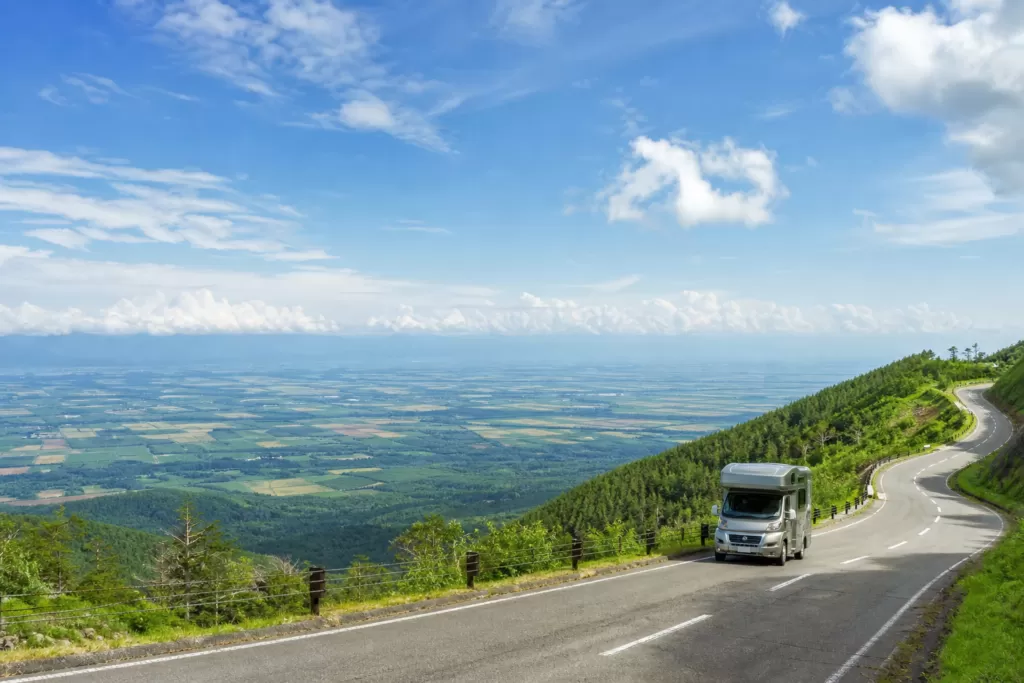
Minamifurano town and Karikachi Pass sit midway along National Route 38, which connects Furano and Obihiro-Tokachi. When you drive a campervan across Hokkaido north to south, the air noticeably shifts along this stretch. Head south past the bustling lavender fields of Furano city, and eventually the quiet surface of Lake Kanayama appears; cross the pass and the Tokachi plain suddenly opens wide before you. A “transit-style journey,” set slightly apart from the noise of tourist spots, gains real depth here.
This guide covers everything from the reality of camping and sleeping in your vehicle at Lake Kanayama, to how to drive Karikachi Pass, hot springs, water refill and shopping bases, and a model north-south route linking Furano and Obihiro. Combine it with campervan travel in the Furano area and the Obihiro-Tokachi area for a trip that lets you savor Hokkaido’s north-south backbone in depth.
The Minamifurano / Karikachi Pass area and the appeal of a transit-style trip
Minamifurano is a small town of about 2,400 people, adjoining Furano city to the south. Its area is a vast roughly 665 square kilometers, most of it forest and farmland. National Route 38 runs through the center of town, passing through from Furano (north) to Shintoku town (south). Farmland and pasture spread along the upper reaches of the Sorachi River that flows through the town, with cattle and mounds of silage blending into the summer scenery. In contrast to Furano’s density of tourism, Minamifurano is a destination that doesn’t sell itself on being famous — a place where “unfiltered Hokkaido” still remains.
What makes this town special for travelers is the moment it transforms from “a place you pass through on the way somewhere” into “a destination in its own right.” The dusk hour when lavender reflects on the surface of Lake Kanayama; the morning view of the Tokachi plain from Karikachi Pass. These have nothing to do with the crowds of famous tourist spots, and are opened up only to those who can stay overnight in a campervan. Not being bound by a lodge’s checkout time, and being able to linger at the lookout until the fog clears, are privileges of vehicle travel.
In terms of transportation, the JR Nemuro Main Line once ran between Furano and Shintoku, but it was discontinued in April 2024. Stations along the line such as Ikutora, Ochiai, and Higashi-Shikabetsu all became defunct, and the region’s transport shifted entirely to roads. Now that the railway is gone, a car is the only way to travel through this stretch. This makes it an area where traveling by campervan carries even greater meaning. The remains of this decommissioned local line still linger as regional memory today — the former Ikutora Station in Minamifurano remains a filming location for the movie “Poppoya (Railroad Man)” and still draws visitors.
From New Chitose Airport to Minamifurano via Route 38 is about 140km, roughly 2 to 2.5 hours. From Furano city it’s about 35km / 40 minutes. From Obihiro city it’s about 90km / 1 hour 20 minutes. Geographically it makes sense as a relay point on trips linking central and eastern Hokkaido. The roads are drivable year-round, but during the spring thaw (March–April) the surface can be rough in places, so check your tires before setting out.
Camping and lakeside overnight stays at Lake Kanayama in practice
Lake Kanayama is a dam reservoir on the Sorachi River completed in 1973, an artificial lake roughly 40km in circumference. Lavender grows wild along the lake’s southern shore, and in early to mid July a band of purple reflects on the water’s surface. At the same time that Farm Tomita in Furano is crowded with tourists, the lavender at Lake Kanayama remains a hidden spot known only to locals and seasoned Hokkaido repeat visitors.
Kanayama Lakeside Campground
A town-run campground on the southeastern shore of the lake. Centered on free sites with wide grassy areas, easy to park even large campervans. Powered sites are limited in number, so during high season (July–August) you’ll need to secure one early.
- Open period: Late May to early October (varies by year)
- Fees: Free site, roughly 1,000 yen per vehicle/pitch; powered site roughly 2,500 yen
- Facilities: Cooking shelter, flush toilets, garbage disposal (paid bag system)
- Showers: None (use nearby hot spring facilities)
- Reservations: Minamifurano Town Tourism Association, or call the management building directly
There’s a water tap within the campground usable as drinking water. It’s a good idea to top up your tank here.
About sleeping in your vehicle at the lakeside
Free parking spaces are scattered around Lake Kanayama, but some areas prohibit overnight vehicle stays. As a rule, using the campground is the local norm. Within the campground, nighttime quiet is assured, and you can view the starry sky reflected on the lake through your campervan’s skylight.
The lakeshore in the early morning hours of 5–6am, wrapped in mist, is exceptional. Just walking the shore before other campers wake up is enough to feel that coming to Minamifurano was worth it. On windless mornings the lake surface becomes mirror-like, reflecting the mountains and sky on the opposite shore. Some travelers bring canoes or kayaks, and groups use it as a base for flatwater touring.
Foxes and Ezo squirrels can be seen around the lake. Feeding wildlife is strictly forbidden as it harms the ecosystem. Keep food in a cooler box or inside your vehicle, and don’t leave it out on tables. Especially in years with brown bear sightings, get the latest information from the campground manager before heading out.
Compare Hokkaido campervan rentals
Base yourself at New Chitose Airport and compare rates, vehicle types, and pickup locations all in one place.
Karikachi Pass’s scenic views and using the roadside station
Heading south from Minamifurano on Route 38, Karikachi Pass lies on the border with Shintoku town. At an elevation of 644m, this pass crosses the Sekisho mountain range and has been a key transport link between eastern and western Hokkaido ever since the railway opened in the Meiji era. That Nemuro Main Line was also discontinued in 2024, leaving the road as the only remaining means of crossing the pass.
The view from the Karikachi Pass lookout
Near the summit of the pass there’s a lookout point and parking area. On a clear day the Tokachi plain spreads out across 270 degrees, and you can even make out the distant Daisetsuzan mountain range. This view was once counted among “Japan’s Three Great Train Window Views” (the others being Obasute and Yatake), and it was long beloved as a railway pass-crossing scene. After the line’s closure, this view now belongs solely to road travelers.
Crossing the pass in the early morning, you can catch the sight of the morning sun striking the entire Tokachi plain. On days when fog covers the plain, you look down on a sea of clouds from the mountaintop. Quite a few travelers stay an extra night at Lake Kanayama just for this view. Near the lookout there’s parking space (for roughly 10–15 vehicles) that can accommodate large campervans. However, avoid long-term parking on the road shoulder as it obstructs following traffic — use the designated parking area.
There’s a stretch south of the pass where the old Nemuro Main Line track bed runs alongside the national highway. Years after closure it’s becoming overgrown with grass, but the fact that trains once ran here adds layers to the road’s history. Pausing for a moment during the pass crossing to imagine the scene of days past adds depth to the drive.
Points to watch when crossing the pass in a campervan
Karikachi Pass has one of the steeper grades among Hokkaido’s major passes, and it places a certain load on campervans. The descent on the southern side (toward Shintoku) especially continues for a long stretch.
- Watch engine coolant temperature: Overheating can occur on the climb during summer. Keep an eye on the temperature gauge as you drive, and pull over to rest if it gets hot
- Expect worse fuel economy: A heavily loaded campervan may see fuel economy drop by roughly 20–30% compared to flat roads. Fill up on the Minamifurano side before descending toward Shintoku
- Winter closures or restrictions: Winter tire requirements and road closures typically start around November each year. If traveling in spring, check remaining snow conditions before entering
- Use engine braking on the downhill: Relying solely on the foot brake on the southern descent can cause brake fade. Downshift to control your speed
Roadside Station “Minami-Furano”
In the Minamifurano town center there’s a roadside station, “Michi-no-Eki Minami-Furano.” It offers direct-from-farm vegetables, local processed goods, and soft-serve ice cream, and is well suited for a restroom break or short rest. The parking lot is fairly large with spaces for large vehicles. Note, however, that long-term parking for the purpose of sleeping overnight is prohibited.
There’s no supermarket or pharmacy within walking distance of the roadside station, so it’s realistic to handle food shopping in Furano city or Shintoku town. The roadside station’s soft-serve, made with local milk, is highly rated, and many travelers stop by before or after crossing the pass. Stamp rallies and local goods are also available, and it functions as a rest stop for drivers aiming to circle Hokkaido.
Information on water refills, shopping, hot springs, and multi-night bases
Minamifurano isn’t a convenient urban center. To stay multiple nights in a campervan, the basic strategy is to stock up on supplies at a base before or after this area.
Shopping
Within Minamifurano town there are only a few small supermarkets and convenience stores. Selection is limited, so it’s better to stock up on food in Furano city (35km north of town) or Shintoku town (30km, on the south side of the pass) before heading in. Shintoku town has the “Super Shintoku Shopping Center.”
To the north, Furano city has large stores like Seicomart, Super Arcs, and Homac, where you can buy several days’ worth of food in one go. If staying several nights at Lake Kanayama, it’s efficient to load up in Furano before heading south.
Water refills
You can refill water at the cooking shelter of the Kanayama Lakeside Campground. Water quality is good and usable as drinking water. There’s also a water tap at the town’s roadside station, allowing for a simple top-up.
Hot springs and bathing facilities
The following two are the main options for bathing in Minamifurano.
- Kanayama Lake Onsen Lodge (Hoshi Kara Hoshi E): A lodging facility near the lakeside that accepts day-trip bathers (check hours and rates in advance). Its open-air bath offers a view of the lake
- Latale (Minamifurano town): A lodging and bathing facility with a hot spring in town, also used by local residents
Once you cross Karikachi Pass into Shintoku town, options expand to include facilities like “Shimukappu Health Center (Shimukappu)” and “Shintoku Yamanoie.” Combining hot springs before and after the pass lets you stay comfortable even over multiple nights.
Garbage disposal
The campground uses a paid garbage bag system (purchase town-designated bags). There are no trash cans at the roadside station, and convenience stores may refuse disposal too. As a rule, keep burnable garbage in your vehicle until you reach the next staffed facility. Check sorting rules at the campground reception.
Power and charging
At campgrounds with powered sites you can charge from an external power source. For unpowered free sites, rely on a sub-battery or portable power station. Since crossing the pass also charges via the alternator while driving, routes with a lot of daytime movement naturally supplement your charge. Lake Kanayama has areas with weak signal, and carriers other than docomo may lose reception on the north side of the lake. It’s reassuring to download offline maps for navigation and routing in advance.
Nearby sightseeing spots
If staying multiple nights in Minamifurano, there are spots worth visiting beyond Lake Kanayama and its immediate surroundings.
- Kanayama Auto Campground: Another campground on the Lake Kanayama shore. Well-equipped, with cottages also available, and a larger number of powered sites
- Ikutora district’s rural scenery: The area around former Ikutora Station is a quiet farming district after the line’s closure, where you can stroll through streets retaining a Showa-era atmosphere
- Lake Kanayama canoe experience: In some years, canoe and kayak experience programs run on the lake during summer. Inquire with the tourism association
- Fishing on the Sorachi River: The upper reaches of the Sorachi River flowing through Minamifurano town are known as a fishing spot for masu salmon, char, and Amemasu trout. Enjoy it by purchasing a fishing license (day passes available)
New Chitose Airport / Tokachi-Obihiro Airport
Rent the cab-conversion “Cresson Journey”
Base yourself at New Chitose Airport and travel all across Hokkaido by campervan.
Furano — Karikachi Pass — Obihiro: A north-south model route
Here’s a sample 6-day, 5-night north-south route starting at New Chitose Airport, passing through Minamifurano and Karikachi Pass, and continuing on to Obihiro. It can be shortened or extended depending on your travel style and number of days.
Day 1: New Chitose Airport → Furano
Pick up your campervan at New Chitose Airport and head toward Furano via the Doto Expressway. Stop at Super Arcs or Seicomart in Furano city to stock up on 3–4 days’ worth of food. In the evening, stay at a campground near Furanui Onsen or elsewhere in the area. See the Furano campervan guide for the Furano area.
Days 2–3: Furano → Minamifurano / Lake Kanayama (2 nights)
After visiting the lavender fields in Furano, head south (in July, the morning lavender fields are less crowded before 9am). Continue 35km south on Route 38 to the Kanayama Lakeside Campground. After checking in, stroll along the lakeshore, and in the evening wash off the day’s travel at a hot spring. Staying two nights lets you catch both the misty morning lake and a clear sunset.
On the morning of day 3, visit the former Ikutora Station site (filming location for “Poppoya”). The station building and platform are preserved even after the line’s closure, letting you experience a piece of Hokkaido’s railway history. In the afternoon, take a leisurely tour of the lakeshore and spend the rest of the time at your multi-night base.
Day 4: Minamifurano → Crossing Karikachi Pass → Shintoku / Shimukappu
Depart the campground around 7am. Head south on Route 38 toward Karikachi Pass. Rest for 30–60 minutes at the pass lookout, taking in the view of the Tokachi plain. After descending the pass, have lunch and shop for supplies in Shintoku town. Shintoku’s soba is famous, one of Hokkaido’s top soba-producing areas. In the afternoon, stop at a hot spring in Shimukappu village or the Hidaka direction, then move toward Obihiro in the evening, or stay one night at a campground near Shimukappu.
Days 5–6: Obihiro / Tokachi area
After restocking at a supermarket in Obihiro city, take in the full experience of the Tokachi plain. Details on campervan travel in the Obihiro-Tokachi area are covered in the Obihiro-Tokachi campervan guide. On the final day, return from Obihiro to New Chitose Airport via the Doto Expressway (about 2 hours 30 minutes).
Route distance and time summary
| Segment | Distance | Estimated time |
|---|---|---|
| New Chitose Airport → Furano | Approx. 110km | Approx. 1 hour 30 minutes |
| Furano → Lake Kanayama | Approx. 35km | Approx. 40 minutes |
| Lake Kanayama → Karikachi Pass lookout | Approx. 25km | Approx. 30 minutes |
| Karikachi Pass → Shintoku | Approx. 20km | Approx. 25 minutes |
| Shintoku → Obihiro | Approx. 65km | Approx. 1 hour |
| Obihiro → New Chitose Airport | Approx. 160km | Approx. 2 hours 30 minutes |
The total journey is about 415km. As a north-south route across Hokkaido, this is relatively compact — a distance you can comfortably cover in about a week.
Frequently Asked Questions (FAQ)
Q: Do I need a reservation for the Kanayama Lakeside Campground?
During the July–August high season, powered sites in particular tend to fill up, so it’s safer to reserve ahead. Free sites can often be entered on a walk-in basis, but they may reach capacity on busy weekends. Contact the Minamifurano Town Tourism Association (by phone) or the facility’s management building directly.
Q: Can a campervan get through Karikachi Pass?
Yes, it’s passable year-round (except in winter). However, heavily loaded large campervans tend to run hotter on the climb, so extra caution is needed especially in summer. Keep constantly checking the coolant temperature gauge, and pull over to let it cool if it gets hot. In winter, road restrictions apply due to snow and ice. Check the Hokkaido Development Bureau’s road information before setting out.
Q: When is the best time to see the lavender at Lake Kanayama?
Typically early to mid July. The timing nearly overlaps with Farm Tomita in Furano, but the Lake Kanayama side has fewer tourists, letting you quietly enjoy the lavender reflected on the lake’s surface. Since bloom timing shifts year to year, check Minamifurano town’s tourism information or local social media in advance.
Q: Can I bathe at a hot spring around Minamifurano?
Kanayama Lake Onsen Lodge accepts day-trip bathers (check hours and closing days in advance). There are also day-use hot spring facilities in Shimukappu village and Shintoku town on the other side of Karikachi Pass. If staying multiple nights, combining hot springs before and after the pass makes for a comfortable stay.
Q: Can I visit the former Ikutora Station (the “Poppoya” filming location)?
Yes, you can. The station building and platform have been preserved even after the Nemuro Main Line’s closure, and some of the film set from the movie shoot also remains. Parking is available (free). Admission fees vary by facility, so check the on-site signage. It’s located along Route 38 near Minamifurano town, making it easily accessible even by campervan.
Q: Can I fill up on gasoline in Minamifurano?
There are gas stations in Minamifurano town, but their operating hours are short and they may not be open at night or early morning. Be sure to fill up before crossing Karikachi Pass. Fueling in Furano city before heading south removes any fuel anxiety about crossing the pass.
Q: Which section of the Nemuro Main Line was discontinued?
The section between Furano and Shintoku (about 81.7km) was discontinued on April 1, 2024. As a result, stations in Minamifurano such as Ikutora and Ochiai became defunct. Currently, it’s not possible to travel this stretch by rail. Some replacement bus service runs, but the number of services is limited. Traveling by campervan is one of the few ways left to freely move through this stretch after the line’s closure.
Book a Campervan in Hokkaido
Moving Inn New Chitose Airport supports English booking and offers airport transfers.

![Campgrounds Near Tokachi-Obihiro Airport: 8 Sites Within 30 km, Compared by Vehicle Access, Power and Price [2026]](https://hokkaido-campingcar.jp/wp-content/uploads/2026/10/photo-obihiro-airport-featured-pl232-768x512.jpg.webp)
![Campgrounds Near Hakodate Airport: 12 Sites Within 30 km, Compared by Vehicle Access, Power and Price [2026]](https://hokkaido-campingcar.jp/wp-content/uploads/2026/10/photo-hakodate-airport-featured-hl4722-768x484.jpg.webp)