Hokkaido Campervan Travel with Children: Safety Guide | Child Seats & In-Transit Rules [2026]
Safety guide for traveling Hokkaido by campervan with children.
Pick a campervan by what matters to you.
Rent at New Chitose Airport
See only the rental bases in Chitose, where the airport is.
Rent in winter (Dec–Mar)
Companies that rent through winter, listed apart from those that close.
Guide price
Moving Inn New Chitose Airport: HIACE van conversion from ¥22,000 per night. 20–30% off when booked 60–90 days ahead (official rate table, checked 15 Oct 2026).
Before you book: with an International Driving Permit if your country is in the Geneva Convention (for example the US, Australia, Singapore); Taiwan, Switzerland, Germany, France, Belgium and Monaco need your licence plus a Japanese translation (Tokyo Metropolitan Police). Questions in English: Moving Inn on WhatsApp. Every roadside station (michi-no-eki) must have free 24-hour toilets, and Hokkaido has 128 of them (MLIT).
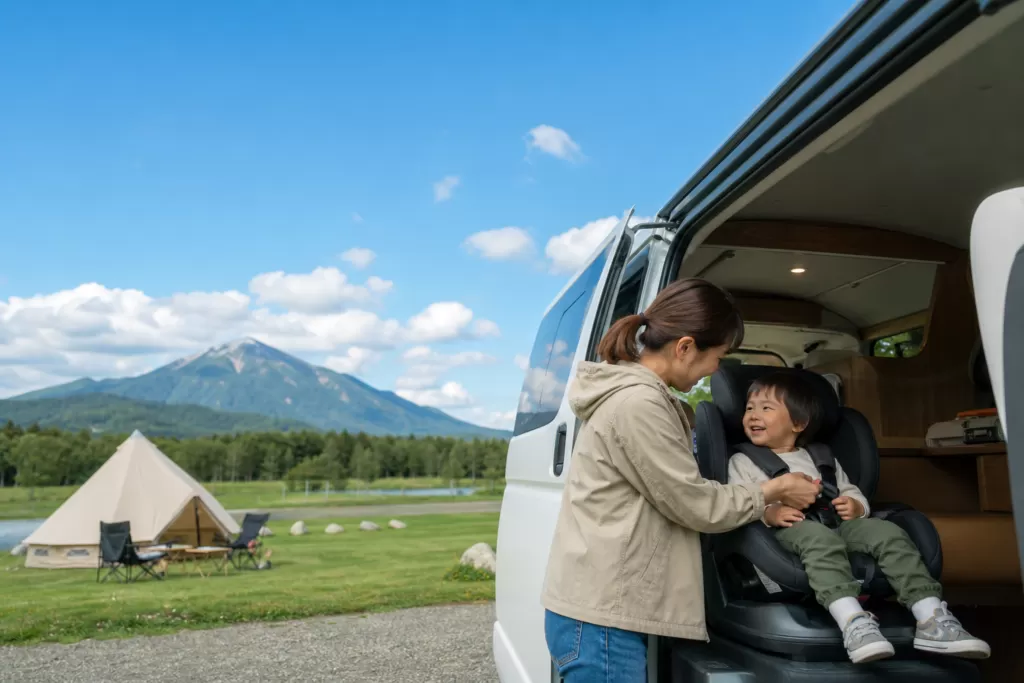
When traveling Hokkaido with children in a campervan, safety is paramount. While the spacious living area and onboard beds are attractive, the rules governing campervans while driving are the same as for ordinary vehicles under the Road Traffic Act. Here is a summary of the legal requirements you need to know—including mandatory child seat use and the prohibition on using the living area while moving—along with practical safety tips.
New Chitose Airport / Tokachi-Obihiro Airport
Rent the Cabcon “Cresson Journey”
Base yourself at New Chitose Airport and compare rates, vehicle types, and pickup locations all in one place.
See details at Moving Inn →The most important rules while driving
Campervans are structurally divided into a “driving section (cab and passenger seats)” and a “living section (sleeping area and dinette).” However, under the Road Traffic Act, all occupants must wear seatbelts while the vehicle is in motion. Moving freely around the living space while driving is illegal.
Allowing children to sleep in the rear living area or walk around the cabin during transit—even “just for a short distance”—can be life-threatening in an accident. The comfort of a campervan and safety while driving are two separate matters. Make sure to review these rules with your children on the first day of the trip to avoid problems later.
Legal requirements for child seats
Under Article 71-3 of the Road Traffic Act, child seats are mandatory for children under 6 years of age. Violations result in one demerit point for the driver (no fine is issued).
| Age / Size | Type of child seat | Orientation |
|---|---|---|
| Newborn–approx. 1 year (under 13 kg) | Infant seat (baby seat) | Rear-facing as a rule |
| Approx. 1–4 years (9–18 kg) | Toddler seat (child seat) | Forward-facing |
| Approx. 4–6 years (15–36 kg) | Junior seat (booster seat) | Forward-facing, seatbelt secured |
| 6 years and over | No obligation (seatbelt required) | — |
Notes on installing child seats in campervans
- Install in seats equipped with seatbelts: Seatbelt-secured child seats can only be installed in seats that have seatbelts
- Caution for front passenger seat: Rear-facing seats in the front passenger seat are dangerous when an airbag is present. Unless the airbag can be disabled, use the rear seats
- Living area cannot be used while moving: Sofas and beds in the living area are not recognized as passenger seats while driving. Using them as seating while moving is a violation of the Road Traffic Act
- Check for ISOFIX anchors: If ISOFIX anchors are fitted, the child seat can be secured more stably. Confirm at the time of rental
Using the living area while driving is prohibited
The “rear living area” of a campervan is a living space for when the vehicle is parked or at a campsite. Lying down in the rear area or allowing children to move freely while driving violates Article 71 of the Road Traffic Act (mandatory seatbelt use). In the event of an accident, not wearing a seatbelt can lead to serious injury.
- While moving, all occupants must sit in their designated seats with seatbelts fastened
- Not only children but adults too must not sleep in the rear area while the vehicle is in motion
- The assumption that “it’s just a short distance” leads to accidents
What to check when choosing a family-friendly campervan
| Checklist item | Details |
|---|---|
| Capacity and number of seatbelts | Confirm there are enough seatbelts for everyone including children. A “5-person capacity” does not necessarily mean 5 seatbelt-equipped seats |
| ISOFIX child seat anchors | ISOFIX anchors allow a more secure installation of child seats |
| Steps (boarding steps) | Check if the step height allows children to board and exit independently. Also check for a supplementary step |
| Safety of sleeping area | Bunk beds (high-position beds) require a guard rail to prevent children from falling. Check even when parked |
| Sharp corners and protrusions inside | Check for sharp corners in areas where children move around. Assess the risk of injury in case of a fall |
| Onboard toilet/shower | For young children, a vehicle with an onboard toilet provides peace of mind. This greatly reduces toilet issues during overnight drives |
Choosing campsites and RV parks for families
For family travel, the facilities at your overnight stop directly affect the comfort of the trip. Checking the following points before booking will reduce problems on-site.
- Clean toilet and shower facilities: Children may need the toilet at night. Check the cleanliness, lighting, and distance of the facilities
- Size of the pitch: Space for children to run around allows them to burn energy after arrival
- Hot spring or bath facilities: On a long trip, bathing the children every day becomes a daily challenge. Choosing an RV park with a hot spring or one near a public bath makes life easier
- Kitchen/wash area: Used for washing dishes and preparing food. Lighting makes it safe to use at night
- Surrounding noise and nighttime safety: Sites near a national highway or construction site have nighttime noise. Choose a quiet pitch where children can sleep soundly
Hokkaido spots children enjoy
| Spot | Area | Target age | Features |
|---|---|---|---|
| Northern Horse Park | Tomakomai City | 2 years+ | Pony riding, horse-drawn carriages, adventure playground. Close to New Chitose Airport, easy to stop on the first or last day |
| Asahiyama Zoo | Asahikawa City | 2 years+ | Observe animals up close with behavioral exhibits. Easily half a day or more. Parking for large vehicles available |
| Farm and ranch experience facilities | Tokachi, Furano, Ebetsu | 4 years+ | Milk-a-cow, butter-making, vegetable-picking experiences. Educational and memorable for children |
| Shakotan and Yoichi beaches | Shakotan Peninsula | 3 years+ | Crystal-clear sea. July–August only. Choose well-maintained beaches with showers and changing rooms |
| Hokkaido Museum | Sapporo City | 5 years+ | Interactive exhibits about Hokkaido’s nature and history. Fine even on rainy days |
| Kushiro City Zoo | Kushiro City | 2 years+ | Many Hokkaido-native animals including polar bears, Ezo deer, and red-crowned cranes. Less crowded than Asahiyama—a hidden gem |
| Ningle Terrace (Furano) | Furano City | 4 years+ | Woodworking and craft experiences, forest walks. Lit up at night for a magical atmosphere |
Health management and how to find medical facilities
Hokkaido is vast, and many areas are far from major hospitals. For family travel, the following preparations provide peace of mind.
Preparations before departure
- Contact details for your family doctor: Keep the number handy so you can call for advice while traveling
- Bring regular medications: Bring fever reducers, antidiarrheal medicine, bandages, and antihistamines (for insect bites/allergies)
- Locate pediatric clinics and emergency hospitals in Hokkaido: Note down pediatric clinics and after-hours emergency services in major cities along your route (Sapporo, Asahikawa, Obihiro, Hakodate). In Sapporo and some nearby towns, calling #7119 (Emergency Consultation Center) will guide you to appropriate medical facilities based on symptoms
- Health insurance card and medical cost certificate: Your child’s medical cost certificate (issued by the municipality) can be used in other areas. However, there are cases where you pay the full amount first when crossing prefectures, so confirm in advance
Health management while traveling
- Sunstroke / heat stroke: Hokkaido summers are cooler than Honshu, but heat stroke can occur at tourist spots with strong sunlight. Stay hydrated and use sun protection
- Food poisoning: Do not keep seafood, raw food, or BBQ leftovers to the next day
- Insect bites: Mosquitoes and horseflies are common in grasslands and wooded areas during certain seasons. Bring insect repellent spray and long-sleeved clothing
Handling nighttime emergencies
Most nighttime problems at campsites can be prevented with preparation.
- Prevent falls from bunk beds: Always attach a guard rail to high-position bunk beds. Using a children’s sleeping bag helps prevent falls from rolling
- Going outside at night: Campsites are dark at night, and children going outside alone risk getting lost or falling. Parents must always accompany them
- Heat and cold management: Even in Hokkaido summers, temperatures can drop to 10–15°C at night. Having a light down jacket or fleece for each person provides security against sudden cold
- Fire management: After BBQ, fully extinguish the charcoal and store it where children cannot reach it
- Share emergency contacts: Share the campsite office phone number, location of the nearest convenience store, and nearest emergency hospital with everyone in the group
Family travel routines and tips
Setting rest stops
Children tire of long drives easily, and avoiding more than 2 hours of continuous driving is practical. Plan stops every 1–2 hours at Michi-no-Eki (roadside stations), service areas, or parks for children to get out and move.
Keeping children entertained
- Bring tablets, picture books, and games to keep children busy during travel
- Creating small goals—”Let’s eat something at the next roadside station”—keeps children engaged
- Reading maps and signs together (builds a sense of participation in the journey)
- For elementary-school age and up, creating a travel journal or stamp rally adds fun
Managing toilet frequency
Young children can suddenly need the toilet. Identify the locations of Michi-no-Eki, service areas, and convenience stores along your route in advance, and get into the habit of checking “how many km to the next toilet” on the navigation system. A campervan with an onboard toilet can handle emergencies.
Family campervan guide for 4–6 people: costs and vehicle types
Campervan beginner’s guide for Hokkaido
Choosing overnight spots differently when traveling with children
When choosing overnight spots for a family campervan trip, facility quality directly affects satisfaction. Aspects that adults can tolerate when traveling alone can become nightly stress when young children are involved. Confirming the following conditions before booking is recommended.
Conditions for family-friendly RV parks and auto campsites
| Facility / condition | Why it matters |
|---|---|
| Electric hookup (AC100V) | Essential for nighttime life with children: fans, electric blankets, smartphone charging. Fans in summer, supplement to the FF heater from autumn onwards |
| Clean shower / hot water | Children sweat a lot and need a daily bath. Clean showers available at night are reassuring. An adjacent hot spring or public bath is even better |
| Kitchen / lit washing area | Used for washing children’s dishes and food prep. Lighting makes it safe to use at night |
| Play area / spacious pitch | Space for children to burn energy after arrival makes bedtime smoother. Playground equipment or a large lawn is ideal |
| Clean flushing toilet | Nighttime toilet access is especially important for families. Check the location, cleanliness, and lighting of the campsite toilets in advance |
In Hokkaido, campsites praised by families include Kagurao Park Campsite in Asahikawa, Auto Resort Tomakomai Arten in Tomakomai, and Hoshi ni Te no Todoku Oka Campsite in the Furano area. All offer electrical hookups, showers, and spacious pitches, and advance booking is required.
Hokkaido experience spots to enjoy with children
Hokkaido has many facilities where children can experience animals, agriculture, and nature—making memories that stay with them. Here are campervan-accessible spots by area.
- Farm Tomita (Furano): Lavender in bloom early-to-mid July. Free entry with spacious parking accessible to large campervans. Soft-serve ice cream and lavender soda are popular
- Hands-on farms in Tokachi (around Obihiro): Some farms offer milking, butter-making, and vegetable-picking experiences — check each farm’s official site for availability. Great for kindergarten to elementary-school-age children
- Asahiyama Zoo (Asahikawa): See animals up close with behavioral exhibits. Penguin parades, polar bears swimming underwater—many things children get absorbed in. Easily half a day. Large vehicle parking available
- Kushiro City Zoo (Kushiro): Less crowded than Asahiyama, with many Hokkaido-native animals including Ezo deer, red-crowned cranes, and polar bears. A good stop on the eastern Hokkaido route
- Historical Village of Hokkaido (Sapporo/Nopporo): An open-air museum with Meiji–early Showa architecture preserved and relocated. Educational for children about Hokkaido’s history and culture, with enough space to walk around and burn energy
Nighttime vehicle environment (lighting, temperature control, child seats during sleep)
A well-maintained nighttime vehicle environment helps children settle into the trip.
- Lighting: Campervan interior lights are often warm-colored LEDs, useful for reading bedtime stories and changing clothes. Bringing one night light provides reassurance if children wake up in the middle of the night
- Temperature control: Even in Hokkaido summers, temperatures can drop to 10–15°C at night. Preparing a light down jacket, fleece, or hot-water bottle per person allows you to handle a sudden drop in temperature. On electric-hookup sites, an electric blanket (about 12W) is energy-efficient and warm
- Child seats during sleep: Child seat use is not required when parked or sleeping. At the campsite, put children to sleep in the beds. However, before setting off the next morning, always move children back to their child seats and confirm seatbelts are fastened before driving
Emergency response (#7119, how to find nearby hospitals)
Being prepared so you don’t panic if a child suddenly becomes ill while traveling is important.
- #7119 (Emergency Consultation Center): An emergency consultation hotline where nurses guide you by phone to appropriate medical facilities based on symptoms. It is not nationwide: in Hokkaido it covers Sapporo, Ebetsu, Eniwa, Kitahiroshima, Ishikari, Tobetsu, Shinshinotsu, Shimamaki, Naganuma, Kuriyama and Nanporo. Available 24 hours
- Nearest pediatric clinic / emergency hospital: Note down pediatric clinics and after-hours emergency services in major cities along your route (Sapporo, Asahikawa, Obihiro, Hakodate, Kushiro). Searching “pediatric clinic” in Google Maps shows nearby facilities from your current location
- Hokkaido Emergency Medical Information System: A public service allowing you to search for medical facilities that handle nighttime and holiday emergencies in Hokkaido. Bookmark the official site by searching “Hokkaido emergency night” before departure for quick access while traveling
- Medication checklist: Confirm you have fever reducers (acetaminophen), antidiarrheal medicine, bandages, insect bite medicine, and antihistamines before departure. You can also buy these at drugstores in Hokkaido (Tsuruha and Satudora are common), but bring any medications prescribed by your child’s doctor
New Chitose Airport / Tokachi-Obihiro Airport
Rent the Cabcon “Cresson Journey”
Base yourself at New Chitose Airport and compare rates, vehicle types, and pickup locations all in one place.
See details at Moving Inn →Frequently asked questions (FAQ)
Q1: Are child seats included with campervans as standard equipment?
Some rental companies offer them as an optional add-on, but in most cases you need to bring your own. Child seats are classified by age and weight, so bringing one suited to your child’s size from home is the most reliable option. Always confirm with the rental company at the time of booking whether child seats can be rented.
Q2: Can I let children sit in the living area while driving?
No. All occupants are required to sit in seatbelt-equipped seats while the vehicle is moving. The living area of a campervan (sofas, dinette, beds) does not have seatbelts, so using it while driving is a violation of the Road Traffic Act. Always seat children in seatbelt-equipped seats behind the driver.
Q3: From what age can children travel in a campervan?
There is no age restriction, and travel is possible from infancy. However, infants require frequent temperature regulation, feeding, and diaper changes, so it is important to plan the trip with plenty of flexibility. Choosing a campervan with an onboard toilet and shower, and keeping daily driving to 4–5 hours or less, provides peace of mind. When children are 3–4 years and above, they can retain memories of the trip, making the experience more enjoyable.
Q4: What should I do if my child develops a fever while traveling?
If you are in Sapporo or a nearby covered town, first call #7119 (Emergency Consultation Center), which will guide you to appropriate medical facilities based on symptoms. Major cities in Hokkaido (Sapporo, Asahikawa, Obihiro, Hakodate, Kushiro) have pediatric clinics and after-hours emergency services. Bring over-the-counter fever reducers, and if a temperature above 38°C persists, pause sightseeing and visit a medical facility. Travel insurance reduces concerns about treatment costs.
Q5: Is Hokkaido’s summer suitable for campervan travel with children?
July–August is the peak tourist season in Hokkaido and is well-suited for family travel. It is cooler than Honshu, and there are many child-friendly activities such as swimming, lavender fields, and farm experiences. However, popular campsite reservations fill up early, so booking 3–4 months in advance is advisable. Golden Week and Obon are especially busy.
Book a Campervan in Hokkaido
Moving Inn New Chitose Airport supports English booking and offers airport transfers.
Pick a campervan by what matters to you.
Rent at New Chitose Airport
See only the rental bases in Chitose, where the airport is.

![When and Where Can You See Harbor Seals at Cape Erimo? Kaze no Yakata Official Information, Viewing Season, and Windy-Day Notes [2026-27]](https://hokkaido-campingcar.jp/wp-content/uploads/2026/10/erimo-cape-lighthouse-768x511.jpg.webp)
![Where and Under What Conditions Can You See Diamond Dust in Hokkaido? How Cold a Morning It Takes, and Where It Appears [2026-27]](https://hokkaido-campingcar.jp/wp-content/uploads/2026/10/hokkaido-diamond-dust-nayoro-768x512.jpg.webp)
![Can You Drive to Hokkaido Jingu for Hatsumode? Parking, Crowds, and Where to Park and Walk [2027]](https://hokkaido-campingcar.jp/wp-content/uploads/2026/10/hokkaido-jingu-winter-torii-768x504.jpg.webp)
![Hokkaido Roads Over New Year [2026-27] | Expressway Sections Prone to Blizzard Closures, Forecast Congestion Days, No Holiday Discount, and New Chitose Airport Parking](https://hokkaido-campingcar.jp/wp-content/uploads/2026/10/hokkaido-winter-rural-road-edge-markers-768x432.jpg.webp)
![Where to See Sea Smoke (Kearashi) in Hokkaido: Rumoi’s Ogon-misaki and the Morning Conditions [2026-27]](https://hokkaido-campingcar.jp/wp-content/uploads/2026/10/rumoi-kearashi-sea-smoke-768x511.jpg.webp)
![Geminid Meteor Shower 2026 in Hokkaido: Peak Around 23:00 on December 14, Sapporo Moonset 20:40, and Staying Warm in a Winter Campervan [2026]](https://hokkaido-campingcar.jp/wp-content/uploads/2026/10/geminids-2026-hokkaido-768x575.jpg.webp)