Hokkaido Solo Campervan Travel Guide | Costs, Vehicle Types, Routes & Safety Tips [2026 Edition]
A guide to solo campervan travel in Hokkaido. Covers the best vehicle types for solo travelers, cost estimates, recommended solo routes, safety precautions, and how to embrace and enjoy the solitude.
Pick a campervan by what matters to you.
Rent at New Chitose Airport
See only the rental bases in Chitose, where the airport is.
Rent in winter (Dec–Mar)
Companies that rent through winter, listed apart from those that close.
Guide price
Moving Inn New Chitose Airport: HIACE van conversion from ¥22,000 per night. 20–30% off when booked 60–90 days ahead (official rate table, checked 15 Oct 2026).
Before you book: with an International Driving Permit if your country is in the Geneva Convention (for example the US, Australia, Singapore); Taiwan, Switzerland, Germany, France, Belgium and Monaco need your licence plus a Japanese translation (Tokyo Metropolitan Police). Questions in English: Moving Inn on WhatsApp. Every roadside station (michi-no-eki) must have free 24-hour toilets, and Hokkaido has 128 of them (MLIT).
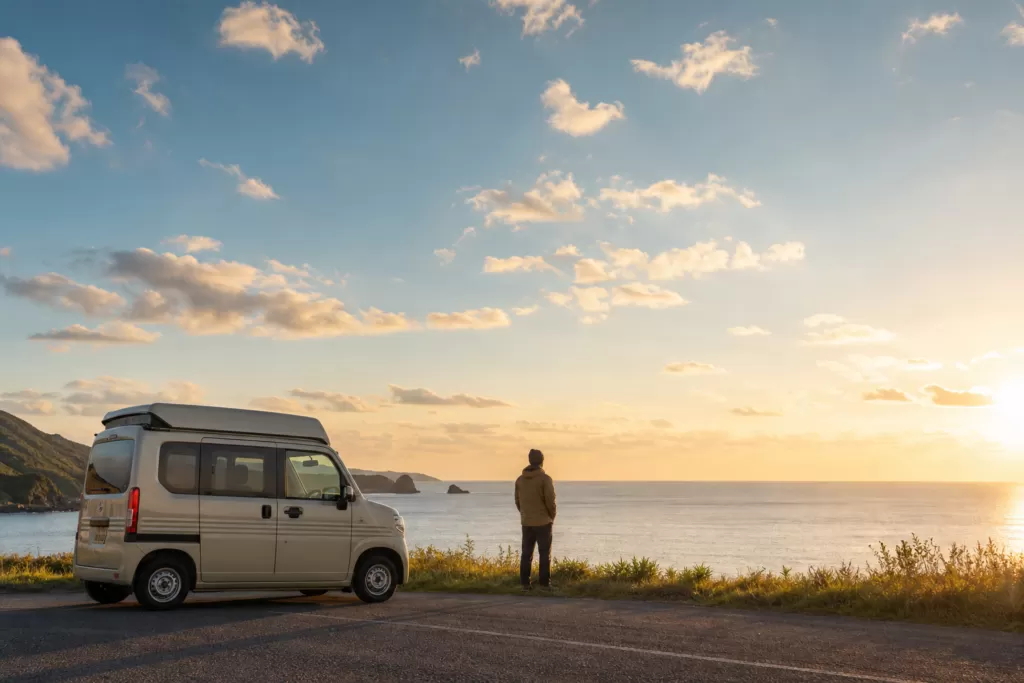
Renting a campervan and traveling solo in Hokkaido offers a level of freedom that simply isn’t available any other way. There are no hotel check-in or check-out times to worry about, no need to coordinate plans with anyone else — you decide where to go, how long to stay, and when to wake up. That said, traveling alone also means you’re responsible for managing your own driving fatigue, handling any vehicle trouble yourself, and making safety decisions on your own. This guide covers everything specific to solo campervan travel in Hokkaido: choosing the right vehicle, estimating costs, recommended routes, safety precautions, and how to make the most of the time alone.
Compare Hokkaido Campervan Rentals
Base yourself at New Chitose Airport and compare rates, vehicle types, and pickup locations all in one place.
Compare rental companies & prices →What to Know Before Renting a Campervan Solo
Renting a campervan alone in Hokkaido costs more per person than sharing with others. But the reason solo travelers still choose campervans is the combination of complete freedom to move at your own pace and the efficiency of combining transportation and accommodation into one. Without hotel bookings, check-ins, or check-outs to manage, you can sleep where you want and wake up when you want — advantages that are amplified when you’re traveling alone.
That said, solo travel comes with specific challenges: it’s harder to call for help in an emergency, you have to manage driving fatigue entirely on your own, and you’ll handle any vehicle problems without a co-pilot. These are manageable with preparation and the right mindset, but if this is your first time renting a campervan, starting with a short 2–3 night route is the practical approach.
Choosing the Right Campervan for Solo Travel
For solo travel, the key is a vehicle that’s “not too small, not too large.” Large cab-over campervans offer excellent living space but take time to get comfortable with for parking and reversing alone. For a solo debut, starting with a kei camper or a small-to-mid-size van conversion is the realistic choice.
Kei Campers (Light Vehicle Base)
Kei campers are compact in both length and width, fit in standard parking spaces, and are economical with fuel efficiency around 12–16 km/L. Sleeping space typically accommodates 1–2 people; models with a fully flat bed are perfectly comfortable. Standard equipment includes a small fridge, lighting, and USB charging — showers and toilets rely on external facilities. This style is especially well-suited for solo travelers who want to roam freely across Hokkaido’s vast landscape.
Van Conversions (HiAce / Caravan Base)
Van conversions offer more space than kei campers and typically come with a more complete setup. Sleeping area, storage, fridge, lighting, and charging are all properly equipped, making them well-suited for longer trips. At roughly 4.7–5.4 meters long, they’re relatively manageable for anyone with regular car driving experience. Rental rates start around ¥20,000–¥30,000 per night in the off-season (as of June 2026), rising to ¥30,000–¥40,000+ in peak season.
Cab-Over Campervans (Truck-Based, Large)
Cab-overs are often slightly over-specced for solo use, but experienced drivers sometimes choose them for the superior living space and equipment on extended solo trips. Many models include a shower, toilet, and permanent bed — allowing you to be fully self-contained even in bad weather. However, at 6–7+ meters in length, they can struggle with narrow roads and parking lots.
Solo Trip Cost Estimates
Solo trip costs vary significantly by vehicle type, duration, and season. The figures below are approximate as of June 2026. Actual rates vary by rental company, timing, and options.
4-Night 5-Day Solo Trip (Off-Season, Kei Camper)
- Campervan rental (kei camper, 4 nights): approx. ¥80,000–¥120,000
- Fuel (1,000 km, 14 km/L, ¥170/L est.): approx. ¥12,000
- Campsite / RV park fees (4 nights): approx. ¥8,000–¥20,000
- Food (mostly self-catering, 4 nights 5 days): approx. ¥10,000–¥15,000
- Sightseeing, hot springs, entry fees: approx. ¥10,000–¥20,000
- Total estimate: approx. ¥110,000–¥180,000
5-Night 6-Day Solo Trip (Peak Season, Van Conversion)
- Campervan rental (van conversion, 5 nights): approx. ¥150,000–¥200,000
- Fuel (1,500 km, 10 km/L, ¥180/L est.): approx. ¥27,000
- Campsite / RV park fees (5 nights): approx. ¥10,000–¥25,000
- Food (mix of self-catering and dining out, 5 nights 6 days): approx. ¥15,000–¥25,000
- Sightseeing, hot springs, entry fees: approx. ¥15,000–¥30,000
- Total estimate: approx. ¥220,000–¥320,000
While the per-person cost is higher than sharing, solo travelers have full control over hotel costs, meal timing, and how the budget is spent — making it easier to concentrate spending on what matters most to you.
3 Recommended Solo Routes in Hokkaido
Solo travel offers total freedom, but without any plan you can easily end up driving too far and wearing yourself out. Keeping daily driving to 200–250 km gives you room to actually enjoy the stops along the way.
Route 1: Central to Northern Hokkaido (4 nights, 5 days)
Pick up at New Chitose Airport → Furano / Biei → Asahikawa / Asahiyama Zoo → Teshio / Sarobetsu Wetlands → Wakkanai → Cape Soya → return to New Chitose Airport. Total distance: approx. 850–1,000 km. This northbound route packs in the essence of Hokkaido, from the flower fields of Furano and Biei to the northernmost point of Japan at Cape Soya. It covers both vast inland scenery and coastline, making it an ideal first solo Hokkaido trip.
Route 2: Eastern Hokkaido Loop (5 nights, 6 days)
New Chitose Airport → Tokachi / Obihiro (ban’ei racing, pork rice bowls) → Kushiro Marshland → Lake Akan → Lake Mashu → Shiretoko → Abashiri → return to New Chitose Airport. Total distance: approx. 1,200–1,400 km. Eastern Hokkaido is packed with highlights — Shiretoko World Heritage Site, Kushiro Marshland, Lake Akan, one after another. The satisfaction of driving open, uncrowded roads is especially well-matched to solo travel. Spring (April–June) and autumn (September–October) tend to have even fewer crowds.
Route 3: Southern Hokkaido / Hakodate Focus (2–3 nights)
New Chitose Airport → Lake Shikotsu → Lake Toya → Hakodate (night view, morning market, Goryokaku) → Onuma Quasi-National Park → return to New Chitose Airport. Total distance: approx. 700–850 km. Centering the route on Hakodate keeps the distances between sights short, making it a good first solo campervan trip. Hakodate has wide roads that are easy to navigate in a campervan.
Solo Travel Safety: Preparation That Matters When You’re Alone
When you’re traveling solo, there’s no one nearby to help in an emergency — which makes advance preparation and staying in contact with people back home even more important.
Sign Up for Roadside Assistance
Most rental companies offer 24-hour roadside assistance. Dealing with a flat tire, dead battery, or running out of fuel alone is exhausting in both time and energy. Make sure the roadside assistance number is saved and accessible before you set off. Also confirm your rental insurance coverage (deductibles, excess amounts) before departure so you’re not caught off guard if something happens.
Share Your Itinerary
Sending your planned overnight stops and next destination to family or a friend once a day makes it much easier for someone to notice if you go out of contact. LINE’s live location sharing or forwarding Google Maps routes via LINE are easy ways to do this. Northern and eastern Hokkaido have areas with no mobile signal in the mountains — check in advance where coverage is weak.
Sleep & Fatigue Management
The most commonly overlooked risk in solo travel is falling asleep at the wheel. Since you’re the only driver, you must stop without hesitation at a roadside station, rest area, or campsite the moment you feel tired. Hokkaido’s national and prefectural roads have long stretches with few traffic lights, which can induce drowsiness faster than roads in Honshu. Setting a personal daily distance limit of 200–250 km and taking a 15–20 minute nap at midday are the two most effective safety habits.
Wildlife Encounters
Brown bear sightings are regularly reported in the mountains and wetland areas of eastern and northern Hokkaido. Basic precautions include keeping food with strong odors inside the vehicle at campsites, minimizing solo outdoor activity at night, and checking bear-sighting reports at tourism offices and roadside stations. Collisions with Ezo deer are also common in Hokkaido — slow down noticeably when driving at night.
Solo Travel & Solitude: How to Make the Most of Your Time Alone
Extended solo travel can bring moments of frustration at not being able to share what you’re seeing with someone. The art of solo travel is turning that into something richer.
Keep a Record of Your Trip
Whether it’s a blog, social media, or a private journal, recording things in real time makes the experience more vivid. Looking at a scene with the lens of “how would I describe this to someone” deepens your observation. Writing down not just the visuals but the temperature, smells, and sounds keeps memories sharp long after the trip ends.
Meeting People at Roadside Stations & Campsites
There’s a culture among Hokkaido road-trippers of striking up conversations. At free-pitch campsites and roadside stations, it’s not unusual to end up chatting with other travelers on similar routes. The off-season in spring and autumn tends to attract more experienced travelers, and tips about lesser-known spots often come this way.
Visit Local Morning Markets & Produce Stands
Stopping at places where you can briefly interact with locals — Hakodate Morning Market, Obihiro farm produce stands, Asahikawa’s morning market — gives you glimpses of daily life in Hokkaido. Solo travel gives you the freedom to browse a market at your own pace and duck into small shops that would be awkward to visit in a group.
Choosing a Campsite for Solo Travel
Choosing a campsite when traveling solo requires slightly different priorities than when you’re with a group. Here’s what makes a campsite “good” for solo travel.
Management Office Nearby with Staff On-Site
Having someone you can quickly consult if something goes wrong is reassuring when you’re alone. Auto campsites with assigned pitches and a management office that operates into the evening make it easier to get help with late-night problems, illness, or disruptive neighbors. Choose a site that’s visible from the management office rather than tucked away in a remote corner of the grounds.
Clean Toilets & Showers
Solo travelers in van conversions and kei campers typically rely on the campsite’s toilets and showers, so facility quality directly affects comfort. Before booking, check reviews on Nap or Jalan Camping for toilet cleanliness — this single factor cuts down on disappointment. Campsites with an attached hot spring bath eliminate the need for a separate shower visit.
Assigned Pitches Over Free-Pitch Areas
Free-pitch areas give you flexibility to set up anywhere, but in solo travel you can end up uncomfortably close to a large group. Assigned pitches maintain a consistent buffer between sites, giving you better privacy and quiet. The per-site fee is slightly higher, but since solo travelers don’t split costs, that tradeoff is worth prioritizing.
Early Check-In & Flexible Departure
The biggest advantage of solo travel is moving entirely at your own pace. Campsites with early check-in (from 2–3 PM) let you make good use of the afternoon. Facilities with check-out at 11 AM or later give you a leisurely morning. Confirm these details on the official site or by phone before booking.
A Solo Traveler’s Daily Routine: Making the Most of Each Day
In solo travel, settling into a daily rhythm helps the trip feel stable. Here’s a routine that works well for many solo campervan travelers in Hokkaido.
Morning: Early Start to Beat the Crowds
Wake up at 6–7 AM, have breakfast in the vehicle, and head to major sights (Farm Tomita, Blue Pond, Lake Mashu Lookout, etc.) by 7–8 AM. Tourist spots are least crowded in the early morning, and the light is usually better for photography. With a campervan, your entire morning routine happens inside the vehicle, so you’re not tied to hotel check-out times.
Midday: Drive & Eat at Roadside Stations
After morning sightseeing, shift into driving mode toward the next area. Lunch at a roadside station, supermarket, or local diner typically comes in around ¥1,000–¥1,500 per dish even when eating out. Keeping midday driving-focused and saving the evening for dinner, a hot spring, and campsite check-in makes for a well-structured day. A 15–20 minute nap at a rest area or roadside station at midday significantly reduces afternoon driving fatigue.
Evening: Hot Spring → Dinner → Bed
Check in and set up at the campsite around 4–5 PM, then head to a nearby hot spring for a day-use soak around 6–7 PM (typically ¥400–¥800). Keep dinner simple — easy self-catering or prepared foods from a roadside station — and start winding down by 8–9 PM to make early rising easy the next morning. Using evening hours for quiet activities like reading, photo editing, or planning the next day’s route deepens the solo travel experience.
Set a Daily Distance Limit
Deciding in advance on a daily limit — “no more than 200 km” or “250 km maximum” — prevents overextending yourself. Hokkaido’s sense of scale is deceptive; the temptation of “just a bit further to that next spot” compounds quickly, and many travelers find themselves having driven 300–400 km by evening. Tired nighttime driving carries real risk, so setting a personal daily ceiling and sticking to it is a direct safety measure.
Packing for Solo Travel: How to Keep It Compact
Solo travel means only packing for one, leaving plenty of space in the campervan’s storage. That said, since you’ll be setting up and packing down alone, keeping things as simple as possible makes the trip easier.
Solo-Sized Cooking Gear Only
Leave the large group pots and big coolers behind. A compact single-person cook set (small pot and pan) and a 15–20 L cooler is all you need. Stock up on 2–3 days of groceries at a time at roadside stations or supermarkets and work through them in order — this reduces food waste and keeps restocking efficient.
Choose Compact Fabrics for Clothing
Hokkaido’s temperature swings mean light clothing alone won’t cover you, but choosing quick-dry, lightweight synthetics or merino wool keeps your pack significantly smaller. Using coin laundromats (common at roadside stations and public bath facilities) 2–3 times a week means you can get by with just 3–4 days of clothes.
Organize Charging for All Your Devices
A single multi-port USB charger (3–4 ports) lets you manage navigation, camera, phone, and power bank charging in one place and keeps the vehicle interior tidy. For photography-heavy solo trips, bringing backup batteries and spare charging cables gives extra peace of mind.
Frequently Asked Questions (FAQ)
Q: Is a standard driver’s license sufficient?
A: Kei campers, van conversions, and most standard cab-over campervans can be driven with a standard Japanese driver’s license. However, requirements can vary depending on the vehicle’s gross weight, payload capacity, and whether you hold an automatic-only license — confirm with the rental company before booking.
Q: Is renting a campervan solo expensive?
A: The per-person cost is higher than sharing. That said, since you have full flexibility over accommodation, transportation, and food costs, total trip expenses often end up comparable. For trips of 2 nights or more, it can actually work out cheaper than booking a different hotel every night. Choosing a kei camper is the most effective way to keep rental costs down.
Q: Do women travel solo by campervan in Hokkaido?
A: Yes, and the number is growing — particularly women choosing kei campers or compact van conversions. The ability to lock the vehicle from the inside while sleeping provides more security than tent camping. Prioritizing auto campsites with assigned pitches and a staffed management office means there’s someone to turn to if you need help.
Q: What season is best for a first solo campervan trip?
A: May–June or September–October. These periods combine low crowds, comfortable temperatures, easier campsite reservations, and lower rental rates compared to peak season. Starting your first trip during the summer peak (late July–August) adds reservation and parking stress — May–June is genuinely the practical starting point.
Q: What do I do when there’s no mobile signal?
A: Download Google Maps offline maps in advance — navigation still works without signal. Also keep a printed or screen-captured copy of your itinerary, campsite contact numbers, and the roadside assistance number so you can act even without connectivity. Pocket Wi-Fi devices with satellite connectivity are increasingly popular among long-distance travelers in Hokkaido.
Compare Hokkaido Campervan Rentals
Base yourself at New Chitose Airport and compare rates, vehicle types, and pickup locations all in one place.
Compare rental companies & prices →Book a Campervan in Hokkaido
Moving Inn New Chitose Airport supports English booking and offers airport transfers.
Pick a campervan by what matters to you.
Rent at New Chitose Airport
See only the rental bases in Chitose, where the airport is.
![When and Where Can You See Harbor Seals at Cape Erimo? Kaze no Yakata Official Information, Viewing Season, and Windy-Day Notes [2026-27]](https://hokkaido-campingcar.jp/wp-content/uploads/2026/10/erimo-cape-lighthouse-768x511.jpg.webp)
![Where and Under What Conditions Can You See Diamond Dust in Hokkaido? How Cold a Morning It Takes, and Where It Appears [2026-27]](https://hokkaido-campingcar.jp/wp-content/uploads/2026/10/hokkaido-diamond-dust-nayoro-768x512.jpg.webp)
![Can You Drive to Hokkaido Jingu for Hatsumode? Parking, Crowds, and Where to Park and Walk [2027]](https://hokkaido-campingcar.jp/wp-content/uploads/2026/10/hokkaido-jingu-winter-torii-768x504.jpg.webp)
![Hokkaido Roads Over New Year [2026-27] | Expressway Sections Prone to Blizzard Closures, Forecast Congestion Days, No Holiday Discount, and New Chitose Airport Parking](https://hokkaido-campingcar.jp/wp-content/uploads/2026/10/hokkaido-winter-rural-road-edge-markers-768x432.jpg.webp)
![Where to See Sea Smoke (Kearashi) in Hokkaido: Rumoi’s Ogon-misaki and the Morning Conditions [2026-27]](https://hokkaido-campingcar.jp/wp-content/uploads/2026/10/rumoi-kearashi-sea-smoke-768x511.jpg.webp)
![Geminid Meteor Shower 2026 in Hokkaido: Peak Around 23:00 on December 14, Sapporo Moonset 20:40, and Staying Warm in a Winter Campervan [2026]](https://hokkaido-campingcar.jp/wp-content/uploads/2026/10/geminids-2026-hokkaido-768x575.jpg.webp)