Cab Conversion vs. Van Conversion: Guide to Differences & How to Choose for Hokkaido Rental [2026 Edition]
New Chitose Airport / Tokachi-Obihiro Airport
Rent the Cab Conversion “Cresson Journey”
Moving Inn New Chitose Airport now takes bookings for full cab conversions. The roomier living space makes Hokkaido trips more comfortable for families and groups.
View Details at Moving Inn →The Fundamental Differences Between Cab Conversions and Van Conversions
There are many types of campervans, but the two most commonly offered in the Hokkaido rental market are cab conversions and van conversions. These two types differ fundamentally — from their base vehicle structure right through to the size of their living space. Which is better for you depends on your travel style, group size, and driving experience.
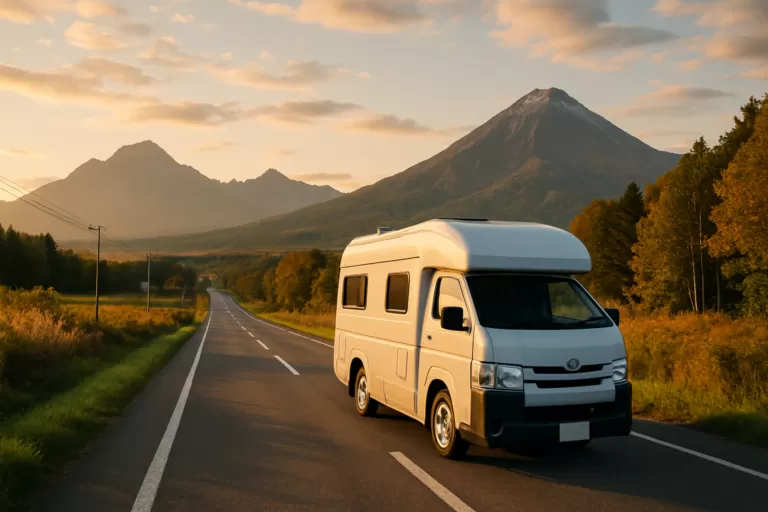
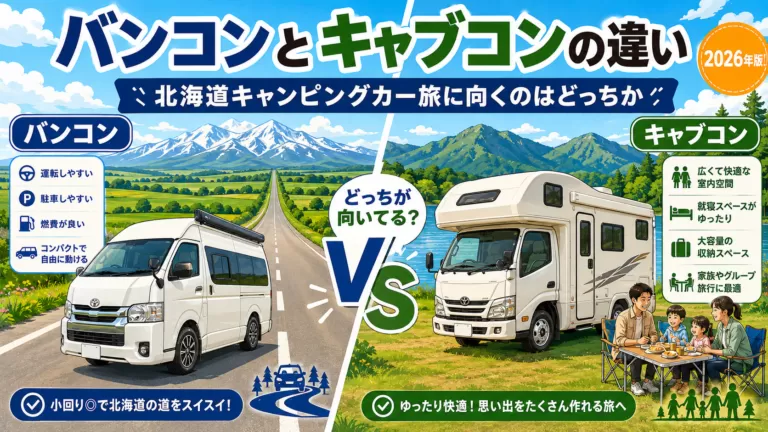
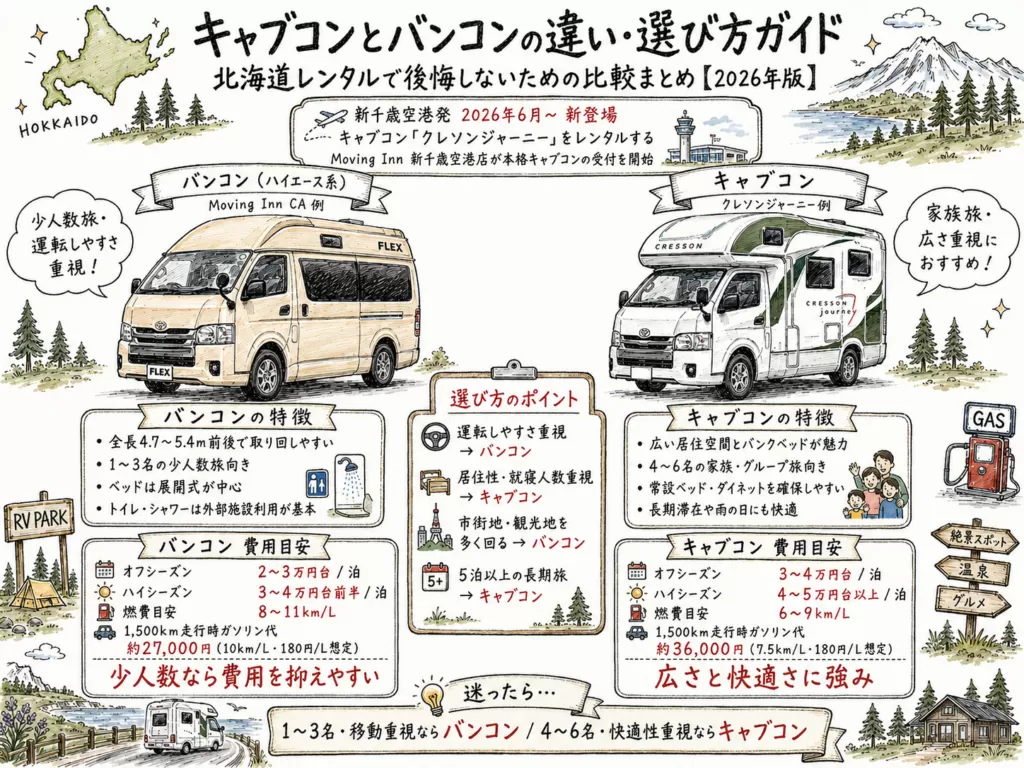
Cab conversions are built on a truck or bus chassis, with a distinctive bunk bed (sleeping area) protruding above the cab. The living section (lounge, kitchen, sleeping area) is purpose-designed, delivering comfort that feels almost like home. Most are 6–8 m long overall — stable thanks to their size, but not well suited to narrow roads or urban car parks.
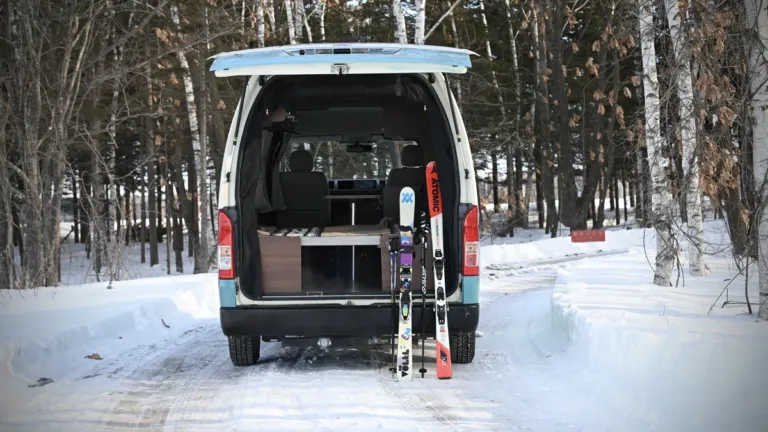
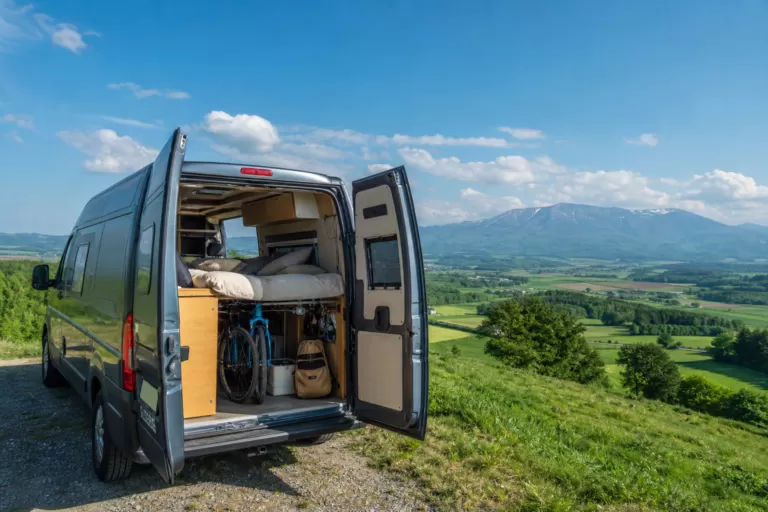
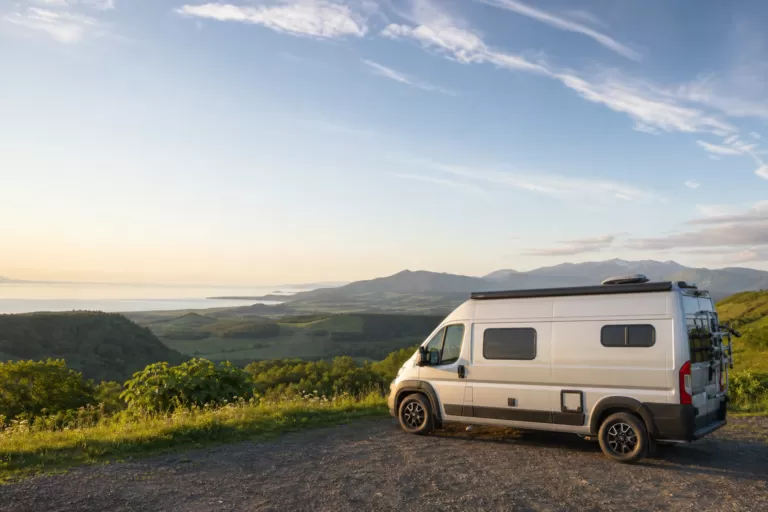
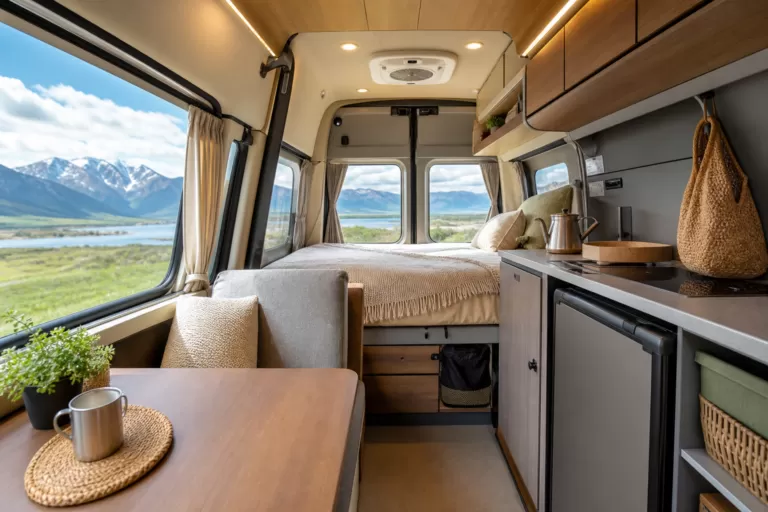
Van conversions are standard commercial vans — HiAce, Caravan, and similar — converted internally to camping spec. At 4.7–5.4 m overall, they are relatively compact, fit in most ordinary car parks, and feel much like driving a regular car. The living space is smaller than a cab conversion, but their ease of travel is outstanding.
Size & Manoeuvrability: Choosing for Ease of Driving
Hokkaido has many wide, straight roads, but you will also encounter tight spots — farm tracks, forest roads, and roadside station car parks. Sightseeing car parks (Shiretoko, Biei, Lake Toya, etc.) get very crowded in summer and sometimes restrict large vehicles.
Cases Where a Van Conversion Is the Better Choice
- You have only ever driven ordinary cars and have no experience with larger vehicles
- Your route takes in urban areas and multiple popular sightseeing spots
- You may be driving on narrow farm tracks, forest roads, or the tight lanes around hot-spring resorts
- Travelling with 1–3 people
Cases Where a Cab Conversion Is the Better Choice
- Family or group travel with 4–6 or more people
- A longer stay (5+ nights) where in-vehicle comfort is the priority
- You want shower, toilet, and a fixed bed all contained within the vehicle
- You have experience driving large vehicles, or are willing to get used to one
Because a cab conversion is substantially wider and taller than a van conversion, first-timers should ask a staff member at the rental company to give a thorough explanation of vehicle handling — especially reversing and rear visibility — before setting off.
Living Space & Equipment: Choosing for Comfort
The biggest difference between a cab conversion and a van conversion comes down to interior space and the range of equipment on board.
Example Equipment in a Cab Conversion
- Fixed bed (large enough for 2+ adults) plus bunk bed
- Shower and toilet (cassette type) fitted in most models
- Living dinette (table and sofa seating)
- Refrigerator (approx. 50–100 L), sink, and stove
- Sub-battery, FF heater, and air conditioning
Example Equipment in a Van Conversion
- Fold-out bed (most models fold the rear seats flat)
- Shower and toilet use of external facilities is assumed for most models (some have basic on-board equipment)
- Refrigerator (approx. 25–40 L), lighting, and USB charging
- FF heater (cold-climate spec)
If you want to spend rainy or rough-weather days comfortably without leaving the vehicle, a cab conversion is clearly the better choice. If your travel style involves using external facilities (hot-spring baths, campsite coin showers) for washing, a van conversion will still give you a comfortable trip.
Cost Differences: Rental Fees, Fuel Economy & Total Costs
In terms of cost, cab conversions are more expensive than van conversions. The following are indicative figures as of June 2026. Actual prices vary by operator, season, and optional extras.
Approximate Rental Prices (per Night)
- Van Conversion (small–medium): Off-peak ¥20,000–30,000s; High season ¥30,000–low 40,000s
- Cab Conversion (medium–large): Off-peak ¥30,000–40,000s; High season ¥40,000–50,000s+
Fuel Economy Difference
A van conversion (HiAce-based) typically achieves around 8–11 km/L; a cab conversion around 6–9 km/L (varies by model, load, and driving conditions). For 1,500 km of travel at ¥180/L:
- Van conversion (10 km/L): approx. ¥27,000
- Cab conversion (7.5 km/L): approx. ¥36,000
Looking at the total cost for a group of 3–4 people over 5 nights / 6 days, a cab conversion can offset some of its higher price through savings on hotel accommodation and more flexible meal costs. A van conversion shared between 2–3 people, on the other hand, makes the per-person rental cost very easy to keep low.
A Representative Cab Conversion Available in Hokkaido: Cresson Journey
Operators offering cab conversion rentals in Hokkaido have historically been few, but from June 2026 Moving Inn New Chitose Airport began accepting bookings for the “Cresson Journey.”
The Cresson Journey is a cab conversion made by NUTS RV, featuring a genuine living space with a fixed bed, dinette, refrigerator, sink, and FF heater. With the bunk bed, up to 5–6 people can sleep on board, making it well suited to family and group travel. The ability to move around freely without worrying about luggage in the spacious interior is particularly appreciated by long-stay travellers.
Because you can pick the vehicle up at a shop about 10 minutes by car from New Chitose Airport, with a free shuttle, the route of flying into Hokkaido and heading straight out on a campervan trip works seamlessly. Check Moving Inn’s official website for detailed pricing and availability (accepting bookings as of June 2026).
Real-World Usability: Driving a Cab Conversion or Van Conversion on Hokkaido Roads
Here is a breakdown of how cab and van conversions perform in real Hokkaido driving conditions — things that catalogue specs alone do not reveal.
On National and Prefectural Highways (Main Routes)
Hokkaido’s national and prefectural highways have many long, straight, flat single-carriageway sections, making them reasonably comfortable even in a cab conversion. There are plenty of stretches where you can keep pace with traffic, and the “this big vehicle is frightening” feeling arises far less often than in mainland urban driving. That said, city centres in Hakodate, Asahikawa, and Sapporo bring more intersections, right-hand turns, and cutting-in — raising the stress level in a large cab conversion. If your itinerary includes a lot of urban sightseeing, a van conversion will be easier to handle.
Sightseeing Car Parks
Major sightseeing spots such as Furano, Biei, Shiretoko, and Lake Toya often have dedicated parking spaces for large vehicles. During the summer peak season, however, these large-vehicle spaces can fill up early. At some locations — such as the car park in front of the Field House at Shiretoko Goko or the Blue Pond car park in Biei — you may be directed into an underground or multi-storey car park with a height restriction (2.1–2.5m), so it is worth checking the car park specifications in advance for peace of mind.
Ferry Travel
If you are bringing a campervan from the mainland to Hokkaido by ferry (Shin Nihonkai Ferry, Pacific Ferry, etc.), the fare category changes depending on overall length and height. Cab conversions are often classified as “large vehicles,” making the boarding fee higher than for a van conversion. This is not relevant when renting at New Chitose Airport for a Hokkaido trip, but it is worth bearing in mind if you are comparing renting with using your own campervan.
Comfort in Bad Weather
Even in summer, Hokkaido has a certain number of rainy or gusty days. Whether you can manage entirely inside the vehicle during bad weather has a big impact on the quality of your trip. In a cab conversion, the lounge, kitchen, and sleeping area are completely separate — you can spend a full day without going outside. A van conversion’s interior is tighter, and for four or more people it starts to feel cramped on a rainy day. The cab conversion’s advantages are particularly pronounced on itineraries that include rainy seasons or areas with frequent rain.
Equipment Comparison: What Is Standard and What Is Optional?
What counts as standard equipment varies between rental operators. Here is a summary of the key equipment differences to check before booking.
Standard Equipment Items to Confirm
- FF Heater: Essential in Hokkaido for cold nights in spring, autumn, and at altitude. Fitted as standard to most rental vehicles, but always confirm.
- External Power Lead (100 V connection): Needed when using powered campsites. Confirm whether it is included with the vehicle.
- Refrigerator Capacity: Cab conversions typically 50–100 L; van conversions 25–40 L. Affects how much food you can store on longer trips.
- Shower & Toilet: Not all cab conversion models include a shower and toilet. Confirm the specification for the specific model when booking.
- Bedding & Towel Rental: Whether this is a paid extra or included as standard varies by operator. Bringing your own saves money.
Equipment Available as Optional Extras
- Chair and table set (outdoor use)
- BBQ grill
- Cooking kit (pots, frying pan, cutlery)
- Bicycle (for getting around sightseeing areas)
For a first rental, borrowing the optional cooking kit, chairs, and table is the easy option. From the second trip onwards you will know what you actually need, and can optimise what you bring yourself versus what you rent.
Summary: Choosing by Group Size and Travel Style
Here is a simple decision framework for when you cannot decide between the two.
1–2 People (Solo or Couple)
A van conversion or kei camper is the right choice. High freedom of movement, easy access to narrow roads and small car parks, and lower per-person costs.
3–4 People (Two Couples or a Small Family)
Either a large van conversion or a cab conversion will work. For an itinerary with frequent moves, choose a van conversion; for staying longer in fewer places and prioritising comfort, choose a cab conversion.
5–6 People (Large Family or Group)
A cab conversion is essentially your only choice. Van conversions often run short on sleeping space, and luggage becomes an issue too. Choosing a model like the Cresson Journey — with both a bunk bed and a fixed bed — means everyone can sleep comfortably. Splitting the rental cost equally per person, the price can work out considerably cheaper than booking hotel rooms.
Long-Stay Travel (7+ Nights)
Long-stay trips mean more time spent living inside the vehicle, so a cab conversion with better livability is the better fit. Having a shower and toilet on board cuts down on the hassle of finding a hot spring or a coin-operated shower, giving you more freedom in how you spend your days. That said, the toilet cassette needs to be emptied and cleaned, so ask the rental company to walk you through how to use it before you set off. Some operators also offer higher discount rates for long-term rentals of 7+ nights, so be sure to check the “long-stay plan” on the price list as well.
Tips for First-Time Cab Conversion Drivers: What to Watch Out For and How to Practise
For those who are comfortable with a van conversion but are trying a cab conversion for the first time, here are the key driving points to understand. Getting to grips with these before you get in will greatly reduce the initial confusion.
Getting a Feel for Reversing and Parking
The first thing that throws people in a cab conversion is rear visibility. Most models come with a reversing camera, but building up a sense of the vehicle’s actual width and length relative to the camera image takes a little time. Always ask the rental company to let you practise reversing and parking — both sides — in their spacious car park for 5–10 minutes before you leave. Saying “I’d like a bit more practice” directly affects your safety on the road, so please speak up without hesitation.
Staying Aware of Height and Width
Cab conversions are often 2.8–3.2 m tall overall, which means there is a real risk of catching on the roof of a convenience store, the canopy of a petrol station, or the barrier of a multi-storey car park. Before getting in, confirm the vehicle’s exact height, and always check the height-restriction sign before entering any underground or multi-storey car park. At sightseeing areas with lots of height-restricted parking, it is safer to research the nearest unrestricted large car park before you head there.
Watch Out for Inner-Wheel Difference and Overhang
The long body of a cab conversion means a greater inner-wheel difference on turns (the rear wheels track inside the front wheels) and a larger rear overhang swing (the tail of the vehicle swings outward). Left turns at narrow intersections are particularly prone to kerb or guardrail contact due to the inner-wheel difference — always go slowly and swing wide. Until you are comfortable, the mindset of “turn wider than feels necessary” keeps you safer.
In-Motion Sway and Securing Your Luggage
Cab conversions have a high centre of gravity, so they sway more than van conversions in crosswinds and when cornering. Items left on shelves or tabletops can fly across the interior during a sharp bend or sudden braking. Before driving, make sure everything is stowed in storage boxes or secured by shelf latches. Note also that some models become less stable above 90–100 km/h on motorways — follow the speed recommendations given by the rental company.
Frequently Asked Questions (FAQ)
Q: Is driving a cab conversion difficult?
A: It is longer and taller than an ordinary car, and reversing and rear-visibility awareness do require practice. That said, many drivers find that on Hokkaido’s wide, straight national and prefectural highways the driving feel is not that different from a van conversion. Ask the rental company staff whether you can practise reversing in a spacious area before you set off.
Q: Can I use a toilet in a van conversion?
A: Most van conversions do not have a toilet installed. Hokkaido has reasonably good coverage of roadside stations, convenience stores, and road-rest areas, so finding a toilet is rarely a problem. That said, distances between facilities can stretch during late-night or early-morning mountain driving — getting into the habit of going before you sleep is reassuring.
Q: Do cab and van conversions require different driving licences?
A: Most standard cab and van conversions can be driven on an ordinary driving licence, but models with a gross weight over 3.5 t may require a semi-medium (quasi-medium) licence or higher. Check the model and the required licence class with the rental company before booking.
Q: Are there few rental outlets offering cab conversions in Hokkaido?
A: Outlets offering cab conversions do tend to be fewer than those offering van conversions. However, from June 2026 Moving Inn New Chitose Airport began accepting reservations for the Cresson Journey, making cab conversions much more accessible in the New Chitose area. The ability to fly into Hokkaido and head straight out in a cab conversion is a significant improvement in options, especially for group travellers. If you want to start from a different area, research which operators there offer cab conversions beforehand.
Q: For a trip with children, which is better — a van conversion or a cab conversion?
A: It depends on the number and ages of your children. For a family of four or more — two adults and two or more children — a cab conversion gives more room for luggage and sleeping. For a smaller family with one or two children, a large van conversion is often perfectly adequate, and if ease of driving is a priority a van conversion can make the whole trip more relaxed. Before renting, confirm child-seat installation options with the rental company for the specific model you are interested in.
New Chitose Airport / Tokachi-Obihiro Airport
Rent the Cab Conversion “Cresson Journey”
Moving Inn New Chitose Airport now takes bookings for full cab conversions. The roomier living space makes Hokkaido trips more comfortable for families and groups.
View Details at Moving Inn →Book a Campervan in Hokkaido
Moving Inn New Chitose Airport supports English booking and offers airport transfers.