Hokkaido Ski Resort × Campervan Overnight Guide | Compatible Parking, Cold-Weather Tips & Recommended Slopes [2026]
A guide to campervan overnight stays at Hokkaido ski resorts. Covers compatible parking lots, cold-weather preparation for temperatures below -20°C, and recommended slopes.
Pick a campervan by what matters to you.
Rent at New Chitose Airport
See only the rental bases in Chitose, where the airport is.
Rent in winter (Dec–Mar)
Companies that rent through winter, listed apart from those that close.
Guide price
Moving Inn New Chitose Airport: HIACE van conversion from ¥22,000 per night. 20–30% off when booked 60–90 days ahead (official rate table, checked 15 Oct 2026).
New Chitose Airport map for campervan travellers →
Before you book: with an International Driving Permit if your country is in the Geneva Convention (for example the US, Australia, Singapore); Taiwan, Switzerland, Germany, France, Belgium and Monaco need your licence plus a Japanese translation (Tokyo Metropolitan Police). Questions in English: Moving Inn on WhatsApp. Every roadside station (michi-no-eki) must have free 24-hour toilets, and Hokkaido has 128 of them (MLIT).
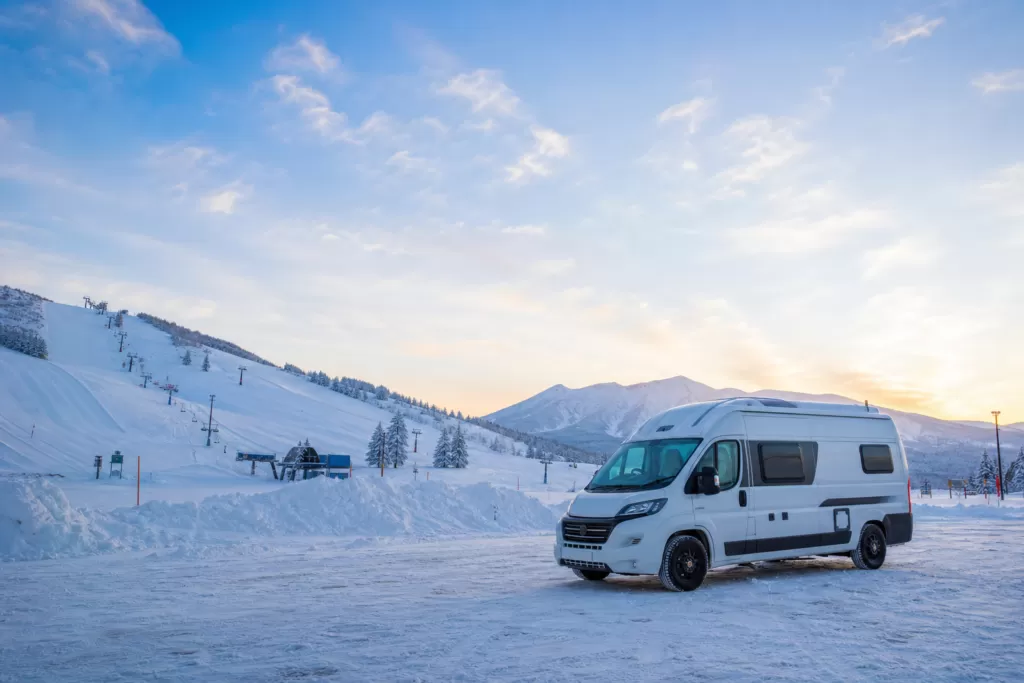
Instead of checking into a hotel after reaching the ski resort, you sleep right there in the slope’s parking lot. The next morning, you change and head straight for the lift. That’s what a ski trip by campervan looks like.
Winter (December–March) at a glance
- FF heater: a fuel-fed cabin heater that works with the engine off. Not every rental vehicle has one, so ask at booking. How an FF heater works and how to check
- Studless (winter) tires: the switch date differs by company. Confirm that your vehicle will be on studless tires for your dates. When companies switch to winter tires
- Who rents December–March: official sites confirm winter operation for Moving Inn (New Chitose Airport and Tokachi Obihiro Airport), Camping Lines Hokkaido, Shin-Chitose Campervan Rental Center and BicUp. Tajima Rental Station Shin-Hakodate-Hokuto, Iris Rental Campingcar and Chikichiki Camping Car Rental close in winter (official sites, checked 2026-10-05). Winter rental guide: closures and what to check
But Hokkaido winters are harsh. Some nights drop below -20°C. Overnight parking rules at ski resort lots vary widely from facility to facility, and some turn away large vehicles entirely. If you head out without checking in advance, you can end up forced to move in the middle of the night.
This guide organizes what you need to know about using a campervan at Hokkaido ski resorts — how to check parking lot rules, concrete steps for dealing with sub-zero temperatures, how to load your ski gear, and the characteristics of the major slopes — with a focus on practical, actionable information.
Before planning where to sleep, compare which resort is how far from which airport and what a day costs in the area-by-area ski resort list.
Tap a dot on the map to see its name here.
Tap a dot to see its name and a link to where it appears in this article. Dot positions are based on each facility’s address or officially published location. Lakes and expressways are from OpenStreetMap data.
Seven Things Australian Skiers Ask Before Anything Else
Forum threads from Australia, Canada, the US and the UK about Hokkaido campervan ski trips keep circling back to the same seven questions. Here are the short answers, so you can decide whether to keep reading.
1. Do I need an International Driving Permit, and can I get one in Japan?
Yes, and no. Japan accepts International Driving Permits issued under the 1949 Geneva Convention, which is the type Australian state motoring bodies issue. You must carry the IDP together with your current Australian licence. The Australian Embassy in Tokyo states that visitors can drive on an IDP for up to 365 days after entering Japan, and that Australian missions cannot issue an IDP or a Japanese licence. Get it at home before you fly. Rental desks will refuse the vehicle without it, and no amount of English will change that.
2. Who actually rents winter-ready campervans, and what does a night cost?
Not every company in Hokkaido operates in winter, and the ones that do often switch to a reduced fleet. Expect roughly ¥20,000 to ¥40,000 per night for a winter-equipped campervan. Moving Inn at New Chitose Airport runs Hiace-based van conversions from ¥15,400 per night in the off season and ¥36,850 in high season, and added the larger "Cresson Journey" cab-over model in June 2026 from ¥28,000 per day before tax. Whichever company you choose, confirm three items in writing before paying: an FF heater, studless winter tyres, and the company's winter operating calendar. Packages sold by ski resorts bundle the vehicle with lift access and hotel facilities, which is convenient but removes the freedom to chase snow that made you consider a campervan in the first place.
3. Can I book and pick up in English?
At Moving Inn New Chitose Airport, yes. The booking page has an English interface, staff handle English and Traditional Chinese, and a free shuttle covers the roughly ten minutes from the airport terminal. Many other Hokkaido rental companies take bookings only through Japanese forms or by phone, so if English support matters to you, treat it as a filter when comparing, not an afterthought.
4. Will the heater last the whole night?
An FF heater burns a small amount of fuel from the vehicle's tank and draws its fan power from the sub-battery, so the real limit is battery charge, not fuel. Ask the rental company how many hours their sub-battery supports the heater in sub-zero conditions, and plan on that number, not on hope. Drive for a while before you park for the night, because winter solar output is minimal. Idling the engine to stay warm is asked against at most Michi-no-Eki and RV parks, so treat it as unavailable. Keep the heater exhaust outlet clear of snow after heavy falls. Overseas travellers who slept in campervans in Hokkaido report that this exhaust outlet is the one item they wish they had checked before bed.
5. Is Google Maps enough for winter roads?
For finding places, yes. For choosing the route, be careful. In winter it will happily send you down rural shortcuts between snowbanks that are narrow, unploughed, or closed. Stay on national routes and expressways between resorts, and check the Hokkaido road information service for closures before each leg. Hokkaido's roads are low and gentle compared with alpine passes in Europe or North America, which is why many overseas drivers describe the driving as easier than expected. The difficulty is not the terrain. It is the whiteout, the black ice on the shaded curve, and the temptation to save fifteen minutes.
6. Do the toilet and the water actually work in winter?
Often not. Many Hokkaido rental companies drain the fresh-water tank and lock the onboard toilet from around November to April so the pipes do not burst. Some say so on their website. Most do not. One traveller on Reddit found a company's toilet ban stated for "the winter months, including November" and then discovered that "most don't say whether the toilets work in the colder months." Ask before you book, and plan your nights around Michi-no-Eki and RV parks with heated 24-hour restrooms. It changes how you pick a route more than any other single fact.
7. How many people really fit, and is the bedding warm enough?
Halve the number on the brochure. A Canadian couple who spent February 2026 in a rented Japan C.R.C. Robinson 771 wrote that it "is said to sleep 4 adults + 3 children, but with ski gear it's comfortable for 2 adults." Skis, boards, boots and wet outerwear take the space the extra beds were counted on. The same couple found that "the rental blankets aren't quite enough" at minus fifteen and slept in down jackets. Bring your own winter sleeping bag or ask the company what rating their bedding is. Their trip cost ¥466,200 for 14 nights, about ¥33,000 a night, which is a fair benchmark for a large cab-over in peak season.
The Benefits of Skiing + Overnight Parking, and the Real-World Caveats
You Can Catch the Early-Morning Lift
If you stay overnight in the resort's parking lot the night before, you can ski the fresh snow right as the lifts open. If you're staying at a hotel or ryokan, breakfast, checkout, and travel time tend to push your arrival at the slopes to 9 or 10 a.m. Sleeping in your campervan means you can be ready to move the moment the lifts open at 8 a.m. Freshly groomed slopes and uncrowded courses are a real advantage for skiers and snowboarders alike.
You Can Ski with Your Gear Left in the Vehicle
Ski wear, boards, boots, and a helmet — ski gear adds up to a lot of luggage. With a campervan, you can leave everything in the vehicle and head straight from the parking lot to the slopes. There's no need to hunt for a coin locker, and once you're done skiing, you can change out of your wear right in the vehicle. You can even hang up wet wear and gloves to dry on the spot, making the next morning's prep that much easier.
Easy to Hop Between Multiple Resorts
Many Hokkaido ski trips hop between several resorts — Rusutsu → Niseko → Kiroro, for example. With a campervan, you can move on without having to re-book accommodation. Drive to the next resort in the evening, park overnight, and you can be out on the slopes early again the next morning.
Caveat: Get Your Cost Expectations Right
Campervan rental rates tend to run higher in winter (December-March) than in summer, due to higher demand. In Hokkaido, expect roughly ¥20,000-¥40,000 per night. Some resorts also charge a separate parking fee. A simple comparison against a ski resort hotel won't always come out cheaper, but the freedom and quality of the experience are different. It's worth working out the actual cost-benefit before booking.
For example, a 4-night, 5-day trip covering Rusutsu, Furano, and Kamui might run ¥120,000-¥160,000 total for the campervan rental, ¥10,000-¥20,000 for fuel, and roughly ¥5,000-¥10,000 total for resort parking fees. Lift tickets are separate. This can end up costing more than 4 nights in a hotel, but the flexibility to move freely between multiple resorts and change your plans on the fly is something a fixed hotel booking simply can't offer.
Caveat: Winter Campervan Trips Require the Right Equipment
Staying overnight in a Hokkaido ski resort parking lot in a summer-spec campervan, without the right equipment, is difficult. In a vehicle without an FF heater (a combustion-type interior heater), sleeping in sub-zero temperatures carries real risk. Companies that offer winter rentals generally make an FF heater standard equipment, but you should always confirm this before booking.
Telling Apart Ski Resort Parking Lots That Allow Overnight Parking from Those That Don't
Overnight parking policy varies widely across Hokkaido ski resorts. There are generally three patterns — "no problem," "prohibited," and "check in advance" — and many official sites don't spell this out clearly.
What to Check on the Official Site
If a resort's parking page mentions terms like "overnight parking," "napping," or "staying overnight," the applicable rules are usually spelled out there. If not, the surest approach is to call and confirm directly. Ask three things: "Is there a space for large vehicles?", "Can I enter the parking lot the day before?", and "Are there any restrictions on nighttime parking lot use?"
Paid Parking Lots Are Easier to Use
Parking lots that charge a fee tend to have clearer rules, since there's someone managing them. If you confirm "how much for one night," the risk of being asked to leave is low. Parking a campervan in a managed, paid lot is far more reassuring than parking on a free roadside shoulder.
Etiquette You Should Follow
Assume idling is basically prohibited. Many ski resorts in Hokkaido have idling bans, and violating them can get you barred from using the facility the following year. An FF heater is a separate combustion system that vents through its own exhaust pipe, so it isn't treated as idling — but it's reassuring to confirm this with the facility just in case.
Keep your vehicle within a single parking space. Large Cabcons or bus-conversion campervans sometimes need the space of two spots. In that case, good etiquette is to pay for two spaces, or use a space designated for large vehicles. Also be mindful of the distance to the vehicle next to you — parking a campervan right next to a regular passenger car can make it hard for that driver to open their door in the morning. Where possible, choose an end space or one grouped with other large vehicles.
Handle your trash inside the vehicle. Trash cans at ski resorts are meant for day skiers, not for disposing of a campervan's household waste. The standard approach is to bag it up and dispose of it at a convenience store or Michi-no-Eki in town.
Noise matters too. Talking loudly at night, playing music, or slamming doors will disturb other skiers nearby. Staying as quiet as possible during sleeping hours (after 10 p.m.) is basic etiquette for overnight parking in a campervan.
Using a Michi-no-Eki or RV Park Instead
If overnight parking at the ski resort lot itself is difficult, one option is to stay the night before at a nearby Michi-no-Eki or RV park and move over the next morning. Near Rusutsu, there's a Michi-no-Eki toward Kimobetsu Town; near Furano, there's one toward the Rokugo area. As long as you can get there within 30 minutes from your overnight spot, it's plenty for an early-morning run. Near Niseko and Kutchan, there are also RV parks equipped with power hookups and drainage facilities (more on this in the Niseko section below).
Compare Hokkaido Campervan Rentals
Base yourself at New Chitose Airport and compare rates, vehicle types, and pickup locations all in one place.
Compare rental companies and prices →Cold-Weather Measures (FF Heater, Insulation, Freeze Prevention, Water Systems)
Around Hokkaido's ski resorts, nighttime temperatures in January and February can drop to -15 to -20°C. Areas like Niseko, Kutchan, and Furano see especially harsh cold. Sleeping comfortably in the vehicle requires both heating and insulation.
FF Heater Basics and How to Use It
An FF heater (Forced Flue heater) draws the vehicle's own engine fuel (diesel or gasoline) from its fuel tank and burns it to send warm air into the cabin. Since it can run heating with the vehicle's engine off, it works even at ski resort lots where idling is banned. Overnight fuel consumption varies with the set temperature, but roughly 1-2 liters is a good guideline.
A setting of 18-20°C is typical. Going higher can fill the cabin with muggy air by morning and worsen condensation. A good balance of fuel efficiency and comfort is to warm the cabin up to 20°C before bed, then drop it to 15-17°C once you're asleep.
Additional Insulation Measures
Even with an FF heater, cold air seeping in through the windows can't be fully blocked. Cutting a reflective insulation sheet ("gin mat") to size and attaching it to the windows improves insulation noticeably. The windshield is a particularly large source of cold air infiltration, so a dedicated shade cover is worth using. Laying a reflective sheet or cork mat on the floor also makes a real difference against cold rising from below.
Preventing the Water Tank from Freezing
A campervan's fresh water tank and hoses will freeze in sub-zero conditions. Freezing doesn't just make the water unusable — the pipes can also burst when the ice thaws.
The simplest countermeasure is to empty the tank before bed. Use up the water, run the pump dry to clear any remaining water from the lines, and then go to sleep. Refill the next morning at a convenience store or gas station in town.
Keeping water actively moving through the system overnight makes it less likely to freeze, but ski resorts generally don't offer a full water hookup. Mixing a small amount of antifreeze (RV-grade propylene glycol type) into the tank is another option, but since it can't be used for drinking water, it's limited to non-potable household use only, and the tank needs to be thoroughly rinsed out afterward.
Handling the Grey Water Tank
The grey water tank freezes too. Ideally, empty it before entering the parking lot for the night. Since RV dump stations are often unavailable near ski resorts, take care of drainage in town the day before. Emptying it near New Chitose Airport or in Chitose City before heading to Rusutsu or Furano gives you a comfortable margin.
Winter Battery Management
Battery performance drops sharply in cold temperatures. Since the FF heater runs on battery power, keeping track of your sub-battery's remaining charge is essential. Charge it via driving before any long parking period, and plan around the fact that solar panel output is much lower in winter. Many lithium battery products stop charging once the outside temperature drops below -10°C, so check your product's specifications in advance.
Lead-acid batteries (including AGM and gel types) can still charge in sub-zero conditions, but their capacity drops at low temperatures. It's reassuring to enter the resort parking lot with a full charge and confirm you have enough FF heater fuel (the diesel or gasoline in the vehicle's tank) before going to sleep. If the FF heater fails, it will shut down in the middle of the night and the cabin temperature will drop rapidly. As a backup, it's worth packing a heavy-duty winter sleeping bag rated comfortable to at least -10°C.
Window Freezing and Morning Prep
After a night in sub-zero temperatures, the windshield and windows can condense and freeze on the inside. You'll need to clear frost from the glass before departing in the morning, so it's handy to pack a scraper and de-icing spray. Fitting a shade over the windshield significantly reduces interior condensation. You can also start the engine and use the defroster, but check the idling rules first.
Loading Ski Gear and Wear, and Drying Techniques Inside the Vehicle
Ski gear takes up more room than summer camping gear. Boards, boots, ski wear (top and bottom), a helmet, goggles, and gloves, plus hot spring clothes and food — packing it all into a compact campervan takes some creative storage.
Storing Boards and Boots
Skis are long. To fit boards measuring 170-190 cm inside the vehicle, the usual approach is to lay them diagonally, or put them in a dedicated ski carrier bag and stand them up in the rear storage area. A bus-conversion (bascon) vehicle may have an exterior storage compartment they'll fit into. Boots go in a storage bag in the lower storage area. Stuffing newspaper inside boots to pull out moisture is still an effective, low-tech trick.
Drying Wet Wear
After a full day of skiing, both your outer wear and base layers get quite damp from sweat and snow. Set up a temporary hanger rack somewhere the FF heater's warm air reaches, and it'll be dry by the next morning. Turning wear inside out before hanging it up helps it dry faster. Placing gloves and socks near the FF heater's air outlet dries them in 1-2 hours.
That said, the cabin will get humid and steam up the windows more heavily. Cracking a vent window open for a bit every 30 minutes or so helps release the moisture. Leaving condensation unchecked becomes a cause of frozen windows the next morning.
Dealing with Odor in Your Wear
Wearing the same gear day after day on a multi-day trip, the smell of sweat starts to become noticeable. Using a coin laundry in town every few days is the practical solution. Furano and Kutchan both have coin laundries in their town centers. It's efficient to time a laundry stop around when you're already leaving the slopes anyway — say, on a hot spring trip.
Storing Food
In winter, a campervan often doesn't even need a refrigerator. On nights when the outside temperature is sub-zero, simply keeping food in the exterior storage compartment will keep it plenty cold. However, keep anything you don't want frozen (vegetables, canned goods, drinks) inside the vehicle. Watch out for drinks in plastic bottles freezing and expanding, which can make a mess of your storage space.
New Chitose Airport / Tokachi-Obihiro Airport
Rent the Cabcon "Cresson Journey"
Base yourself at New Chitose Airport and travel all across Hokkaido by campervan.
See details at Moving Inn →Recommended Resorts (Rusutsu, Kiroro, Furano, Tomamu, Kamui)
Rusutsu Resort
Located in Rusutsu Village, Abuta District, Rusutsu Resort is one of Hokkaido's largest ski resorts. With three mountains (Isola, East Mountain, and West Mountain), 37 courses, and 18 lifts, it draws everyone from families to serious powder hunters.
The parking lot is vast, with space set aside for large vehicles. According to the official site's driving and parking guide, winter-season parking is free for both overnight guests and day visitors (confirmed 2026-08-14). That said, it's best to confirm by phone whether overnight parking itself is allowed. Checking before the season whether you can stay the night before makes planning much easier.
It's about a 1 hour 30 minute drive from New Chitose Airport via Route 230. Along the way, Kimobetsu Town has the Michi-no-Eki "Boyo-Nakayama," which also works as an overnight option.
One thing worth flagging: the "Rusutsu Furusato Park Campsite," located behind the Michi-no-Eki "230 Rusutsu" in the village, is often cited in summer overnight-parking guides as a facility where you can park overnight for a ¥500 per-vehicle operating contribution. However, the official Rusutsu Village site's notice announces a spring opening ("available from April 29"), with no mention of winter operation (confirmed 2026-08-14). It's a snow-free-season facility, and you shouldn't count on it as an overnight base during ski season.
Kiroro Resort
Located in Akaigawa Village, Yoichi District, Kiroro Resort is known — alongside the Niseko area — for its powder snow. It has a strong international reputation and draws many overseas skiers.
According to the official site's winter access guide, the outdoor parking area holds about 1,900 vehicles and is free (confirmed 2026-08-14). That said, it gets crowded during peak season, and you should confirm space for large vehicles in advance. Since some sections are reserved for hotel guests, day-trippers and overnight-parkers should inquire separately. In some cases, it may be more realistic to stay overnight in nearby Otaru City or at the Michi-no-Eki "Akaigawa" in Akaigawa Village and move over the next morning.
It's about 1 hour 30 minutes to 2 hours from New Chitose Airport via the Do-O Expressway and Otaru. From Sapporo, it's about an hour away.
Furano Ski Resort
Furano Ski Resort, in Furano City, Sorachi District, consists of two areas: the Kitanomine Zone and the Furano Zone. It's known for heavy snowfall and a long season for skiing.
The parking lot is large and split across several areas. There are sections that fit large vehicles, though the layout can change by season. For overnight parking, it's safer to use the Michi-no-Eki "Furano Marche" in Furano City or an auto campsite in town (confirm winter operation first). Since the slopes are only a 10-15 minute drive from the town center, staying overnight in town still gets you to the first lift on time. For the latest on parking and operating details, check the official Furano Ski Resort site (confirmed 2026-08-14).
It's about 1 hour 40 minutes from New Chitose Airport via the Do-To Expressway and Shimukappu. It's also close to Asahikawa Airport, about 40 minutes away.
Hoshino Resorts Tomamu
Hoshino Resorts Tomamu, in Shimukappu Village, Yufutsu District, is a stay-and-play resort where the ski slopes, two hotels (Tomamu The Tower and Risonare Tomamu), and the indoor pool "Minamina Beach" all sit within a single area. The Tomamu IC on the Doto Expressway is the nearest interchange, giving you highway access from both the New Chitose Airport direction and the Tokachi direction.
On parking, the official FAQ states that "parking is available free of charge" (Hoshino Resorts Tomamu official FAQ, confirmed 2026-08-14). Hotel guests use the T1 lot in front of the Tower (T2 when full), while day-trippers using the ski slopes or the Muhyo Terrace (a frost-covered tree observation deck) use the U1 lot. However, the official FAQ makes no mention of overnight parking (confirmed 2026-08-14). If you're considering an overnight stay by campervan, it's worth confirming by phone in advance whether there's space for large vehicles and whether nighttime use is allowed.
Since lodging and dining are self-contained within the resort, in some situations it may suit you better to combine a hotel stay with parking your campervan there, rather than overnight parking itself. One option is to build a Tomamu hotel stay into your itinerary as a base to reset your in-vehicle living for a night.
Kamui Ski Links
Located in Asahikawa City, Kamui Ski Links is easy to reach — just 20-30 minutes by car from central Asahikawa. It's smaller than Rusutsu or Furano, but its proximity to the city makes it easy to combine with a base for supplies and overnight stays.
Central Asahikawa has supermarkets, coin laundries, and hot spring facilities, making it a convenient resupply point on a campervan trip. The resort itself isn't large, but Asahikawa works well as a base for a winter trip covering Mt. Asahidake, Furano, and Biei. The official site lists free parking for about 2,000 vehicles (confirmed 2026-08-14).
It's about 1 hour 30 minutes from New Chitose Airport via the Do-O Expressway and Asahikawa Expressway. From Asahikawa Airport, it's within 30 minutes.
About the Niseko Area
Niseko (Grand Hirafu, Annupuri, Hanazono, and the Village) is a world-famous powder snow destination, but parking circumstances are changing year by year as international tourist numbers grow. According to C9 Hotelworks' Niseko Tourism & Property Market Review 2025/2026 (as reported via Powderlife), visitor numbers to the Niseko-Kutchan-Rankoshi area for the 2025-26 season are reported to have reached 2.135 million (up 8.4% year-on-year), with roughly a fifth of visitors coming from Australia. Checking individually with each resort about parking and overnight parking for large vehicles matters more than ever. Parking lots fill up from early morning during peak season, so if you're staying overnight, you'll need to secure a spot with certainty. The latest parking information is published on each resort's official site (for example, Niseko Grand Hirafu) (confirmed 2026-08-14).
Niseko Town and Kutchan Town have the Michi-no-Eki "Niseko View Plaza," a convenient overnight base for moving to each resort the next morning. Central Kutchan also has a supermarket, making it a good timing point to restock food. Niseko's powder snow is high-quality enough to draw skiers from around the world, and it's worth spending several days there in a campervan.
For a fully-equipped overnight base, "RV Park Kutchan," about a 10-minute drive from central Kutchan, is another option. It offers powered auto-camp sites, a deep sink with hot water, a dump station that handles both grey and black tanks, and an outdoor sauna (from ¥1,000) (official site, confirmed 2026-08-14). The official facility guide notes that the sink is designed to remain usable in winter, and a facility where you can handle water refills, drainage, and trash disposal all in one place near the ski resorts is genuinely valuable. Confirm winter operating days, rates, and freeze-prevention details with the official site and by phone when booking.
Choosing a Resort and Building Your Itinerary
When planning a ski trip by campervan, it's easier to build your itinerary if you factor in "ease of resupply" alongside the quality of the slopes themselves. Checking your route on a map for the timing of water refills and drainage, plus access to coin laundries, hot springs, and supermarkets, greatly reduces stress along the way.
For example, a 4-night, 5-day route like "New Chitose → Rusutsu (2 nights) → Furano (1 night) → Asahikawa/Kamui (1 night) → New Chitose" keeps travel time between each base under 2-3 hours and makes it easy to work in resupply stops in town. Starting from New Chitose Airport, a smooth flow is to pick up your campervan near the airport, head south to Rusutsu, and on the return leg head south from Asahikawa to return the vehicle at New Chitose.
Frequently Asked Questions (FAQ)
Q: Are there companies that rent campervans in Hokkaido during winter?
Some rental companies based at New Chitose Airport offer winter-ready vehicles equipped with FF heaters. Moving Inn began renting out the Cabcon "Cresson Journey" from its New Chitose Airport location starting June 2026. At Moving Inn, every vehicle has studless tires and 4WD, and every HIACE and Cresson Journey has an FF heater (interview with Moving Inn, October 6, 2026). Check with each company individually about their winter operating schedule.
Q: Can I stay overnight at a Hokkaido ski resort in a vehicle without an FF heater?
In a Hokkaido winter where temperatures can drop to -10 to -20°C, overnight parking without an FF heater is extremely dangerous. A cassette gas heater or electric blanket alone often isn't enough. An electric blanket can't run for long without a power source (either shore power or a large-capacity sub-battery). For winter overnight parking in Hokkaido, it's safest to assume an FF-heater-equipped vehicle is your only real option. For freeze-prevention measures beyond heating, and general concerns about winter overnight parking, see this article covering all your winter worries in one place.
Q: Is idling banned in ski resort parking lots?
Many ski resorts explicitly ban idling. Hokkaido as a whole also has idling-restriction ordinances. An FF heater runs on a separate combustion system from the engine, so it doesn't count as idling, but some facilities may still want you to confirm this. It's reassuring to check with the parking lot's management office in advance.
Q: What should I do if the water or grey water tank freezes?
First, warm up the cabin and let the tank thaw naturally. Running the pump while the tank is still frozen can cause damage. Once the tank has warmed up, drain the water, and going forward, make it a habit to empty the tank before bed each night. If a pipe has burst, repairing it yourself is difficult, so contact the rental company.
Q: Where do I load skis in a campervan?
It depends on the vehicle type. In a bascon or Cabcon, they often fit in an exterior storage compartment (under the floor). However, if a board is longer than 170 cm, it may not fit, so it's worth checking the vehicle's specs with the rental company along with your booking. You can also put them in a ski carrier bag and lay them diagonally inside the cabin. For how many sets fit in each Moving Inn model, inside or on the roof, see how to carry skis and snowboards in a campervan.
Q: How many nights should I plan for a Hokkaido ski trip by campervan?
3 nights, 4 days is a manageable schedule for a first trip. Picking up at New Chitose Airport and moving through Rusutsu → Furano → Kamui lets you cover three resorts. With 5 nights or more, you can work in Niseko, Kiroro, or Tomamu as well. The longer the trip, the more important it becomes to plan around coin laundries and water refill/drainage.
Book a Campervan in Hokkaido
Moving Inn New Chitose Airport supports English booking and offers airport transfers.
Pick a campervan by what matters to you.
Rent at New Chitose Airport
See only the rental bases in Chitose, where the airport is.

![When and Where Can You See Harbor Seals at Cape Erimo? Kaze no Yakata Official Information, Viewing Season, and Windy-Day Notes [2026-27]](https://hokkaido-campingcar.jp/wp-content/uploads/2026/10/erimo-cape-lighthouse-768x511.jpg.webp)
![Where and Under What Conditions Can You See Diamond Dust in Hokkaido? How Cold a Morning It Takes, and Where It Appears [2026-27]](https://hokkaido-campingcar.jp/wp-content/uploads/2026/10/hokkaido-diamond-dust-nayoro-768x512.jpg.webp)
![Can You Drive to Hokkaido Jingu for Hatsumode? Parking, Crowds, and Where to Park and Walk [2027]](https://hokkaido-campingcar.jp/wp-content/uploads/2026/10/hokkaido-jingu-winter-torii-768x504.jpg.webp)
![Hokkaido Roads Over New Year [2026-27] | Expressway Sections Prone to Blizzard Closures, Forecast Congestion Days, No Holiday Discount, and New Chitose Airport Parking](https://hokkaido-campingcar.jp/wp-content/uploads/2026/10/hokkaido-winter-rural-road-edge-markers-768x432.jpg.webp)
![Where to See Sea Smoke (Kearashi) in Hokkaido: Rumoi’s Ogon-misaki and the Morning Conditions [2026-27]](https://hokkaido-campingcar.jp/wp-content/uploads/2026/10/rumoi-kearashi-sea-smoke-768x511.jpg.webp)
![Geminid Meteor Shower 2026 in Hokkaido: Peak Around 23:00 on December 14, Sapporo Moonset 20:40, and Staying Warm in a Winter Campervan [2026]](https://hokkaido-campingcar.jp/wp-content/uploads/2026/10/geminids-2026-hokkaido-768x575.jpg.webp)