Shibetsu, Nakashibetsu & Eastern Hokkaido Nature Campervan Travel Guide | Scenic Route via Kaiyodai, Notsuke & Hidden Hot Springs [2026]
A campervan nature travel guide to Shibetsu, Nakashibetsu, and eastern Hokkaido. Covers the scenic route through Kaiyodai Observatory, Notsuke Peninsula, and secluded hot springs.
Pick a campervan by what matters to you.
Rent at New Chitose Airport
See only the rental bases in Chitose, where the airport is.
Rent in winter (Dec–Mar)
Companies that rent through winter, listed apart from those that close.
Guide price
Moving Inn New Chitose Airport: HIACE van conversion from ¥22,000 per night. 20–30% off when booked 60–90 days ahead (official rate table, checked 15 Oct 2026).
New Chitose Airport map for campervan travellers →
Before you book: with an International Driving Permit if your country is in the Geneva Convention (for example the US, Australia, Singapore); Taiwan, Switzerland, Germany, France, Belgium and Monaco need your licence plus a Japanese translation (Tokyo Metropolitan Police). Questions in English: Moving Inn on WhatsApp. Every roadside station (michi-no-eki) must have free 24-hour toilets, and Hokkaido has 128 of them (MLIT).
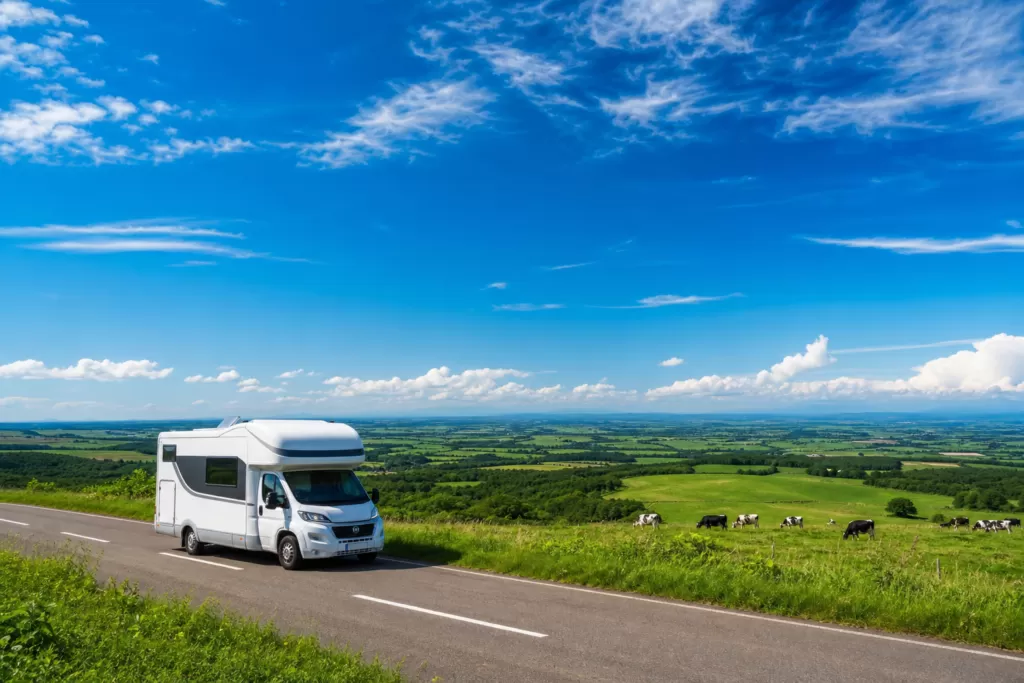
The Shibetsu–Nakashibetsu area sits at the crossroads of Eastern Hokkaido’s “dairy plateau” and untouched wilderness. The 360-degree horizon panorama from Kaiyodai, the withered fir forest of Todowara on the Notsuke Peninsula, the open-air bath at Yoroushi Onsen — enjoying all of this at your own pace is the biggest strength of campervan travel. For travelers who want to avoid the crowds of Kushiro and Abashiri and soak in the true landscape of Eastern Hokkaido, Nakashibetsu makes an ideal base.
This guide covers everything you need to travel the Shibetsu–Nakashibetsu area by campervan, starting from Nakashibetsu Airport, Memanbetsu Airport, or Kushiro Airport. From access routes and scenic spots to dairy cuisine and overnight parking, this is the latest 2026 edition.
Tap a dot on the map to see its name here.
Tap a dot to see its name and a link to where it appears in this article. 5 places whose location could not be confirmed are not shown. Dot positions are based on each facility’s address or officially published location. Lakes and expressways are from OpenStreetMap data.
The Appeal and Position of the Shibetsu–Nakashibetsu Area
Shibetsu District (Shibetsu Town and Nakashibetsu Town) belongs to the Nemuro Subprefecture in eastern Hokkaido. The mountains of the Shiretoko Peninsula rise to the west, the silhouettes of the Northern Territories islands lie to the east, and the Notsuke Peninsula and the Nemuro Strait spread out to the south. Inland, the vast pastures of the Konsen Plateau stretch on, and rising from its gentle undulations is Kaiyodai, one of Hokkaido's finest observation points.
What sets this area apart from other Eastern Hokkaido destinations is that tourists rarely crowd it. Compared with Shiretoko, Lake Mashu, or the Kushiro Marsh, its name recognition is a bit lower, so even at the height of summer you can enjoy the Michi-no-Eki (roadside rest stops) and observation decks at a relaxed pace. For a travel style built around staying for several days by campervan, this kind of uncrowded location is actually a perfect fit.
Nakashibetsu Town has a population of about 23,000, making it a relatively large town for Eastern Hokkaido. Supermarkets, home centers, and drugstores are all available, so restocking food and daily necessities is never a problem. Nakashibetsu Airport (served by flights to New Chitose, Okadama, and Haneda) also makes air access possible, and combined with a rental car, it's an easy base to reach from anywhere in Hokkaido.
The Size of the Area and a Sense of the Route
The sightseeing zone centered on Shibetsu and Nakashibetsu spreads highlights across roughly a 50–80 km radius. Kaiyodai (in Nakashibetsu Town), Yoroushi Onsen (Nakashibetsu Town), the Notsuke Peninsula (Shibetsu Town), the Shiretoko-Shari direction, and the Nemuro direction — to visit these efficiently, plan for at least 2 nights/3 days, or 3 nights/4 days if you want more breathing room.
With a campervan, you can use Michi-no-Eki and auto campsites as your overnight base and change each day's destination depending on the weather or your mood. This area is prone to fog, and Kaiyodai in particular can produce a sea of clouds in the morning and evening. Being able to adjust your schedule to the weather is a clear advantage of campervan travel over fixed lodging.
Access from Memanbetsu, Nakashibetsu, and Kushiro Airports
There are mainly three airports to choose from when accessing the Shibetsu–Nakashibetsu area. Let's go through each route and the travel time involved.
Access from Nakashibetsu Airport (Shortest and Most Convenient)
Nakashibetsu Airport (Nemuro-Nakashibetsu Airport) is about a 10-minute drive from central Nakashibetsu Town. The airport is small, but besides flights to New Chitose and Okadama, there is a Haneda flight linking it to Honshu, making it usable for access from Honshu and other parts of Hokkaido. If you rent a car at the airport, its biggest strength is being able to drive straight to Kaiyodai or central Nakashibetsu.
However, campervan rentals are not currently available at Nakashibetsu Airport. To rent a proper campervan, New Chitose Airport is the starting point. The realistic route is to rent a campervan at New Chitose Airport and drive to Nakashibetsu from there.
Driving Route from New Chitose Airport to Nakashibetsu
From New Chitose Airport to central Nakashibetsu via the Doto Expressway is about 330–350 km, taking roughly 4.5 to 5 hours. Head toward Kushiro via Obihiro and the Honbetsu Interchange, then take local roads to Nakashibetsu. Alternatively, the route via the Akan Interchange through Teshikaga and Shibecha offers rich scenery as well.
Since this is a long drive, taking a break for food along the way — in Obihiro (Michi-no-Eki Otofuke) or Teshikaga Town (the Lake Mashu/Kussharo area) — makes things much easier on the body. In Obihiro especially, enjoying Tokachi specialties like pork bowl (butadon) and Rokkatei sweets makes it easy to build an itinerary that starts full-scale sightseeing the day after arriving in Nakashibetsu.
Access from Memanbetsu Airport and Kushiro Airport
From Memanbetsu Airport (in the Abashiri area), head south on National Routes 334 and 244 to reach Shibetsu Town in about 2 hours. From Kushiro Airport, a northbound route takes about 2 hours 30 minutes. Since campervan rentals are difficult from either airport, starting from New Chitose Airport is the realistic option, but this information is useful if you plan to fly into Eastern Hokkaido and use a rental car for a secondary loop.
One thing to note: while roads throughout Eastern Hokkaido tend to be long, straight, and easy to drive, the risk of Ezo deer darting out is extremely high. Be especially careful from 4 p.m. onward through the night — slow down on local roads and keep a constant eye on the shoulder. Since collision repairs are costly for a campervan, we strongly recommend finishing your drive to a Michi-no-Eki or overnight stop before sunset whenever possible.
Compare Hokkaido Campervan Rentals
Base yourself at New Chitose Airport and compare rates, vehicle types, and pickup locations all in one place.
Compare Rental Companies & Rates →Scenic Spots: Kaiyodai, Yoroushi Onsen, Yaushubetsu, and More
The highlights of the Shibetsu–Nakashibetsu area are defined by a combination of grand nature and hidden hot springs. There are several places here where, free from crowds, you can face the essential landscape of Eastern Hokkaido.
Kaiyodai — A 360-Degree Horizon Observation Deck
Kaiyodai is an observation deck standing on a plateau 270 meters above sea level, about a 20-minute drive from central Nakashibetsu Town. It's one of Hokkaido's representative scenic spots, and was once famous as a pilgrimage site for motorcycle riders. The view from the deck can be summed up in one phrase: "the horizon spreads 360 degrees around you." Pastureland stretches on endlessly, and on clear days you can even make out the Shiretoko mountain range and the silhouette of Kunashiri Island.
The best times to visit the deck are early morning and dusk. Arrive in the early morning (around 5–6 a.m., just before and after sunrise) and you'll encounter a dreamlike sight: green pastureland emerging from the morning mist that blankets the plateau. When the conditions for a sea of clouds align — temperatures dropping the night before combined with high humidity — you get the spectacular view of a cloud sea from atop the plateau. Dusk is beautiful too; the moment the setting sun on the horizon dyes the grassland orange is moving enough even seen from inside your campervan.
The observation deck has a parking lot (large-vehicle accessible) and a building with a shop and restrooms. Overnight parking is prohibited, but long daytime stays are not a problem. A cycling road is also maintained in the area, and it's a pleasant experience to leave your campervan in the parking lot and ride a bicycle across the pastureland.
Yoroushi Onsen — Hidden Open-Air Baths and Autumn Foliage
Yoroushi Onsen is a hidden hot spring welling up along the Yoroushi River in western Nakashibetsu Town. Surrounded by a forest of conifers and broadleaf trees, its best-known facility is Yuyado Daiichi, whose riverside open-air bath is certified by the Association for the Preservation of Japan's Hidden Hot Springs. The alkaline simple hot spring water flows straight from the source, feels gentle on the skin, and is excellent for relieving fatigue.
The autumn foliage season from early to mid-October is especially spectacular. Oak, maple, and Erman's birch trees turn color, and the autumn leaves viewed from the open-air bath are breathtaking. This period draws more overnight guests, so if you're visiting for a day bath, aim for an early morning time slot.
Campervan travelers can make use of the large-vehicle spaces in Yuyado Daiichi's parking lot. Resting and eating in your vehicle after a soak, taking your time — that's a way of using the spot that only a campervan allows. The surrounding area is also bear habitat, so be careful not to leave food outside your vehicle while parked.
Wild Scenery Around the Yaushubetsu Training Area
The Yaushubetsu Training Area spreading across Betsukai Town is a vast tract of wilderness preserved as a Self-Defense Force training ground; simply driving the local road along its perimeter offers views of Ezo deer herds and sweeping grassland and wetland scenery. Betsukai Town is also Japan's largest dairy farming region, and black-and-white Holstein cattle graze in herds along the roadside. This landscape where agriculture and wildlife coexist is a piece of Eastern Hokkaido's original scenery that you can't see anywhere but here.
Notsuke Peninsula — Todowara, the Land's End
The Notsuke Peninsula, extending east from Shibetsu Town, is Japan's largest sand spit landform — a long, narrow peninsula about 26 km in length. Near the tip of the peninsula lies Todowara, a stand of Sakhalin fir trees withered by seawater erosion, where ash-gray trunks line the tidal flats in a uniquely striking landscape. It's a place unlike anywhere else, one that truly earns the phrase "the end of the world."
The Notsuke Nature Center has a parking lot (large-vehicle accessible), and you can reach Todowara by walking along a boardwalk. In spring (April–May), you can spot rare migratory birds such as Baikal teal and long-tailed ducks, and in summer, colonies of the black lily bloom — making it a well-known birdwatching spot too. For more detail on the Notsuke Peninsula covered in this article, please also see our dedicated guide, the "Notsuke Peninsula & Nemuro Area Campervan Guide."
A Day Trip Toward Shiretoko
Shiretoko Pass (in Rausu Town) is about 1.5 hours from Nakashibetsu. It's entirely realistic to base yourself in Shibetsu-Nakashibetsu and enjoy a day trip to part of Shiretoko. The view of Mount Rausu and the sea from the Shiretoko Pass parking lot (caution for large vehicles; closed in winter), and snacking on kelp or salmon at Rausu Port, make a fitting finale to an Eastern Hokkaido trip. That said, the Shiretoko Pass road (National Route 334) has many hairpin curves, so large campervans over 10 meters in length need to drive with extra care.
Eastern Hokkaido Dairy Cuisine — Enjoying Dairy Products and Local Ingredients
The Shibetsu–Nakashibetsu area is one of Hokkaido's premier dairy farming regions, rich in fresh dairy products and local ingredients. Because you're traveling by campervan, you can buy ingredients found only at local direct-sale shops and farms, then cook and enjoy them right in your vehicle.
Nakashibetsu's Milk and Dairy Products
Nakashibetsu Town ranks among the top areas for raw milk collection volume through Hokuren, the region's dairy cooperative. Local milk, cheese, and butter are sold directly at the Michi-no-Eki "Swan 44 Nemuro" (in Nemuro City) and at JA shops within Nakashibetsu Town. In particular, "Konsen non-homogenized milk" is produced without low-temperature pasteurization or homogenization, giving you the rich, full flavor of milk in its original form. Since campervans come standard with a refrigerator, you can chill your purchase right away — using it in the next morning's coffee is becoming a classic part of the trip.
Shibetsu Salmon Park — Dining in the Salmon Sanctuary
The Shibetsu Salmon Science Museum and the "Salmon Road" along the Shibetsu River in Shibetsu Town draw many visitors during the autumn salmon run season (September–October). Inside the museum, Japan's largest salmon aquarium features an extensive display of salmon and trout species from around the world. At restaurants on-site and nearby, you can enjoy autumn salmon chanchan-yaki (grilled salmon with miso and vegetables), salmon-and-salmon-roe rice bowls, and salmon jerky (sake toba). Soy-marinated salmon roe is also a popular souvenir, and it's easy to buy on a campervan trip since you have refrigeration and freezer storage on hand.
Treasures of the Northern Territories — Hairy Crab, Hanasaki Crab, and Kelp
At the fishing ports of the Shibetsu–Nemuro area, you can sometimes buy hairy crab and hanasaki crab (a rare spiny king crab caught only in eastern Hokkaido) at relatively reasonable prices. Direct-sale shops near Shibetsu Fishing Port carry fresh seafood landed during the fishing season (mainly spring through summer). Kelp is also available direct from producers, and ne-kombu kelp from the Nemuro–Shibetsu area is said to have a particularly strong umami flavor when used for stock. With a sink and portable gas stove in your campervan, you can even boil crab you've bought and eat it inside the vehicle (just watch out for the smell and disposing of the shells).
Cafes and Farm Spots Around Kaiyodai
Within a 10–15 minute drive of Kaiyodai, several cafes run directly by local farms serve soft-serve ice cream and gelato. At "farm cafe"-style shops, menus feature house-made cheese, yogurt, and freshly squeezed milk — stopping in along the way is a quintessentially Eastern-Hokkaido way to spend your time. Eating soft-serve while gazing over pastureland under a clear summer sky is a special kind of delicious. Many of these shops have short operating hours, so we recommend checking ahead before heading over.
Overnight Parking, Michi-no-Eki, Water Refills, and Hot Spring Information
The Shibetsu–Nakashibetsu area's environment for accepting campervans is steadily improving. Combining Michi-no-Eki, auto campsites, and RV parks makes a comfortable extended stay possible.
Michi-no-Eki "Odaito" (Betsukai Town, Gateway to Notsuke Peninsula)
Located in Betsukai Town near the Notsuke Peninsula, Michi-no-Eki "Odaito" is marked by an observation tower with views of Kunashiri Island. It has a large parking lot, making it a spot campervans can use for short rest stops or naps (excluding areas where overnight parking is explicitly prohibited). The shop stocks dairy products and seafood from Betsukai, making it handy for restocking food too. Restrooms are open 24 hours.
Michi-no-Eki "Swan 44 Nemuro" (Nemuro City)
This Michi-no-Eki stands on the shore of Furen Lake and is also famous as a wintering site for whooper swans. From late October through March, swans arrive to winter here, and the sight of swans floating on the lake in the early-morning mist is dreamlike. There's direct sales of Betsukai-produced cheese and local farm products, plus a light-meal corner. The parking area accommodates large vehicles.
Shopping and Water Refills in Central Nakashibetsu
Central Nakashibetsu Town concentrates supermarkets (Maxvalu Nakashibetsu, Coop Sapporo, and others), drugstores, and a home center (Homac). Taking care of food, water, and amenities here keeps the rest of your itinerary running smoothly. For freshwater tank refills, auto campsites, some RV parks, and gas stations may be able to help (advance confirmation recommended). Self-service gas stations in town accommodate both regular and large vehicles, so you'll never have trouble refueling.
Auto Campsites and RV Parks
Here are some representative campsites you can use in the Nakashibetsu-Shibetsu area.
- Shibetsu River Floodplain Auto Campsite (Shibetsu Town): A flat site spread across the riverside floodplain. Mostly unpowered sites, but with plenty of space for parking a campervan. A popular stay for combining with fishing.
- Kaiyodai Campsite (Nakashibetsu Town): Set atop the Kaiyodai hill, its appeal is camping with a view of the horizon. Powered sites available. Open in summer only, reservation required. Shower facilities available.
- Kerochi Traffic Park Campsite (Yubetsu Town — a bit further out, on the Okhotsk side): An unusual campsite that displays a steam locomotive. Useful when combining a route toward the Okhotsk side.
RV parks (fully equipped with power and water hookups) are still being developed near central Nakashibetsu, so we recommend checking the latest information before use. The Japan RV Association's website and the Eastern Hokkaido feature in Car Neru magazine are good references.
Hot Springs and Bathing Facilities
On a campervan trip, actively using outside hot springs and public baths is the golden rule for a comfortable journey. Here are the main bathing facilities in this area.
- Yoroushi Onsen Yuyado Daiichi (Nakashibetsu Town): A certified hidden hot spring with open-air baths. Day-use bathing available (confirm in advance; time limits apply). October's foliage season is the best time to visit. About ¥800–¥1,000 for adults.
- Nakashibetsu Onsen Po-gawa Onsen (Nakashibetsu Town): A day-use hot spring facility a short distance from the town center. A community bath used by many locals. A sodium chloride spring that warms you thoroughly.
- Shibetsu Onsen (Shibetsu Town): A small, town-run hot spring by the sea. A chloride spring with the simple, unpretentious atmosphere of a fishing town. An ideal stop after visiting the Salmon Park.
- Farmhouse Guesthouse Indoor Baths Near Kaiyodai: In some areas, farmhouse guesthouses accept outside bathers. Advance inquiry is needed, but it's a valuable chance to interact with locals.
Ezo Deer Precautions — Take Care Driving in the Evening and at Night
This applies to Eastern Hokkaido generally, but the local roads and farm roads of Shibetsu-Nakashibetsu carry an especially high risk of Ezo deer darting out. From around 4 p.m. to 6 a.m. the next morning is the most dangerous window; deer that dart out without regard for the border between grassland and road sometimes won't move even when caught in your headlights.
Here are specific precautions to keep in mind while driving a campervan.
- After sunset, avoid driving local roads other than the main national highways (Routes 272 and 244) as much as possible
- Slow down to 60 km/h or below, and to around 50 km/h or below on sharp curves or sections with a lot of grassland
- Use your high beams to spot deer early via "eyeshine," the reflection of light in their eyes
- If you spot a deer, avoid slamming the brakes — slow down as much as possible and steer around it
- Make it a rule to finish your day's drive and reach your overnight stop by evening
A collision with a deer can cause serious damage to a campervan's body, with repairs sometimes costing several hundred thousand yen. Be sure to confirm whether you have voluntary vehicle insurance, or check the coverage details offered by your rental company.
Recommended Touring Route (3-Night, 4-Day Model)
Here's a proposed 3-night, 4-day model route departing from and returning to New Chitose Airport, centered on Shibetsu-Nakashibetsu.
- Day 1: Pick up your campervan at New Chitose Airport → head toward Obihiro via the Doto Expressway → pork bowl lunch in central Obihiro → Teshikaga/Lake Mashu (evening view) → overnight parking at a Michi-no-Eki or campsite near Lake Mashu
- Day 2: Early morning at the First Lake Mashu Observation Deck (chasing the misty Lake Mashu) → to Nakashibetsu via Shibecha → Kaiyodai (morning mist and sea of clouds if you arrive early) → lunch and day bathing at Yoroushi Onsen → shopping in central Nakashibetsu → overnight parking at Kaiyodai Campsite or a nearby Michi-no-Eki
- Day 3: Notsuke Peninsula (Todowara walk, birdwatching) → Shibetsu Salmon Park → bathing at Shibetsu Onsen → dinner at Michi-no-Eki Odaito → overnight parking at the same Michi-no-Eki or a nearby campsite
- Day 4: Day trip toward Shiretoko/Rausu (Rausu Port, Shiretoko Pass), or head toward the Kushiro Marsh and return the vehicle at Kushiro Airport / or loop back north to New Chitose
If you finish Day 4 in the Kushiro direction, you can turn this into a grand Eastern Hokkaido touring route by combining it with the Kushiro Marsh and Lake Akan. Please also see our "Kushiro & Lake Akan Campervan Guide" for reference.
New Chitose Airport / Tokachi-Obihiro Airport
Rent the Cabcon "Cresson Journey"
Base yourself at New Chitose Airport and travel all across Hokkaido by campervan.
See Details at Moving Inn →Frequently Asked Questions (FAQ)
Q: Can I rent a campervan at Nakashibetsu Airport?
Currently, campervan rentals are not available at Nakashibetsu Airport. The common method is to rent one starting from New Chitose Airport and drive to Nakashibetsu from there. If you rent a car at Nakashibetsu Airport for a secondary loop, it will be a regular passenger car rental.
Q: What month is best to visit Kaiyodai?
The view is enjoyable from May through October, and summer (July–August) especially has a high rate of clear weather, making it easy to see the horizon. If you're chasing morning mist or a sea of clouds, aim for a morning (June–September) after temperatures drop the night before. Autumn foliage peaks from early to mid-October, and combining it with Yoroushi Onsen makes for a quintessentially Eastern-Hokkaido autumn itinerary. In winter (November–April), snow and ice can make access to the observation deck difficult.
Q: How can I avoid a collision with an Ezo deer?
The most effective step is not driving on local roads after 4 p.m. Farm roads and local roads after sunset carry an extremely high risk of deer darting out, and since a campervan sustains major damage in a collision, plan your itinerary from the start so you can reach your overnight stop by evening. While driving, using your high beams and keeping your speed down are the basic precautions.
Q: Can I take a day bath at Yoroushi Onsen?
Yuyado Daiichi accepts day-use bathers, but overnight guests are given priority, so there may be time-slot or capacity restrictions. We strongly recommend calling ahead to confirm before visiting. It gets especially crowded during the autumn foliage season (October), so weekday mornings are your best bet.
Q: Is campervan access to the Notsuke Peninsula a problem?
The road to the Notsuke Nature Center (Prefectural Route 950) has some narrow stretches, so large campervans (roughly over 7m in length and 2.3m in width) need to drive with care. The Nature Center's parking lot can accommodate large vehicles, but since there are sections where passing an oncoming vehicle is difficult, drive slowly and watch carefully for traffic coming the other way.
Q: Where are good spots for overnight parking in the Shibetsu–Nakashibetsu area?
Michi-no-Eki "Odaito" (Betsukai Town) has a large parking lot and is easy to use for a short nap or rest. If you're aiming for a proper overnight stay, Kaiyodai Campsite (summer only, powered) or the Shibetsu River Floodplain Auto Campsite (free, simple sites) are realistic choices. It's best to avoid overnight parking in town-center parking lots to prevent trouble.
Book a Campervan in Hokkaido
Moving Inn New Chitose Airport supports English booking and offers airport transfers.
Pick a campervan by what matters to you.
Rent at New Chitose Airport
See only the rental bases in Chitose, where the airport is.

![When and Where Can You See Harbor Seals at Cape Erimo? Kaze no Yakata Official Information, Viewing Season, and Windy-Day Notes [2026-27]](https://hokkaido-campingcar.jp/wp-content/uploads/2026/10/erimo-cape-lighthouse-768x511.jpg.webp)
![Where and Under What Conditions Can You See Diamond Dust in Hokkaido? How Cold a Morning It Takes, and Where It Appears [2026-27]](https://hokkaido-campingcar.jp/wp-content/uploads/2026/10/hokkaido-diamond-dust-nayoro-768x512.jpg.webp)
![Can You Drive to Hokkaido Jingu for Hatsumode? Parking, Crowds, and Where to Park and Walk [2027]](https://hokkaido-campingcar.jp/wp-content/uploads/2026/10/hokkaido-jingu-winter-torii-768x504.jpg.webp)
![Hokkaido Roads Over New Year [2026-27] | Expressway Sections Prone to Blizzard Closures, Forecast Congestion Days, No Holiday Discount, and New Chitose Airport Parking](https://hokkaido-campingcar.jp/wp-content/uploads/2026/10/hokkaido-winter-rural-road-edge-markers-768x432.jpg.webp)
![Where to See Sea Smoke (Kearashi) in Hokkaido: Rumoi’s Ogon-misaki and the Morning Conditions [2026-27]](https://hokkaido-campingcar.jp/wp-content/uploads/2026/10/rumoi-kearashi-sea-smoke-768x511.jpg.webp)
![Geminid Meteor Shower 2026 in Hokkaido: Peak Around 23:00 on December 14, Sapporo Moonset 20:40, and Staying Warm in a Winter Campervan [2026]](https://hokkaido-campingcar.jp/wp-content/uploads/2026/10/geminids-2026-hokkaido-768x575.jpg.webp)