Daisetsuzan & Sounkyo Campervan Drive Guide | Complete Guide to Kurodake, Ofuku & Tenninkyo [2026]
A campervan drive guide to Daisetsuzan and Sounkyo. Complete coverage of Kurodake, Ofuku Gorge, and Tenninkyo.
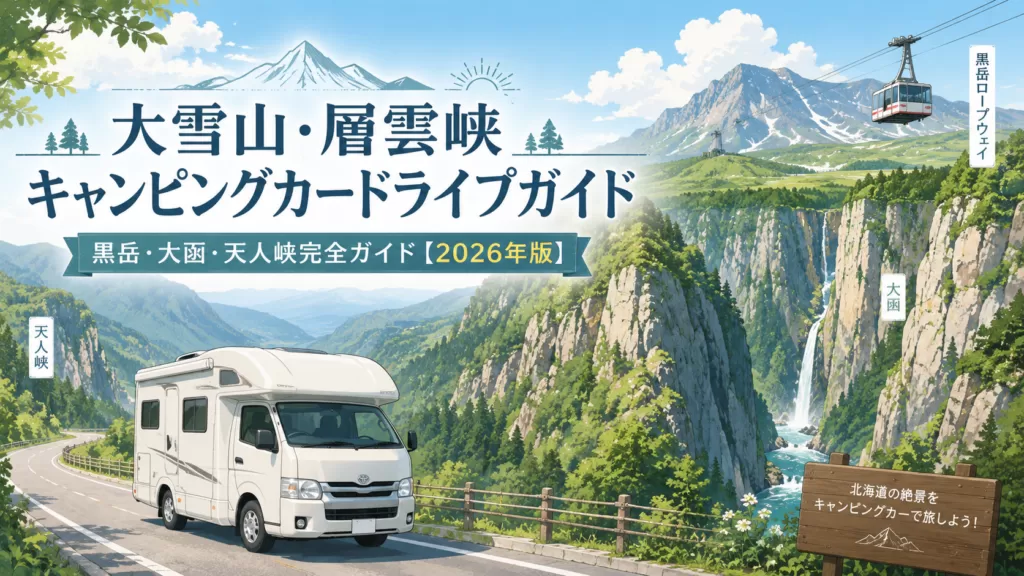
The Daisetsuzan and Sounkyo area is the core of Daisetsuzan National Park — Japan’s largest national park, often called “the roof of Hokkaido.” With its majestic mountain scenery, the Kurodake Ropeway, Sounkyo Onsen, and dramatic gorge views, it’s an area best explored slowly, staying overnight in a campervan.
This article covers access, key sightseeing spots, places to stay, a cost simulation, autumn foliage information, and recommended routes for traveling the Daisetsuzan and Sounkyo area by campervan. It’s based on 2026 information.
Estimated Cost of Touring Daisetsuzan & Sounkyo by Campervan
| Vehicle Type | Approx. Rental Fee per Night | Travel Style |
|---|---|---|
| Kei-camper | Approx. ¥13,000–¥38,000 | Up to 2 people, suited to compact travel |
| Vancon | Approx. ¥20,000–¥58,000 | 2–4 people, family-friendly |
| Cabcon | Approx. ¥26,000–¥94,000 | 4–6 people, well-equipped |
The prices above cover only the campervan rental itself. Fuel, toll roads, campsite fees, and food costs are added on top. For a full cost simulation of a 3-night, 4-day trip starting and ending in Asahikawa, see Hokkaido Campervan 3-Night 4-Day Cost Simulation.
Getting to Daisetsuzan & Sounkyo
| Departure Point | Distance to Sounkyo | Approx. Travel Time |
|---|---|---|
| Asahikawa Airport (near Asahikawa City) | Approx. 80 km | Approx. 1 hr 10 min (Route 39) |
| Asahikawa City | Approx. 70 km | Approx. 1 hour |
| New Chitose Airport | Approx. 230 km | Approx. 3 hours (via Doo Expressway & Asahikawa) |
| Obihiro City | Approx. 170 km | Approx. 2 hr 20 min (Route 273) |
Asahikawa is the most convenient gateway to the area. For campervan rental operators in Asahikawa, see Asahikawa Campervan Rental Comparison. From the Obihiro direction, you can access the area via Mikuni Pass (Route 273) — the views of the Daisetsuzan mountain range from the pass are a highlight in themselves.
Route 39 is the main road connecting Asahikawa and Kitami, and it’s an easy route to drive even in a large campervan. However, in winter (late November to early April) heavy snow and ice make studless winter tires and tire chains essentially mandatory. Spring through autumn (May–October) is the best season for a campervan trip.
Main Sightseeing Spots in the Daisetsuzan & Sounkyo Area
Kurodake Ropeway & Mt. Kurodake
From Sounkyo Onsen town, the Kurodake Ropeway (about a 7-minute ride) takes you up to the 5th station. From there, a chairlift continues to the 7th station, from which you can hike to the summit of Mt. Kurodake (elevation 1,984 m). From the summit, a vast panorama of the Daisetsuzan mountain range unfolds — one of Hokkaido’s iconic mountain views.
Kurodake Ropeway fares are ¥2,200 round-trip for adults and ¥1,100 for children (2025 figures; please confirm for 2026). The chairlift round-trip is ¥900 for adults and ¥450 for children. A combined ropeway + chairlift round-trip ticket runs about ¥3,000 for adults. Operating hours vary by season; in summer (June–August) it generally runs 7:00–18:00. Please check the official Kurodake Ropeway website in advance for details and any changes (checked November 2025).
During the autumn foliage season (mid-September to early October), the ropeway gets crowded, with waits of 1–2 hours possible on weekends. Riding on a weekday morning (around 7–9 a.m.) can cut the wait dramatically. Staying overnight locally in a campervan makes it much easier to get an early start — one of the real advantages of a campervan trip.
At the Kurodake 5th station there’s a rest house and a shop where you can grab lunch or a snack. Along the hiking trail from the 7th station, alpine flowers (such as Chingurma and Ezo-kozakura) are at their best from late June through August. Even if you’re not confident in your stamina, simply going as far as the 5th or 7th station is enough to experience the grandeur of the Daisetsuzan landscape.
Sounkyo Onsen
The hot spring town stretches along a gorge lined with columnar-jointed cliffs. Some facilities offer day-use bathing, letting you soothe away the fatigue of hiking and sightseeing. With several different spring sources, including sulfate and chloride springs, the baths are reputed to be excellent for the skin.
Day-use bathing fees vary by facility, but generally run about ¥800–¥1,200. Many onsen facilities don’t require reservations, but during the busy season (July–October) they can get crowded, so it helps to avoid the hours right around typical check-in times. Every summer (July–September), Sounkyo Onsen hosts events such as the “Sounkyo Onsen Summer Festival.” For details, see the official Sounkyo Onsen Tourist Association website (checked November 2025).
Obako & Kobako (Sounkyo Gorge)
This gorge is lined with towering cliffs, and “Obako” — a cliff face 100 m high and 250 m wide — is a spectacular sight. You can view it up close from the promenade, on a stroll that takes about 15–20 minutes (free, with parking available).
The Obako parking area has space for campervans, but it gets crowded when tour buses arrive. Visiting during hours with fewer tour buses (around 8 a.m. or after 4 p.m.) lets you take it in at a more relaxed pace. Kobako is sometimes restricted due to road construction, so check the on-site signage or Kamikawa Town tourist information in advance.
Ginga Falls & Ryusei Falls
From the Sohbakudai observation deck, near the entrance to Sounkyo Onsen town, you can view two waterfalls at once: “Ginga Falls” (a slender, gracefully straight cascade) and “Ryusei Falls” (a wide, powerfully rushing waterfall). It’s a few minutes’ walk from the parking area and free to view. A promenade is maintained right up near the base of the falls, so you can feel the force of the water up close while taking in the negative ions. The flow is especially powerful just after the snow melts, in May and June.
Mikuni Pass
This is the highest point (elevation 1,139 m) on Route 273 heading from Sounkyo toward Obihiro, and the highest-elevation pass on any national route in Hokkaido. The primeval forest spread out against the backdrop of the Daisetsuzan range, along with the autumn foliage (late September to early October), makes for spectacular scenery, and you can take a break at the pass-side café “Matsumi Chaya” (open roughly June through late October each year — please confirm locally).
Heading southeast from Mikuni Pass gives good access to Lake Nukabira and the Taushubetsu Bridge, letting you enjoy the nature of the Higashi-Daisetsu area in turn as you descend toward Obihiro. Large campervans can make the drive, but take care with ice and snow in winter. The autumn view from the pass is one of Hokkaido’s finest scenic spots, and it’s worth a 15–30 minute stop even just as part of a longer drive.
Tenninkyo Gorge
Reached from Asahikawa via Higashikawa Town, up the Chubetsu River, this gorge is famous for Hagoromo Falls, a 270 m drop — the tallest in Hokkaido. It sees fewer tourists than Sounkyo, making it a quiet spot to enjoy nature.
You can also enjoy Tenninkyo Onsen here, and walking the surrounding promenade lets you take in several waterfalls, including Shikishima Falls. Parking is free, with space for large vehicles too. That said, the prefectural road to Tenninkyo (Tenninkyo–Biei Line) has some narrow stretches, so large cabcons (over 7 m in total length) should proceed with caution. It’s also well suited to a day trip from Asahikawa.
Daisetsuzan & Sounkyo During Autumn Foliage Season
The Daisetsuzan and Sounkyo area is known as one of the spots where autumn foliage begins earliest in Hokkaido. Part of the appeal is that you can follow the “autumn foliage front” as it descends from the summit — a trip that chases the colors down the mountain.
| Area / Spot | Best Viewing Period | Characteristics |
|---|---|---|
| Near the Kurodake summit (elevation 1,984 m) | Early to mid September | Hokkaido’s earliest foliage; yellow leaves of Chingurma |
| Near the Kurodake 7th-station chairlift | Mid to late September | Easily accessible via ropeway and chairlift |
| Sounkyo Gorge (around Obako & Sohbakudai) | Late September to early October | Stunning contrast of columnar-jointed cliffs and autumn colors |
| Mikuni Pass | Late September to early October | Foliage spreading across primeval forest, with superb views |
| Around Tenninkyo | Early to mid October | Slightly later than Sounkyo due to lower elevation |
Compare Hokkaido campervan rentals
See prices, vehicle types, and bases side by side, including areas beyond Asahikawa.
Compare rental companies and prices →Places to Stay Overnight in a Campervan in Daisetsuzan & Sounkyo
| Place to Stay | Location | Approx. Cost | Characteristics |
|---|---|---|---|
| Sounkyo Auto Campground | Kamikawa Town, Sounkyo Onsen area | ¥2,500–¥4,000/night | Powered sites available, near the onsen facilities, with an open-air bath on site |
| Michi-no-Eki Kamikawa Sounkyo | Kamikawa Town | Free (overnight parking) | Gateway to Sounkyo; has a supermarket and convenience store; large-vehicle parking available |
| RV Park near Asahikawa | Around Asahikawa City & Higashikawa Town | ¥2,000–¥4,000/night | Power and water hookups available; convenient as a base for Daisetsuzan |
| Higashikawa Town Michi-no-Eki “Michikusakan” | Higashikawa Town | Free (overnight parking) | Midway between Asahikawa and Tenninkyo; supermarket and convenience store nearby |
Sounkyo Auto Campground has both powered and non-powered sites; for connecting a campervan to power, choosing a powered site is comfortable (and some rental operators recommend using one). The open-air bath on the grounds is convenient since you can bathe without heading into the onsen town. Note that extended overnight parking at a Michi-no-Eki is not considered good etiquette — it’s best kept to about one night, with the next day’s move to your next destination as the norm.
For the latest RV park information, search the Kamikawa and Asahikawa area on the official Japan RV Park website (checked November 2025).
2-Night, 3-Day Daisetsuzan Loop Model Route from Asahikawa
Day 1: Asahikawa → Tenninkyo → Sounkyo
- Pick up your campervan in Asahikawa (around 10 a.m.)
- Head from Asahikawa to Higashikawa Town to stock up (supermarket / convenience store)
- Stop at Tenninkyo (Hagoromo Falls, a stroll along the promenade — about 1–1.5 hours)
- Head back toward Asahikawa, then east on Route 39 to Sounkyo (about 1 hour from Asahikawa)
- Visit Ginga Falls and Ryusei Falls in the evening (a different atmosphere as the light angle changes)
- Stay overnight at Sounkyo Auto Campground or Michi-no-Eki Kamikawa Sounkyo
Day 2: Kurodake Ropeway → Obako → Sounkyo Onsen
- Head to the ropeway station early, around 7–8 a.m. (to avoid crowds and enjoy clear views from the summit)
- Ropeway then chairlift to the 7th station; hike to the summit if you have the stamina (3–4 hours round trip)
- Descend around midday and have lunch at the 5th-station rest house
- Stroll the Obako promenade (about 30 minutes)
- In the evening, enjoy day-use bathing at Sounkyo Onsen (soothing away the day’s hiking fatigue)
- Stay another night at Sounkyo Auto Campground, or move on to a place to stay closer to the next day’s destination
Day 3: Mikuni Pass → Obihiro or Return in Asahikawa
- After breakfast, head southeast on Route 273 (toward Obihiro)
- Enjoy the view at the Mikuni Pass overlook (about 20–30 minutes)
- Descend toward Obihiro, sightseeing at Lake Nukabira and the Taushubetsu Bridge (easier to see when water levels drop in autumn/winter)
- Have lunch and pick up souvenirs in Obihiro; if returning to Asahikawa, it’s about 2 hr 30 min via Route 38 and the Doto Expressway
- Return your campervan in Asahikawa (around 5–6 p.m.)
This route efficiently covers Daisetsuzan’s main highlights over 2 nights and 3 days out of Asahikawa, making it especially suited to first-time campervan travelers exploring Daisetsuzan. Ending Day 3 in Obihiro and building it into an onward Obihiro itinerary is another good option.
5-Night, 6-Day Daisetsuzan & Eastern Hokkaido Route from Asahikawa
- Day 1: Pick up in Asahikawa → Tenninkyo → overnight in Sounkyo
- Day 2: Sightsee in Sounkyo (Kurodake Ropeway, Obako) → Mikuni Pass → overnight in Obihiro
- Day 3: Obihiro → Kushiro Marsh → overnight in Kushiro
- Day 4: Lake Akan → Lake Mashu → overnight at Lake Kussharo
- Day 5: Toward Shiretoko → overnight in Utoro
- Day 6: Shiretoko Five Lakes → Abashiri → return campervan in Asahikawa or Obihiro
For details on the Kushiro and Lake Akan area, see Kushiro & Lake Akan Campervan Drive Guide. For details on Shiretoko, see Shiretoko Campervan Rental Travel Guide.
Cost Simulation (2 Nights, 3 Days from Asahikawa)
| Cost Item | Kei-camper | Vancon | Cabcon |
|---|---|---|---|
| Rental fee (2 nights) | Approx. ¥26,000–¥76,000 | Approx. ¥40,000–¥116,000 | Approx. ¥52,000–¥188,000 |
| Fuel (approx. 300 km, gasoline at approx. ¥175/L) | Approx. ¥5,250 (18 km/L) | Approx. ¥6,563 (14 km/L) | Approx. ¥8,750 (10 km/L) |
| Campsite / parking fees (2 nights) | Approx. ¥5,000–¥8,000 | Approx. ¥5,000–¥8,000 | Approx. ¥5,000–¥8,000 |
| Kurodake Ropeway + chairlift (2 adults, round trip) | Approx. ¥6,000 (approx. ¥3,000 per adult × 2) | ||
| Food, day-use bathing, souvenirs (2 nights, 3 days) | Approx. ¥15,000–¥25,000 (for 2 people) | ||
| Estimated total (2 adults) | Approx. ¥57,000–¥120,000 | Approx. ¥72,000–¥163,000 | Approx. ¥84,000–¥235,000 |
Fuel cost is estimated based on a roughly 300 km loop from Asahikawa through Sounkyo and Mikuni Pass and back to Asahikawa. Actual distance, fuel efficiency, and gasoline prices will vary. During peak season (weekends from July to October, and Obon), rental rates tend to rise, so using the vehicle on weekdays and booking early are the keys to saving on cost.
Frequently Asked Questions (FAQ)
Can I drive a campervan to Sounkyo?
Route 39 is a main road that large vehicles can use without trouble, and vancons and cabcons can drive it with no issues. Some roads within Sounkyo Onsen town are somewhat narrow, so a realistic approach is to base yourself at Sounkyo Auto Campground or Michi-no-Eki Kamikawa Sounkyo and get around the individual spots on foot or by car from there. In winter (late November to early April), snow and ice make studless winter tires essential.
How much does the Kurodake Ropeway cost, and what are its operating hours?
Based on 2025 figures, a ropeway round trip is ¥2,200 for adults and ¥1,100 for children, and a chairlift round trip is ¥900 for adults and ¥450 for children. We recommend checking the Kurodake Ropeway’s official website in advance for 2026 rates. In summer (June–August) operating hours generally run 7:00–18:00, but this varies by season and weather (checked November 2025). Weekends during autumn foliage season get crowded, so riding on a weekday morning is more comfortable.
When is the autumn foliage at Sounkyo, and does it get crowded?
Near the Kurodake summit, the best viewing period is early to mid September; in Sounkyo Gorge and at Mikuni Pass, it’s late September to early October. This is one of Hokkaido’s earliest foliage spots, and on weekends both the parking areas and the ropeway get crowded. The advantage of a campervan trip is that staying overnight locally makes it easy to move on weekdays and early mornings, letting you enjoy peak foliage while avoiding the crowds.
Are there powered overnight sites for campervans around Sounkyo?
Sounkyo Auto Campground has powered sites, at roughly ¥2,500–¥4,000 per night, with an open-air bath on the grounds as well. There are also RV parks with powered sites near Asahikawa, but since they’re farther away, Sounkyo Auto Campground is the most convenient base for sightseeing in Daisetsuzan. We recommend confirming reservations and details directly with the facility.
Can a large campervan drive over Mikuni Pass?
Mikuni Pass, on Route 273, is a paved main road that large cabcons can drive without issue. However, in winter, heavy snow and ice can lead to closures. In the spring-to-autumn season (late May to early November) there are generally no major issues driving it, but it’s a good habit to check Hokkaido road conditions before setting out.
Can a large campervan get into Tenninkyo?
The prefectural road to Tenninkyo (Tenninkyo–Biei Line) has some narrow stretches, so large cabcons over 7 m in total length should proceed with caution. Vancons and smaller cabcons can generally drive it without much trouble, but for large vehicles, it’s also worth considering parking your campervan in Asahikawa city or Higashikawa Town and accessing the area by regular car instead.
Book a Campervan in Hokkaido
Moving Inn New Chitose Airport supports English booking and offers airport transfers.

![When and Where Can You See Harbor Seals at Cape Erimo? Kaze no Yakata Official Information, Viewing Season, and Windy-Day Notes [2026-27]](https://hokkaido-campingcar.jp/wp-content/uploads/2026/10/erimo-cape-lighthouse-768x511.jpg.webp)
![Where and Under What Conditions Can You See Diamond Dust in Hokkaido? How Cold a Morning It Takes, and Where It Appears [2026-27]](https://hokkaido-campingcar.jp/wp-content/uploads/2026/10/hokkaido-diamond-dust-nayoro-768x512.jpg.webp)
![Can You Drive to Hokkaido Jingu for Hatsumode? Parking, Crowds, and Where to Park and Walk [2027]](https://hokkaido-campingcar.jp/wp-content/uploads/2026/10/hokkaido-jingu-winter-torii-768x504.jpg.webp)
![Hokkaido Roads Over New Year [2026-27] | Expressway Sections Prone to Blizzard Closures, Forecast Congestion Days, No Holiday Discount, and New Chitose Airport Parking](https://hokkaido-campingcar.jp/wp-content/uploads/2026/10/hokkaido-winter-rural-road-edge-markers-768x432.jpg.webp)
![Where to See Sea Smoke (Kearashi) in Hokkaido: Rumoi’s Ogon-misaki and the Morning Conditions [2026-27]](https://hokkaido-campingcar.jp/wp-content/uploads/2026/10/rumoi-kearashi-sea-smoke-768x511.jpg.webp)
![Geminid Meteor Shower 2026 in Hokkaido: Peak Around 23:00 on December 14, Sapporo Moonset 20:40, and Staying Warm in a Winter Campervan [2026]](https://hokkaido-campingcar.jp/wp-content/uploads/2026/10/geminids-2026-hokkaido-768x575.jpg.webp)