Campervan Parking & Navigation Complete Guide | Height Restrictions, Wide Roads & Parking Lot Selection Tips [2026]
A complete guide to campervan parking and navigation in Hokkaido. Covers height restrictions, wide road handling, and how to choose the right parking lots.
Pick a campervan by what matters to you.
Rent at New Chitose Airport
See only the rental bases in Chitose, where the airport is.
Rent in winter (Dec–Mar)
Companies that rent through winter, listed apart from those that close.
Guide price
Moving Inn New Chitose Airport: HIACE van conversion from ¥22,000 per night. 20–30% off when booked 60–90 days ahead (official rate table, checked 15 Oct 2026).
Before you book: with an International Driving Permit if your country is in the Geneva Convention (for example the US, Australia, Singapore); Taiwan, Switzerland, Germany, France, Belgium and Monaco need your licence plus a Japanese translation (Tokyo Metropolitan Police). Questions in English: Moving Inn on WhatsApp. Every roadside station (michi-no-eki) must have free 24-hour toilets, and Hokkaido has 128 of them (MLIT).
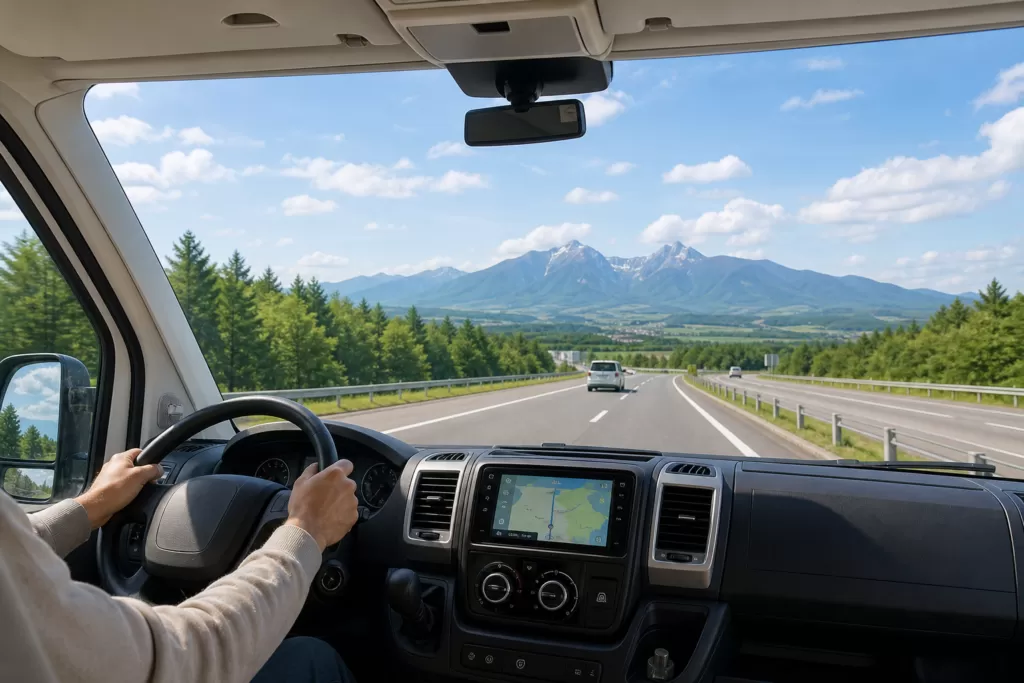
When driving a campervan around Hokkaido, many people worry about two things: “will it fit in the parking lot” and “how should I set up the navigation.” Multi-story parking structures are almost entirely off-limits, and if you just use your smartphone’s regular map navigation, it can route you down a road with a height restriction. This article walks through everything practical you need to know — from the actual dimensions of a campervan (especially a cabcon), to choosing and setting up navigation, to the parking situation across Hokkaido.
Campervan Dimensions: The Basics of Height and Width
A campervan’s (cabcon’s) dimensions differ greatly from an ordinary passenger car. Before you even choose a parking lot, it’s important to know your specific vehicle’s exact specs.
Typical cabcon dimensions
Cabcon-type campervans use a truck chassis as their base — typically a Toyota Camroad or Toyota Dyna — so the body tends to be large. Typical specs are as follows:
- Overall length: around 6–7m
- Overall width: around 2.0–2.2m
- Overall height: around 2.8–3.2m (varies by model and options)
- Gross vehicle weight: around 3–5 tons
An overall height of around 3m is close to that of a medium-sized truck. Height restrictions on road signs, guardrails, bridges, and tunnels are things most people never notice while driving an ordinary car, but as a campervan driver you need to be conscious of them at all times.
Why knowing your height and width matters
Japanese roads have a variety of height restrictions in place. Common ones include:
- Multi-story and mechanical parking structures: height limits are often around 1.55m–2.1m, ruling out every cabcon
- Underpasses and overpasses on public roads: some have limits of 2.5m–3.0m, requiring caution
- Approach roads to sightseeing spots and mountain roads: even without a posted height limit, tree branches or rock faces can physically block passage
The 2.0–2.2m overall width is also an issue. Narrow roads with a width of 1.5–2.5m — where passing an oncoming vehicle is difficult — remain common on Hokkaido’s farm roads, forest roads, and old roads near sightseeing spots. Getting into a situation where you can no longer even reverse out is a trouble spot particularly common among beginners.
Always check and note down your vehicle’s exact specs before you start renting. You’ll use these directly when entering data into your navigation and when choosing parking lots.
Navigation Settings to Avoid Height-Restricted Structures and Tunnels
Navigation for a campervan has different requirements than a regular car’s built-in navigation or a smartphone app. You need route guidance that accounts for height, width, and weight restrictions.
The problem with smartphone navigation
General smartphone navigation apps, such as Google Maps or Yahoo! Car Navi, calculate routes on the assumption you’re driving an ordinary car. This can cause problems such as:
- Guiding you along a route through a height-restricted road or bridge
- Guiding you across a weight-restricted bridge (which prohibits entry if you’re over the limit)
- Treating a narrow farm road or forest road as the “shortest route”
If you’re going to use smartphone navigation, choose an app that lets you set a “vehicle type: truck” or “large-vehicle mode,” or check restrictions on a map yourself before you drive. As of 2024, Google Maps does not offer route options tailored for large vehicles or trucks, so it isn’t recommended for campervan use.
Why an in-vehicle truck navigation unit gives peace of mind
A common choice among campervan enthusiasts is a Yupiteru or Panasonic truck/large-vehicle navigation unit. By entering your vehicle’s height, width, weight, and length before you set off, these units automatically calculate a route that avoids roads with restrictions your vehicle would violate.
- Yupiteru YPB series: avoids height- and weight-restricted roads in large-vehicle mode, with voice guidance also tailored for large vehicles
- Panasonic Strada (large-vehicle-compatible models): rich map-update features, giving high-precision road information
Be sure to enter your vehicle settings accurately. To let the navigation calculate whether “my 2.9m-tall vehicle can pass through a 3.0m-limited road,” you need to know your own vehicle’s exact specs.
Give up on multi-story parking entirely
Height limits at multi-story parking structures in Japan are mostly in the 1.55m–2.3m range — nowhere near enough for a cabcon’s 2.8–3.2m overall height. Even paid parking at commercial facilities, hotels, and sightseeing spots is physically impossible to enter if it’s a multi-story or mechanical structure.
When looking for parking, start from the assumption that it must be a flat, ground-level lot. Any parking lot with a height-restriction bar at the entrance is a non-starter for a campervan. The basic approach is to choose outdoor flat spaces at shopping malls or Michi-no-Eki roadside stations, or roadside parking lots with large-vehicle bays.
Compare Hokkaido Campervan Rentals
Base yourself at New Chitose Airport and compare rates, vehicle types, and pickup locations all in one place.
Compare rental companies and prices →How to Choose Parking You Can Park in Safely Across Hokkaido
Compared to Honshu, Hokkaido has much more flat land, and flat, ground-level parking lots that can accommodate large vehicles are found all over. That said, not every parking lot is campervan-friendly. Here are the key points to consider when choosing one.
Look for parking lots with large-vehicle spaces
Hokkaido’s Michi-no-Eki roadside stations, expressway service areas (SAs), and public parking lots at sightseeing spots very often have dedicated spaces for buses and large trucks. Using this “large-vehicle space” is the basic etiquette for a campervan.
Characteristics of large-vehicle spaces include:
- Individual bays are generously sized, around 5–12m (designed with large buses in mind)
- Flat, ground-level, with no height-restriction bar
- Whether the surface is paved or gravel varies by location
When it’s full, some drivers use the end of the regular car section (spanning two spaces), but make this call based on the situation around you. During busy sightseeing season (July–August), it’s smart to arrive at your parking lot early.
Checking in advance with Google Maps
Google Maps’ Street View and reviews let you get a rough sense of a parking lot’s layout in advance. If reviews or photos mention “multi-story” or “mechanical,” avoid it. Conversely, information like “large vehicles OK” or “buses can park” is a good sign.
Some large-vehicle navigation POI (point-of-interest) datasets, along with services like P-NAVI (a parking navigation service), also include lists that exclude height-restricted parking lots. Updating this data before a long trip can be handy.
Things to watch for when using paid parking
Most coin-operated parking (like Times) uses mechanical or multi-story systems and can’t be used. If a sign next to the payment machine reads something like “max height 2.1m,” entry is prohibited. If you can’t confirm this at the entrance, ask an attendant or find a different lot.
Paid parking lots at Michi-no-Eki stations or sightseeing spots that are marked “campervan-friendly” or have “large-vehicle rates” are generally well set up for you. Fees are also often set as a large-vehicle rate (1.5–2x the regular car rate), so check this when you pay.
Parking Conditions at Michi-no-Eki, SAs, and RV Parks
Hokkaido has 128 Michi-no-Eki roadside stations (as of 2026), widely used as waypoints for campervan trips. Along with expressway SAs and RV parks, let’s look at the characteristics of each.
Michi-no-Eki: almost entirely flat, ground-level parking in Hokkaido
With a few exceptions in more urban parts of Honshu, Hokkaido’s Michi-no-Eki stations are almost universally flat, ground-level lots. Since they’re designed with large trucks and sightseeing buses in mind, most can accommodate a campervan without issue.
That said, keep the following in mind:
- Use only the bays clearly marked “large vehicles only” for large-vehicle spaces
- Some Michi-no-Eki prohibit or restrict overnight parking
- During peak season (summer weekends), crowding can start around 10am, and even the large-vehicle spaces may fill up by the afternoon
Popular Michi-no-Eki stations (such as “Utoro Shiretoko,” “Mashu Onsen,” and “Biei Shirogane Birke”) get especially crowded. The trick is to move the evening before or arrive early in the morning to secure a spot before it fills up.
Expressway SAs/PAs: they have large-vehicle areas
Hokkaido expressway (such as the Doo Expressway) SAs and PAs have parking bays dedicated to large trucks and buses. Campervans can use these areas too. They’re handy for breaks or naps on a long drive, but since commercial vehicles often park overnight, if noise bothers you, it may be worth moving on to a Michi-no-Eki or RV park.
RV parks: comfortable, with power and water
RV parks are paid overnight-stay facilities certified by the Japan RV Association (JRVA). They typically come with power hookups, water, and toilets, making them more comfortable than free overnight parking at a Michi-no-Eki. Hokkaido has several RV parks, including “RV Park Hana Road Eniwa” and “RV Park Tokachi Wakka no Mori.”
Rates typically run about ¥1,000–¥3,000 per night, and most require advance booking. Once your itinerary is set, it’s a good idea to book early.
Approaching Narrow Sightseeing Areas (Shiretoko, Shakotan, etc.)
Some of Hokkaido’s famous sightseeing spots have roads too narrow for easy campervan access. Let’s look at concrete strategies for two well-known examples: Shiretoko and Shakotan.
Shiretoko (Shiretoko Five Lakes, Kamuiwakka)
Access to the Shiretoko Five Lakes uses Hokkaido Prefectural Road Shiretoko Koen Line, which branches off National Route 334 beyond the Utoro hot spring town. This road is a paved, two-lane road, and driving it in a campervan is not a problem in itself. However, there are the following restrictions:
- Private-vehicle restriction period: for a short period in summer, private vehicles are restricted on the section beyond the Shiretoko Five Lakes toward Kamuiwakka (August 8–15 in 2026). During this period, use the direct bus from the Shiretoko Nature Center. You can still drive to the Shiretoko Five Lakes parking lot. Note that during the brown bear activity season (May 10–July 31), walking the ground-level trail at the Five Lakes requires joining a tour led by a registered guide.
- Shiretoko Five Lakes parking lot: a flat, ground-level lot with space for large buses. Campervans can drive in.
- Kamuiwakka Falls: on the forest-road section, a 4WD vehicle or the shuttle bus is recommended. A 6–7m-long cabcon is best kept off the forest road.
The parking lot at the Utoro hot spring town is relatively large and includes flat spaces that fit a campervan. If you’re using the shuttle bus or a sightseeing boat, basing yourself here is efficient.
Shakotan Peninsula (Cape Kamui, Shimamui Coast)
Shakotan Peninsula’s sightseeing spots (Cape Kamui, Shimamui Coast, Yobetsu) are reached via roads branching off National Route 229. The national route itself is wide and easy to drive, but the approach roads and parking at each cape can be a problem.
- Cape Kamui parking lot: a flat lot large enough for buses to park. Campervans can park here, but you’ll need to walk about 30–40 minutes along a path from the parking lot to the tip of the cape.
- Shimamui Coast: the parking lot is flat but small. Large vehicles often need to park on the wide shoulder near the entrance and continue on foot.
- Around Horomui fishing port: located just before the cape, with a wide parking area. From here you can also take a shuttle or walk in.
The roads to the tips of Shakotan’s capes are generally narrow, and campervans over 2m wide can have a hard time passing oncoming traffic. Traffic also increases on weekends during sightseeing season, so it’s smarter to visit early in the morning or in the evening.
New Chitose Airport / Tokachi-Obihiro Airport
Rent the Cabcon “Cresson Journey”
Base yourself at New Chitose Airport and travel all across Hokkaido by campervan.
See details at Moving Inn →Frequently Asked Questions (FAQ)
Q: Can I use coin-operated parking with a campervan?
Most coin-operated parking is mechanical or multi-story, or has a height-restriction bar, so a cabcon can’t use it. Even a flat, “open-air” coin parking lot often has bays no wider than 2.5m, and a campervan 2.0–2.2m wide can end up interfering with the neighboring car’s door. The basic approach is to use paid parking near sightseeing areas that’s explicitly marked as large-vehicle-friendly, or to use Michi-no-Eki and SAs instead.
Q: Are there roads in Hokkaido where I might hit a height restriction?
On major national routes and prefectural roads (Hokkaido’s equivalent of prefectural roads), hitting a height restriction is rare. What requires caution are underpasses in city centers (roads passing under railway lines) and low bridges on old farm or forest roads. If you set a truck-compatible navigation unit to “avoid height restrictions,” you should have essentially no trouble on the main sightseeing routes.
Q: How do I judge whether a road is passable by campervan?
If there’s a sign at the entrance reading something like “height limit ○m,” “no large vehicles,” or “width 2.0m,” you can check before entering. Even without a sign, if you look at the road width and surface and feel that “I couldn’t pass an oncoming car,” it’s important to turn back rather than force your way through. Turning back while you still have room to reverse is the safest response. Since a campervan has limited rear visibility, it’s ideal to have a passenger guide you when reversing.
Q: Is it legally OK to sleep overnight in a campervan at a Michi-no-Eki?
Under Japan’s Road Traffic Act, overnight parking at a Michi-no-Eki is not itself prohibited. That said, individual Michi-no-Eki stations sometimes set their own rules, such as “no overnight parking” or “no idling.” It’s best to check the notices posted at each station or its official website before you stay. Also, always take your trash with you and avoid disturbing other visitors — good manners here help maintain the reputation of the campervan community as a whole.
Q: Where can I check the dimensions of a rental campervan?
Vehicle specs are usually listed on the rental company’s website or in your booking confirmation email. If they aren’t, ask the company directly for the overall height, width, length, and gross vehicle weight before you book. You’ll need this information for your navigation settings and for choosing parking, so it’s worth having it noted down before you set off.
Q: Can I use Hokkaido’s RV parks without a reservation?
RV parks are basically reservation-only. During the season (June–September), many fill up early on weekends, so book as soon as your itinerary is set. You can check the list of RV parks nationwide and their availability on the Japan RV Association (JRVA)’s official website.
Q: Does Shiretoko’s private-vehicle restriction apply to campervans too?
Yes — during the restriction period, all private vehicles, including campervans, are covered. The restriction covers the section beyond the Shiretoko Five Lakes toward Kamuiwakka, and in 2026 it ran from August 8 to 15. During this period, use the direct bus from the Shiretoko Nature Center. You can still drive to the Shiretoko Five Lakes parking lot during the restriction. Since the restriction period changes year to year, check the Shiretoko Nature Center official website for the latest information before you go.
Q: Are there things to watch for at gas stations when traveling Hokkaido by campervan?
Hokkaido has wide gaps between towns, and in some areas gas stations can be more than 50km apart. Eastern Hokkaido (toward Nemuro/Kushiro) and northern Hokkaido (toward Wakkanai) in particular have limited places to refuel. Since campervans get worse fuel economy than ordinary cars (roughly 7–10 km per liter), make it a habit to refuel at the next station once you’re down to half a tank. Also, if a self-service station’s canopy is low (2.5m or less in clearance), your roof or roof-mounted air conditioner could hit it, so check before pulling in.
Q: What should I watch for regarding parking when traveling Hokkaido by campervan in winter?
In winter (November–April), more areas restrict roadside parking to allow snowplows through. Some Michi-no-Eki parking lots also use part of their space to store snow-removal equipment, shrinking the usable area compared to summer. In addition, on a snow-covered large-vehicle space, there’s a risk your tires could sink in and get stuck. If you’re driving a campervan around Hokkaido in winter, we strongly recommend confirming that studless winter tires are fitted, and carrying tire chains and a tow rope.
Book a Campervan in Hokkaido
Moving Inn New Chitose Airport supports English booking and offers airport transfers.
Pick a campervan by what matters to you.
Rent at New Chitose Airport
See only the rental bases in Chitose, where the airport is.

![When and Where Can You See Harbor Seals at Cape Erimo? Kaze no Yakata Official Information, Viewing Season, and Windy-Day Notes [2026-27]](https://hokkaido-campingcar.jp/wp-content/uploads/2026/10/erimo-cape-lighthouse-768x511.jpg.webp)
![Where and Under What Conditions Can You See Diamond Dust in Hokkaido? How Cold a Morning It Takes, and Where It Appears [2026-27]](https://hokkaido-campingcar.jp/wp-content/uploads/2026/10/hokkaido-diamond-dust-nayoro-768x512.jpg.webp)
![Can You Drive to Hokkaido Jingu for Hatsumode? Parking, Crowds, and Where to Park and Walk [2027]](https://hokkaido-campingcar.jp/wp-content/uploads/2026/10/hokkaido-jingu-winter-torii-768x504.jpg.webp)
![Hokkaido Roads Over New Year [2026-27] | Expressway Sections Prone to Blizzard Closures, Forecast Congestion Days, No Holiday Discount, and New Chitose Airport Parking](https://hokkaido-campingcar.jp/wp-content/uploads/2026/10/hokkaido-winter-rural-road-edge-markers-768x432.jpg.webp)
![Where to See Sea Smoke (Kearashi) in Hokkaido: Rumoi’s Ogon-misaki and the Morning Conditions [2026-27]](https://hokkaido-campingcar.jp/wp-content/uploads/2026/10/rumoi-kearashi-sea-smoke-768x511.jpg.webp)
![Geminid Meteor Shower 2026 in Hokkaido: Peak Around 23:00 on December 14, Sapporo Moonset 20:40, and Staying Warm in a Winter Campervan [2026]](https://hokkaido-campingcar.jp/wp-content/uploads/2026/10/geminids-2026-hokkaido-768x575.jpg.webp)