Campervan Rental Japan: Can You Drive on Your License? Country-by-Country Guide (2026)
Yes, you can rent a campervan in Japan — travelers from most countries can. The first thing to check isn’t the vehicle or the route, though: it’s whether your driver’s license qualifies you to drive here, because the rule depends on which country issued it. All sources were checked on 2026-10-01.
Can you drive in Japan on your license? Check your country first
Japan allows foreign visitors to drive in one of two ways, and which one applies to you depends entirely on your home country or region. According to the Tokyo Metropolitan Police Department, there is no option that works for every nationality (Tokyo Metropolitan Police Department — International Driving Permit guidance; Tokyo Metropolitan Police Department — foreign driver’s license guidance, both checked 2026-10-01).
| Country / region | Can you drive? | What you need | How long it’s valid |
|---|---|---|---|
| Taiwan | Yes — translation route | Original Taiwan license + Japanese translation from the Taiwan-Japan Relations Association, JAF, or Zip-Plus Co. | Within 1 year of arrival in Japan |
| Hong Kong | Yes — IDP route | Geneva Convention-format International Driving Permit (IDP) + original license | Within 1 year of IDP issuance and within 1 year of arrival |
| Mainland China | No | Neither a Chinese license nor a Chinese-issued IDP qualifies — mainland China is not covered by either route | — |
| South Korea | Yes — IDP route | Geneva Convention-format IDP + original license | Within 1 year of IDP issuance and within 1 year of arrival |
| Singapore | Yes — IDP route | Geneva Convention-format IDP + original license | Within 1 year of IDP issuance and within 1 year of arrival |
| Malaysia | Yes — IDP route | Geneva Convention-format IDP + original license | Within 1 year of IDP issuance and within 1 year of arrival |
| Australia | Yes — IDP route | Geneva Convention-format IDP + original license | Within 1 year of IDP issuance and within 1 year of arrival |
| New Zealand | Yes — IDP route | Geneva Convention-format IDP + original license | Within 1 year of IDP issuance and within 1 year of arrival |
| United States | Yes — IDP route | Geneva Convention-format IDP (issued by AAA or the National Auto Club) + original license | Within 1 year of IDP issuance and within 1 year of arrival |
| Canada | Yes — IDP route | Geneva Convention-format IDP + original license | Within 1 year of IDP issuance and within 1 year of arrival |
| United Kingdom | Yes — IDP route | Geneva Convention-format IDP + original license | Within 1 year of IDP issuance and within 1 year of arrival |
Two details trip people up more than any other. First, an International Driving Permit only counts if it was issued in the format set by the 1949 Geneva Convention — a permit issued under the 1968 Vienna Convention format is not valid in Japan, even if your home country otherwise qualifies. Second, Switzerland, Germany, France, Belgium, Monaco, and Taiwan are not on the Geneva Convention country list, so travelers from those places cannot use an IDP at all — they must use the home-license-plus-translation route instead, with the translation prepared by an authorized body such as JAF (checked 2026-10-01, source).
For a closer look at your own country, including Australia, New Zealand, the US, the UK, Taiwan and Hong Kong, see our country-by-country guide to driving a campervan in Hokkaido on your licence.
If you’re from mainland China, note that neither route applies to a Chinese license or a Chinese-issued IDP, so self-drive campervan rental in Japan isn’t an option on that license. Separately from the government rule, individual rental companies may set their own conditions — minimum age, years of driving experience, accepted license types — so always confirm these with the rental company at the time of booking.
New from New Chitose Airport — Available from June 2026
Rent the Cabcon “Cresson Journey”
Base yourself at New Chitose Airport and compare rates, vehicle types, and pickup locations all in one place.
See details at Moving Inn →Other things that worry first-time visitors — and how to handle them
Once your license is sorted, most of the remaining concerns are things you can prepare for in advance rather than worry about on the road.
- Left-hand traffic: Japan drives on the left, the opposite of the US, mainland Europe, and much of mainland China. A campervan is also wider and taller than an ordinary car, so until you’re used to both at once, it helps to plan routes on wider suburban roads rather than tight city streets.
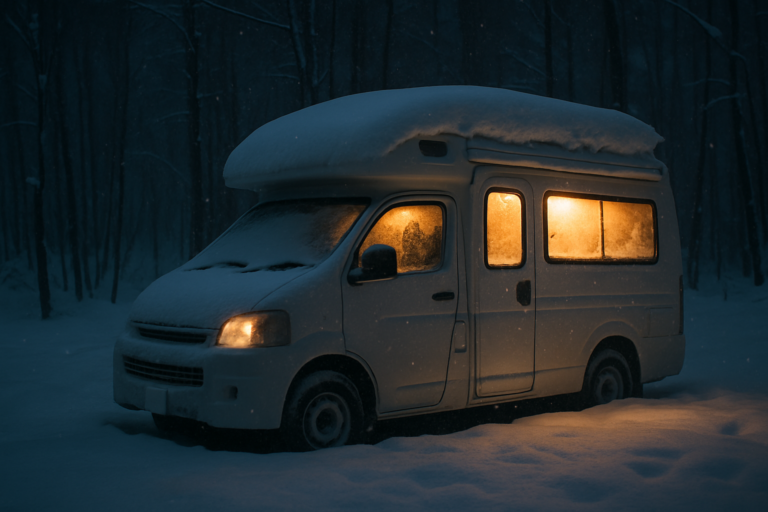
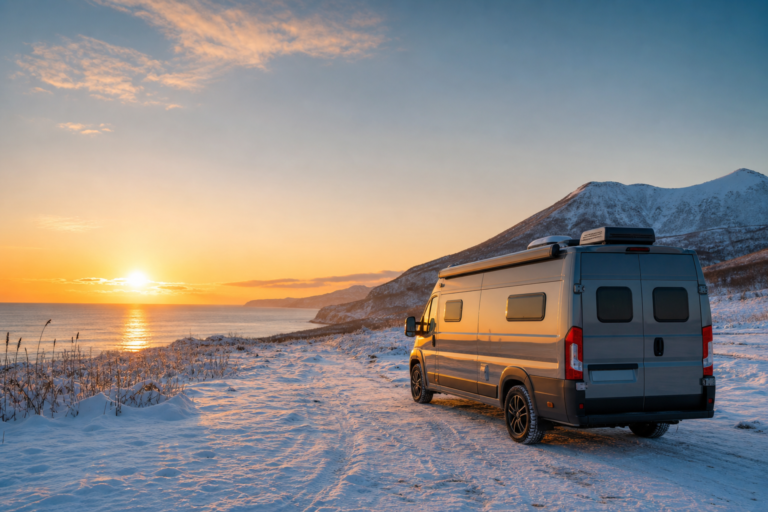
- Winter driving in Hokkaido: From late autumn through spring, Hokkaido’s roads are routinely snow- and ice-covered, and winter tires are treated as a given rather than an option. If you’re considering a winter trip, read what to know before a winter campervan trip in Hokkaido before you book.
- English support: Not every rental base has English-speaking staff, and this varies company by company, so confirm English support when you book if it matters to you.
- Insurance and the NOC (Non-Operation Charge): Rental quotes include basic insurance, but an added NOC charge typically applies on top to limit your liability in an accident, and the deductible you’re responsible for depends on the plan you choose. See our guide to insurance, NOC, and the deductible for what you’re actually agreeing to.
- If you’re in an accident, or hit a deer: Call the police at 110 and, for a medical emergency, call 119 for ambulance or fire services (checked 2026-10-01, japan-guide.com — emergency numbers in Japan). Reporting to the police at the scene is also a legal obligation after any traffic accident in Japan, however minor it looks, and a police report is generally what your insurance claim depends on — so save the rental operator’s emergency contact number to your phone before you set off, not after something happens.
- Where you can sleep overnight: Having a campervan doesn’t mean you can park and sleep anywhere. See the “where you’ll sleep” section further down for the facility types that are actually designed for it.
Three main vehicle types, matched to your travel style
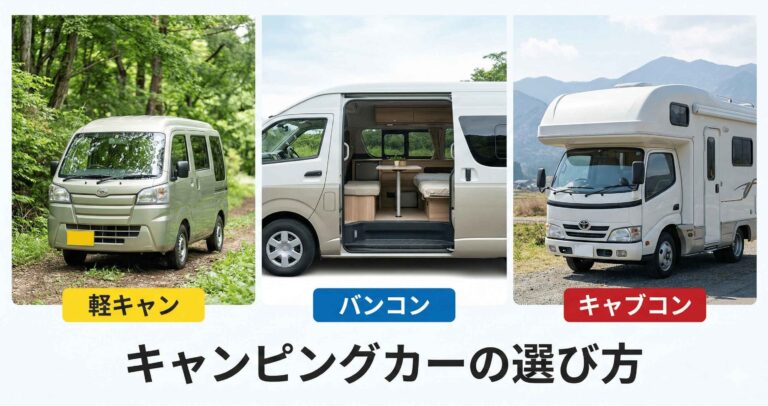
Campervans available for rental in Japan generally fall into three types based on the base vehicle. The names may be unfamiliar, but the distinctions themselves are simple.
| Type | Base vehicle | Characteristics | Best suited for |
|---|---|---|---|
| Kei-camper | Kei car (mini vehicle) | Compact and easy to maneuver on narrow roads and in cities. Amenities are basic | Solo or two-person trips traveling light, or drivers new to larger vehicles |
| Vancon | Van such as the HiAce | Balances a driving feel close to a regular car with proper sleeping arrangements | Couples, or anyone renting a campervan for the first time |
| Cabcon | Truck such as the Camroad | Spacious living area, typically with standing headroom inside. Wider and taller than the other types | Family trips, or trips where you’ll spend a lot of time inside the vehicle |
If you’re undecided, starting with a Vancon is the safe default. It drives close to a regular car, so there’s little room for mistakes. On the other hand, if you’re traveling with kids and expect to spend a lot of time inside during the day, a Cabcon may suit you better from the start. For more detail on the layout and equipment of each type, see What Is a Campervan?.
Cost depends on vehicle type × season × number of days
The total rental cost can’t be read off a simple daily rate. It helps to know what actually moves the price before comparing quotes.
- Vehicle class: As a basic pattern, daily rates rise from Kei-camper to Vancon to Cabcon
- Season: Rates rise and bookings fill up faster during peak periods such as long holiday weekends and summer break
- Number of days: Some companies offer long-term discounts, so the per-day rate can drop on week-long trips
- NOC (Non-Operation Charge): An added charge for coverage that limits your liability in case of an accident
- Equipment options: Bedding, cookware, child seats, winter tires, and similar items may cost extra
- One-way drop-off: An extra fee applies if you return the vehicle at a different base from where you picked it up
Since actual amounts vary widely by region and company, we won’t list specific figures here. To get a sense of real-world pricing, our Hokkaido campervan rental price guide, which breaks down typical rates by vehicle type, is a useful benchmark. Even if you’re renting in a different region, the same framework for breaking down a quote still applies.
Choosing a region — work backward from your travel style
With a campervan trip, where you rent largely determines the character of the whole trip. Road conditions and the density of sights vary a lot by region in Japan, so it’s fastest to work backward from the scenery you actually want to see.
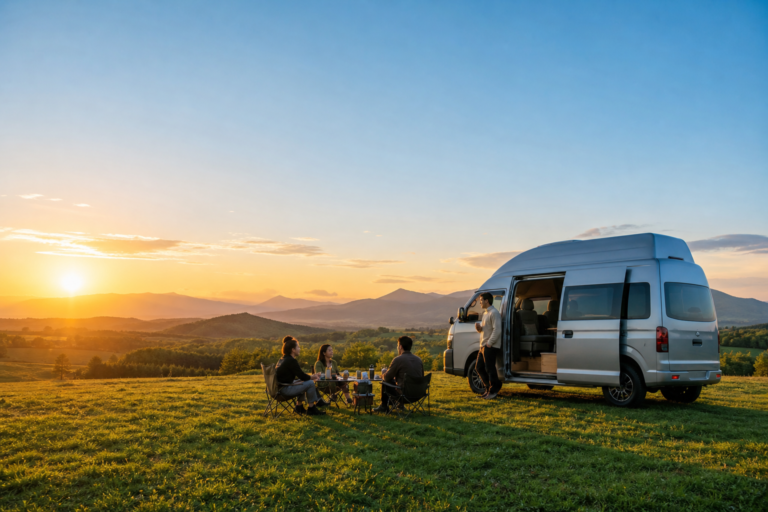
If you want to drive through wide-open nature, Hokkaido is the classic choice. Long, straight roads with light traffic make a large vehicle easy to handle, and there’s no shortage of Michi-no-Eki (roadside rest stops) and RV parks to choose from — all the ingredients for a campervan trip. First-timers can get the full flow from booking to return in our complete Hokkaido campervan rental guide. Winter brings snowy roads, though, so read what to know before a winter campervan trip in Hokkaido before deciding on a winter trip.
If you want to combine city sightseeing with your trip, Honshu is a good fit. Renting from a base in Tokyo or Osaka and extending out to Mt. Fuji, the mountains of Shinshu, or hot spring areas is an easy itinerary to put together. Because the sights are more densely packed, you’ll spend more time in cities and on narrow roads, so a smaller Vancon or Kei-camper is easier to handle.
If hot springs and food are your priority, Kyushu is also worth considering. Hot spring towns are scattered throughout the region, which suits a circuit-style itinerary well. Whichever region you choose, base locations, vehicle availability, and whether airport pickup is offered all vary by company, so once you’ve picked a region, the next step is checking that area’s base information before booking.
From booking to departure — decide where you’ll sleep, too
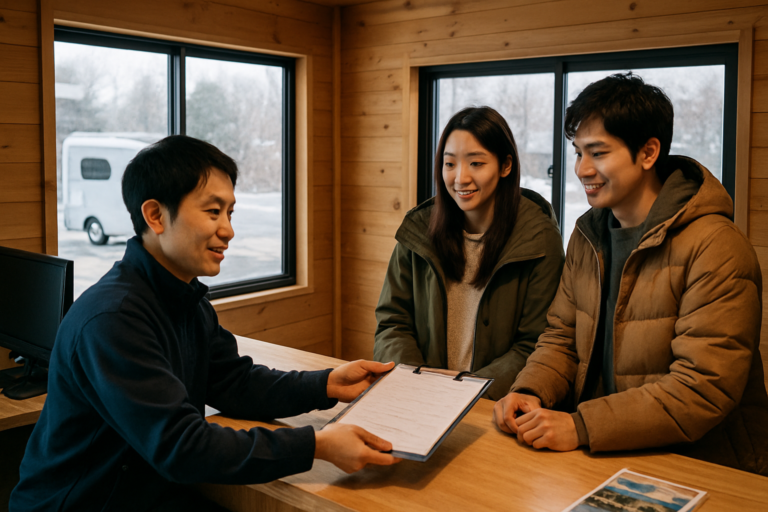
The flow from booking to departure is the same regardless of region: ① decide the region and dates → ② choose a vehicle type and base, then book → ③ confirm license, insurance, and equipment conditions → ④ at pickup, check the vehicle for existing damage and get the operation walkthrough before setting off. That pickup walkthrough tends to run longer than for a regular rental car, since it covers equipment you may be using for the first time, like the water system and the FF heater — so build some slack into your pickup time slot.
One more thing to decide before you leave is where you’ll spend the night. Having a campervan doesn’t mean you can park and sleep anywhere. Facilities meant for overnight stays are RV parks and auto campsites, which come with amenities like power hookups. A Michi-no-Eki is primarily a rest stop for drivers, and whether overnight parking is permitted differs facility by facility. Check the official guidance for any facility you plan to stay at before you go. We cover how to tell these facility types apart in our guide to using RV parks.
New from New Chitose Airport — Available from June 2026
Rent the Cabcon “Cresson Journey”
Base yourself at New Chitose Airport and compare rates, vehicle types, and pickup locations all in one place.
See details at Moving Inn →Frequently Asked Questions
Can I rent a campervan in Japan on my foreign license?
It depends on your country. Most nationalities — including Hong Kong, South Korea, Singapore, Malaysia, Australia, New Zealand, the US, Canada, and the UK — can drive with a Geneva Convention-format International Driving Permit plus their original license, valid within one year of issuance and within one year of arrival. Taiwan, Switzerland, Germany, France, Belgium, and Monaco use a different route: the original license plus an authorized Japanese translation. A mainland Chinese license does not qualify under either route (Tokyo Metropolitan Police Department guidance, checked 2026-10-01). Check the table above for your country, and confirm the rental company’s own conditions when booking.
Can I drive a campervan on a standard driver’s license?
Most campervans available for rental in Japan can be driven on a standard passenger-car license. That said, the required license class can change depending on the vehicle’s gross weight, so once you’ve picked a vehicle, check both the license class chart and the rental company’s own conditions.
How much does campervan rental cost?
The total depends on vehicle class, season, number of days, insurance coverage, equipment options, and whether you’re doing a one-way drop-off. Because the range varies a lot by region and company, we can’t quote a single figure, but our Hokkaido price guide, which breaks down typical rates by vehicle type, is a useful benchmark for judging whether a quote is high or low.
What’s the best season to rent a campervan?
If you’re not yet used to handling the equipment, spring through autumn is the easiest window, with less to worry about in terms of heating or snowy roads. Rates rise and bookings fill up faster around summer break and long holiday weekends, so book early once your dates are set. Driving in winter assumes you’re prepared for snowy-road driving and winter equipment. For Hokkaido specifically, see what to know before a winter campervan trip.
Can I park overnight anywhere I like?
No, not anywhere. Facilities meant for overnight stays are places like RV parks and auto campsites, which are designed for it. A Michi-no-Eki is a rest stop for drivers, and whether overnight parking is allowed differs facility by facility, so check the official guidance for any facility you plan to use beforehand. For a closer look at the legal side, see our guide to the legality of sleeping in your car in Japan, which walks through the rules with official sources.
Can I pick up a campervan directly at the airport?
Some companies have bases near airports and offer a shuttle or direct airport pickup. Whether this is offered, and how it works, varies by base, so confirm before booking. For a concrete example of how this works, see our New Chitose Airport pickup guide.
Book a Campervan in Hokkaido
Moving Inn New Chitose Airport supports English booking and offers airport transfers.