Is It Legal to Sleep in Your Car in Japan? Rules for Roadside Stations, SA/PA, and Public Roads
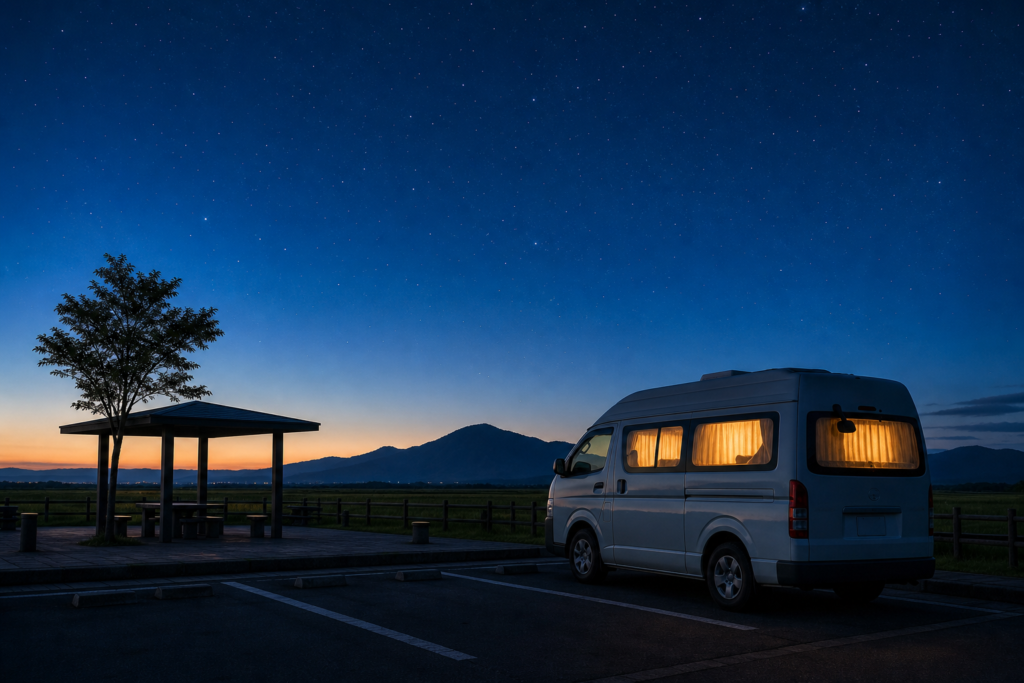
“Is it actually illegal to sleep in your car in Japan?” A lot of people get stuck on this question before renting a campervan. Here’s the short answer: Japanese law has no rule that punishes the act of sleeping inside a vehicle itself. What separates legal from illegal is where you park and how long you stay there. It’s the parking that’s regulated, not the sleeping.
This article checks how overnight car sleeping is treated on public roads, at roadside stations (道の駅, Michi-no-Eki), at expressway service areas, and on private land, using only primary sources: the actual text of the Road Traffic Act and the Vehicle Storage Act, plus the official positions of Japan’s Ministry of Land, Infrastructure, Transport and Tourism (MLIT) and the expressway operators. Every law and official source here was checked on August 19, 2026. This article focuses only on the legal and regulatory side. If you’re looking for actual places to stay in Hokkaido, see our complete guide to overnight parking in Hokkaido.
The bottom line: no law bans sleeping inside a car
The Road Traffic Act (see the official text on e-Gov Japanese Law Search) regulates “driving” and “stopping/parking.” There is no provision in the Road Traffic Act that specifically targets napping or sleeping inside a vehicle (confirmed Aug 19, 2026). In other words, sleeping in your car is neither automatically illegal nor automatically legal — the answer depends entirely on where you’ve parked.
Here’s how each type of location is treated, at a glance.
| Where you park | Legal / official treatment |
|---|---|
| Public road (on-street) | Easily runs into no-stopping/no-parking rules and the ban on long-duration parking in one spot (Vehicle Storage Act). Can be a violation |
| Roadside station (Michi-no-Eki) | Napping is fine, but overnight stays are something visitors are “asked to refrain from” (MLIT, a request, not a ban) |
| Expressway service areas / parking areas (SA/PA) | Rest facilities. NEXCO West Japan explicitly bans “long-duration or extended parking beyond the purpose of a rest stop, sleeping outdoors, camping, or living in a vehicle” |
| Private land (convenience stores, commercial facilities, etc.) | Entirely up to the owner/manager’s permission. Unauthorized overnight parking is a common source of trouble |
| RV parks / auto campsites | Facilities built for overnight stays. You can sleep there with no concerns |
Now let’s look at the actual legal text and official sources behind each of these.
Why sleeping on a public road is the easiest way to get into trouble
Sleeping in your car on a public road comes closest to being clearly illegal, and it’s because of two separate laws.
The first is the Road Traffic Act. Articles 44 and 45 spell out in detail where stopping and parking are prohibited (near intersections and crosswalks, for example) and where parking specifically is prohibited (see e-Gov Japanese Law Search, confirmed Aug 19, 2026). If you’re parked somewhere parking is banned and sleeping, it’s a parking violation regardless of whether you’re asleep.
The second, easily overlooked law is the “Vehicle Storage Act” (the Act on Securing Vehicle Garages). Article 11, Paragraph 2 bans parking in the same spot on a public road for 12 or more consecutive hours, or 8 or more consecutive hours overnight (from sunset to sunrise) (see e-Gov Japanese Law Search, confirmed Aug 19, 2026). Violations carry a fine of up to ¥200,000 (same Act, Article 17, Paragraph 2). If you park on the street from evening until the next morning and sleep, you’ll easily cross that 8-hour overnight threshold. This applies even on a quiet side street with no “no parking” sign posted.
In short, sleeping in your car on a public road isn’t illegal because you slept — it’s illegal because of how and how long you parked. And the simple act of sleeping through the night almost always satisfies that time condition. The conclusion is: rule out public roads.
Is sleeping at a Michi-no-Eki illegal? Here’s the government’s official answer
MLIT, which oversees Japan’s roadside stations, has officially answered the question “Can I sleep overnight in a Michi-no-Eki parking lot?” on its “Road Consultation Room” page. Here’s the original text, translated (see MLIT Road Consultation Room, confirmed Aug 19, 2026):
“Michi-no-Eki” are rest facilities available 24 hours a day to prevent traffic accidents among drivers and other visitors, so it’s fine to take a nap inside your vehicle to recover from fatigue while on a drive. However, we generally ask visitors to refrain from staying overnight in public spaces such as the parking lot.
There are three key points to take from this. First, napping while on a drive is explicitly stated to be “fine.” Second, overnight stays are not “banned” — they’re something visitors are “asked to refrain from,” which is a request, not a legal prohibition. And third, MLIT doesn’t give any time-based line between a nap and an overnight stay. There’s no written rule saying how many hours turns a rest into a stay.
The same answer also notes that “some Michi-no-Eki have separately set up dedicated parking spaces for overnight stays, so please check each Michi-no-Eki’s own website for details before using it.” In other words, some roadside stations really do have designated areas where staying overnight is fine — often paired with an on-site RV park. Conversely, individual stations sometimes post their own stance on overnight car sleeping, so check that specific station’s official site before you stay.
We checked the official websites of Hokkaido’s roadside stations one by one; the results are in Which roadside stations in Hokkaido allow overnight parking? 20 picks with official confirmation. And for the kind of behavior that keeps these “please refrain” requests from becoming outright bans, see our Michi-no-Eki overnight-parking manners guide.
How are expressway service areas and parking areas (SA/PA) treated?
Like Michi-no-Eki, service areas and parking areas are also “rest facilities,” but the expressway operators go a step further in how they put it. NEXCO West Japan’s “Notes on Using SA/PA” explicitly lists the following as prohibited conduct (see NEXCO West Japan, Notes on Using SA/PA (PDF), confirmed Aug 19, 2026):
Long-duration or extended parking beyond the purpose of a rest stop, sleeping outdoors, camping, or living in a vehicle.
The same document also bans “using open flames carelessly, or camping, barbecuing, or setting off fireworks without permission.” It states that anyone engaging in prohibited conduct may be asked to stop or leave, and the matter may be reported to the relevant authorities.
The key question here is still whether your stay serves “the purpose of a rest.” Driving through the night, hitting your limit, napping a few hours, and pushing on — that’s exactly what a rest stop is for, and exactly why SA/PAs exist. On the other hand, treating one as a substitute hotel for multiple nights, or setting up chairs and a table outside your vehicle, is explicitly prohibited conduct under the wording above.
Note that we could not find a page on NEXCO East Japan’s site — which covers Hokkaido’s expressways — listing similarly explicit prohibited conduct (as of Aug 19, 2026). If you’re planning to use an SA/PA in Hokkaido, check NEXCO East Japan’s official site for the latest guidance.
Convenience store and commercial parking lots: it’s entirely about the owner’s permission
Parking lots at convenience stores, supermarkets, pachinko parlors, and similar businesses are private property. Whether you can park there isn’t a matter of law — it’s up to the owner or manager, and a parking lot meant for shoppers generally isn’t intended to be used for overnight stays.
Parking there overnight without permission won’t necessarily get you criminal charges on the spot, but it’s entirely normal to be asked to leave by the manager, be billed for damages, or have the police called. There’s no good reason to take that risk while traveling. The exception is when a facility explicitly allows it — some RV parks, for example, are set up by an attached commercial facility or hot spring that has opened up a corner of its own lot specifically for overnight car sleeping. That’s private land with the owner’s permission, which is the safest version of this option.
Even a legal spot can turn illegal through what you do there
Even if you’ve picked the right kind of spot, certain behavior can still get you into legal trouble. The one to watch closely during overnight car sleeping is alcohol.
Article 65 of the Road Traffic Act bans driving under the influence, and according to Japan’s National Police Agency, driving with a breath alcohol concentration of 0.15 mg/L or higher counts as driving while impaired, punishable by up to 3 years’ imprisonment or a fine of up to ¥500,000 (see National Police Agency, drunk-driving elimination page, confirmed Aug 19, 2026). There are two moments where this matters for overnight car sleeping. One is moving the car after drinking — even just to “adjust the parking position a little.” If you move it, that’s driving. The other is the following morning: if alcohol from the night before is still in your system when you set off, that can also count as driving while impaired. If you drink inside the vehicle, the rule is simple: don’t move it even a millimeter that night, and give yourself plenty of time the next morning too.
Beyond that, behavior like leaving trash in the parking lot or on the roadside, cooking on a stove in a parking lot, or making noise late at night with engine sounds or loud talking is a direct cause of complaints and police reports. Open flames and camping-type activity are explicitly banned at SA/PAs, as noted above. This kind of behavior is also part of why “please refrain” requests at Michi-no-Eki keep increasing — for details, see our overnight-parking manners guide.
If you want to sleep without worrying, just pick a place built for it
Flip everything above around and the answer is simple. Choose a place that’s built for overnight stays — an RV park, an auto campsite, or a Michi-no-Eki with a dedicated overnight parking area — and you can sleep without worrying about the law or any gray areas. These places often come with power, restrooms, and trash disposal too, so they usually end up more comfortable as well.
We leave the question of exactly where to stay in Hokkaido to the articles where we’ve actually confirmed the spots. For the big picture, start with our complete guide to overnight parking in Hokkaido; for specific spots, go to Recommended campervan overnight-parking spots in Hokkaido.
New from New Chitose Airport — Available from June 2026
Rent the Cabcon “Cresson Journey”
Base yourself at New Chitose Airport and compare rates, vehicle types, and pickup locations all in one place.
See details at Moving Inn →FAQ
Q1: Is it illegal to sleep in your car in Japan?
There’s no provision in the Road Traffic Act that punishes the act of sleeping inside a vehicle itself (confirmed Aug 19, 2026). Whether it’s illegal depends on where you park and for how long. Parking overnight on a public road easily runs into the Vehicle Storage Act’s ban on long-duration parking (8+ hours overnight), while RV parks, campsites, and other places built for overnight stays are fine.
Q2: Is it a violation to sleep overnight at a Michi-no-Eki?
It’s not a legal violation. MLIT states that napping while on a drive is “fine,” and that overnight stays are something visitors are “generally asked to refrain from” (confirmed Aug 19, 2026). It’s a request, not a ban — but since there’s no stated time line between a nap and an overnight stay, the honest approach is to keep your stay within “rest” and, if you actually want to stay overnight, choose a Michi-no-Eki with a dedicated overnight parking area or an RV park.
Q3: Why is it a problem to park and sleep on a public road?
Because Article 11 of the Vehicle Storage Act bans parking in the same spot on a public road for 12 or more consecutive hours (8 or more overnight) (confirmed Aug 19, 2026). Sleeping through the night easily meets that time condition, and violations carry a fine of up to ¥200,000. This applies even on a street with no “no parking” sign.
Q4: Is it okay to drink alcohol during overnight car sleeping?
Drinking itself where you’ve parked isn’t driving, but moving the car even a little after drinking can count as drunk driving. Driving with a breath alcohol concentration of 0.15 mg/L or higher is driving while impaired, punishable by up to 3 years’ imprisonment or a fine of up to ¥500,000 (National Police Agency, confirmed Aug 19, 2026). Watch out for leftover alcohol the next morning too.
Q5: I’m a foreign traveler — what should I watch out for with overnight car sleeping in Japan?
The rules are the same as for Japanese residents. Avoid parking overnight on public roads, use Michi-no-Eki and SA/PAs only within the bounds of a rest stop, and book an RV park or campsite if you actually want to stay overnight. Follow these three and overnight car sleeping in Japan is safe and comfortable. Signage at these facilities is often Japanese-only, so if you see a “no” symbol posted in a parking lot, follow it.
Bottom line: decide where you’ll sleep first, and the legal worries disappear
No law bans overnight car sleeping itself. But public roads easily run afoul of the Vehicle Storage Act and parking rules, Michi-no-Eki and SA/PAs take the position of “napping is fine, please refrain from staying overnight,” and private land is entirely about permission. So the answer is always the same: decide on a place where you’re allowed to stay before you set off. Pick tonight’s spot from our list of officially confirmed roadside stations or our complete overnight-parking guide, and every concern in this article disappears.
Book a Campervan in Hokkaido
Moving Inn New Chitose Airport supports English booking and offers airport transfers.
![Hokkaido Winter Trip: Shoes & Packing List [2026] – 2,060 Sapporo Fall Transports and a Pre-Departure Checklist](https://hokkaido-campingcar.jp/wp-content/uploads/2026/10/hokkaido-winter-trip-shoes-packing-eyecatch-768x432.webp)
![Snow Cancels Your New Chitose Airport Flight? Rebooking Rules and Campervan Rental Delays [2026]](https://hokkaido-campingcar.jp/wp-content/uploads/2026/10/new-chitose-airport-snow-cancellation-eyecatch-768x432.webp)