Can You Sleep Overnight at Cape Erimo? Kaze no Yakata’s Official Notes, Hyakunin Beach Auto Campground, and Where to Stay on the Hidaka–Erimo Coastal Drive [2026]
A complete campervan road trip guide from Hidaka to Cape Erimo, Hokkaido.
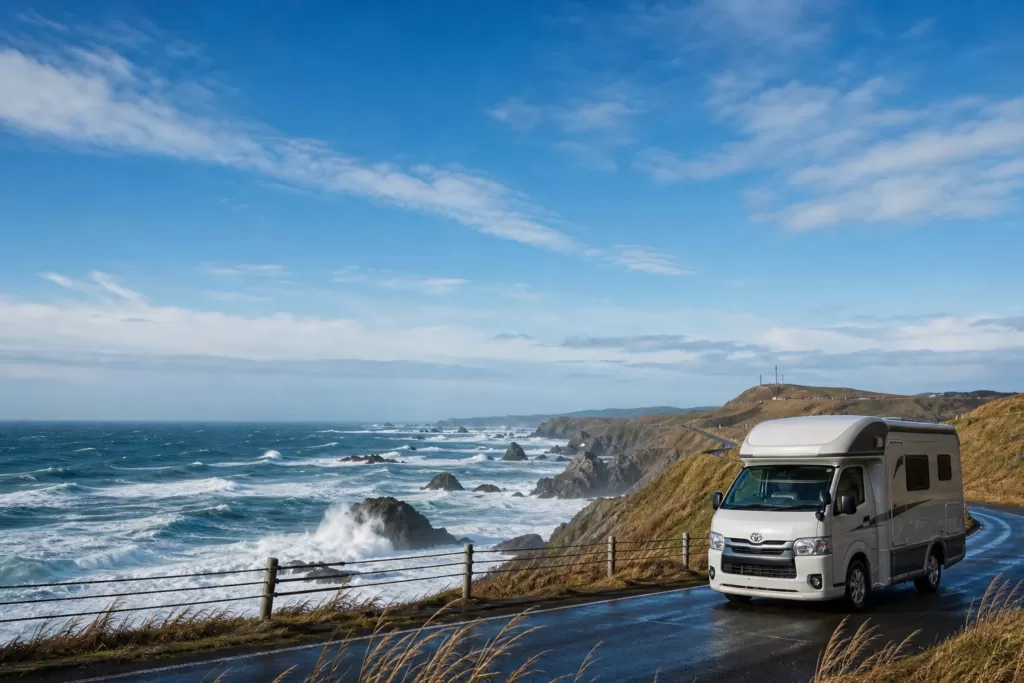
Thoroughbred horses grazing in lush pastures, a windswept cape jutting into the Pacific, freshly harvested kelp and whelks from the shore — the coastal route south from Hidaka to Cape Erimo is one of Hokkaido’s most scenically dense stretches. The distance from New Chitose Airport to Cape Erimo is roughly 220 km, but with no expressway for most of the route, expect half a day of driving. That very remoteness keeps tour buses away, making it ideal territory for a leisurely campervan journey. This guide covers how to drive the Hidaka–Erimo route and practical overnight parking information, updated for 2026.
Why Hidaka–Erimo Suits a Campervan Road Trip
Hidaka is located in southeastern Hokkaido, where a Pacific coastline meets inland mountain terrain. The towns of Niikappu, Urakawa, Samani, and Erimo line the shore, with thoroughbred farms spreading toward the Hidaka Mountains inland. The region produces roughly 70% of Japan’s thoroughbreds, and horses grazing behind fences line the roads throughout the area.
At the southern tip lies Cape Erimo, one of the windiest spots in Japan — recorded as having 260+ “windy days” per year (wind speed 10 m/s or above). The land was once desertified by deforestation; locals spent 40 years replanting it, and the windbreak forest still stands on the hillside today.
For campervan travelers, this is not a route you drive through — it’s a route you linger on, stopping at farms, capes, and fishing ports. From Cape Erimo you can continue inland via Route 336/236 toward Obihiro, or loop back to New Chitose in 2 nights / 3 days. If you plan to extend to Tokachi, see our 2-night Shikaribetsu Lake & Tokachigawa Onsen campervan route.
Access from New Chitose Airport
Head south from New Chitose Airport on the Hidaka Expressway (free) toward Hidaka-Tomikawa IC, then continue on Route 235. The expressway reaches Hidaka-Tomikawa IC as of 2024. Beyond that, all towns — Niikappu, Shizunai, Urakawa, Samani, Erimo — are served by ordinary roads only. For information on the Tomakomai / Shiraoi departure hub, see our Tomakomai–Shiraoi campervan guide.
- New Chitose Airport → Tomakomai-Higashi IC: approx. 25 min (Doo Expressway)
- Tomakomai-Higashi IC → Hidaka-Tomikawa IC: approx. 40 min (Hidaka Expressway, free)
- Hidaka-Tomikawa IC → Niikappu: approx. 25 min (Route 235)
- Niikappu → Shizunai (Shinhidaka Town): approx. 25 min
- Shizunai → Urakawa: approx. 35 min
- Urakawa → Samani: approx. 30 min
- Samani → Cape Erimo: approx. 50 min (via Route 336)
Non-stop driving time from New Chitose Airport to Cape Erimo is approximately 3.5–4 hours. Add farm stops and sightseeing and you have a half-day journey. On the return you can either retrace the route or head inland via Route 236 toward Hiroo and Obihiro.
Driving the Thoroughbred Coast & Yuushun Roman Road
The stretch from Niikappu to Shinhidaka–Shizunai is known as “Thoroughbred Ginza” — horse paddocks line both sides of the road and thoroughbreds graze within arm’s reach. The section from Urakawa to Samani carries the poetic nickname “Yuushun Roman Road,” offering simultaneous views of the Pacific and horse pastures.
Viewing from the Road Is the Rule
Most farms are private property. Viewing from outside the fence is fine, but entering grounds, opening gates, or feeding horses is strictly prohibited — for biosecurity and animal health reasons. Pulling over briefly for photos is acceptable, but don’t park long or block agricultural traffic.
If you want a hands-on farm experience, Northern Horse Park in Tomakomai is open to the public and offers horse riding and interaction. Serious thoroughbred farms in Hidaka are generally closed to the public, though some open for specific spring events.
Cherry Blossom Avenue in Shizunai
Shinhidaka Town’s Shizunai is famous for the Nijukkandoro Cherry Blossom Avenue — roughly 7 km of cherry trees lining a road. Peak bloom is early May. Large-vehicle parking is available near the avenue during the season, but early arrival is practical on busy days. Outside cherry season, the road becomes a peaceful green tunnel perfect for a slow campervan cruise.
Short Stops: Urakawa and Samani
Urakawa has the Urakawa Yuushun Village AERU, a horse-experience facility open for day trips and overnight stays. Confirm large-vehicle parking in advance. In Samani, Enrumu Cape is a scenic rest stop with a walkable trail to the tip and free parking for all vehicle sizes.
Cape Erimo “Kaze no Yakata” & Wind Precautions
At the tip of Cape Erimo stands the exhibition hall “Kaze no Yakata” (Wind Hall), which tells the history of Erimo’s fierce winds, desertification, and the 40-year reforestation effort. Inside, the Erimo wind experience lets you feel a 25 m/s wind (official site, verified 2026-10-14). (Admission ¥300 for adults and ¥200 for elementary through high school students; opening hours vary by season, confirm locally.)
Inside the building, a TV-style telescope lets you watch harbor seals on the rocks (official site, verified 2026-10-14). The walking trails are maintained, but be careful in strong wind.
How Strong Wind Affects Campervan Overnight Stays
If you plan to stay overnight near Cape Erimo, wind preparedness is essential. “260+ windy days a year” is hard to visualize until you arrive — you’ll quickly feel that calm days are the exception.
- Body sway from crosswinds: Cab-conversion campervans (tall vehicles) rock noticeably in crosswinds even while you sleep. Park at an angle to the wind, and prioritize spots sheltered by buildings or windbreaks.
- Opening doors: In gusts, sliding doors and rear doors can slam fully open and damage hinges or door arms. Check wind direction and strength before opening, and brace the door with your body.
- Side awning: Never extend the awning above 10 m/s. Assume you won’t use it near Cape Erimo at all.
- Outdoor furniture: Treat everything placed outside as something that will blow away.
On windy nights, consider relocating to calmer spots in Samani or Hiroo rather than forcing an overnight at the cape. Check the wind forecast for “Erimo-cho” in advance; if gusts above 15 m/s are expected overnight, plan an alternate location.
Compare Hokkaido Campervan Rentals
Base yourself at New Chitose Airport and compare rates, vehicle types, and pickup locations all in one place.
Compare rental companies & rates →Hyakunin Beach, Overnight Parking & Local Seafood
East of Cape Erimo stretches Hyakunin Beach — about 16 km of sand. Its name traces to a shipwreck in the Edo period. Swimming is prohibited, but beach walks and tide pool exploration are possible. Hyakunin Beach Auto Campground is adjacent and has sites suitable for campervans (advance reservation recommended).
Overnight Spots & RV Parks in the Area
The Hidaka–Erimo area has limited RV park infrastructure. Use the following spots:
- Michi-no-Eki Mitsuishi (Mitsuishi): Roadside station in Shinhidaka Town. We could not confirm any official statement about 24-hour parking access or overnight parking at this station for this article (as of September 21, 2026). Adjacent to Mitsuishi Kombu Onsen Kurazo hot spring — convenient to bathe then return to your vehicle. Confirm overnight parking rules with the facility.
- Michi-no-Eki Urakawa Yuushun Village AERU: Urakawa Town. Roadside station adjacent to the facility.
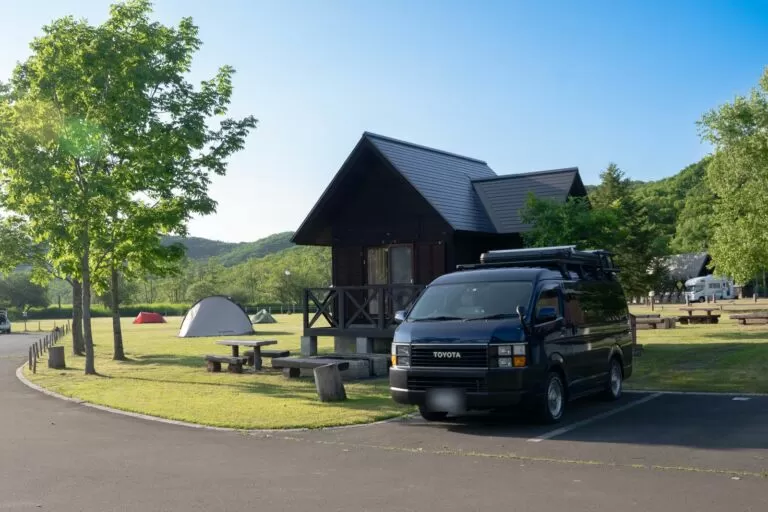
- Hyakunin Beach Auto Campground: 102-5 Shono, Erimo Town. According to Erimo Town’s official page, the season runs April 1 to March 31, with irregular closures from November onward (check before you go). All 19 auto sites have AC power (16 for standard cars, 3 for large vehicles). Rates are per site per night: small auto sites ¥2,500–3,500 from April to November and ¥1,500–2,000 from December to March (large sites ¥4,000–5,500, or ¥2,500–3,000 in December–March), plus a ¥200 entry fee per person (junior high school age and up). Check-in 1:00–7:00 PM; the gate is closed from 7:00 PM to 7:00 AM. The adjacent Tomabetsu Ikoi-no-Yu “Chap” bathhouse is open to campers (adults ¥400, closed Mondays). Bookings by phone (Erimo Town official page, last updated April 9, 2026; confirmed October 14, 2026). If you plan to stay from November onward, always confirm the campground is open that day.
- Samani Town campgrounds: Samani’s municipal Uenshiri Campground is set in the hills, sheltered from wind.
Hidaka Kelp, Whelk & Horsehair Crab: Local Seafood Guide
Hidaka kelp (Hidaka kombu) accounts for about 60% of national kelp distribution. It draws out dashi stock easily and is used in homes nationwide. In summer, kelp drying on beaches is a quintessential local scene. Roadside stations and local kelp shops sell kombu products at source prices — popular souvenirs.
Whelk (tsubugai / Ezo whelk) is common along these Pacific rocky shores. Soy-braised whelk and raw whelk sashimi appear at local izakayas and diners. Horsehair crab peaks in spring–early summer; live and boiled crab can be purchased at fish markets and roadside stations in Urakawa and Samani. Campervan travelers can cook crab in the onboard sink or eat at roadside station rest areas.
The Erimo Fishermen’s Cooperative direct sales shop sells kelp products and, seasonally, sea urchin and salmon. It typically opens early (around 8–9 AM) — stop in before departing in the morning.
Restaurants & Dining
Near Cape Erimo, a handful of diners and souvenir shops serve sea urchin rice bowls, seafood bowls, and kelp ramen. Arrive before 11 AM or after 1 PM to avoid the lunch rush. Shizunai and Urakawa town centers have conveyor-belt sushi, seafood izakayas, and set-meal restaurants for evening dining. Mixing fresh-market cooking in the van with meals at local restaurants is the quintessential Hidaka–Erimo campervan experience.
2-Night / 3-Day Route from New Chitose / Tomakomai
Below is a model 2-night / 3-day itinerary starting and ending at New Chitose Airport. With no expressway for much of the route, keeping daily mileage to 120–150 km makes for a relaxed trip. For summer booking tips see our Complete Summer Campervan Rental Guide for Hokkaido.
Day 1: New Chitose Airport → Shizunai (Shinhidaka Town)
- Pick up campervan at New Chitose Airport (morning)
- Head south on the Hidaka Expressway, exit at Hidaka-Tomikawa IC onto Route 235
- Pull over in the Thoroughbred Ginza area of Niikappu to view horses
- Drive through Shizunai’s Nijukkandoro Cherry Blossom Avenue (beautiful green tunnel outside cherry season too)
- Pick up kelp and souvenirs at Michi-no-Eki Mitsuishi
- Dinner at a diner in Shizunai
- Overnight near Michi-no-Eki Mitsuishi or at a campground (driving distance: approx. 120 km)
Day 2: Shizunai → Cape Erimo → Hyakunin Beach
- Morning: buy horsehair crab and whelk at Urakawa fishing harbor / market
- Drive the Yuushun Roman Road (Urakawa–Samani) enjoying ocean and pasture views
- Stop at Enrumu Cape in Samani (15–20 min)
- Arrive at Cape Erimo; tour Kaze no Yakata (wind tunnel experience is a highlight)
- Watch harbor seals through the telescope at Kaze no Yakata
- Lunch at a cape-area diner: sea urchin or seafood rice bowl
- Check in and overnight at Hyakunin Beach Auto Campground (driving distance: approx. 110 km)
Day 3: Hyakunin Beach → Erimo Fishermen’s Cooperative → New Chitose Airport
- Morning: purchase kelp and seafood at Erimo Fishermen’s Cooperative (often open from early morning)
- Head north on Route 235 and the Hidaka Expressway back toward New Chitose
- Stop at the “Le·Cord Kan” in Niikappu (world’s largest record library)
- Refuel and have lunch in Tomakomai
- Return campervan and proceed to New Chitose Airport (driving distance: approx. 200 km)
Total trip distance is approximately 430 km. Expressway sections are limited to the New Chitose–Hidaka-Tomikawa stretch on Days 1 and 3; the rest is on ordinary roads. Fuel up in Tomakomai, Shizunai, or Urakawa. There are gas stations in Erimo Town too, but the Samani–Erimo stretch has few stations — fill the tank in Urakawa or Samani before heading south.
New Chitose Airport / Tokachi-Obihiro Airport
Rent the Cab-Conversion “Cresson Journey”
Base yourself at New Chitose Airport and travel all across Hokkaido by campervan.
View details at Moving Inn →FAQ
Q: How long does it take from New Chitose Airport to Cape Erimo?
Pure driving time with no stops is approximately 3.5–4 hours. Add farm visits, meals, and sightseeing and it becomes a half-day to full-day journey. The expressway ends at Hidaka-Tomikawa IC; beyond that everything is on ordinary roads (Routes 235 and 336) with speed limits of 50–60 km/h in many sections.
Q: Can I sleep overnight in my campervan at Cape Erimo?
The official Erimo Town “Kaze no Yakata” (Wind Museum) page has no statement about overnight parking or nighttime parking in its lot — it’s neither explicitly allowed nor prohibited (confirmed September 21, 2026). Kaze no Yakata is closed December through February; when open, hours are 9:00 AM–6:00 PM (May–August) and 9:00 AM–5:00 PM (March, April, and September–November). If you’re planning to stay overnight, use Hyakunin Beach Auto Campground, about 9 km by car from the cape (season April 1 to March 31, with irregular closures from November onward, so check ahead; all 19 auto sites have power, and small sites start at ¥1,500 from December to March; Erimo Town official page, last updated April 9, 2026, confirmed October 14, 2026). This area is said to have 260+ “windy days” a year, so on nights with high winds, plan to relocate toward Samani or Hiroo.
Q: Can visitors tour thoroughbred farms in Hidaka?
Working thoroughbred farms are private property and generally not open to the public — enjoy the view from the road. For official farm experiences, visit Northern Horse Park in Tomakomai or Urakawa Yuushun Village AERU. Never cross fences or open gates — it is strictly prohibited for biosecurity and safety reasons.
Q: Is there a gas station near Cape Erimo?
Erimo Town has gas stations, but with limited hours. The Samani–Erimo stretch has very few stations. Always fill up in Urakawa or Samani before heading south. Note that campervans have lower fuel efficiency than regular cars (roughly 7–10 km/L), so plan fuel stops conservatively.
Q: What is the best season to visit Hidaka and Erimo?
June through September offers the most comfortable driving conditions. May has beautiful cherry blossoms along Nijukkandoro Avenue but can be cold. July–August brings the best seafood (sea urchin, horsehair crab, whelk), long daylight hours, and the fullest travel experience. September features kelp harvest scenes and fewer crowds. From October onward, storm risk increases and some roadside stations and campgrounds close — confirm ahead of time.
Q: How strong is the wind at Cape Erimo? Will it surprise me?
Even in summer, wind speeds of 10–15 m/s are common throughout the year. In the Kaze no Yakata wind experience at 25 m/s, staying upright becomes genuinely difficult. Visitors describe it as “standing at the edge of a typhoon.” Your hat will fly off on the walking trails. Cameras and glasses become hard to manage. Prepare accordingly before heading to the tip. That said, the experience of watching the Pacific Ocean panorama unfold under that relentless wind is something you can only find at Cape Erimo in Hokkaido.
Book a Campervan in Hokkaido
Moving Inn New Chitose Airport supports English booking and offers airport transfers.

![Campgrounds Near Tokachi-Obihiro Airport: 8 Sites Within 30 km, Compared by Vehicle Access, Power and Price [2026]](https://hokkaido-campingcar.jp/wp-content/uploads/2026/10/photo-obihiro-airport-featured-pl232-768x512.jpg.webp)
![Campgrounds Near Hakodate Airport: 12 Sites Within 30 km, Compared by Vehicle Access, Power and Price [2026]](https://hokkaido-campingcar.jp/wp-content/uploads/2026/10/photo-hakodate-airport-featured-hl4722-768x484.jpg.webp)