Campervans for Three-Generation Family Trips | A Hokkaido Travel Guide Grandparents Can Feel Safe With [2026 Edition]
As of August 25, 2026, we checked the official websites of 5 major Hokkaido campervan rental companies and found none listed specific accessibility features.
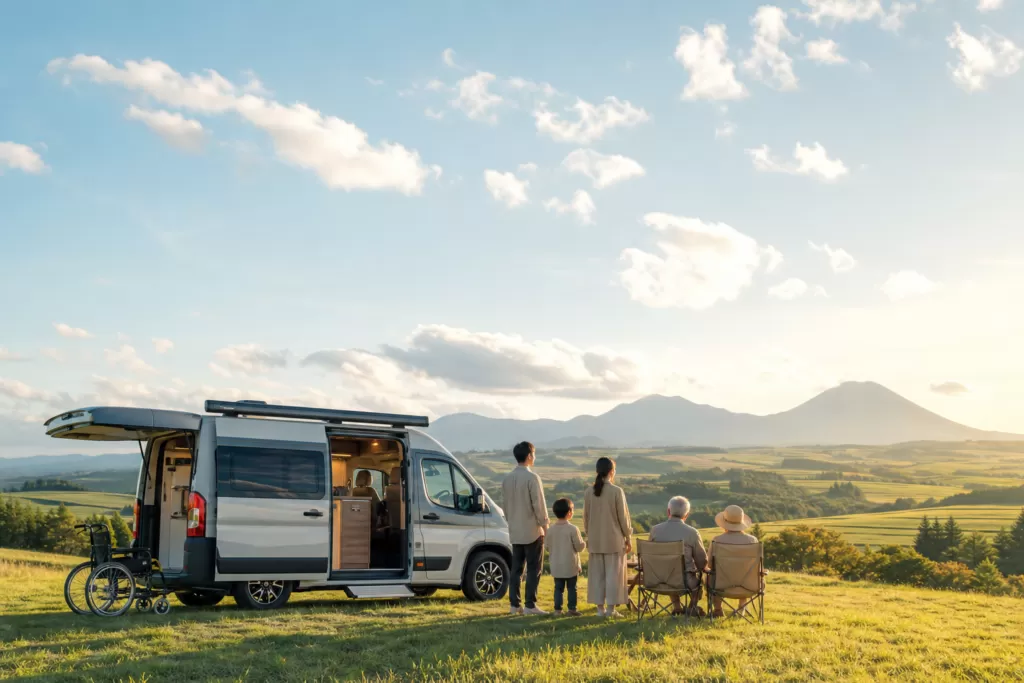
When grandparents, parents, and children travel together across three generations in Hokkaido, neither vehicle choice nor itinerary can be built around “whichever generation has the most stamina” or “whichever generation needs the most consideration.” You need to satisfy three conditions at once: how easily grandparents can get in and out, how easily children get bored, and how much driving burden falls on the parents’ generation. As of August 25, 2026, we checked the official websites of five major Hokkaido rental companies (99 Rent-A-Car Hokkaido, Fuji Cars Japan, Moving Inn, Shiro Journey, and Hokkaido Nomad Rental Car) and found not a single one that specifically described accessibility features such as step height or handrails at the entrance. You can get a general sense of vehicle types, but the actual step height and presence of handrails vary by company and vehicle, so the first thing to keep in mind is that you need to confirm these details directly with each company’s official site.
This article organizes a Hokkaido campervan trip that grandparents can join with peace of mind, looking at five angles: vehicle type, group size, itinerary, bathing, and lodging. We’ve already covered the perspective of a two-person senior trip in A Hokkaido Campervan Trip for Seniors, and the perspective of traveling with young children in How to Enjoy a Family Campervan Trip with Kids in Hokkaido, but neither covers this article’s core topic: how to absorb the “gap in pace between generations” that arises when grandparents, parents, and children travel together at the same time.
New Chitose Airport / Tokachi-Obihiro Airport
Rent the Cabcon “Cresson Journey”
Base yourself at New Chitose Airport and compare rates, vehicle types, and pickup locations all in one place.
See details at Moving Inn →Why a campervan suits three-generation trips
With a hotel or ryokan trip, you’re often stuck with two options: split rooms by generation, or pack everyone into one room. Grandparents and grandchildren sharing a room means mismatched bedtimes that make both sides feel they have to be considerate of the other, while splitting rooms drives up the cost of the stay. In a campervan, actions like “grandparents turn in early,” “the kids play outside a bit longer,” and “the parents tidy up” can all proceed in parallel, in and around the same vehicle, each generation keeping its own pace. Because you aren’t locked into a hotel’s check-in time, you can also flex departure and arrival times to match grandparents’ condition or the children’s mood — another reason a campervan and a three-generation trip pair well.
Worry #1: Can grandparents get in and out safely?
The first concern on a three-generation trip is usually whether the grandparents’ generation can get in and out of the vehicle smoothly. As a general tendency, “vancons” built on a passenger-vehicle-like base such as the HiAce tend to sit at a height closer to a regular car and are easier to step into, while “cabcons,” which mount a living space onto a truck chassis, tend to sit higher and have a bigger step up. That said, this is only a general tendency — among the five companies we checked, none had official-site information on the actual step height or presence of handrails for specific vehicles. The structural differences between vancons and cabcons are covered in detail in Cabcon vs. Vancon: Differences and How to Choose. If grandparents are joining, don’t decide on a vehicle from general tendencies alone — when booking, ask each company individually by phone or email whether there’s an assist step, where the handrails are, and how high the entry point sits.
Worry #2: Is there a vehicle that fits and sleeps a full three-generation group?
A common group size on three-generation trips is 5–6 people — two grandparents, two parents, and one or two children — and depending on the vehicle, the number of seats and the number of sleeping berths don’t always match. As of August 25, 2026, we confirmed that the “Robinson 771” (HiAce-based) from New Chitose Campervan Rental Center seats 7 and sleeps 7 (japan-crc.com/shinchitose, confirmed 2026-08-25), the “HAYATE” from Tabisuru Kuruma New Chitose Airport Base seats 7 and sleeps 6 (travel-camper.jp, confirmed 2026-08-25), and the “Cordo Banks” (a cabcon) from Hokkaido Nomad Rental Car seats 7 and sleeps 5 (nomad-r.jp, confirmed 2026-08-25). If a 5–6 person three-generation group wants everyone to sleep together in the vehicle, it’s worth confirming individually whether the sleeping capacity meets or exceeds your group size. A cross-company comparison of seating and sleeping capacity is also available in A Hokkaido Campervan Guide for Groups of 4–6, which can help when narrowing down vehicle choices.
Worry #3: Should the pace match the grandparents or the children?
For a two-person senior trip, a driving distance of up to 200km a day with a break every two hours is considered a reasonable benchmark (see A Hokkaido Campervan Trip for Seniors). On a three-generation trip, you also need to factor in how long children’s attention spans hold up. Children tend to get bored on long stretches in the car, and grandparents tend to get tired from staying in the same position or from the vehicle’s vibration over long periods. Rather than adjusting toward fewer breaks for either generation, keep the grandparents’ break pace as the baseline, and build in roadside stations or parks along the way where children can move around at each stop — this reduces the burden on both generations at once. Keeping daily driving to around 150km and limiting sightseeing to one or two spots a day is a realistic “itinerary with breathing room” for a three-generation trip.
Worry #4: Where do you put canes, mobility aids, and strollers for three generations of luggage?
Three-generation trips tend to bring a wider variety of luggage. The grandparents’ generation tends to carry canes, regular medication, and extra changes of clothes, while the children’s generation adds a stroller, diapers, changes of clothes, and toys. Choosing a vehicle with sleeping capacity right at your group size can leave little storage space once the sleeping area is set up, so it’s worth choosing a vehicle with one or two more sleeping berths than your group size, or considering a cabcon-type vehicle with larger storage capacity. If you have items you want to secure inside the vehicle, such as a cane or stroller, check the vehicle’s floor plan for the location and size of storage space before booking.
Worry #5: Who should do the driving?
On three-generation trips, it’s usually the parents’ generation that actually does the driving. Even if grandparents hold a driver’s license, if they’re uneasy about the feel of driving a larger vehicle, or have physical concerns about long-distance driving, it’s also an option to have them focus on riding along rather than putting them on the driving rotation. Guidelines on driving suitability by age, and how to think about it if someone has a pre-existing condition, are covered in Hokkaido Campervan Rental for Seniors and Older Adults. If one person from the parents’ generation is doing all the long-distance driving alone, frequent breaks and securing a backup driver are key to reducing the burden. Because some vehicles can’t be driven on a standard license depending on gross vehicle weight, it’s worth confirming the license class needed for the driving generation before booking.
Worry #6: Should bathing be split by generation?
Hot springs are one of the pleasures of a three-generation trip, but bathing pace differs greatly by generation. Infants can’t stay in the bath long, while grandparents often want to soak slowly to avoid overheating. If everyone tries to enter a large communal bath at once, one generation or the other tends to end up waiting, so it’s better to choose a facility with a family bath or private bath, or to plan the itinerary around bathing in shifts at different times. Day-use bathing facilities in Hokkaido are listed in A Hot Spring Guide for Hokkaido Campervan Trips; we’d recommend confirming whether each facility has a family bath before building it into your itinerary.
Worry #7: Should you stay at a campsite or an RV park?
For lodging, RV parks — where you can use electricity and where the route to the toilet and cooking area is short — tend to be more convenient for the grandparents’ generation on a three-generation trip. Campsites, on the other hand, tend to have larger plots, making it easier to secure space for children to play outside. Many facilities of either type don’t clearly state whether there are steps or ramps, so if grandparents using a wheelchair or cane are joining, you’ll need to check directly with the facility when booking whether the route to the toilet and cooking area has any steps. A list and facilities of Hokkaido’s RV parks can be found in A List of Hokkaido RV Parks.
Practical points for choosing a vehicle
For a three-generation trip, it’s realistic to check ease of entry/exit, sleeping capacity, and storage space in that order of priority. If you’re worried about grandparents getting in and out, start by considering a vancon-type vehicle, then confirm the actual step height and presence of handrails with each company individually. If your group is 5–6 people, always confirm not just seating capacity but whether sleeping capacity meets or exceeds your group size. Vehicles with more sleeping-capacity margin also tend to have more storage space available. Characteristics by vehicle type are covered across all seven types in Comparing Campervan Types: Features and How to Choose Among 7 Types.
| Point to check | Grandparents’ perspective | Children’s perspective |
|---|---|---|
| Getting in/out | Confirm step height and handrails individually | Not usually a major issue |
| Sleeping capacity | Prioritize a margin above your group size | Whether everyone can sleep side by side |
| Daily driving distance | Guideline: within 200km, a break every 2 hours | Frequent breaks before boredom sets in |
| Bathing | Whether a family bath or private bath is available | Plan around not being able to soak for long |
| Lodging | An RV park with a short route to toilet/cooking area | A campsite with enough space to play outside |
A sample three-generation itinerary (3 nights, 4 days, touring Dō-ō hot springs)
For a three-generation trip, a shorter loop that keeps the burden low for both older and younger generations is more realistic than the family itinerary in our article on traveling with children, or the longer senior itinerary in our article for two-person senior trips. Here’s one example: a 3-night, 4-day trip starting and ending at New Chitose Airport, keeping daily driving to around 150km.
- Day 1: Pick up the vehicle at New Chitose Airport → Lake Shikotsu (a lakeside walk; grandparents rest while children play by the water) → Overnight at an RV park
- Day 2: Lake Shikotsu → Noboribetsu Onsen (a light walk through Jigokudani, then use a family bath at a day-use hot spring) → Overnight at an RV park near Noboribetsu
- Day 3: Noboribetsu → Lake Toya (a relaxed loop around the lakeshore, with extra breaks) → Overnight at Lake Toya
- Day 4: Lake Toya → Return the vehicle at New Chitose Airport
Lake Shikotsu, Noboribetsu, and Lake Toya are all roughly 100km from New Chitose Airport one way, making it an area where you can keep the distance for each leg short while combining both hot springs and nature. If you can extend your trip, staying multiple nights at one base and doing day trips around it further reduces the burden on the grandparents’ generation.
A checklist to confirm before booking
Before booking a campervan for a three-generation trip, confirming the following items within the family can reduce surprises on the day.
- Step height at the entrance, and whether there’s an assist step or handrails (confirm individually with each company)
- Whether sleeping capacity exceeds your group size (seating capacity and sleeping capacity are different things)
- Storage space for items you want to secure, such as canes or a stroller
- The license class needed for whoever is driving, and whether there’s a backup driver
- Whether the itinerary keeps daily driving to 150–200km or less
- Whether bathing facilities have a family bath or private bath
- Whether the route to the toilet and cooking area at your lodging has any steps
New Chitose Airport / Tokachi-Obihiro Airport
Rent the Cabcon “Cresson Journey”
Base yourself at New Chitose Airport and compare rates, vehicle types, and pickup locations all in one place.
See details at Moving Inn →Summary: build a three-generation trip around whichever generation needs the most consideration
As of August 25, 2026, we couldn’t find a single Hokkaido rental company that listed accessibility equipment on its official site. As a general tendency, vancons are said to be easier to get in and out of, but the actual step height and presence of handrails can only be confirmed vehicle by vehicle. On a three-generation trip, it’s realistic to build driving distance, bathing time, and break frequency all around whichever generation needs the most consideration, then compensate for children’s boredom with stops along the way. The perspective for a grandparents-only trip is covered in detail in A Hokkaido Campervan Trip for Seniors, and the perspective for traveling with young children in How to Enjoy a Family Campervan Trip with Kids in Hokkaido.
Frequently asked questions
If grandparents are joining, what should we prioritize in a vehicle?
If ease of getting in and out is your top priority, a vancon-type vehicle generally sits lower and feels closer to a regular car. That said, none of the five companies we checked clearly stated step height or the presence of handrails on their official sites, so once you’ve narrowed down a vehicle, it’s worth contacting the company individually before booking to confirm.
For a group of 5–6 (two grandparents, two parents, one or two children), what vehicles should we consider?
As of August 25, 2026, there are vehicles that let a group of 5–6 sleep together in the vehicle, such as the “Robinson 771,” which seats 7 and sleeps 7 (japan-crc.com/shinchitose). If sleeping capacity is right at your group size, storage space tends to run short, so choosing a vehicle with one or two more sleeping berths than your group also gives you more room for storage.
Should the itinerary match the grandparents’ pace or the children’s pace?
Set your break frequency to the grandparents’ generation’s benchmark (roughly once every two hours), and build in a spot where children can move around at each break — this creates an itinerary that’s manageable for both generations. Keeping daily driving to around 150km also tends to give both generations more breathing room.
If we want all three generations to bathe together at a hot spring, how should we plan the itinerary?
Since infants can’t stay in the bath long and grandparents often want to soak slowly, it’s better to choose a facility with a family bath or private bath, or to plan the itinerary around bathing in shifts by generation. Whether a family bath is available varies by facility, so it’s worth confirming individually before booking.
If we bring a cane or stroller in the vehicle, will there be enough storage space?
A vehicle with sleeping capacity right at your group size tends to run short on storage space. If you have items you want to secure inside the vehicle, such as a cane or stroller, check the floor plan for the location and size of storage space before booking, and choose a vehicle with more sleeping-capacity margin if needed.
Should grandparents also take a turn driving?
Even with a valid license, if there’s uneasiness about the feel of driving a larger vehicle, or physical concerns about long-distance driving, it’s also an option to have grandparents focus on riding along rather than putting them on the driving rotation. If one person from the parents’ generation is driving alone, frequent breaks and securing a backup driver are key to reducing the burden.
Which suits a three-generation trip better, a campsite or an RV park?
RV parks, where you can use electricity and the route to the toilet and cooking area is short, tend to be more convenient for the grandparents’ generation. If you’d rather prioritize space for children to play outside, a campsite is also a candidate. Many facilities of either type don’t clearly state whether there are steps or ramps, so if grandparents using a wheelchair or cane are joining, it’s worth confirming individually when booking.
Book a Campervan in Hokkaido
Moving Inn New Chitose Airport supports English booking and offers airport transfers.

![Hokkaido Tourism Statistics: 46.13 Million Visitors a Year, Foreign Visitors by Country, Peak Months and Travel Purposes [FY2025]](https://hokkaido-campingcar.jp/wp-content/uploads/2026/10/hokkaido-tourism-statistics-2025-eyecatch-768x432.webp)
![What to Do in Tokachi in Winter: Dog Sledding, Snowshoeing, the Shikaribetsu Ice Village, and Staying at Kitanomori [2027]](https://hokkaido-campingcar.jp/wp-content/uploads/2026/10/tokachi-winter-dogsled-1-768x432.jpg.webp)
![Where to See Snow for the First Time in Hokkaido: Snow Play Spots and When Snow Is Guaranteed [2026-27]](https://hokkaido-campingcar.jp/wp-content/uploads/2026/10/hokkaido-snow-play-first-snow-eyecatch-768x432.webp)
![10 Days in Hokkaido in Winter: Campervan Itinerary from New Chitose Airport, January Skiing and Hot Springs, February Snow Festival and Drift Ice [2027]](https://hokkaido-campingcar.jp/wp-content/uploads/2026/10/winter10days-eyecatch-a-0-mi-js1v1qqiiz0aaaaaaaclwq-768x432.jpg.webp)