Hokkaido Campervan Summer Travel Guide | July-August Top Spots, Costs & Crowd Tips [2026 Edition]
Complete guide to Hokkaido campervan rental in summer (July-August). Best time for lavender, fireworks festivals, and beaches; summer cost guide; peak-season crowd management.
Pick a campervan by what matters to you.
Rent at New Chitose Airport
See only the rental bases in Chitose, where the airport is.
Rent in winter (Dec–Mar)
Companies that rent through winter, listed apart from those that close.
Guide price
Moving Inn New Chitose Airport: HIACE van conversion from ¥22,000 per night. 20–30% off when booked 60–90 days ahead (official rate table, checked 15 Oct 2026).
Before you book: with an International Driving Permit if your country is in the Geneva Convention (for example the US, Australia, Singapore); Taiwan, Switzerland, Germany, France, Belgium and Monaco need your licence plus a Japanese translation (Tokyo Metropolitan Police). Questions in English: Moving Inn on WhatsApp. Every roadside station (michi-no-eki) must have free 24-hour toilets, and Hokkaido has 128 of them (MLIT).
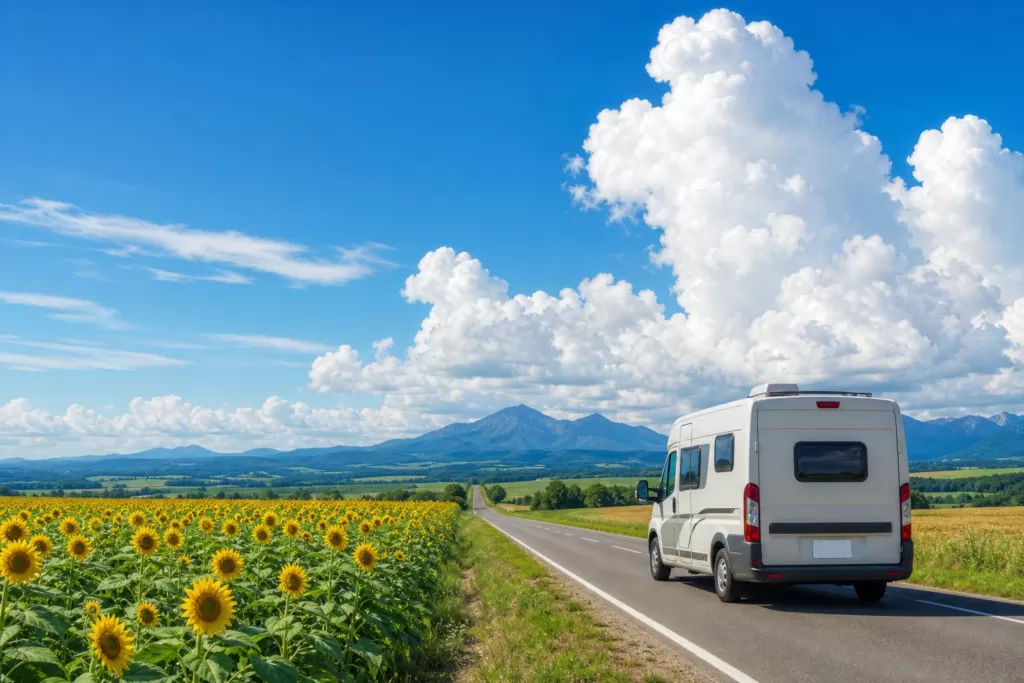
Compare Hokkaido Campervan Rentals
Base yourself at New Chitose Airport and compare rates, vehicle types, and pickup locations all in one place.
Compare Rental Companies & Prices →Tap a dot on the map to see its name here.
Tap a dot to see its name and a link to where it appears in this article. 2 places whose location could not be confirmed are not shown. Dot positions are based on each facility’s address or officially published location. Lakes and expressways are from OpenStreetMap data.
Why Choose a Campervan for Your Summer Hokkaido Trip — and What It Costs
July and August in Hokkaido pack in lavender fields, fireworks festivals, swimming beaches, and mountain hiking all at once. If you want to cover the island efficiently, a campervan trip that removes the need to book hotels is especially well-suited. Because travel and accommodation are combined, you can catch the early-morning lavender in Furano and evening fireworks without paying extra for lodging.
Estimated costs (as of June 2026): in high season, a van conversion (bankon, 4–5 berths) runs approximately ¥30,000–¥40,000 per night, while a cab-over conversion (cabcon, 5–6 berths) is roughly ¥40,000–¥50,000 per night. Adding fuel, campsite fees (approximately ¥2,000–¥5,000 per night), and food, a 5-night 6-day trip for 2–3 adults comes to around ¥200,000–¥300,000 in total. July–August prices tend to run 20–30% higher than off-season at many rental companies, so booking early directly reduces cost.
For the full picture — cost simulations, model routes, and Michi-no-Eki overnight parking rules — see our Complete Guide to Hokkaido Campervan Travel.
Note that summer in Hokkaido is considerably cooler than Honshu, and temperatures at higher elevations and inland areas can drop below 15°C at night. Bring warm layers for sleeping just in case.
July: A Route Through Central and Northern Hokkaido Centered on Lavender and Fireworks
July is when lavender peaks (typically mid-to-late July) and northern Hokkaido's abundant nature overlap — it's the time of year that most captures Hokkaido's character.
Furano & Biei Area (Lavender)
Farm Tomita in Furano is at its most spectacular in July, with poppies and sunflowers blooming alongside the lavender at the same time. It opens from around 6 a.m., making it ideal to overnight in a campervan nearby and visit first thing in the morning. The adjacent Hokuseizan Lavender Garden lets you ride a lift to the top of a hill, making it popular with families. Pairing the visit with Biei's Blue Pond and Shirogane Onsen makes for a full itinerary.
The campsite "Hoshi ni Todoku Oka" (Stars Within Reach Hill Campsite) near Furano (in Nakafurano) is popular for its views from the hilltop, but fills up quickly in summer. For July, it's realistic to make reservations at least 2–3 weeks in advance.
Northern Hokkaido — Wakkanai, Rishiri, Rebun
July is the most weather-stable month for Wakkanai, Rishiri Island, and Rebun Island. Because island access requires a ferry, the typical approach is to base the campervan at a roadside station near Cape Soya and explore the islands on foot or by rental bicycle. The White Road on the Soya Hills sees a lot of fog even in July–August, so acting early in the morning to catch clear weather is key.
Major July Fireworks and Events
- Hokkai Heso Festival, Furano (every year on July 28–29): an unusual festival held in the town center.
- Kitami Citizens' Fireworks Festival (usually late July–early August): a good stop when passing through eastern Hokkaido.
- Lake Toya Long-Run Fireworks (nightly 8:45 p.m., April–October): a reliable choice regardless of timing.
Fireworks festival schedules can change year to year — check the latest information on each municipality's official tourism website.
August: A Leisurely Route Through Eastern Hokkaido, the Okhotsk Coast, and Southern Hokkaido
August is peak tourist season across all of Hokkaido. Eastern Hokkaido (Shiretoko, Kushiro, Obihiro) and the Okhotsk coast are comfortable even in summer at around 25°C, well-suited to long-distance campervan travel.
Shiretoko, Lake Mashu, Lake Akan Area
Even in August, brown bears are occasionally spotted early in the morning in Shiretoko. For campervan overnight stays, the campsite in the Utoro district — slightly away from the Shiretoko Five Lakes area — is a safer option. "Shiretoko National Campground" (Kokusetsu Shiretoko Yaeijo) has the public hot spring "Yuhidai no Yu" right next to it, making it suitable for multi-night stays (it is a traditional campground, not an auto campground). Lake Mashu, Sulphur Mountain, and Lake Akan are within a day's drive of each other, forming the core of an eastern Hokkaido route.
Okhotsk Coastline (Abashiri, Mombetsu)
Along the Okhotsk coast, seafood (scallops, hairy crab) can be found at low prices. Abashiri offers the Salmon Science Museum and Abashiri Prison museum, both popular with families. The Gariya Cape in Mombetsu has beautiful sunsets; the roadside station "Okhotsk Mombetsu" is often used as an overnight spot (confirm overnight parking policy in advance).
Southern Hokkaido — Hakodate and Lake Onuma Area
Hakodate concentrates its tourist appeal in its night view, morning market, and Goryokaku fort. Lake Onuma Quasi-National Park has multiple campsites where you can enjoy views of Mt. Komagatake. August's freshly-picked sweet corn and Yubari melon are easy and cost-effective picks up at roadside stations.
Major August Events
- Kushiro Port Festival (Kushiro; three days from the first Friday of August each year)
- Banei Tokachi at Obihiro Racecourse: races are held mainly on Saturdays, Sundays and Mondays, including in summer.
Check the event organizer's official website for the latest schedules.
Managing Peak-Season Crowds: Accommodation, Travel, and Booking Tips
Campsites in July–August fill up on weekends, and popular spots around Furano, Biei, Shiretoko, and Lake Toya can be fully booked more than a month in advance.
Campsite Booking Strategy
Building weekdays into the core of your itinerary gives you advantages in both availability and price. A route design that uses weekends for driving and weekdays for high-density tourist spots works particularly well. Also, campsites that accept bookings through multiple channels — "Nap" booking platform, individual roadside station phone reservations, etc. — often have slots that show up on one channel but not another. Timing for the campervan rental itself, along with a detailed 7-night 8-day itinerary, is covered later in this article under “Summer Rental Booking Timing and the 7-Night 8-Day Model Route.”
Using Roadside Stations (Michi-no-Eki) and Service Areas for Overnight Stops
Hokkaido has one of the highest concentrations of roadside stations in Japan, and they can serve as overnight staging points (though you must confirm that each facility permits overnight stays). Most have clean restrooms and ample parking, which also makes early-morning departures easier. Popular stations like "Shikabe Intermittent Spring Park," "Utoro Shirietoku," and "Mashu Onsen" get crowded in summer.
Tips for Avoiding Traffic and Crowds
The Furano–Biei area sees heavy weekend congestion especially in early August. Parking lots at major tourist sites (Farm Tomita, Blue Pond, etc.) often fill up by 9–10 a.m., so arriving between 6–7 a.m. is effective. Being able to overnight nearby in a campervan and act early in the morning is a significant advantage.
Summer Rental Booking Timing and the 7-Night 8-Day Model Route
Booking the campervan itself is a separate task from reserving campsites, and it needs to happen early. Here's the booking timeline for the vehicle, plus a detailed model route built around a 7-night, 8-day trip.
Book 3–4 Months Ahead; 6 Months for Obon
The standard lead time for summer rentals is 3–4 months. For August, that means moving in April–early May; for late July, in March–April. Obon (around August 10–16) is fiercely competitive, and securing your preferred vehicle and dates realistically requires 3–6 months' notice. If you're targeting summer 2026, booking by January or February is ideal. The process goes: (1) choose your departure airport and pickup location (most options are near New Chitose) → (2) decide on vehicle and duration for a quote → (3) pay the deposit → (4) confirm pickup time and insurance details one week before departure.
Three Common Booking Mistakes
"Booked the flight first and the campervan was fully booked" is the classic error. Always secure the vehicle before the airline ticket. "Planned a long drive on pickup day" is another headache — the handover briefing alone takes an hour, so keep Day 1 driving under 100 km. "Didn't read the cancellation policy" is also costly: many operators charge 30–50% from one month out.
What to Check at Pickup
Make sure to receive a full walkthrough from staff at pickup. Sub-battery charging, external power hookup, water tank operation, refrigerator and stove use — these are all features a regular car doesn't have. Ask every question on the spot rather than figuring things out mid-trip. Also confirm your insurance coverage: personal injury and property liability limits, vehicle damage excess, and the conditions under which a "Non-Operation Charge" (NOC) applies.
7 Nights 8 Days | Grand Route: Central → North → East
Departing and returning to New Chitose Airport via central, northern, and eastern Hokkaido — approximately 1,300–1,400 km total. Keeping daily distances to 150–200 km means even families with children won't feel rushed.
| Day | Itinerary | Distance |
|---|---|---|
| Day 1 | Pick up at New Chitose → Lake Shikotsu → Chitose overnight | ~60 km |
| Day 2 | Chitose → Biei (Blue Pond, Patchwork Road) → Furano overnight | ~160 km |
| Day 3 | Furano (Farm Tomita) → Asahikawa → Sounkyo overnight | ~110 km |
| Day 4 | Sounkyo → Sekihoku Pass → Abashiri overnight | ~180 km |
| Day 5 | Abashiri → Shiretoko (Five Lakes, Utoro) overnight | ~90 km |
| Day 6 | Shiretoko → Lake Mashu, Lake Kussharo → Lake Akan overnight | ~150 km |
| Day 7 | Lake Akan → Ashoro → Obihiro (Tokachi gourmet) overnight | ~120 km |
| Day 8 | Obihiro → Hidaka → Return to New Chitose | ~200 km |
4 Nights 5 Days | Eastern Hokkaido Focus
Starting from Kushiro Airport, this eastern-focused route covers roughly 600–700 km and suits nervous drivers or first-time campervan travelers. Day 1: Kushiro Marsh–Lake Akan. Day 2: Lake Mashu–Kawayu Onsen (Mt. Io). Day 3: Shiretoko Pass–Utoro. Day 4: Rausu–Notsuke Peninsula. Day 5: Nemuro–Cape Nosappu–return to Kushiro. Perfect for anyone wanting to explore Shiretoko and Nemuro — the far eastern tip of Hokkaido — in depth.
2 Nights 3 Days | Sapporo-Area Short Trip
For first-time Hokkaido visitors or those with limited time off — about 350 km total. Day 1: New Chitose → Lake Shikotsu (canoe) → Lake Toya. Day 2: Niseko → Shakotan Peninsula (Yoichi Whisky Distillery). Day 3: Otaru → return to New Chitose. A well-balanced mix of food, shopping, and sightseeing that's also a great introduction to campervan travel.
Summer Trip Gear & Packing List
Hokkaido summers have large swings between daytime and nighttime temperatures — in northern and eastern Hokkaido particularly, nights can drop to 10–15°C. Your gear choices directly affect travel comfort.
Temperature Management and Bedding
- Bringing one summer sleeping bag and one 3-season bag lets you adapt to temperature swings
- A light fleece or down jacket (for evenings and early mornings)
- Mesh window covers for ventilation (also keeps insects out)
Insect Protection
- Insect repellent (DEET or icaridin-based) is essential
- Northern Hokkaido and wetland areas in July have especially heavy mosquito and midge activity
- Prepare 1–2 sets of lightweight long-sleeve and long-trouser clothing
Power and Charging
- Running a refrigerator and fan in summer drains the sub-battery faster
- Including an external power hookup site (electric campsite) at least once a week gives peace of mind
- A portable power station (200–400 Wh) extends the number of days you can go without a hookup
Sun Protection
- Hokkaido's clear air means UV levels are often high
- Sunscreen (SPF 50), sunglasses, and a hat will be used every day of the trip
- Extra care is needed in open locations like flower fields and lakesides
Campsite Booking Tips: How to Secure a Spot in Summer Hokkaido
Here are specific strategies for securing a site at popular campsites during the summer season.
Know When Bookings Open
Prefectural and national park campsites often have a fixed booking start date (e.g., all dates for the year open on March 1) and fill up immediately. Check the booking start date on the campsite's official website or by phone in advance, and you can lock in a spot as soon as they open.
Have Backup Campsites Listed
List 2–3 alternatives in the same area in advance in case your first choice is full. The Furano–Biei area in particular has numerous town-managed and privately-operated campsites, so alternatives are relatively easy to find.
Take Advantage of Free Sites and Multi-Night Discounts
Some campsites offer free-access (first-come, first-served) areas alongside reserved plots, usable without advance booking. Many facilities also offer multi-night discounts (e.g., 10% off for 3+ nights), and basing yourself at one site while doing day trips is a cost-effective approach.
Use RV Parks
RV parks (paid parking facilities dedicated to campervans) are less likely to be fully booked than regular campsites, and most have hot springs, power hookups, and restrooms. You can find a list of RV parks in Hokkaido on the Japan RV Association's official website (as of June 2026).
Setup and Campsite Etiquette for a Comfortable Summer Stay
Summer Hokkaido campsites are busy, and adjacent pitches can be close together. Attention to both personal comfort and etiquette raises the quality of everyone's experience.
Choosing Your Pitch
On free-choice sites, walk the whole area once right after check-in to check sun exposure, slope, drainage direction, and distance from neighbors before choosing your pitch — this prevents regrets later. In summer's strong sun, a shaded pitch helps keep the vehicle interior cooler. However, the risk of falling leaves and branches from directly under large trees means it's best to avoid parking directly beneath them.
Rubbish Sorting and Disposal
Many Hokkaido campsites have waste stations, but some require purchasing designated rubbish bags or only accept burnable waste. Check the site's rubbish rules in advance and bring the appropriate bags. Good habits that add up over the trip: dispose of food packaging in the supermarket's bins when you buy it, and minimize food waste to avoid leaving scraps.
Lights-Out and Noise Rules
Most campsites have a quiet hours rule around 10–11 p.m. Long summer days mean it can still feel light at 10 p.m., but other campers may already be asleep. Finish conversation, music, and generator use before lights-out — and observe generator operating hours (many sites limit it to before 8 or 9 p.m.) to keep the campsite pleasant for everyone.
Campfire Rules and Firewood
Campfires are permitted at many Hokkaido campsites, but direct ground fires are increasingly prohibited (fire grates required). Firewood is usually sold on-site (approximately ¥500–¥800 per bundle), making on-site purchase the simplest option. Supermarkets and roadside stations sometimes sell firewood more cheaply. Note that burning brought-in wood (felled timber, driftwood) is prohibited at most sites — do not burn anything without checking.
Road Conditions You Should Know for Summer Hokkaido Driving
Understanding Hokkaido's summer-specific road conditions makes for a smoother trip. Road surfaces, wildlife, and driving etiquette differ from Honshu in several ways.
Watch Out for Ezo Deer Collisions
Ezo deer (Hokkaido sika deer) darting onto roads cause frequent accidents in summer. They are most active from dusk onward, so reducing speed after sunset is very important. On farm roads, forest tracks, and mountain passes, deer can appear suddenly from the undergrowth — take extra care on blind corners. If you do collide with a deer, contact the rental company and your insurer, and file a report with the police.
Gaps Between Roadside Stations, Convenience Stores, and Gas Stations
In northern and eastern Hokkaido, stretches of 50–80 km or more can pass without a convenience store or gas station. The Nakashibetsu–Nemuro and Wakkanai–Sarobetsu Prairie sections in particular have few refueling points — make it a habit to fill up at the previous station before starting the next leg. Checking "gas stations along the route" in your map app in advance provides reassurance.
Dealing with Fog and Sudden Weather Changes
The eastern Hokkaido coast (Nemuro, Kushiro direction) and northern Hokkaido's coastline are prone to dense fog even in summer, sometimes reducing visibility to under 50 meters. In fog, switch on your fog lights and reduce speed significantly. The Shiretoko and Lake Mashu areas frequently see morning fog that clears in the afternoon — build schedule slack so you don't have to rush.
Campervan Height Restrictions
Cab-over conversions and high-roof van conversions have overall heights of around 2.5–3 meters. Some multi-story car parks, low bridges, and covered parking areas at tourist sites prohibit entry. Tourist spots usually have large-vehicle or height-unrestricted parking nearby, so looking this up before you arrive prevents unnecessary detours. Ferry check-in also requires declaring the vehicle's full height in advance — confirm exact dimensions with the rental company at pick-up.
Frequently Asked Questions (FAQ)
Q: Is air conditioning necessary in a campervan in Hokkaido in summer?
A: In inland areas of central and southern Hokkaido (Furano, Obihiro, etc.) temperatures can exceed 30°C in July–August. The vehicle interior heats up quickly when closed, so AC while driving is essential. At night, temperatures usually drop enough that a fan plus mesh ventilation handles most evenings — but during extended hot spells, maximizing sub-battery-powered fan use while sleeping is the practical approach. Before renting, ask the company whether running the AC overnight is possible in the specific vehicle.
Q: When should I start moving on summer holiday reservations?
A: The Obon period (around August 10–16) and late July–early August weekends are especially busy. Campervan rentals at popular companies begin filling up 3–4 months in advance, so locking in your first-choice dates by May is advisable. Campsite reservations follow the same logic — moving on popular sites in April or May is realistic.
Q: How much does renting a campervan in Hokkaido in summer cost?
A: As of June 2026, a van conversion (4–5 berths) runs approximately ¥30,000–¥40,000 per night; a cab-over conversion (5–6 berths) is roughly ¥40,000–¥50,000 per night. High-season (July–August) rates are typically 20–30% higher than off-season at many companies. Adding fuel, campsite fees, and food, a 5-night 6-day trip for 2–3 people comes to approximately ¥250,000–¥350,000, though this varies significantly by group size, vehicle type, and itinerary.
Q: Which is easier to travel — July or August?
A: If seeing lavender at peak bloom (mid-to-late July) is the goal, July is the only option. In August the lavender ends but sunflowers and cosmos come into season, and you catch the edge of the autumn harvest festival schedule. Crowd levels are generally higher in August (Obon), with late July–early August weekends close behind. Weather stability in eastern and northern Hokkaido tends to be slightly better in July, though it varies year to year.
Q: Is a summer Hokkaido campervan trip hard with children?
A: Having your accommodation fixed in the vehicle means children can rest whenever they tire — often easier than hotel travel. Choosing a vehicle with an onboard toilet reduces nighttime trips and handles small children better. That said, you should plan for summer insects, significant temperature swings, and children getting bored on long drives. Keeping daily driving to 200–250 km or under makes the trip manageable for families.
Compare Hokkaido Campervan Rentals
Base yourself at New Chitose Airport and compare rates, vehicle types, and pickup locations all in one place.
Compare Rental Companies & Prices →Book a Campervan in Hokkaido
Moving Inn New Chitose Airport supports English booking and offers airport transfers.
Pick a campervan by what matters to you.
Rent at New Chitose Airport
See only the rental bases in Chitose, where the airport is.
![When and Where Can You See Harbor Seals at Cape Erimo? Kaze no Yakata Official Information, Viewing Season, and Windy-Day Notes [2026-27]](https://hokkaido-campingcar.jp/wp-content/uploads/2026/10/erimo-cape-lighthouse-768x511.jpg.webp)
![Where and Under What Conditions Can You See Diamond Dust in Hokkaido? How Cold a Morning It Takes, and Where It Appears [2026-27]](https://hokkaido-campingcar.jp/wp-content/uploads/2026/10/hokkaido-diamond-dust-nayoro-768x512.jpg.webp)
![Can You Drive to Hokkaido Jingu for Hatsumode? Parking, Crowds, and Where to Park and Walk [2027]](https://hokkaido-campingcar.jp/wp-content/uploads/2026/10/hokkaido-jingu-winter-torii-768x504.jpg.webp)
![Hokkaido Roads Over New Year [2026-27] | Expressway Sections Prone to Blizzard Closures, Forecast Congestion Days, No Holiday Discount, and New Chitose Airport Parking](https://hokkaido-campingcar.jp/wp-content/uploads/2026/10/hokkaido-winter-rural-road-edge-markers-768x432.jpg.webp)
![Where to See Sea Smoke (Kearashi) in Hokkaido: Rumoi’s Ogon-misaki and the Morning Conditions [2026-27]](https://hokkaido-campingcar.jp/wp-content/uploads/2026/10/rumoi-kearashi-sea-smoke-768x511.jpg.webp)
![Geminid Meteor Shower 2026 in Hokkaido: Peak Around 23:00 on December 14, Sapporo Moonset 20:40, and Staying Warm in a Winter Campervan [2026]](https://hokkaido-campingcar.jp/wp-content/uploads/2026/10/geminids-2026-hokkaido-768x575.jpg.webp)