Hokkaido Campervan Fishing Trip Guide | Stream Fishing, Sea Fishing, Spot Access & Overnight Parking Summary [2026]
A fishing trip guide for Hokkaido campervan travelers. Covers stream fishing, sea fishing spots, access routes, and recommended overnight parking locations.
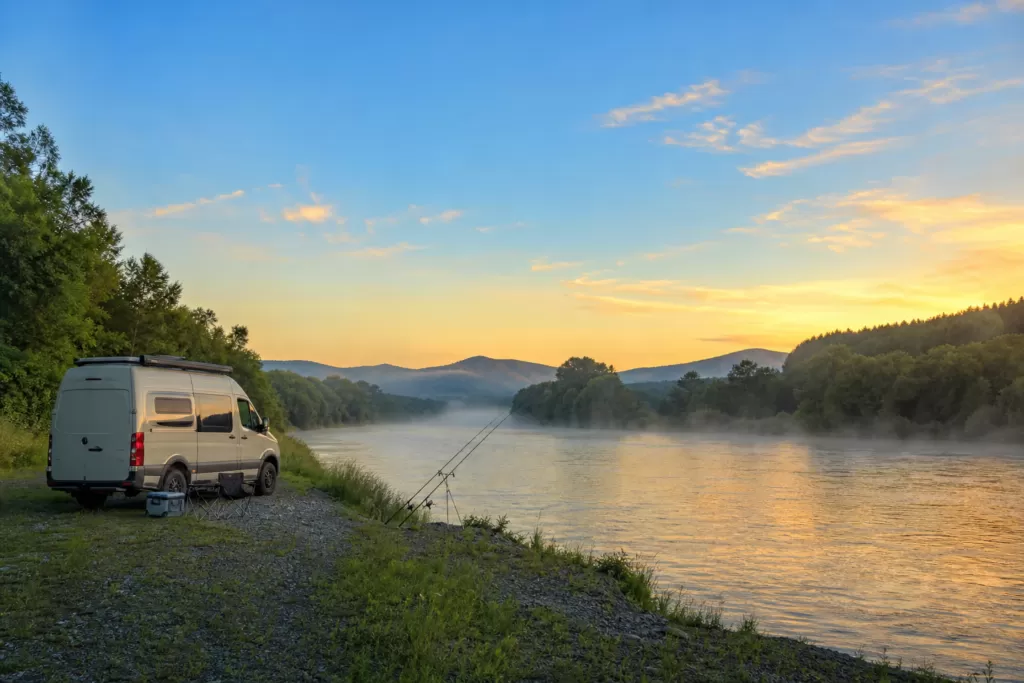
“I want to be at the fishing spot at dawn, but my lodging is too far away.” “Every time I change fishing spots, I have to rebook a place to stay.” A campervan solves both problems at once. Hokkaido offers a huge range of fishing grounds, from rockfish and Atka mackerel in eastern Hokkaido to white-spotted char in the streams of Tokachi and Hidaka. This article covers everything you need for a Hokkaido fishing trip by campervan: planning, fishing-spot information, overnight parking spots, and how to pack your gear and manage fish odor.
It goes into specifics on sea fishing around eastern Hokkaido and Shiretoko, stream fishing in Tokachi and Hidaka, the RV parks that serve as bases for each, and how to handle your catch and control odor.
Why a campervan works so well for a fishing trip, and how to plan one
Hokkaido’s fishing grounds are vast. Even eastern Hokkaido alone spans the Shiretoko Peninsula, Rausu, Nemuro, and Akkeshi, spread far apart — if you base yourself at a hotel or ryokan, you can easily end up more than an hour from the fishing spot. With a campervan, the biggest advantage is that you can park overnight right near the fishing spot and start casting at first light.
It also means you can change fishing spots as fish runs and weather shift, without worrying about lodging reservations. A campervan is especially well suited to a style of trip where you cover long distances and fish multiple spots — for example, moving from eastern Hokkaido to Hidaka.
Choosing the right campervan for a fishing trip
For a fishing trip, what matters most is storage capacity and refrigeration. Rod cases can run over two meters long, and how easily they fit varies a lot by vehicle type. A cabcon (cab-conversion camper) tends to have a spacious cargo area with a layout that makes it easy to stow rods lengthwise. A vancon can also work with some creativity, and suits shorter setups like lure rods better.
For keeping your catch cold, a vehicle with an AC-powered refrigerator is ideal. A cooler box and ice packs alone have their limits if you need to store fish for several days. Building a route around RV parks where you can plug into AC power makes a longer fishing trip much more realistic.
A sample basic schedule for a Hokkaido fishing trip
A common pattern is to pick up your campervan at New Chitose Airport and head toward eastern Hokkaido on day one. After two or three days of sea fishing in eastern Hokkaido, moving on to Tokachi and Hidaka for stream fishing lets you enjoy both saltwater and freshwater fishing efficiently on one route.
- Day 1: New Chitose Airport → travel to eastern Hokkaido (Akan/Kushiro area), overnight parking
- Days 2–3: Sea fishing in Rausu and Utoro
- Day 4: Explore fishing spots while moving through the Nakashibetsu/Nemuro area
- Days 5–6: Stream fishing in Tokachi and Hidaka
- Day 7: Return the vehicle at New Chitose Airport
A trip of six to seven nights gives you enough breathing room to enjoy it properly. Being able to adjust your plans to match the weather and how the fish are biting is one of the real advantages of a campervan trip.
Compare Hokkaido campervan rentals
Base yourself at New Chitose Airport and compare rates, vehicle types, and pickup locations all in one place.
Compare rental companies and prices →Sea fishing spots and access in eastern Hokkaido and Shiretoko
The appeal of sea fishing in eastern Hokkaido is the sheer variety of species. Rockfish (soi, gaya, and greenling), Atka mackerel, flounder, and sculpin can all be targeted with a single rod. Knowing which fishing spots and target species go together each season makes it much easier to plan a trip.
Rausu: prime grounds for rockfish and Atka mackerel
Located on the eastern side of the Shiretoko Peninsula, Rausu is blessed with clear water and rich reefs. Inside the harbor, rockfish (gaya and soi) can be targeted year-round. From spring into early summer, Atka mackerel run through, and sabiki rigs make for good numbers-fishing.
Rausu Fishing Port has some parking space available for campervans, but avoid the hours when fishery workers are operating. Always check the rules posted on-site. The road from around the inn “Rausu no Yado Kuma no Ie” in Rausu toward the coastline includes some narrow stretches that larger vehicles cannot enter, so cross-check your navigation with an on-the-ground look before committing.
Utoro (Shari Town): a good bet for flounder and sculpin
On the western side of the Shiretoko Peninsula, the area around Utoro Fishing Port is mainly known for flounder and sculpin. From spring through autumn, casting rigs reliably bring in Korean flounder and sand flounder. Sculpin is in season from autumn to winter, and casting near rocky bottoms works well.
The Utoro area has the “Utoro Shiretoko” roadside station (michi-no-eki), which is convenient for a short campervan break. That said, check the facility’s own policy before parking overnight there. There are also paid parking lots near the Utoro Onsen bus terminal nearby.
Nemuro and Akkeshi: good grounds for flounder, sand smelt, and saffron cod
At Ochiishi Fishing Port near the tip of the Nemuro Peninsula and at Nemuro Port, there are seasons when schools of chika, a Japanese smelt (smelt family, related to wakasagi), move in. Around Akkeshi, winter saffron cod fishing is well known, with anglers casting lines even in sub-zero temperatures. In a campervan, you can warm up inside between casts even when it’s cold out, letting you fish comfortably for longer than most anglers around you.
Akkeshi has the “Konkirie” roadside station, where you can also enjoy local seafood such as oysters. Lake Akkeshi and the Bekanbeushi Wetland are registered under the Ramsar Convention, and parts of the area have restrictions on where fishing is allowed. Check with the Akkeshi town website or the local fishery cooperative beforehand.
Stream fishing in Tokachi and Hidaka (white-spotted char and rainbow trout)
In Hokkaido’s inland rivers, white-spotted char and rainbow trout are the stars of stream fishing. White-spotted char (Ezo iwana) in particular is a species rarely encountered on Honshu, making it a highlight of any Hokkaido fishing trip. What you can’t do, though, is target cherry salmon in rivers the way you might on Honshu. We’ll start with the regulatory basics.
Cherry salmon: off-limits in Hokkaido’s rivers (sea fishing is a winter–spring license system)
On Honshu, there are rivers where you can buy a fishing permit and target cherry salmon in-stream. Hokkaido is different. The Hokkaido Fisheries Adjustment Regulation’s definition of “masu” (trout) includes cherry salmon, and catching them in rivers or lakes (inland waters) is banned outright. Even catch-and-release counts as “catching” under the rule, so casting a line in a river during the spawning run is illegal (source: Hokkaido Government, “Fishing Rules 2026”, confirmed 2026-08-14).
If you want to target cherry salmon in Hokkaido, it has to be at sea. Boat fishing requires an approved vessel under a license system in designated sea areas: Iburi (December–March), Shiribeshi (March–May), and Hiyama (January–May) (same source, confirmed 2026-08-14). All of these windows fall in winter through spring, so none apply to an autumn fishing trip.
White-spotted char: catchable year-round, and beginner-friendly
Unlike cherry salmon, white-spotted char (Ezo iwana) can legally be targeted in rivers, and it’s found throughout many of Hokkaido’s rivers. Along with rainbow trout, it’s an accessible target for beginners to stream fishing, and can be caught with fly, lure, or bait fishing alike.
The Saru and Nukabira rivers, which rise in the Hidaka Mountains, and the Shikaribetsu and Memuro rivers in Tokachi, are well-known spots for white-spotted char. Spring through summer, the main stem tends to fish well; in autumn, the upper reaches of the tributaries tend to produce bigger fish. When you head into a stream, remember you’re in bear country. Carrying a bear bell and fishing in a group should be your default.
Stream fishing precautions: always check closed areas and permit requirements
Fishing in Hokkaido’s inland waters (rivers and lakes) is governed by the Hokkaido Inland Water Fisheries Regulation, which sets closed areas, closed seasons, and gear restrictions. Since the periods and locations where fishing is allowed differ river by river, check the Hokkaido government’s inland water fisheries regulation information and each fishery cooperative’s angling rules before you enter the water.
Fishing without paying the required angling fee on waters where angling rules have been established counts as poaching. Don’t be tempted to cast a line in a river you happen to pass while driving your campervan — always confirm the rules in advance without exception.
Autumn (September–November) salmon and trout fishing | Pink salmon and aki-aji season, and the latest regulations
Autumn is when salmon and trout return to the coast of eastern Hokkaido — the high season for a campervan fishing trip. It’s also the season where the campervan’s biggest advantage, parking overnight right next to your fishing spot to catch the dawn bite, pays off the most. At the same time, salmon and trout species carry Hokkaido’s strictest fishing regulations. Casting a line without knowing “where, what, and how many” can turn into an illegal act, so treat the season information and the regulations as a single package.
Pink salmon: typically late July through September, target the sea off Shiretoko and the Okhotsk coast
Pink salmon (karafutomasu) lead off the autumn season. According to a Hokkaido tackle shop’s guide, “the run period from late July through September is the window to target,” with the peak around mid-August, near Obon (source: tackle shop Blue Marlin’s column, confirmed 2026-08-14). The main fishing grounds are the surf and breakwaters along the Shiretoko and Okhotsk coasts, using float lures or float-and-bait rigs. Because pink salmon split into distinct even-year and odd-year breeding populations, factor in that catch numbers can swing widely from year to year.
One thing to keep in mind: catching salmon and trout species, pink salmon included, is banned outright in rivers and lakes (inland waters) — see the regulation summary later in this section for details. You can only target them at sea. Once the run starts in September, wading into a river or a restricted river-mouth zone to chase the fish is illegal.
Aki-aji (autumn chum salmon): peaks from mid-September, float lures off breakwaters and surf
Chum salmon — known among Hokkaido anglers as “aki-aji” — are the star of autumn. According to a Hokkaido tackle shop’s guide, fishing can start as early as July in a good year on the Pacific side (Kushiro/Tokachi) and from mid-August on the Okhotsk side, with the peak from “mid-September onward, when the most salmon move in close to shore” (source: tackle shop Blue Marlin’s column, confirmed 2026-08-14). To target bright, silver-scaled fish, aim for September–October; in some areas you can still fish into November. Standard rigs are a float lure — a spoon fitted with a float — or bukkomi (bottom-cast) fishing.
Starting autumn 2026, the rules got a notch stricter. In the coastal waters off Abashiri City, Koshimizu Town, and Shari Town, Abashiri Sea Area Fisheries Adjustment Commission Instruction No. 5 (issued July 23, 2026) sets, for shore-based rod fishing for chum salmon from September 1 through November 30, 2026: “no more than 3 rods in simultaneous use per person” and “no more than 3 chum salmon caught per person per day.” Any chum salmon caught must be kept, and releasing them back is also prohibited except in unavoidable circumstances (source: Okhotsk General Subprefectural Bureau, Abashiri Sea Area Fisheries Adjustment Commission Instruction, confirmed 2026-08-14). What used to be a voluntary limit on rod count and catch numbers is now a formal instruction under the Fisheries Act.
Shari Town has published its “Shari Coastal Salmon and Trout Fishing Rules” for shoreline salmon and trout fishing, which include bans on staking out spots, setting up permanent tents, and dumping trash (source: Shari Town official website, Reiwa 8 edition, confirmed 2026-08-14). Read through it before you cast a line around Utoro. Also, boat fishing for chum salmon in September in the Shari, Abashiri, and Utoro sea areas operates under a license system that requires boarding an approved vessel (source: Hokkaido Government, “Fishing Rules 2026”, confirmed 2026-08-14).
Autumn stream fishing: white-spotted char and yamame remain fair game (the closed season is in spring)
White-spotted char, yamame (masu salmon parr), and rainbow trout — none of which fall under the regulated “salmon and trout” category — can still be targeted in rivers through autumn. Yamame have a closed season in spring: May 1–June 30 in the Hidaka, Tokachi, Kushiro, Nemuro, Okhotsk, Soya, and Rumoi subprefectures, and April 1–May 31 in the Kamikawa, Sorachi, Ishikari, Shiribeshi, Hiyama, Oshima, and Iburi subprefectures. September through November falls outside the closed season everywhere in Hokkaido (source: Hokkaido Government, “Fishing Rules 2026”, confirmed 2026-08-14). For white-spotted char, the autumn approach is what we covered earlier — working the upper tributaries for bigger fish. That said, protected waters and river- or lake-specific rules still apply separately, so you still need to check the rules for each river you enter.
Salmon and trout regulations in summary: rivers are fully off-limits, and river mouths have restricted zones too
The Hokkaido Government’s “Fishing Rules 2026” states plainly that “catching salmon and trout in inland waters is banned outright.” “Trout” here covers five species: cherry salmon, pink salmon, sockeye salmon, coho salmon, and chinook salmon. Catch-and-release counts as “catching” too — as the rule puts it, “even if you release the fish, it can still be an illegal act subject to penalties if it’s a prohibited species” (quoted from Hokkaido Government, “Fishing Rules 2026”, confirmed 2026-08-14). The one legal way in for anglers is to register as a catch participant in the “effective use survey” on the Chuurui River (Shibetsu Town) or the Hamamashike River (Ishikari City); what’s run each year needs to be confirmed with the respective office.
Sea waters carry restrictions too. No-catch zones are set near the mouths of salmon- and trout-enhancement rivers, and this includes the mouths of major eastern Hokkaido rivers mentioned in this article — the Rausu, Sashirui, Iwaubetsu, Onnebetsu, Shari, and Abashiri rivers, among others. The banned distance offshore and the restricted period both vary by river and are revised year to year (source: same, “List of Prohibited Salmon and Trout Catch Zones Near River Mouths,” confirmed 2026-08-14). Check the latest list before you go, and follow the posted signage on-site.
- Salmon and trout: sea only: rivers and lakes are fully off-limits, catch-and-release included
- River-mouth restrictions: confirm your fishing spot isn’t inside a river-mouth no-catch zone (distance and period vary by river) using the official list and on-site signage
- Abashiri, Koshimizu, and Shari coastal waters: September 1–November 30, 2026 — 3 rods max, 3 chum salmon per day, and fish must generally be kept
- Municipal local rules: Abashiri City, Shari Town, and Koshimizu Town have each published their own local rules for salmon and trout fishing
Checking all these regulations can feel like extra work, but flip it around: pick a fishing spot with no restrictions, and you can fish it without a second thought. With the freedom of movement a campervan gives you, it’s easier to build a spot that avoids river-mouth restrictions right into your plan.
RV parks and overnight parking spots near the fishing grounds
Here are RV parks and spots well suited to overnight parking in the eastern Hokkaido and Tokachi areas. Choose based on access to the fishing spots you plan to fish.
RV Park Shiretoko Rausu (Rausu Town)
If you’re fishing the Shiretoko and Rausu coastline, an RV park in Rausu Town makes a good base. If the site has power hookups, you can run a fridge to keep your catch. It’s just a few minutes’ drive from Rausu Fishing Port, making it easy to head out at first light. Check the details when you book, since facilities and rates can change from year to year.
Campsites and RV parks around Utoro Onsen
The Utoro area has a campsite near the Shiretoko Nature Center. It has good access to Utoro Fishing Port and pairs easily with Shiretoko sightseeing, so it works well even if fishing isn’t your only goal for the trip. It gets busy during peak season (July–August), so it’s worth booking ahead.
Michi-no-Eki Nakasatsunai (Nakasatsunai Village, Tokachi)
As a base for stream fishing in Tokachi and Hidaka, the area around Nakasatsunai Village is very convenient. The roadside station “Nakasatsunai” has 24-hour restrooms and parking space for larger vehicles. The Satsunai River, flowing down from the Hidaka Mountains, is close by, making it an easy base for a stream-fishing trip. That said, follow the facility’s own policy regarding overnight parking there.
RV parks around Obihiro
Obihiro, the central city of Tokachi, has several RV parks. Basing yourself at an RV park in or near Obihiro gives you good access to the Tokachi River system, including the Toshibetsu and Otofuke rivers, and it’s also convenient for restocking supplies and gear. Obihiro’s supermarkets and home-improvement stores are well stocked, making it easy to pick up any fishing tackle you’re missing.
Things to watch for when parking overnight
If you plan to camp or park overnight near a fishing spot, you need the landowner’s or manager’s permission. Some fishing-port parking lots and riverbanks prohibit long-term parking or overnight stays by campervan. Also, during periods with frequent bear sightings, make sure never to leave food or fish entrails in or around your vehicle.
New Chitose Airport / Tokachi-Obihiro Airport
Rent the Cabcon “Cresson Journey”
Base yourself at New Chitose Airport and travel all across Hokkaido by campervan.
See details at Moving Inn →Packing your gear, controlling odor, and handling your catch
Two things you’ll always run into when using a campervan for a fishing trip are how to pack your gear and how to deal with fish odor. Here are concrete ways to keep the cabin clean.
Packing rods and gear
Stream rods and casting rods can run three to four meters at their longest. The usual approach is to slide the rod case in vertically or horizontally through the cabcon’s rear hatch. It’s worth confirming the rear storage dimensions for your vehicle with the rental company before you pack.
Keep lures and rigs organized in clear, compartmentalized cases inside a bag — it makes them easy to find and harder to lose. Loose hooks rolling around the cabin are a real injury risk, so use hook covers or dedicated cases.
Keeping fish cold: how to use a cooler box
To bring your catch home fresh, the basic combination is ice or ice packs plus a cooler box. Hokkaido summers (July–August) can push past 30°C during the day. Choose a well-insulated cooler box and pre-chill it before putting fish in — the ice will last longer.
Ice is available at convenience stores, home-improvement stores, and tackle shops all over Hokkaido. Making a habit of picking up block ice at a convenience store near the fishing spot cuts down on cold-storage mishaps. On nights at a powered RV park, moving your catch into the fridge also helps conserve ice.
Gutting and bleeding your catch
Most in-cabin odor problems come down to fish blood and entrails. The golden rule is to dispatch and bleed your catch on the spot, and if possible remove the entrails before putting the fish in the cooler box. Dispose of the entrails at a designated waste point at the fishing spot, or bag them to take away with you — never dump them on the shore or in the parking lot.
A dedicated folding knife and a water tank for washing up make bleeding and gutting much easier. Most campervans come with an onboard water tank, which is handy for washing your hands and gear after fishing.
Controlling odor inside the cabin
If fish odor soaks into the cabin, it can become a problem when you return the vehicle. Combine the following measures.
- Seal fish inside the cooler box: close the lid firmly and check the drain valve so nothing leaks
- Keep waders and boots outside the cabin: after fishing, store waders or rubber boots in an exterior compartment or hang them outside in a bag
- Protect the floor and seats: lay down a rubber fishing mat or a tarp
- Ventilate thoroughly: open the windows to air out the cabin after a day’s fishing — deodorizing spray is only a supplement
- Handle drainage carefully: catch cooler-box drip in a plastic bag and dispose of it outside the vehicle
If you tell the rental company in advance that you plan to use the vehicle for fishing, they can sometimes point you to a suitable vehicle type and flag things to watch out for.
Handy items to bring on a fishing trip
Here’s a rundown of items that make a campervan fishing trip more comfortable — mostly things people tend to forget beyond the fishing gear itself.
- Plastic bags (large and medium): useful for entrails, food waste, wet clothing, and more
- A folding bucket: handy for drawing water or washing gear at the fishing spot — one that packs down small is convenient
- Zip-lock odor-proof bags: keep smells from leaking out when storing fish temporarily
- A headlamp: essential for getting ready before dawn or for camp tasks at night — bring spare batteries
- Rain gear and waders: waders open up your options once you’re in a stream
- Bear spray: worth considering as a rental if you’re heading into the forests and streams of eastern Hokkaido or Hidaka
- A fishing permit (yugyoken): if buying locally, research the sales point before you leave
The more gear you bring, the more your packing plan matters. Just checking your vehicle’s storage space before you set off, and putting the things you use most somewhere easy to reach, makes everything move more smoothly once you’re at the water.
Frequently Asked Questions
Q: Do I always need a fishing permit to fish Hokkaido’s streams?
Unlike Honshu, only some of Hokkaido’s rivers and lakes have angling rules (and angling fees) set under fishing rights. That said, even on rivers where no fee is required, the Hokkaido Fisheries Adjustment Regulation’s closed periods, closed areas, and gear restrictions still apply — as does the outright ban on catching salmon and trout species, including cherry salmon. Check the Hokkaido Government’s “Fishing Rules 2026” and the managing fishery cooperative’s and municipality’s information for each river before you enter the water (confirmed 2026-08-14).
Q: What season is best for sea fishing in eastern Hokkaido?
Rockfish (soi and gaya) can be targeted year-round, but they tend to run bigger from autumn into winter. Atka mackerel become active from spring into early summer. Flounder numbers increase around their spawning periods in spring and autumn. The sightseeing season (July–August) gets crowded, but in terms of fish activity, spring (May–June) is said to fish more easily.
Q: Can I clean fish inside the campervan?
For a rental vehicle, it’s generally not recommended. It causes odor and mess, and can lead to extra cleaning charges when you return the vehicle. Do your fish prep at an outdoor table and keep any in-cabin handling to an absolute minimum. Some RV parks have sinks you can use for this.
Q: What should I watch for when fishing in bear country?
The streams of eastern Hokkaido and Hidaka overlap with bear habitat. Avoid fishing alone — going in a group is the basic rule. Many anglers ring a bear bell while walking and carry bear spray in case of an encounter. Leaving fish blood or entrails along a stream can attract bears, so bag them and take them away with you. It’s also worth checking bear-sighting information from the local tourism association or hunting association before you set out.
Q: Can I buy rods and lures locally?
Major cities like Obihiro, Kushiro, and Abashiri have tackle shops where you can pick up basic consumables — line, lures, rigs, and fishing permits. That said, stock of specialized stream-fishing gear can be limited, so bringing your own rods and reels from home is the safer bet. Many anglers carry their gear as flight luggage before picking up their campervan at New Chitose Airport.
Q: How do I get my catch home?
The common approach is to pack it in a cooler box and check it in at the airline counter. Rules vary by airline, so check in advance whether dry ice is allowed and what the weight limits are. You can also ship your catch straight home through a local courier (such as Yamato Transport or Sagawa Express) — some convenience stores and roadside stations near the fishing spot accept shipments.
Book a Campervan in Hokkaido
Moving Inn New Chitose Airport supports English booking and offers airport transfers.

![Campgrounds Near Tokachi-Obihiro Airport: 8 Sites Within 30 km, Compared by Vehicle Access, Power and Price [2026]](https://hokkaido-campingcar.jp/wp-content/uploads/2026/10/photo-obihiro-airport-featured-pl232-768x512.jpg.webp)
![Campgrounds Near Hakodate Airport: 12 Sites Within 30 km, Compared by Vehicle Access, Power and Price [2026]](https://hokkaido-campingcar.jp/wp-content/uploads/2026/10/photo-hakodate-airport-featured-hl4722-768x484.jpg.webp)