Solo Campervan Rental in Hokkaido: Complete Guide for Solo Travelers [2026]
A complete guide to renting a campervan solo in Hokkaido: best vehicle types for solo travel (kei camper, van conversion), cost simulations for 4-night 5-day and 7-night 8-day trips, safe overnight spots, and recommended routes.
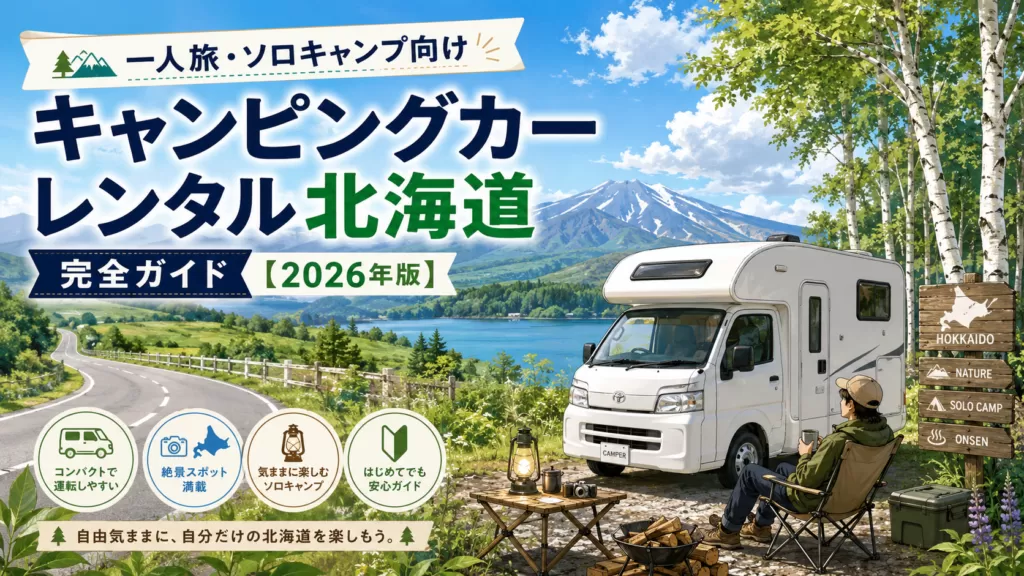
Thinking about renting a campervan solo in Hokkaido? Some people wonder if it’s wasteful or impractical to rent a large vehicle alone — but solo campervan trips in Hokkaido are more common than you might think.
This guide covers vehicle type comparisons for solo travel, the reality of solo pricing, cost simulations (4-night 5-day and 7-night 8-day), safety considerations, and recommended routes for first-time solo campervan travelers.
New Chitose Airport / Tokachi-Obihiro Airport
Rent the Cabcon “Cresson Journey”
Base yourself at New Chitose Airport and compare rates, vehicle types, and pickup locations all in one place.
See details at Moving Inn →Why Rent a Campervan Solo?
No need to worry about accommodation: Summer Hokkaido hotels are expensive and hard to book in popular areas. A campervan eliminates hotel costs entirely — in some peak-season areas where a single hotel room runs ¥15,000–¥25,000 per night, a campervan can work out cheaper even for one person.
Total freedom of schedule: No need to check in or out by fixed times. Stay at a view spot as long as you want, leave when you’re ready. If you find somewhere you love, extend your stay on the spot.
Access to places with no public transport: Large parts of Hokkaido have little or no public transport. A campervan opens up scenic spots and remote national park areas that are otherwise inaccessible.
Personal space and privacy: A shared hostel or guesthouse means interacting with strangers. A campervan is your own private space — quiet time when you want it.
Best Vehicle Types for Solo Travel
① Kei Camper (Recommended for Solo)
A kei car (light vehicle) converted into a mini campervan. The most popular option for solo renters in Hokkaido.
| Feature | Detail |
|---|---|
| Sleeping capacity | 1–2 people |
| Body size | Compact (standard kei car dimensions) |
| Fuel economy | Very good (~15–18 km/L) |
| Parking | Fits standard kei car spaces, no height restrictions |
| Daily rental rate (off-peak) | ¥9,000–¥15,000 |
Best for: solo travelers who want to minimize costs and travel light. Mountain roads, narrow farm tracks, and hidden viewpoints are no problem. Downsides: limited storage, no standing space inside.
② Van Conversion (For Comfort-Priority Solo)
A HiAce-based van conversion gives you a small kitchen, refrigerator, and more storage space. Better for solo travelers who want to self-cater on a longer trip or carry more gear.
| Feature | Detail |
|---|---|
| Sleeping capacity | 2–3 (solo use gives you extra space) |
| Kitchen | 1–2 burner, small fridge |
| Daily rental rate (off-peak) | ¥15,000–¥25,000 |
Best for: solo travelers on trips of 5+ days who want to self-cater, or those carrying bikes, camera equipment, or other large gear.
Solo Pricing: What to Expect
Most Hokkaido campervan rental operators price by vehicle (not per person) — solo travelers pay the same rate as a couple using the same vehicle. Some operators offer a “solo discount” or “1-person rate” for smaller vehicles. Always check the operator’s pricing page directly.
To compare every campervan rental base in Hokkaido side by side, see the Hokkaido campervan rental & hire comparison.
Cost Simulation: Solo Trip
4-Night 5-Day (Off-Peak, Kei Camper)
| Item | Cost |
|---|---|
| Kei camper rental (4 nights) | ¥40,000–¥55,000 |
| Fuel (~400–500km) | ¥5,000–¥7,000 |
| Campsites (4 nights) | ¥2,000–¥6,000 |
| Food (self-catering focused) | ¥8,000–¥12,000 |
| Entrance fees, etc. | ¥2,000–¥4,000 |
| Total | ¥57,000–¥84,000 |
7-Night 8-Day (Off-Peak, Van Conversion)
| Item | Cost |
|---|---|
| Van conversion rental (7 nights) | ¥105,000–¥150,000 |
| Fuel (~700–900km) | ¥10,000–¥15,000 |
| Campsites (7 nights) | ¥5,000–¥12,000 |
| Food | ¥14,000–¥20,000 |
| Entrance fees, etc. | ¥3,000–¥6,000 |
| Total | ¥137,000–¥203,000 |
Safety Tips for Solo Campervan Travel
Choose established overnight spots: Stick to designated campsites, RV parks, and roadside stations (Michi no Eki) rather than informal spots. These locations have other travelers nearby, toilets, and a level of security.
Share your itinerary: Before leaving, share your planned route with someone back home. Check in daily if possible.
Keep doors locked while sleeping: Standard practice — lock up when parked overnight just as you would at home.
Bears in Hokkaido: Brown bears (Higuma) are present across Hokkaido. When hiking or walking in bear territory, make noise, never hike alone in deep forest, and follow posted warnings at each park.
Cell coverage: Some remote areas of Hokkaido have poor or no cell reception. Download offline maps before your trip. Carry emergency supplies (water, food, warm layers).
New Chitose Airport / Tokachi-Obihiro Airport
Rent the Cabcon “Cresson Journey”
Base yourself at New Chitose Airport and compare rates, vehicle types, and pickup locations all in one place.
See details at Moving Inn →Recommended Solo Routes
4-Night 5-Day: New Chitose → Furano/Biei → Asahikawa → Sapporo
Day 1: New Chitose pickup → Furano (flower fields) → campsite overnight
Day 2: Biei patchwork road → Blue Pond → overnight near Biei
Day 3: Asahikawa → Asahiyama Zoo → overnight at Asahikawa campsite
Day 4: Drive back south via Sorachi → Yoichi → overnight near Otaru
Day 5: Otaru Morning Market → return to New Chitose → return vehicle
7-Night 8-Day: Full Circuit (New Chitose → Shiretoko → Kushiro → Return)
Day 1: New Chitose → Obihiro → overnight
Day 2: Akan Lake → overnight near Kushiro
Day 3: Kushiro Wetlands → Mashu Lake → Shiretoko (Utoro) → overnight
Day 4: Shiretoko Five Lakes → Kamuiwakka → overnight in Shiretoko area
Day 5: Abashiri → Drift Ice Museum (off-season: aurora viewing area) → overnight
Day 6: Abashiri → Kitami → Daisetsuzan (Sounkyo Gorge) → overnight
Day 7: Biei → Tokachidake area (Bogakudai) → Furano → overnight
Day 8: Return to New Chitose → return vehicle
Summary
Solo campervan travel in Hokkaido is a genuinely rewarding way to explore. With a kei camper, costs can be kept surprisingly low. For longer trips, a van conversion with a small kitchen allows comfortable self-sufficient travel. The key is choosing the right vehicle for your trip length and style — then just booking early for peak season.
Book a Campervan in Hokkaido
Moving Inn New Chitose Airport supports English booking and offers airport transfers.
![When and Where Can You See Harbor Seals at Cape Erimo? Kaze no Yakata Official Information, Viewing Season, and Windy-Day Notes [2026-27]](https://hokkaido-campingcar.jp/wp-content/uploads/2026/10/erimo-cape-lighthouse-768x511.jpg.webp)
![Where and Under What Conditions Can You See Diamond Dust in Hokkaido? How Cold a Morning It Takes, and Where It Appears [2026-27]](https://hokkaido-campingcar.jp/wp-content/uploads/2026/10/hokkaido-diamond-dust-nayoro-768x512.jpg.webp)
![Can You Drive to Hokkaido Jingu for Hatsumode? Parking, Crowds, and Where to Park and Walk [2027]](https://hokkaido-campingcar.jp/wp-content/uploads/2026/10/hokkaido-jingu-winter-torii-768x504.jpg.webp)
![Hokkaido Roads Over New Year [2026-27] | Expressway Sections Prone to Blizzard Closures, Forecast Congestion Days, No Holiday Discount, and New Chitose Airport Parking](https://hokkaido-campingcar.jp/wp-content/uploads/2026/10/hokkaido-winter-rural-road-edge-markers-768x432.jpg.webp)
![Where to See Sea Smoke (Kearashi) in Hokkaido: Rumoi’s Ogon-misaki and the Morning Conditions [2026-27]](https://hokkaido-campingcar.jp/wp-content/uploads/2026/10/rumoi-kearashi-sea-smoke-768x511.jpg.webp)
![Geminid Meteor Shower 2026 in Hokkaido: Peak Around 23:00 on December 14, Sapporo Moonset 20:40, and Staying Warm in a Winter Campervan [2026]](https://hokkaido-campingcar.jp/wp-content/uploads/2026/10/geminids-2026-hokkaido-768x575.jpg.webp)