Hokkaido Campervan Travel with Toddlers Guide | Safe Travel Preparation, Spots & Schedule for Ages 0-3 [2026]
A complete guide to traveling Hokkaido by campervan with infants and toddlers aged 0-3. Covers preparation, recommended spots, and sample schedules for worry-free travel.
Pick a campervan by what matters to you.
Rent at New Chitose Airport
See only the rental bases in Chitose, where the airport is.
Rent in winter (Dec–Mar)
Companies that rent through winter, listed apart from those that close.
Guide price
Moving Inn New Chitose Airport: HIACE van conversion from ¥22,000 per night. 20–30% off when booked 60–90 days ahead (official rate table, checked 15 Oct 2026).
New Chitose Airport map for campervan travellers →
Before you book: with an International Driving Permit if your country is in the Geneva Convention (for example the US, Australia, Singapore); Taiwan, Switzerland, Germany, France, Belgium and Monaco need your licence plus a Japanese translation (Tokyo Metropolitan Police). Questions in English: Moving Inn on WhatsApp. Every roadside station (michi-no-eki) must have free 24-hour toilets, and Hokkaido has 128 of them (MLIT).
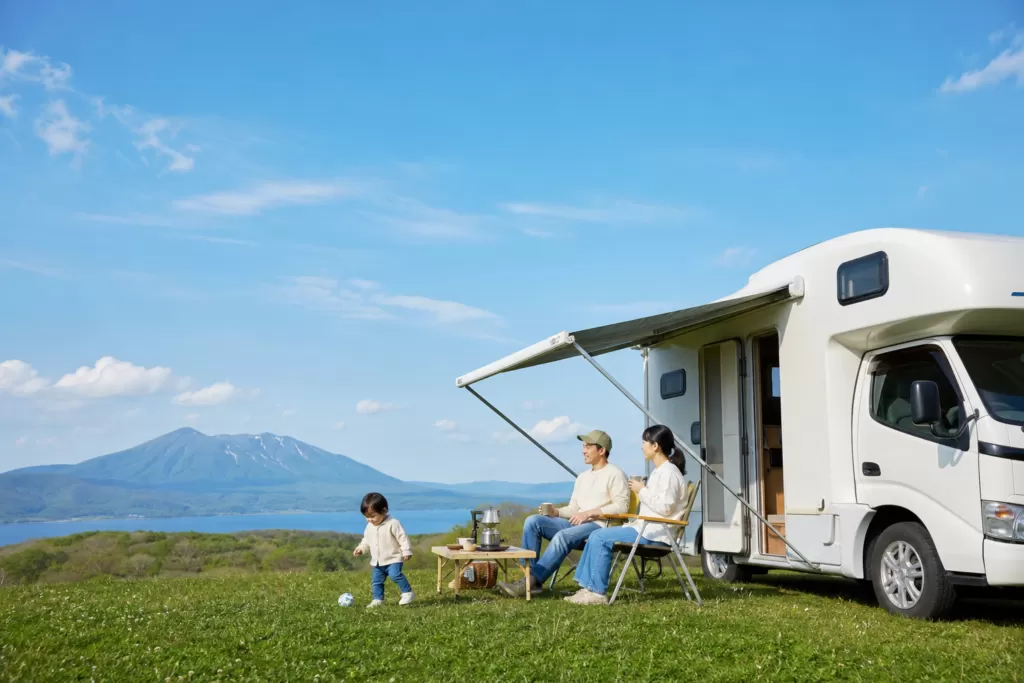
Traveling around Hokkaido by campervan with a baby or a 1-2 year old — many families ask, “Is this really okay?” The short answer: with the right preparation, a campervan can be a powerful ally even for trips with children aged 0-3.
Unlike hotels or ryokan, nursing, diaper changes, and putting your child to sleep can all happen inside your own private space. You don’t have to worry about disturbing others if your baby cries, and packing a large amount of luggage is never a problem. That flexibility is the biggest advantage of traveling with an infant or toddler.
This guide covers the preparation, routes, spots, and packing list you need for a Hokkaido campervan trip with a baby or toddler aged 0-3.
Tap a dot on the map to see its name here.
Tap a dot to see its name and a link to where it appears in this article. 1 places whose location could not be confirmed are not shown. Dot positions are based on each facility’s address or officially published location. Lakes and expressways are from OpenStreetMap data.
Why a Campervan Works Well for Traveling with Toddlers, and What to Watch For
Nurse and Change Diapers in Your Own Private Space
The biggest worry when traveling with an infant is finding somewhere to nurse and change diapers. Out and about, you might have to hunt for a nursing room, or end up at a restroom with no changing table. In a campervan, the bed space or seating area lets you handle this anytime. Whether you're parked at a Michi-no-Eki (roadside rest stop) or a convenience store, as long as you have your own space, there's no problem.
Adjust the Itinerary to Your Child's Pace
Babies and toddlers are unpredictable — their mood and condition can change at any time, making it hard to stick to a schedule. With a hotel reservation, you may feel pressured to keep moving even if your child isn't feeling well. A campervan solves this: you can change where you stay on the same day. Stay put if your child isn't well, or linger longer at one spot if they're happy. This kind of flexible travel becomes possible.
Pack Without Worrying About Luggage
Traveling with a child aged 0-3 means a lot of luggage — diapers, formula, baby food, changes of clothes, a stroller, a car seat, a baby carrier, favorite toys, and more. On a flight or train trip, all that luggage becomes a burden, but in a campervan you can load a large amount using the roof carrier and interior storage without any trouble.
Caution: Car Seats and Safety While Driving
Even in a campervan, the law requires children to be in a car seat whenever the vehicle is moving. Children under 6 years old must use a car seat (Road Traffic Act, Article 71-3). Letting a child sleep in the bed space while the vehicle is in motion is illegal, so always stop the vehicle before moving them.
When it comes to sleep, it's fine to move your child to the bed while the vehicle is stopped or parked. However, you must move them back to the car seat before driving again. "They're asleep, so let's just keep driving" is against the law, so be careful.
Some rental companies offer car seats for rent, but make sure to check how it's installed beforehand. Reserve and confirm this in advance.
Caution: Managing Interior Temperature in Summer
In Hokkaido's summer (July-August), inland areas can exceed 30°C. A rapid rise in interior temperature while parked is dangerous for infants. Run the engine and use the air conditioner, park in the shade, or run the ventilation fan — pay close attention to temperature control. Ventilate thoroughly, especially during midday breaks.
Compare Hokkaido Campervan Rentals
Base yourself at New Chitose Airport and compare rates, vehicle types, and pickup locations all in one place.
Compare rental companies and prices →Tips for Nursing, Changing Diapers, and Putting Your Child to Sleep Inside the Vehicle
Securing a Nursing Space
In Cabcon and Vancon-type campervans, the rear bed space or dinette seating can be used as a nursing area. Adding curtains or a privacy shade to block the view from outside creates a private nursing environment.
If your baby is exclusively formula-fed, you'll need a supply of hot water. Many campervans come with an electric kettle that can run off the sub-battery. However, how long you can use it depends on the sub-battery's capacity and how much charge it's getting while driving, so check with the rental company beforehand. Some Michi-no-Eki even offer free "hot water for babies" (such as Michi-no-Eki Mikasa and Michi-no-Eki Boyo-Nakayama).
The ideal temperature for formula is around 40°C. A reliable method is to keep boiled water in a thermos and mix the formula on the spot. If you carry pre-mixed formula in a cooler bag, it must be used within 2 hours.
Setting Up a Diaper-Changing Space
Laying a changing mat on the bed space lets you handle diaper changes inside the vehicle without hunting for an outside restroom. Keep used diapers from smelling up the cabin by using a lidded plastic bag or an odor-blocking diaper pail inside the vehicle. Since many Michi-no-Eki prohibit bringing in household trash, it's more practical to dispose of diapers at a convenience store. Seicomart and 7-Eleven accept diaper disposal at nearly every location.
Getting Your Child to Sleep and Managing Night Crying
One of the biggest concerns with campervan overnight parking is how nighttime crying affects those around you. At a regular campsite, sites tend to be close together, and crying can carry. For families with infants, an RV park is a great option. RV parks have independent, separated plots and power hookups, so you can run the air conditioner too — reducing how much you need to worry about your neighbors.
RV parks in Hokkaido include "RV Park Tabisuru Kuruma New Chitose Airport BASE" near New Chitose Airport and "RV Park HAKODATE SHOWA BASE" in Showa-cho, Hakodate. Since advance reservations are often required, book early once your itinerary is set.
Many children fall asleep to the vibration of the moving vehicle. Timing your drive for the evening and then quietly moving your sleeping child to the bed after arrival can work well. Keep in mind that a car seat is required while driving, so the process is: let them fall asleep in the car seat, then move them to the bed once the vehicle is stopped.
Managing Interior Temperature and Humidity
Infants and toddlers have an immature ability to regulate body temperature, making them more sensitive to heat and cold than adults. While sleeping, it's ideal to keep the room temperature at 18-22°C using the air conditioner (FF heater or electric). Since running the air conditioner requires battery power or the engine, parking at an RV park or Michi-no-Eki with power hookups is the basic approach. If sleeping without power, use a thin blanket or a cooling sheet.
Designing Short Routes and Rest Stops to Reduce Travel Strain
Keep Daily Travel Under 2-3 Hours as a Guideline
It's difficult for a child aged 0-3 to stay in a car seat for long stretches. They need to get outside and move around every 1-2 hours. Longer stretches of travel tire out children and affect how well they sleep at night. It's realistic to design your itinerary with a daily travel distance capped at 100-150 km.
Hokkaido's roads are straight and easy to drive, which means it's easy to pick up speed and misjudge distances. Places that look close on the map often actually take more than an hour to reach, so check the actual travel time on Google Maps before building your itinerary.
Sample Short Route Starting and Ending Near New Chitose Airport
If you're based at Moving Inn's New Chitose Airport location, the following short route works well for families with young children.
- Day 1: Pick up your campervan at New Chitose Airport → lunch and a walk in a park around Tomakomai → rest at the Mukawa Michi-no-Eki → stay overnight at a Michi-no-Eki or RV park in Hidaka/Monbetsu (approx. 60 km of driving)
- Day 2: A light drive around the Hidaka area → bathe at Saru-gawa Onsen Hidaka Kogen-so (baby-friendly) → lunch at the Biratori Michi-no-Eki → head toward Yubari → stay overnight near Michi-no-Eki Yubari Melon-do (approx. 80 km of driving)
- Day 3: Yubari → Chitose → return the vehicle at New Chitose Airport (approx. 50 km of driving)
This route keeps daily travel to 50-80 km, making it easy to adjust to your child's pace.
How to Choose a Michi-no-Eki as a Rest Stop
Hokkaido has a huge number of Michi-no-Eki, but for families with young children, look for ones with a nursing room and a diaper-changing table. The following Michi-no-Eki are confirmed to have nursing and diaper-changing spaces.
- Michi-no-Eki Mukawa Shiki-no-Yakata (Mukawa Town, Yufutsu District): nursing room, diaper-changing table, and hot spring
- Michi-no-Eki Salmon Park Chitose (Chitose City): nursing room and diaper-changing space, great dining options
- Michi-no-Eki Utonai-ko (Tomakomai City): spacious parking lot, nursing space available
- Michi-no-Eki Yubari Melon-do (Yubari City): well-equipped for families
It's a good idea to check nursing rooms and restroom facilities on Google Maps before you visit. Since facility details can change, check each Michi-no-Eki's official website for the latest information.
Don't Hesitate to Stop When Your Child Cries
If your child won't stop crying while driving, it's dangerous to press on anxiously. Pull over somewhere safe, take them outside, and let them have a change of scenery. Along Hokkaido's national highways, you'll find "road information stations" and parking areas throughout the region. Wide shoulders are also common, so you're unlikely to struggle to find a place to stop.
Baby-Friendly Spots, Bathing, and Shopping
Hot Springs and Day-Use Baths That Welcome Babies
Hokkaido has abundant hot springs, but whether you can bring a baby in depends on the facility. Some places generally decline infants (babies whose necks aren't yet steady), so check in advance.
Facilities that are relatively welcoming to families with babies include:
- Saru-gawa Onsen Hidaka Kogen-so (Hidaka Town): has family baths, easy to use with a baby
- Tomakomai Onsen Nishikitappu (Tomakomai City): spacious bathing area, popular with families
- Northern Horse Park (Tomakomai City): has family baths and plenty of play areas
- Garden Spa Tokachigawa Onsen (Otofuke Town): well-equipped for families and infants
Facilities with a family bath (private rental bath) let you bathe safely even with a baby. If a facility doesn't explicitly say "babies welcome," call ahead to check before visiting.
Shopping for Diapers, Formula, and Baby Food
Once you leave Hokkaido's urban areas, stores become scarce. To avoid running out of diapers or formula, stock up in the region's major cities (Chitose, Tomakomai, Obihiro, Asahikawa, Sapporo).
- Seicomart: a Hokkaido-native convenience store chain with about 1,100 locations across the region. It even reaches remote islands and mountain areas, and many stores carry diapers and formula.
- Tsuruha Drug: a Hokkaido-founded drugstore chain with many locations across the region. Stocks diapers, powdered formula, and baby food.
- Coop Sapporo (Co-op): a community-based supermarket chain that also carries organic baby food.
It's reassuring to bring plenty of shelf-stable retort-pouch baby food, since selection can be limited in Hokkaido's rural areas.
Outdoor Spots Kids Will Love
Children aged 0-3 tend to be happier when they can move around outdoors. Here are a few Hokkaido spots that even babies and toddlers can enjoy.
- Hokkaido Greenland (Mikasa City): a large lawn area with attractions that even 1-2 year olds can enjoy
- Kojohama Beach, Shiraoi: gentle waves, easy for playing in the sand. Gets crowded in summer but has an open, spacious feel.
- Horokanai Buckwheat Fields (Horokanai Town): from mid-July to mid-August the fields turn white with buckwheat flowers, great for photos too
- Showa-Shinzan / Mt. Usu Area (Sobetsu Town): flat walking paths, easy to stroll with a baby carrier or stroller
- Sango-so (Coral Grass) Colony, Lake Notoro (Abashiri City, September): a short boardwalk walk that's manageable even with young children
New Chitose Airport / Tokachi-Obihiro Airport
Rent the Cabcon "Cresson Journey"
Base yourself at New Chitose Airport and travel all across Hokkaido by campervan.
See details at Moving Inn →Packing List and a Sample Daily Schedule
Packing List for a Campervan Trip with a Baby or Toddler
In addition to your usual travel gear, prepare the following items.
Safety and Travel
- Car seat (confirm with the rental company, or bring your own)
- Baby carrier or sling (for getting around at sightseeing spots)
- Stroller (a foldable one is easier to store in the vehicle)
Nursing and Baby Food
- Electric kettle (check whether it's included with the rental vehicle)
- Thermos (to keep hot water for mixing formula)
- Baby bottles and a bottle sterilizing case (a microwave sterilizer is convenient)
- Powdered or cube formula (bring extra)
- Retort-pouch baby food (shelf-stable)
- Baby spoon and plate
- Nursing cover
Diapers and Hygiene
- Diapers (bring extra — consumption tends to increase while traveling)
- Baby wipes (large-capacity pack)
- Changing mat (for use in the vehicle)
- Diaper disposal bags (odor-blocking bags like BOS work well)
- Changes of clothes (2-3 sets per day)
- Plastic bags (for soiled clothing)
Sleep and Comfort
- Baby sleeping bag or blanket
- Portable insect repellent items (also useful for gaps around window screens)
- White noise machine (effective for night crying and getting your child to sleep)
- Baby monitor (if you're away from the vehicle)
Medical and Emergencies
- Baby thermometer and fever medicine (get a prescription from your pediatrician beforehand)
- Your pediatrician's phone number and patient card
- Health insurance card and infant medical certificate
- First-aid kit (antiseptic, gauze, bandages)
- A list of pediatric clinics in Hokkaido (check hospitals in your travel area in advance)
Sample Daily Schedule (for Ages 0-1)
Build your itinerary around your child's regular meal and nap times so their rhythm isn't disrupted.
- 6:30: Wake up, nurse or bottle-feed
- 7:00: Breakfast (adults) / baby food (child)
- 8:00: Depart (travel during the morning, when the child is most active)
- 9:00-10:00: First destination (park or Michi-no-Eki) — walk and play outside
- 10:30: Nurse/feed and change diaper in the vehicle or at a facility's nursing room
- 11:00: Start driving (many children nap around this time)
- 12:00: Lunch at a Michi-no-Eki or restaurant (if the child is awake)
- 13:00-14:00: Drive or rest, timed around the child's nap
- 15:00: Second destination (hot spring or sightseeing spot)
- 16:30: Move to your overnight stop (RV park or Michi-no-Eki)
- 17:00: Arrive, prepare dinner
- 18:00: Dinner and bath
- 19:30-20:00: Get your child ready for bed
- 20:30 onward: Time for the adults (reading, stargazing, etc.)
This schedule is just a guideline. Stay flexible and adjust to your child's rhythm and condition. The key to traveling with a baby or toddler is building your itinerary around the assumption that things won't go exactly as planned.
Sample Daily Schedule (for Ages 2-3)
By ages 2-3, children typically nap just once a day and can walk a bit on their own, giving you more flexibility in your itinerary than with a child under 1.
- 6:30-7:00: Wake up, breakfast
- 8:00: Depart
- 9:00-11:30: Morning sightseeing (animal farm, farming experience, park, etc.)
- 12:00: Lunch
- 13:00-14:30: Travel (time the nap for this stretch)
- 15:00-17:00: Afternoon sightseeing or hot spring
- 17:30: Head to your overnight stop
- 19:00-20:30: Dinner and bedtime
Frequently Asked Questions (FAQ)
Q: Is a campervan trip okay for a newborn?
Most families wait until around 3 months of age. Once a baby's neck is steady, nursing and moving around becomes much easier. Long-distance travel with a very young infant puts significant strain on their body, so it's best to start with a short trip nearby (1-2 nights). Consulting your pediatrician beforehand is a good idea for peace of mind.
Q: Can I rent a car seat?
Some rental companies do offer car seats for rent. However, since availability is limited, you'll need to confirm and reserve one when you book. Bringing your own car seat is more reliable, and a familiar seat also helps put your child at ease.
Q: Can I go to a hot spring while breastfeeding?
There's no issue with a breastfeeding mother bathing in a hot spring. However, since long soaks can lead to dehydration, be sure to drink water regularly. If you want to bathe together with your baby, choose a facility with a private family bath.
Q: I'm worried about night crying disturbing others
At an RV park, plots are usually independent and set further apart than at a regular campsite. If you're still concerned, closing the windows and managing the temperature with the ventilation fan or air conditioner can help reduce sound leaking outside. When parking overnight at a regular Michi-no-Eki, try to keep things quiet at night, and if crying continues for a long time, focus on soothing your child inside the vehicle.
Q: Can I fit a baby crib in the campervan?
A foldable compact crib or travel cot can sometimes fit in the spacious bed area of a Cabcon-type vehicle. However, the available space varies by vehicle, so check the interior dimensions (especially the bed area) with the rental company before deciding whether to bring one. In most cases, simply laying your child directly in the campervan's bed space (sized for two adults) works just fine.
Q: Do I need to take precautions against bears or insects?
Since a campervan can be fully sealed up, the risk from insects and bears is much lower than with a tent. That said, use baby-safe insect repellent when playing outside, and be careful about food management in mountainous or forested areas. You can check for bear sighting reports through Hokkaido news or bulletin boards at Michi-no-Eki.
Traveling with a baby or toddler often doesn't go as planned, but that's exactly what creates those special memories you'll look back on. Make the most of a campervan's mobility and private space, and enjoy your family trip through Hokkaido.
Book a Campervan in Hokkaido
Moving Inn New Chitose Airport supports English booking and offers airport transfers.
Pick a campervan by what matters to you.
Rent at New Chitose Airport
See only the rental bases in Chitose, where the airport is.

![When and Where Can You See Harbor Seals at Cape Erimo? Kaze no Yakata Official Information, Viewing Season, and Windy-Day Notes [2026-27]](https://hokkaido-campingcar.jp/wp-content/uploads/2026/10/erimo-cape-lighthouse-768x511.jpg.webp)
![Where and Under What Conditions Can You See Diamond Dust in Hokkaido? How Cold a Morning It Takes, and Where It Appears [2026-27]](https://hokkaido-campingcar.jp/wp-content/uploads/2026/10/hokkaido-diamond-dust-nayoro-768x512.jpg.webp)
![Can You Drive to Hokkaido Jingu for Hatsumode? Parking, Crowds, and Where to Park and Walk [2027]](https://hokkaido-campingcar.jp/wp-content/uploads/2026/10/hokkaido-jingu-winter-torii-768x504.jpg.webp)
![Hokkaido Roads Over New Year [2026-27] | Expressway Sections Prone to Blizzard Closures, Forecast Congestion Days, No Holiday Discount, and New Chitose Airport Parking](https://hokkaido-campingcar.jp/wp-content/uploads/2026/10/hokkaido-winter-rural-road-edge-markers-768x432.jpg.webp)
![Where to See Sea Smoke (Kearashi) in Hokkaido: Rumoi’s Ogon-misaki and the Morning Conditions [2026-27]](https://hokkaido-campingcar.jp/wp-content/uploads/2026/10/rumoi-kearashi-sea-smoke-768x511.jpg.webp)
![Geminid Meteor Shower 2026 in Hokkaido: Peak Around 23:00 on December 14, Sapporo Moonset 20:40, and Staying Warm in a Winter Campervan [2026]](https://hokkaido-campingcar.jp/wp-content/uploads/2026/10/geminids-2026-hokkaido-768x575.jpg.webp)