Convenience Store Parking Lot Manners for Campervan Trips in Hokkaido: How to Avoid Trouble [2026 Edition]
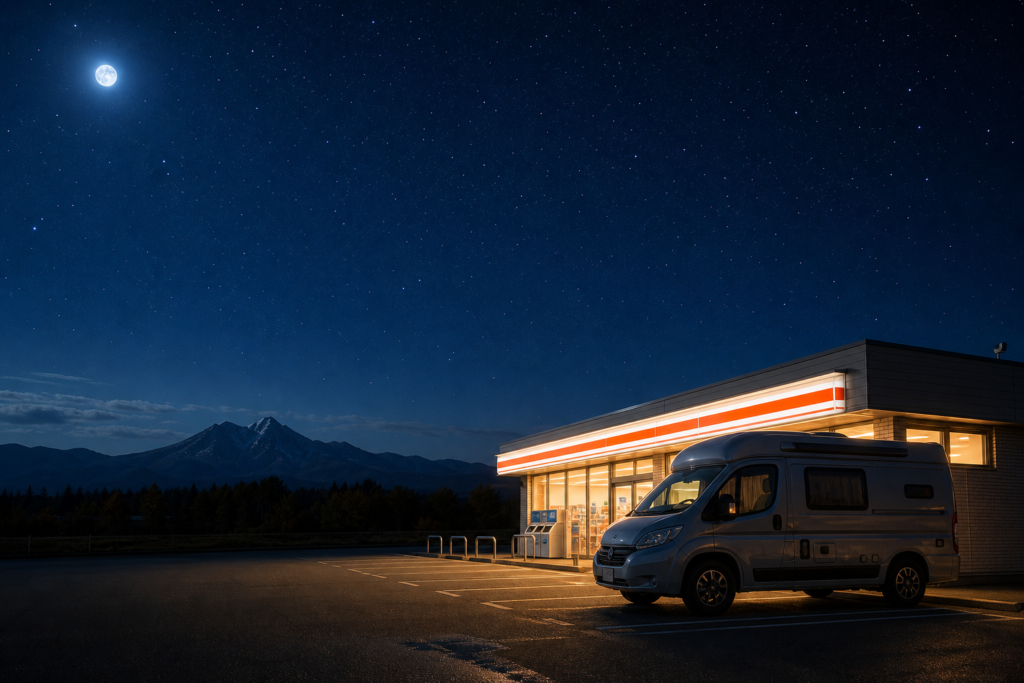
It’s late at night on a Hokkaido highway, and the next Michi-no-Eki is still more than 50km away. Drowsiness is creeping in, and up ahead you spot the lights of a convenience store. “Could I just sleep in this parking lot until morning?” If you’ve driven a campervan around Hokkaido, you’ve likely faced this exact situation. Once you leave the built-up areas, a convenience store is sometimes the only thing open late at night for long stretches of road, and that parking lot light is genuinely a relief to see.
Here’s the conclusion up front: convenience store parking lots were never built to be a place to sleep overnight. A short nap to fight off drowsiness and a full night of overnight parking (shachuhaku) are two different things, and they need to be treated separately. This article doesn’t go deep into the legal side of things — it focuses on the manners needed to avoid causing trouble for the store or the neighborhood, and to keep yourself out of trouble too. If you want the legal picture — how overnight parking is treated at Michi-no-Eki, expressway SAs/PAs, public roads, and private land, based on statutes and official positions — that’s all covered in our article checking whether overnight parking in Japan is illegal. From here on, this article is about manners.
Who is a convenience store parking lot actually for?
This is the starting point for thinking about manners. A Michi-no-Eki is registered as a “rest facility for road users,” and its 24-hour parking lot and restrooms are open on that basis. Expressway SAs and PAs are also facilities set up specifically for drivers to rest. A convenience store parking lot, on the other hand, sits on the grounds of a for-profit business — it’s private land, provided so customers have somewhere to leave their car “while they shop.” It was never opened up as a place for resting or sleeping overnight, and that difference in premise matters.
| Location | Nature of the parking lot | How rest / napping is positioned |
|---|---|---|
| Michi-no-Eki | Rest facility for road users | Rest is the intended use. Staying multiple nights for lodging purposes is not expected |
| SA / PA | Expressway rest facility | Rest and napping are one of the intended uses |
| Convenience store | Private land of the store (for shoppers) | Short-term parking tied to shopping is the premise. Overnight stays are not expected |
The reality is “it’s private land, so it comes down to what the owner (the store) decides.” Some stores quietly tolerate it, while others post notices asking people not to park for long periods. In other words, there’s no blanket answer to “is overnight parking at a convenience store OK or not” — all you really have is a position where you might be allowed, within the store’s goodwill, to use the space in a way it was never intended for. If you keep that position in mind, the right actions tend to follow naturally.
Incidentally, this site also has a Michi-no-Eki overnight parking manners guide, but that one covers public rest facilities. Read this article not as a “convenience store version” of that guide, but as a separate topic altogether, since the premise — private land, a for-profit business — is different. Even though it’s the same act of “sleeping in a parking lot,” the level of consideration expected here is a step higher.
Why convenience store parking lots turn into trouble so easily
Before getting into the specific manners, it helps to understand the structure of why trouble happens. Once you know the reasons, you’re less likely to misjudge a situation you’ve never been in before.
First, these lots are small and turn over quickly. A convenience store parking lot often has room for only a handful to a dozen or so cars, with customers cycling through every few minutes. If a vehicle sits there unmoved overnight, it blocks off one parking spot (effectively two, for a campervan) that’s directly tied to the store’s sales. The smaller the lot and the higher the customer turnover, the less tolerance there is for long-term parking.
Second, campervans stand out. An ordinary car parked overnight might go unnoticed, but that’s not the case for a cabcon nearly 3 meters tall. Staff and neighbors alike will register, “that vehicle has been there since evening.” Whether it works for or against you, it’s more accurate to assume that everyone around is watching what a campervan does.
Third, stores are short-staffed late at night. Many run with a skeleton crew overnight, and it’s both a burden and a psychological hurdle for a staff member to walk up and speak to a suspicious-looking vehicle themselves. As a result, the response sometimes comes not as a direct word but as a call to the police. Even if you were sleeping with no bad intent, a knock on the window and a police check in the middle of the night is a real possibility.
Fourth, convenience stores in Hokkaido’s built-up areas often sit right next to houses. Idling noise and exhaust, doors opening and closing late at night, voices outside the vehicle — these reach not just the store but the bedroom next door. Even if the store itself lets it slide, a complaint from the neighborhood can force the store to act anyway.
Six manners worth keeping to avoid trouble
Here’s the main point of this article. Assuming you’re borrowing a convenience store parking lot for a short nap, here’s what that looks like in concrete terms.
1. Turn the engine off. Don’t sleep with it idling
Idling while napping is a nuisance to those around you, both from the exhaust and the noise. A campervan’s engine is louder than an ordinary car’s, and it carries to the customer parked next to you and to nearby homes. Many local governments require idling to stop under ordinances or guidelines, so “turn the engine off before sleeping” is the basic move.
This is exactly where a campervan fitted with an FF heater and a sub-battery earns its keep: it lets you run heating and power with the engine off, which is the whole point of having that equipment. Put another way, if you have that gear and still sleep with the engine idling, it drags down how campervan travelers are seen as a whole. In winter Hokkaido, there’s also a real danger if snow buries the vehicle while it’s idling — a blocked muffler can send exhaust back into the cabin, which is a matter of your own safety long before it’s a matter of being a nuisance.
2. Don’t dump your trash in the store’s bins
A convenience store’s trash bins are there for trash from what you bought at that store. Stuffing in the trash that’s built up in your vehicle over the trip — yesterday’s bento container, cooking scraps, cans and bottle bags — shifts the store’s own disposal costs onto them to cover your travel expenses. The rule is to take your trash with you, or dispose of it at a lodging facility or a site equipped to handle it. Leaving a trash bag outside the vehicle and driving off is out of the question — in a crow-heavy place like Hokkaido, it will be scattered across the whole lot by morning.
3. Buy something. Use the lot as a paying customer
If you’re going to use the parking lot, be a customer of that store. A single drink, a late-night snack, or coffee the next morning all work — it’s not about the amount. What matters is following through on the logic that “a parking lot for shoppers gets used by an actual shopper.” A vehicle that spends nothing and occupies the lot for hours reads completely differently to the store than one that buys something each time it takes a break.
4. Be careful where you park. Avoid the entrance and the delivery route
Park in the spot farthest from the store’s entrance. The spots right in front of the entrance are prime, high-turnover real estate, and a campervan sitting there for hours will visibly get in the way of business. Late night through early morning is also when delivery trucks come and go, so avoid any spot that blocks the delivery route or the path to the back of the store. If your vehicle doesn’t fit within one marked space and spills into a second, take that as a sign the lot isn’t sized for your vehicle, and go find somewhere else — that’s the wiser call.
5. Keep quiet and dark at night. Don’t live outside the vehicle
Doors opening and closing, loud conversation inside the car, leaking TV or music sound, a bright interior light — none of it would register during the day, but in a quiet parking lot late at night it carries. And the one thing you absolutely shouldn’t do is spill out beyond the vehicle. Setting up chairs or a table in the lot, cooking outside, propping the door open for ventilation — that’s camping, not napping, and doing it in a private parking lot invites complaints. Cooking smoke and smells reach both the store and the neighbors. The line is simple: everything happens inside the vehicle.
In summer, it’s tempting to open the windows to cool off, but open windows let conversation inside the car carry straight outside. Hokkaido has its share of tropical nights in built-up areas during July and August, and “windows wide open plus chatting” stands out far more than expected in a parking lot late at night. The same goes for families — if a child wakes up and their crying or soothing voices carry, that’s a cue to consider moving rather than staying put. If you’re napping with passengers, whether everyone can actually stay quiet is worth factoring in before you park.
6. If someone speaks to you, move before you explain yourself
If a staff member tells you, “please don’t park here for a long time,” comply on the spot and move. It’s the store that decides how its private parking lot gets used. Pushing back with “it’s only for a little while” or “other cars are parked here too” only grows the trouble yourself. On the flip side, mentioning it at the register beforehand — “I’m hitting my limit, would it be okay to nap in the parking lot for about 30 minutes?” — lets the store know what’s going on and avoids the kind of misunderstanding that leads to a call to the police. That heads-up only works if you’re prepared to move immediately should they say no.
A 30-minute nap and a full night of overnight parking are entirely different things
Even if you follow every manner above, none of it answers the separate question of whether it’s okay to stay the whole night. A nap and overnight parking mean something different to the people around you.
Continuing to drive while drowsy is dangerous, both to you and to others. Pulling over somewhere safe for a short sleep before you doze off at the wheel is less a rest stop and more an emergency measure to prevent an accident, and a 30-minute-to-one-hour nap alongside a purchase is very unlikely to become a problem as long as you keep to the manners above. Hokkaido’s cities are far apart, and driving at night will always bring on drowsiness eventually. Buying a drink at a convenience store and napping is a far better call than pushing on regardless.
Staying from evening until the next morning, on the other hand, is “lodging.” Setting up the bed, closing the curtains, and occupying a parking spot for close to ten hours — nobody would call that an extension of a shopper’s parking. Using it as a place to sleep, when your plans weren’t even disrupted by the store, means pushing an unintended use through purely for your own convenience. Don’t build “sleeping in a convenience store lot tonight” into your itinerary — make a place meant for overnight stays your actual destination from the start.
When you’re not sure, ask yourself: “is this a nap to prevent an accident, or lodging to save on a room?” — that usually settles it. If you meant to nap but you’re tired enough that you’ll likely sleep three or four hours, that’s no longer a state a nap can cover. On a day like that, it’s easier on both your body and your schedule to push on (or swap driving with a passenger) to the nearest place where staying overnight is actually fine, and call it a day there.
If you plan to stay overnight, make a place built for that your destination from the start
Hokkaido has plenty of places built around the assumption of overnight parking. Most reasons to spend the night at a convenience store disappear once you plan ahead.
Start with Michi-no-Eki. They’re scattered along the main national routes, with 24-hour parking and restrooms. They aren’t lodging facilities, so multi-night stays or camping-style behavior should be avoided, but plenty effectively accept overnight parking as part of a journey. Reading our picks of Hokkaido Michi-no-Eki that work well for overnight parking alongside our roundup of the manners to keep at a Michi-no-Eki covers both where to go and how to behave once you’re there.
Going a step further, there are RV parks. These are paid spaces built specifically for overnight parking, and the fee covers the fact that they’re a “place you’re allowed to stay” — some come with power hookups, others handle trash disposal. Not having to walk the tightrope of manners is worth a lot on a night when you’re worn out from driving. How they work and how to use them is covered in our RV park guide.
There’s really only one practical trick: decide “where am I sleeping tonight” before you set off for the day. In Hokkaido, it’s completely normal for the next town to be 50 or 100km away. If you start looking for a place to sleep after dark, your options narrow fast, and you’ll end up drawn to the nearest convenience store light. Fix your destination for the day — a Michi-no-Eki, an RV park, or lodging — while it’s still evening, and the convenience store gets to stay what it’s meant to be: a reliable stop to restock along the way.
New from New Chitose Airport — Available from June 2026
Rent the Cabcon “Cresson Journey”
Base yourself at New Chitose Airport and compare rates, vehicle types, and pickup locations all in one place.
See details at Moving Inn →With a rental campervan fitted with an FF heater and a sub-battery, you can sleep comfortably with the engine off, so equipment naturally handles most of the manners covered in this article. All that’s left is choosing where to sleep.
Frequently Asked Questions
Q. Does sleeping in a convenience store parking lot break the law?
A. There’s no single answer — since it’s private land, whether that use is allowed comes down to the owner (the store). This article recommends, from a manners standpoint, avoiding use for lodging purposes. For the legal picture, including Michi-no-Eki, SA/PA, and public roads, see our article examining whether overnight parking is illegal.
Q. I’m at my limit for drowsiness. Is it okay to nap at a convenience store?
A. Pulling over to sleep is far safer than continuing to drive while drowsy. Buy something, turn the engine off, and keep the nap to about 30 minutes to an hour in a spot away from the entrance. Mentioning it at the register beforehand helps avoid any misunderstanding. Once you wake up, don’t linger — get back on the road.
Q. What should I do if a staff member says something to me?
A. Don’t argue — move right away. The authority to decide how the private parking lot gets used belongs to the store. Staying put instead of complying risks a bigger problem, such as a call to the police. If you have nowhere else in mind, search for a nearby Michi-no-Eki or RV park, and if there isn’t one, driving a little further to find a 24-hour bathhouse or a paid parking lot is a realistic fallback.
Q. Is there anything a campervan needs to watch for that an ordinary car doesn’t?
A. Yes. Because the vehicle is large and stands out, how it behaves becomes how campervans in general are perceived. Before pulling in, check whether it fits within a marked space, whether it blocks the delivery trucks’ route, and whether height limits or overhangs are a risk — and if it doesn’t look like it fits, don’t pull in at all. An FF heater lets you get through the cold without idling, so it’s worth learning how to use your equipment before you set off.
Q. Is there anything specific to watch for when napping at a convenience store in Hokkaido winters?
A. Avoid napping with the engine idling while it’s snowing. Snow building up around the muffler can send exhaust back into the cabin, risking carbon monoxide poisoning. The basic approach is to turn the engine off and stay warm with a sleeping bag, blankets, or an FF heater. In lots where snowplows come through, also avoid parking in a spot that would get in the way of plowing — a winter-specific consideration.
New from New Chitose Airport — Available from June 2026
Rent the Cabcon “Cresson Journey”
Base yourself at New Chitose Airport and compare rates, vehicle types, and pickup locations all in one place.
See details at Moving Inn →Convenience stores are an important resupply point that keeps a Hokkaido campervan trip running. That’s exactly why it’s worth keeping the relationship one you can enjoy — treating them as a place to stop by, not a place to stay the night. Decide where you’re sleeping at the planning stage, and that alone keeps you clear of almost every problem covered in this article.
Book a Campervan in Hokkaido
Moving Inn New Chitose Airport supports English booking and offers airport transfers.
![Hokkaido Winter Trip: Shoes & Packing List [2026] – 2,060 Sapporo Fall Transports and a Pre-Departure Checklist](https://hokkaido-campingcar.jp/wp-content/uploads/2026/10/hokkaido-winter-trip-shoes-packing-eyecatch-768x432.webp)
![Snow Cancels Your New Chitose Airport Flight? Rebooking Rules and Campervan Rental Delays [2026]](https://hokkaido-campingcar.jp/wp-content/uploads/2026/10/new-chitose-airport-snow-cancellation-eyecatch-768x432.webp)