Hokkaido Sugoroku: A Free Road-Trip Board Game Around Hokkaido
Hokkaido Sugoroku is a free browser board game: a road trip from New Chitose Airport over 39 real RV parks and campgrounds. What's new, how to play, and ways to enjoy it.
Want to visit Hokkaido, but not sure how big it really is?
This game is for you.
No sign-up · 1 to 3 players · Works on a phone
English · Japanese · Traditional Chinese · Korean
- You get a feel for the size as you play. The distances are real road distances, and you can drive up to 200 km a day.
- When the game ends, you get an itinerary. The roads you drove become a first draft of your trip.
- You can play with your travel companions. Up to 3 people can play by passing one device around.
Ways to enjoy it
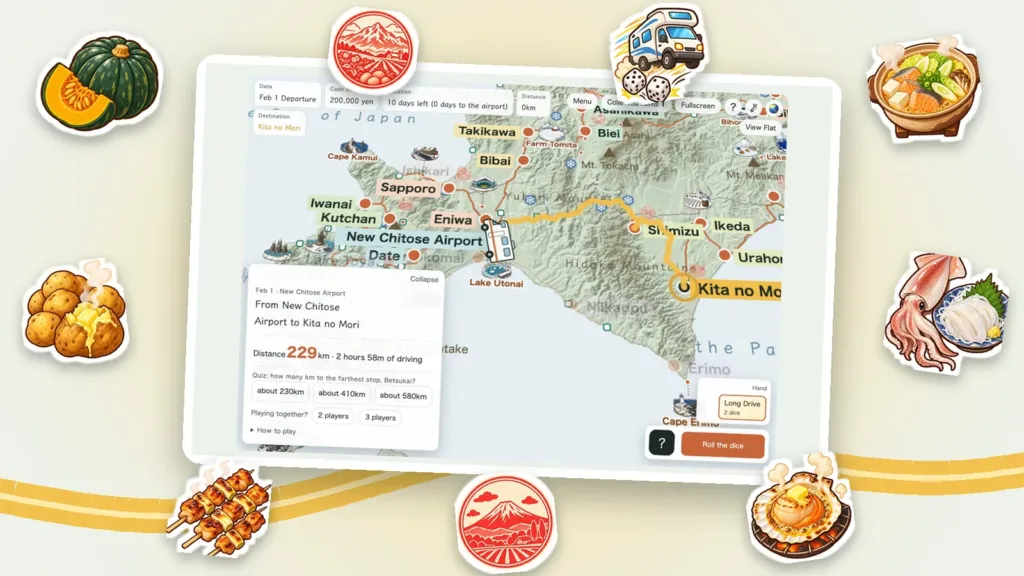
SoloScout your next vacation. You get an itinerary when the game ends.With 2 or 3Pass one device around and choose where to go together.Collect38 local specialties and 21 travel stamps. Your Specialty Book fills up.CompareThe course changes between summer and winter. Change the departure month and play again.
Hokkaido Sugoroku is a free board game. You take a road trip around Hokkaido, starting from New Chitose Airport. When you open it, the road from the airport to your first destination lights up on the map. Then you just roll the dice. This page was checked on November 12, 2026.
It runs in your web browser. There is nothing to download or print, and you don’t need an account. It works on a phone, too. You can play alone, or with up to 3 people. The game is fully in English.
Hokkaido is bigger than it looks on a map. The roads and distances in the game are real. As you roll the dice, you start to feel it: “This town is a full day’s drive away.” By the end, you will probably have found a few towns you really want to visit.
What is sugoroku?
Sugoroku is a traditional Japanese board game. In the picture version, called e-sugoroku, players roll a die and move from the start square, furidashi, toward the goal, agari. Harvard-Yenching Library describes it as “a racing game similar to Snakes and Ladders.”
Picture sugoroku spread as popular entertainment in the Edo period. From around the late 17th century, boards themed on journeys came to be called dochu sugoroku, or travel sugoroku. Long trips were still hard for most people. These boards let them enjoy the feeling of traveling at home. Over time, squares such as “lose a turn” were added. Sugoroku also became a classic New Year’s game in Japan.
Sources: National Diet Library, Japan (in Japanese), Waseda University Library (in Japanese), Harvard-Yenching Library.
Hokkaido Sugoroku is a travel sugoroku for today. The squares are real RV parks and campgrounds, and the roads are real roads.
How to play: roll the dice and choose where to go
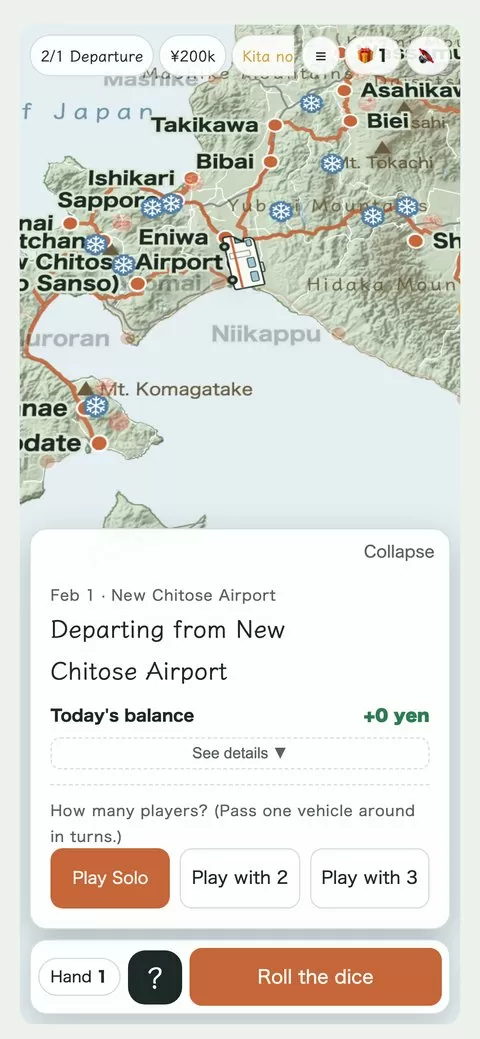
You don’t need to set anything up or read a rulebook. The screen shows a map, your cards and the day’s events together. Most of the time, you just press a button. There are four steps.
1. Choose where to go
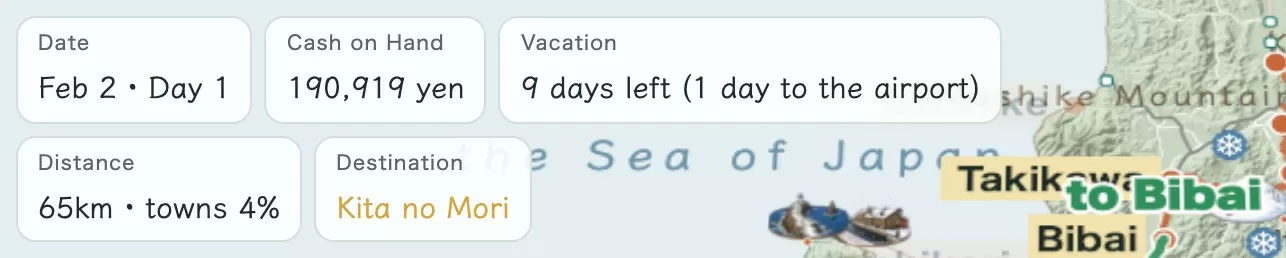
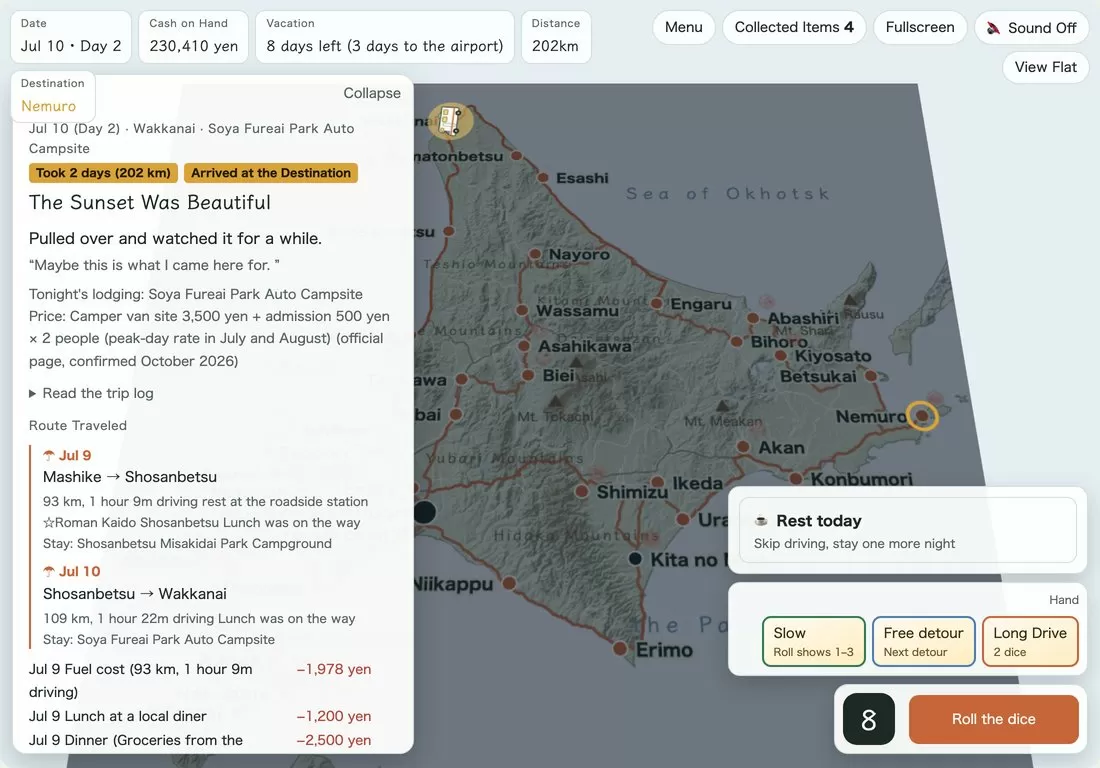
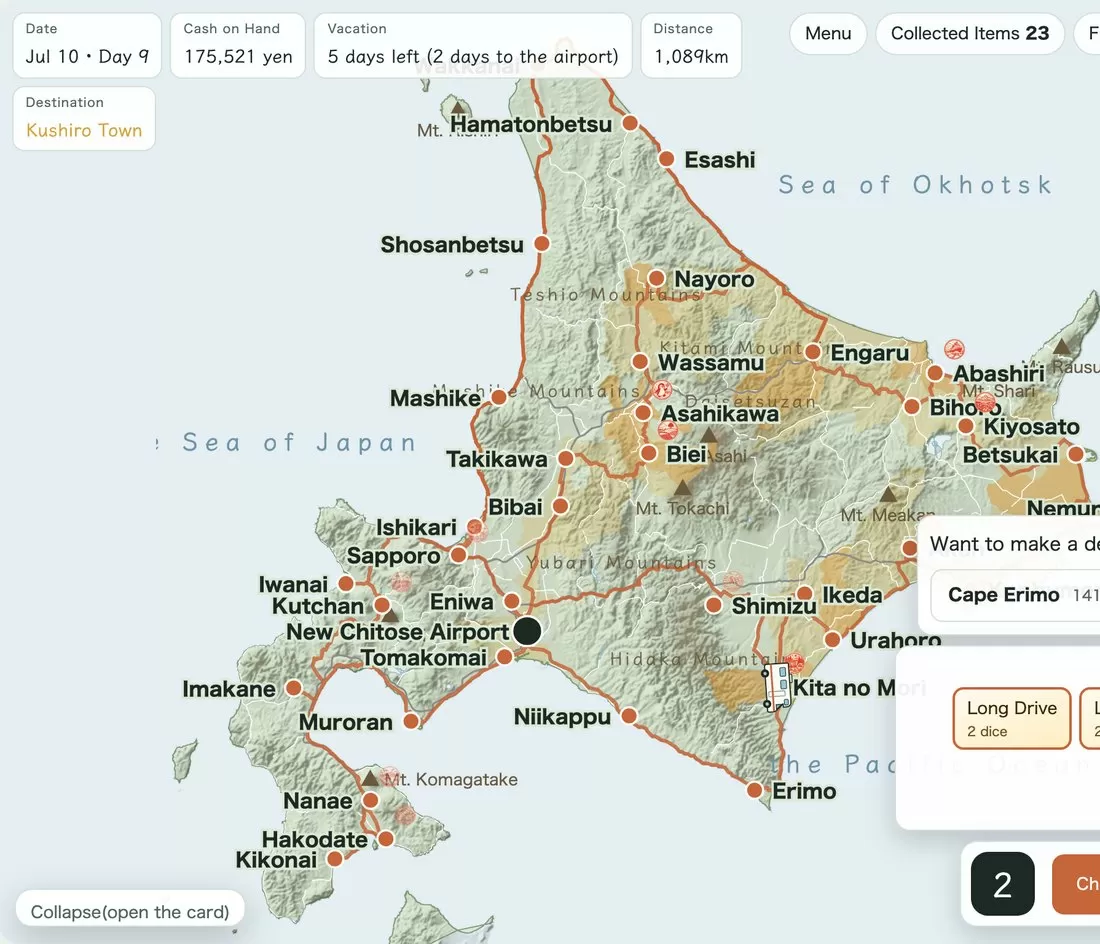
At the start, you choose your trip’s goal from six options: Kita no Mori in Taiki Town, Hakodate, Biei, Abashiri, Nemuro and Kushiro. If you choose Kita no Mori, the day you arrive there is the goal. The bar at the top shows the date, your money, the days left in your vacation, the distance you’ve driven and your destination. You can see how your trip is going at a glance. If you keep traveling after the goal, a roulette picks your destination each time you arrive, and you get a bonus when you get there.
2. Pick a card and roll
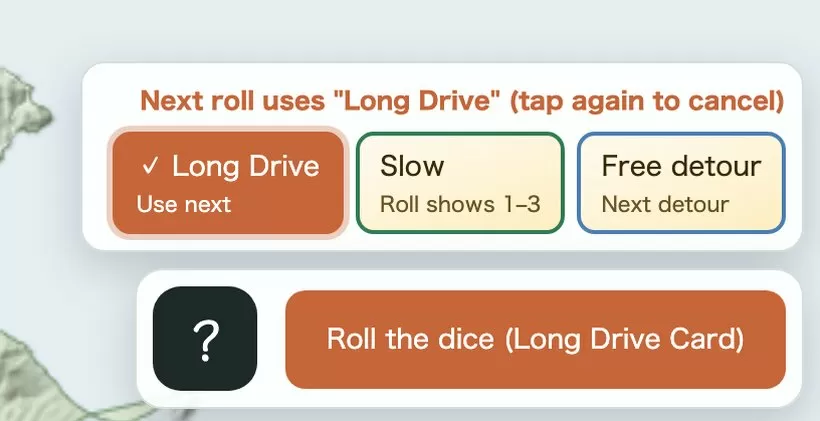
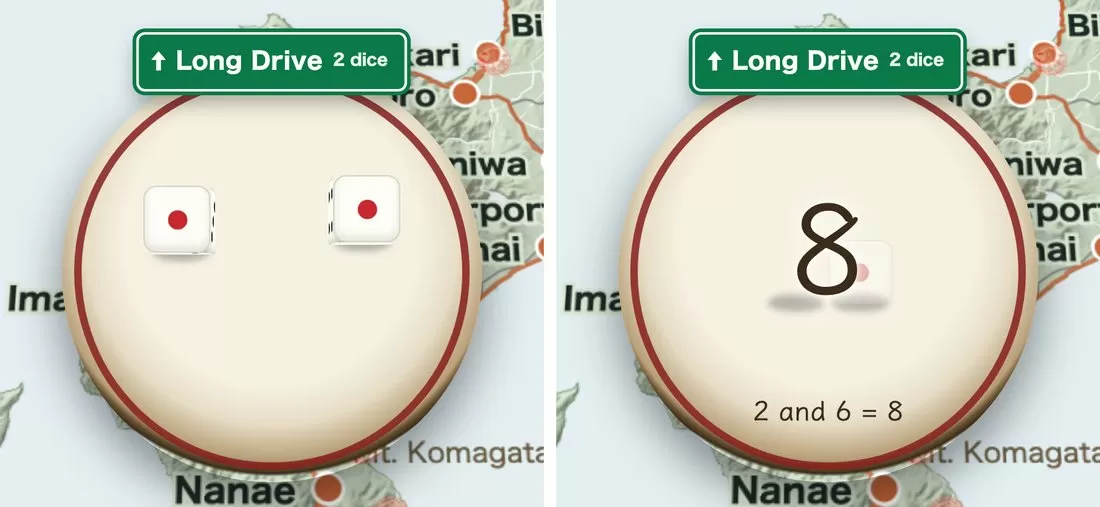
Check the cards in your hand, then roll. The Long Drive card lets you roll two dice. When you roll with a card, a green sign like a Japanese expressway sign appears. The dice stop one by one, and the total shows up big.
3. Pick a route and drive
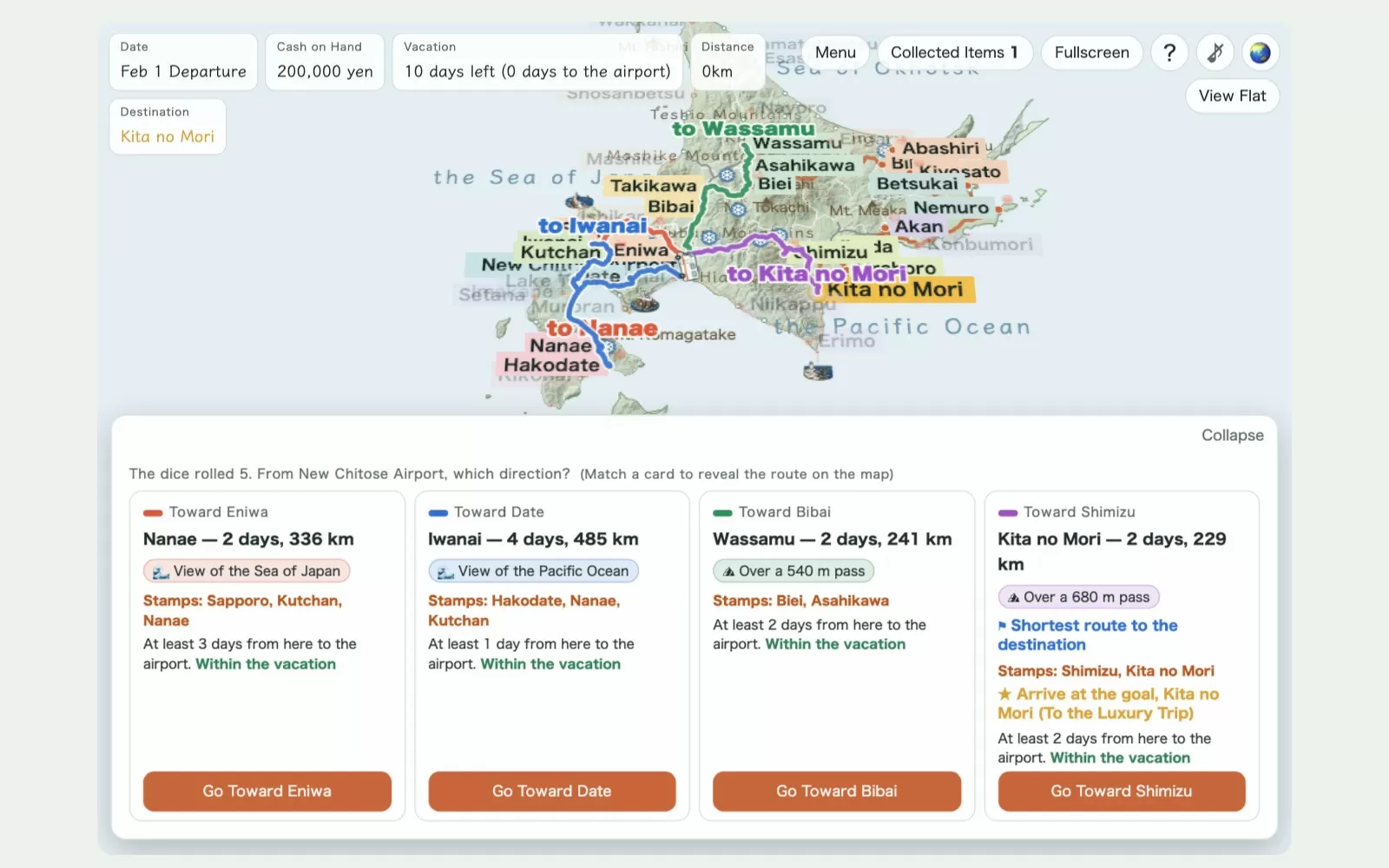
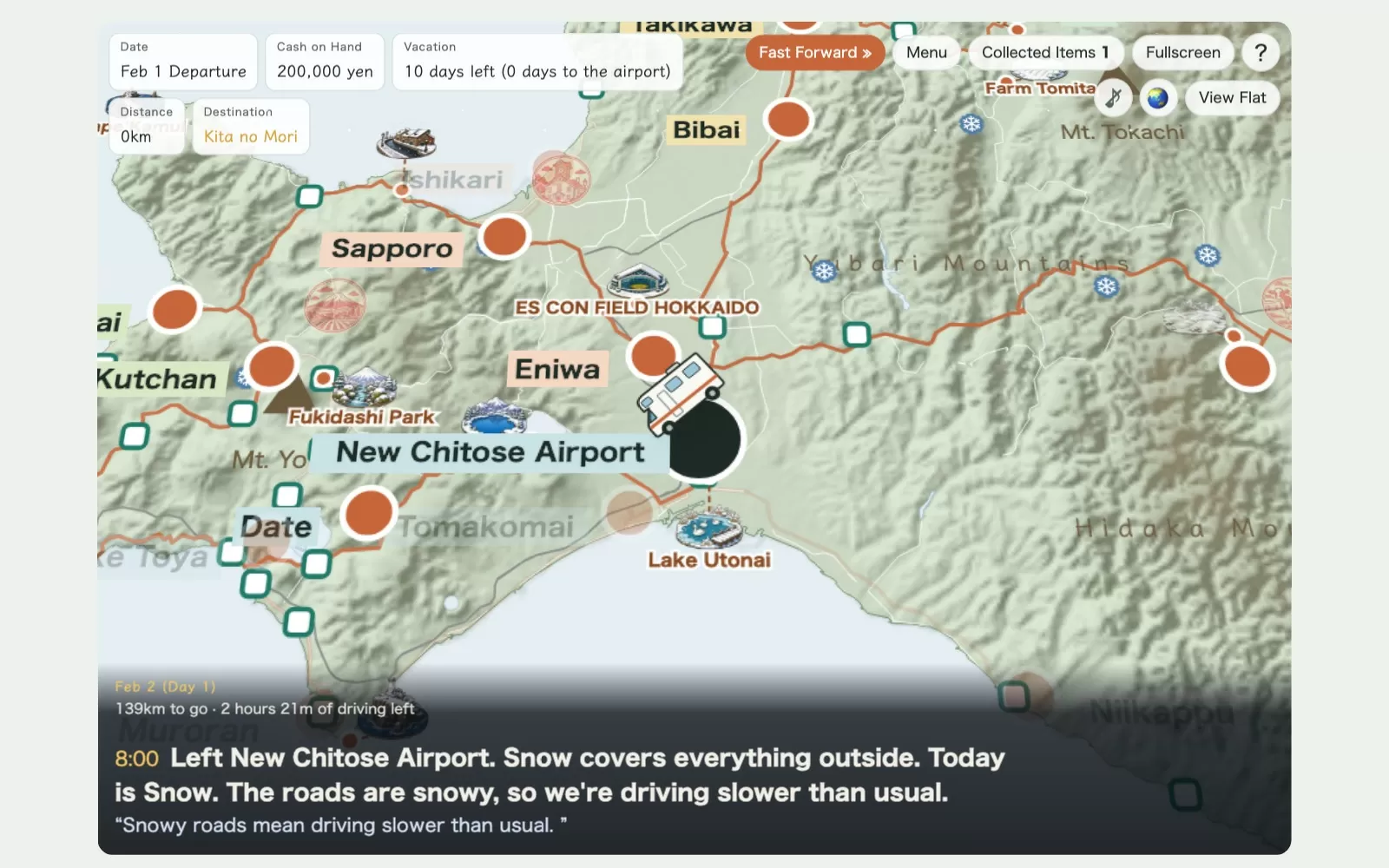
Choose your route from the options for each direction. Each option shows how many days and kilometers it takes, whether it’s the shortest route to your destination, and which stamps you’ll get. While you drive, the screen shows “Xkm to go · X hours Xm of driving left.” Just before you arrive, it says “Coming up: X.” You drive up to 200 km and 9 hours a day. If a trip is longer, you stay overnight at a square on the way. For safe driving, this limit never changes, even in winter.
4. Read about your day
When you arrive, the day’s events come to you as a card. You might take a break at a roadside station (michi-no-eki), buy a local specialty, or meet someone unexpected. It reads like a short travel diary. At the end of each day, it shows “Today: Xkm. So far, X% of all the roads (Xkm),” so you can see how far you’ve come. It also keeps a record of your route, fuel and lodging costs.
Repeat these steps and you’ll feel like you’ve traveled around Hokkaido. When you reach your goal, Kita no Mori in Taiki Town, a “luxury trip” begins. You stay there and enjoy day trips around the area (up to 5 nights). Get back to New Chitose Airport to finish a lap, or keep going for a second or third lap.
What do you get as you go? Specialties and stamps keep adding up
Buy a specialty in a town where you stay, and the screen shows “(Name) GET!” The specialty goes into your Specialty Book. In towns marked on the map, you also get a travel stamp, even if you only drive through. When you rest at a roadside station (michi-no-eki), a card sometimes joins your hand.
Tap “Collected Items” at the top of the screen to look back at what you have. In the Specialty Book, specialties you have not found yet show as “???”. The more you travel, the fewer “???” are left, and the more stamps fill in. That gives you more reasons to pick your next stop: “Let’s go get that town’s specialty.”
There are 38 specialties across 11 areas, and 21 travel stamps. The summer and winter courses offer slightly different specialties. Collect every specialty in one area and you see “Complete!”
There are many other small rewards along the way, such as a goal celebration and a winter bonus. All the money is in-game money. Nothing costs real money.
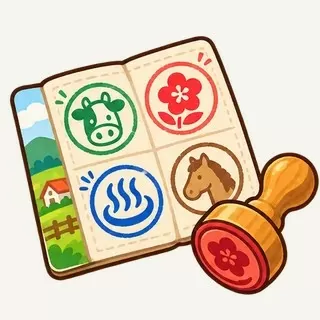
You get one in each of the 12 marked towns. Just passing through counts.

Buy a specialty in a square’s town to collect it. There are 38 across 11 areas.
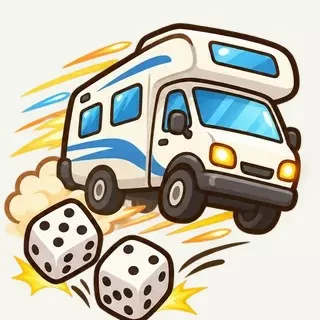
You sometimes get one when you rest at a roadside station: Long Drive, Slow, Free Detour and Destination Change. A special card that lets you roll three dice is said to be at some far-off cape in Hokkaido.
You get this when you reach your goal, Kita no Mori. It’s the reward at the end of the trip.

You get this once a year, when January comes. A very Hokkaido kind of reward.

Collect every specialty in one area to complete it.

A bonus comes in automatically when the month changes.

After the goal, stay at Kita no Mori and enjoy day trips around it.
Can you play with family or friends? With three people, a special three days begins
Up to 3 people can play together by passing one device around. The cars are red, blue and green. You can’t play together with someone in another place.
If you play with three people, try making Kita no Mori your goal. When all three of you reach Kita no Mori, “All three are here! Three days at Kita no Mori” begins. Each of you stays in one of three rooms. For three days, you take turns choosing a day trip. With two players, these three days don’t happen.
At the end, you compare money and memories. The same Hokkaido makes for very different trips, depending on the roads you choose.
What happens when the game ends? You get your own itinerary
When the trip ends, “Your Hokkaido Itinerary” appears. One page shows whether you made it back to the airport, a map of the roads you drove, the days and distance, and the places you stayed.
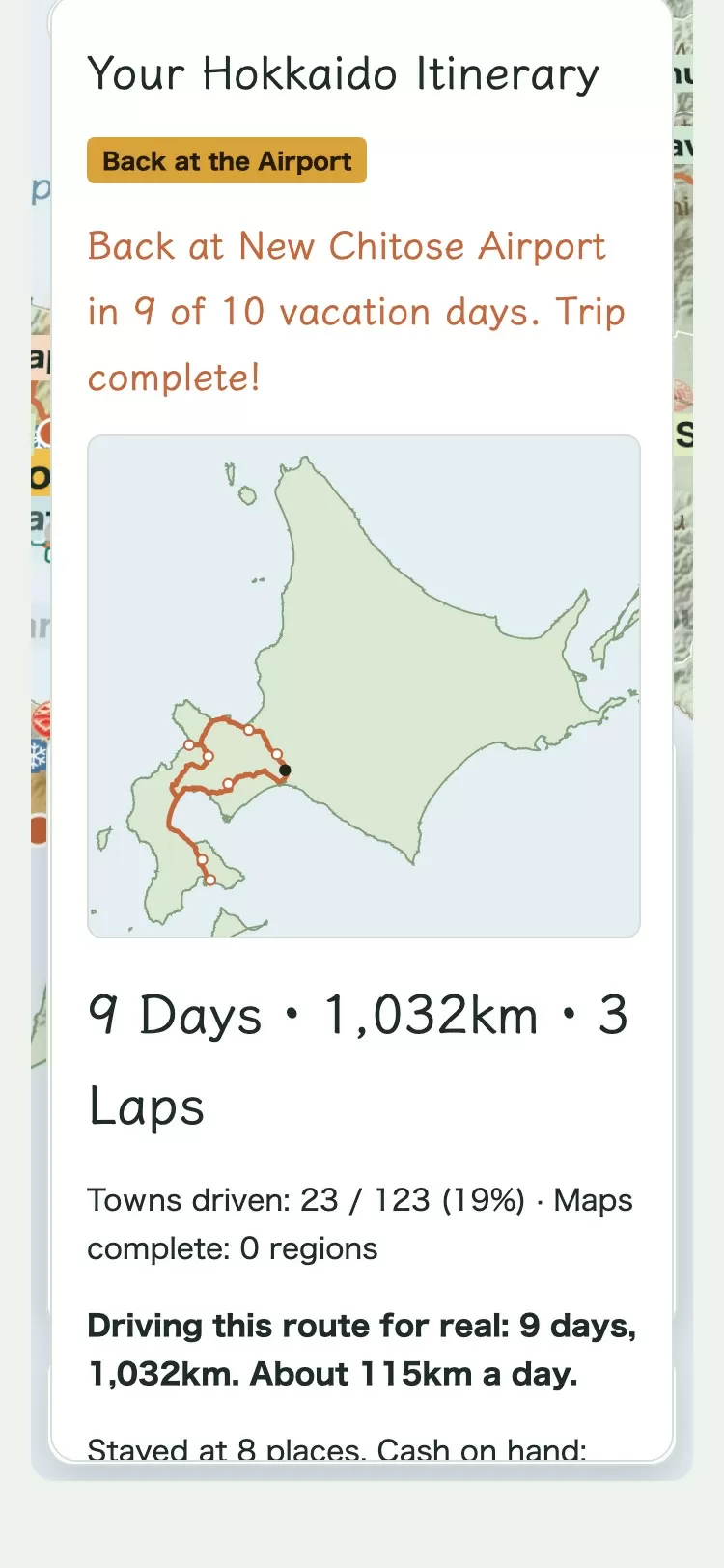
It also shows one line: “Driving this route for real: X days, Xkm. About Xkm a day.” The distances and driving times come from real roads. So you can see the roads you chose in the game as the length of a real trip.
It also lists “Areas you haven’t driven yet,” which makes a good starting point for your next trip. Press “Copy Itinerary” to take the itinerary out as text and send it to the people you’re traveling with. If you played alone, press “Play again on another road” to try a different route.
What’s new? Screens that show how your trip is going
In November 2026, we reworked the screens so players can see how their trip is going more easily. Five things changed.
- You see the road ahead as soon as you open it. The road from the airport to your destination lights up, with the distance and driving time. You don’t have to read any instructions: roll the dice and you’re off.
- You see what’s left while you drive. The screen shows “Xkm to go · X hours Xm of driving left” and “Coming up: X.”
- At the end of each day, you see how far you’ve come. It shows “Today: Xkm. So far, X% of all the roads (Xkm).”
- At the end of the trip, you get an itinerary. One page shows whether you made it back to the airport, a map of the roads you drove, and the areas you haven’t driven yet.
- Play with three people and you get a special three days. It starts when all three reach Kita no Mori.
Want to play more? Try a different vacation length or season
The rules are simple: roll the dice and move. But changing your goal, the length of your vacation or the month you travel makes for a completely different trip. Here are a few ways to play.
Head for Kita no Mori and enjoy a luxury trip
We recommend Kita no Mori in Taiki Town as your goal. The day you arrive is the goal. Then a “luxury trip” begins: you stay at Kita no Mori and take day trips around the area (up to 5 nights). You can also pick a faraway town such as Nemuro or Abashiri as your goal and make a big loop of Hokkaido.
Set your vacation length and race the clock
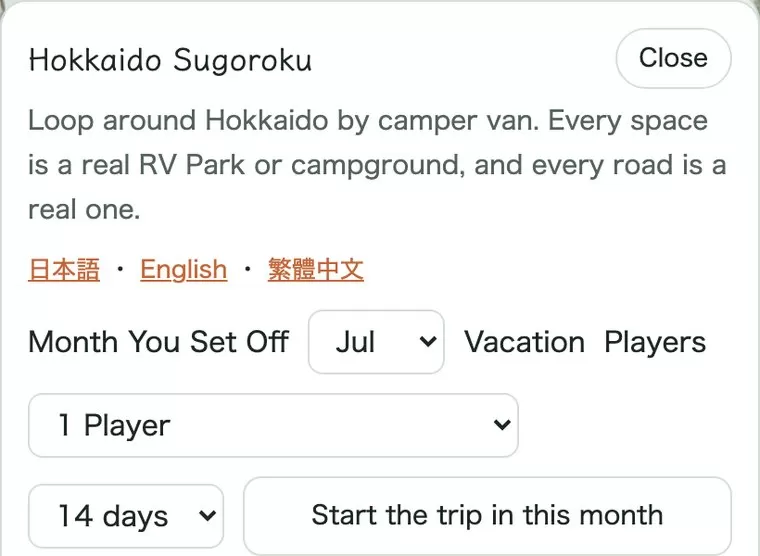
In the menu, choose a vacation of 7, 10 or 14 days, or No Limit. Once you set a number of days, you finish the trip if you get back to New Chitose Airport by the last day. If your next break is 7 days long, try 7. Goals and route options show whether you can make it back in time, so you can plan around that.
Fill in the map of Hokkaido
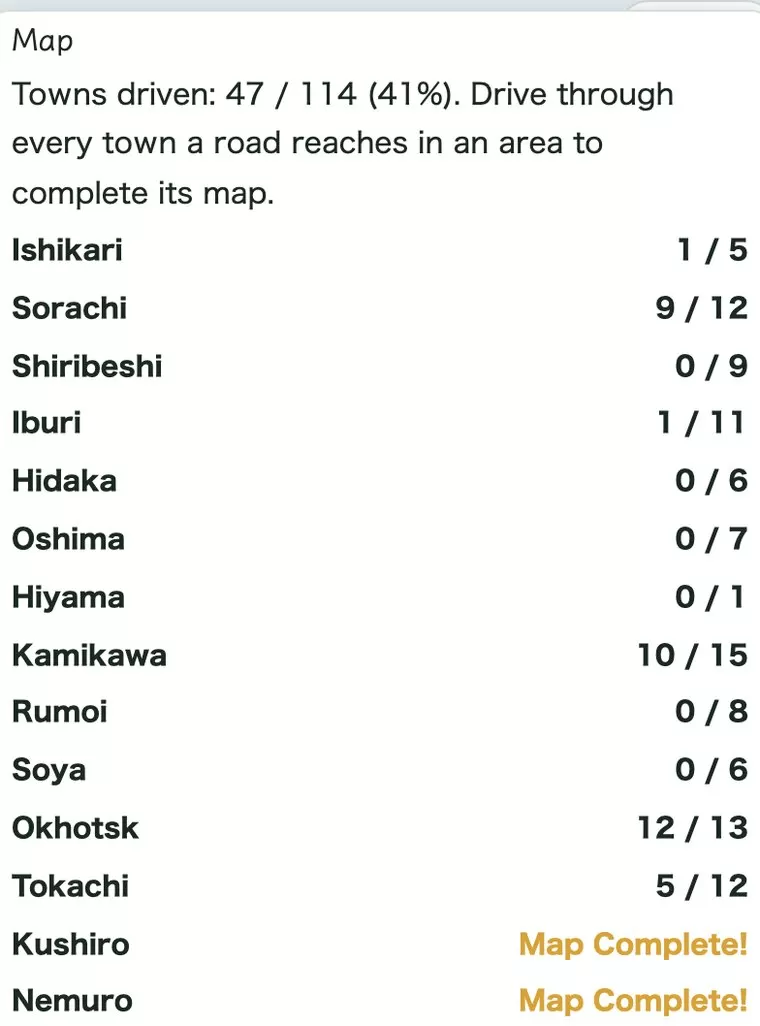
Towns you drive through get a light color on the map, and towns where you stay get a deeper one. Drive through every town a road reaches in a subprefecture to complete its map. You get a bonus at each monthly settlement. By the time you finish a lap, the towns along your route are colored in.
Collect local specialties and travel stamps
Buy a specialty in a town where you stay and it goes into your specialty book. Collect every one in an area to complete it (there are 38 in all). There are 21 travel stamps, with a bonus for collecting them all. Deciding what to collect changes which detours you take.
Play in a different season
You can choose the month you travel. From December to March, you follow a winter course that links only places open in winter, and in January you get a winter bonus. From April to November, you follow the summer course, with coastal roads too. In July and August, you can even drive north to Wakkanai and down the Okhotsk coast. Weather, snow and events change by month.
Which roads can you take only in summer? Three coastal roads
The summer course, from April to November, has three coastal roads that branch off the loop. On all three, you stay at campgrounds near the sea.
The Hidaka and Erimo coast: from Tomakomai through Niikappu and Hyakuninhama in Erimo to Kita no Mori. Hyakuninhama Auto Campsite is open from April to October, so in November you drive past without staying.
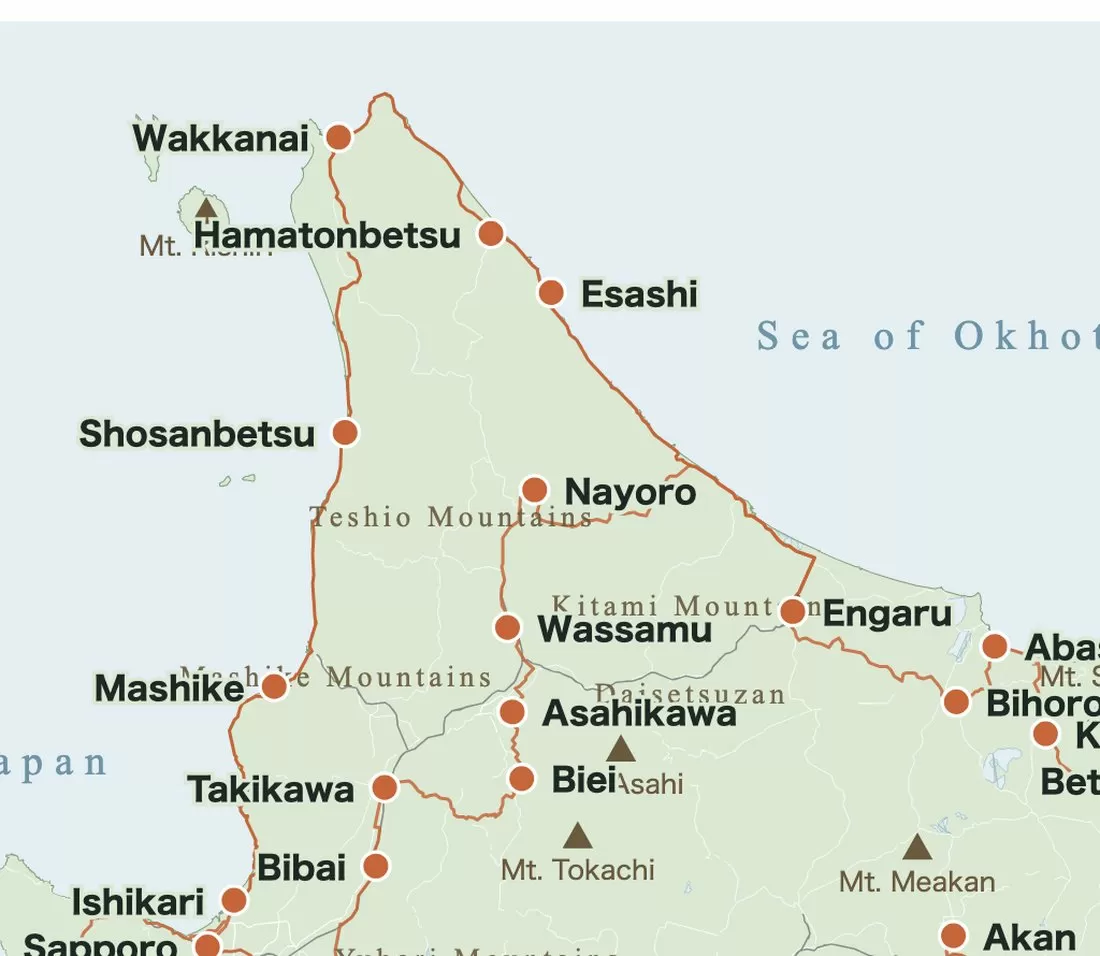
From the northern Sea of Japan to Soya and the Okhotsk coast: from Ishikari through Mashike, Shosanbetsu, Wakkanai (Soya), Hamatonbetsu (Lake Kutcharo) and Esashi to Engaru. You can take this road only in July and August, when the campgrounds are open.
The Hiyama coast: from Iwanai through Setana Town to Kikonai. You stay at a campground in Setana Town. You can take this road only from May to October.
Are the squares real places? Yes, every square is a real place in Hokkaido
The squares are 39 real RV parks and campgrounds. You start from Moving Inn New Chitose Airport and loop around central, southern, northern and eastern Hokkaido. You pass through places like Eniwa, Kutchan, Hakodate, Asahikawa, Abashiri, Kushiro and Taiki. The roads, distances and driving times are real. Search for a square’s name in a map app and you’ll find a place you can actually visit. Kita no Mori, the goal in Taiki Town, is an RV park where you can really stay.
From December to March, you follow a winter course that links only places open in winter. You never stay somewhere closed for the season.
The local specialties are real too: yakitori in Muroran, surf clams in Tomakomai, squid in Hakodate, ramen in Asahikawa, hanasaki crab in Nemuro, wine in Ikeda, Tokachi, and more.
Driving in Japan with a foreign license
If the game makes you want to take a real road trip, check your license first. You need an International Driving Permit issued under the 1949 Geneva Convention. Licenses from Switzerland, Germany, France, Belgium, Monaco and Taiwan can instead be used with an official Japanese translation. Licenses from mainland China cannot be used to drive in Japan. (Source: Tokyo Metropolitan Police Department, in Japanese)
Also in Traditional Chinese and Korean
Hokkaido Sugoroku is also available in Traditional Chinese and Korean. Friends and family who read those languages can play the same board.
FAQ
Is it free?
Yes. There’s no sign-up and nothing to buy. Just open the page and play. You don’t need to install an app.
Can I play on my phone?
Yes. The layout adjusts to your screen, so it works on a smartphone too. Sound is off at first, so you can play on a train.
How many people can play?
From 1 to 3 people. With 2 or 3 players, you pass one device around. You can’t play together with someone in another place.
Do I need to read Japanese?
No. The English version translates the whole game, including the day’s stories, place names and menus.
How many squares are there?
There are 39 real RV parks and campgrounds, or 40 squares including the starting point at New Chitose Airport. Eight of the campgrounds can only be reached in summer.
If I stop partway, can I pick up where I left off?
Yes, on the same device and in the same browser. When you open the game, you can choose “Continue” or “Start Over.” Your game can’t be carried over to another device.
What happens when all three players are together?
If you’re playing with three people and all three reach your goal, Kita no Mori, “Three days at Kita no Mori” begins. You stay in three separate rooms and take turns choosing a day trip. With two players, it doesn’t happen.
Is the game over if I run out of money?
No. Your trip continues even at 0 yen. Destination bonuses, stamps and completed sets help you get back on your feet.
Once you’ve traveled around Hokkaido in the game, it’s time for the real thing. Find the RV parks from the board in our list of RV parks in Hokkaido, and compare camper van rentals on our Hokkaido camper van rental guide.
Book a Campervan in Hokkaido
Moving Inn New Chitose Airport supports English booking and offers airport transfers.