Hokkaido Campervan Rental for Seniors: Key Considerations and Services [2026 Edition]
A guide to campervan travel in Hokkaido for seniors in their 60s and 70s: vehicle selection, daily mileage tips, age-related booking considerations, RV park accommodation, and cost simulation.
Pick a campervan by what matters to you.
Rent at New Chitose Airport
See only the rental bases in Chitose, where the airport is.
Rent in winter (Dec–Mar)
Companies that rent through winter, listed apart from those that close.
Guide price
Moving Inn New Chitose Airport: HIACE van conversion from ¥22,000 per night. 20–30% off when booked 60–90 days ahead (official rate table, checked 15 Oct 2026).
Before you book: with an International Driving Permit if your country is in the Geneva Convention (for example the US, Australia, Singapore); Taiwan, Switzerland, Germany, France, Belgium and Monaco need your licence plus a Japanese translation (Tokyo Metropolitan Police). Questions in English: Moving Inn on WhatsApp. Every roadside station (michi-no-eki) must have free 24-hour toilets, and Hokkaido has 128 of them (MLIT).
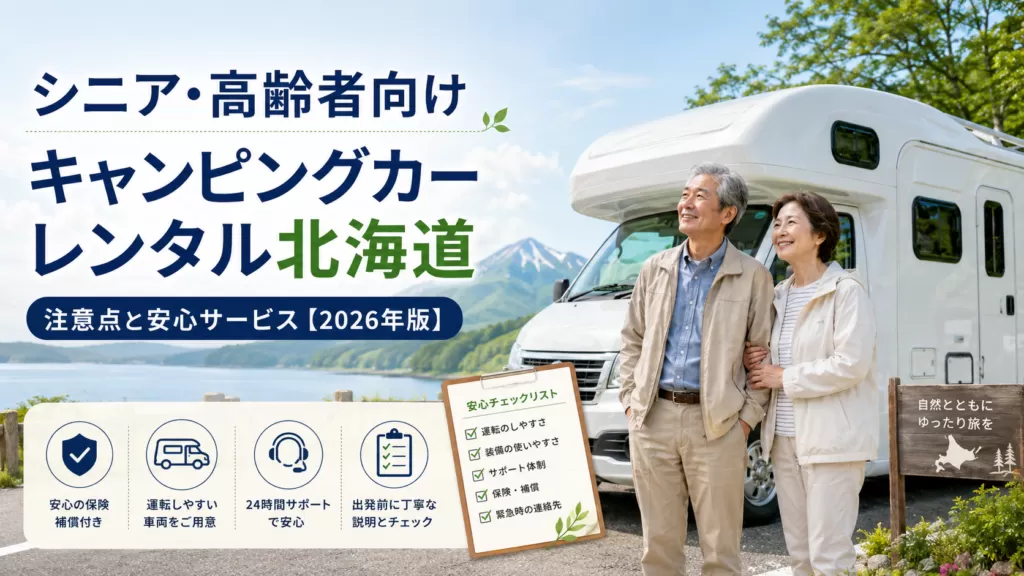
Many people in their 60s and 70s dream of touring Hokkaido by campervan after retirement. With the right preparation to manage physical demands, the trip can be done safely and enjoyably.
This article covers vehicle selection, tips for reducing physical strain, cost simulation, and recommended routes for seniors travelling by campervan in Hokkaido. It is structured so that first-time campervan renters can get a complete picture of what to check beforehand.
Suitable Vehicle Types for Senior Travellers
Campervans fall into broad categories: van conversions (vancon), cab-over conversions (cabcon), kei campervans, and bus conversions. For seniors, we recommend choosing based on ease of entry/exit, interior comfort, and driving ease.
Van Conversions (HiAce-based): Best for Easy Entry/Exit
Many operators recommend van conversions for seniors, primarily for ease of entry and exit. HiAce-based van conversions have a vehicle height similar to a standard minivan (approx. 1.9–2.1 m), so boarding and alighting can be done in a natural posture. The driving feel is based on the HiAce, so anyone who has previously driven a minivan or 1-BOX vehicle will find it familiar.
- Daily rate: ¥12,000–¥33,000
- Features: easy entry/exit, easy to park, good manoeuvrability
- Sleeping: rear converts to flat bed (check floor height)
- Best for: people in their 60s with no major physical limitations
However, the sleeping space tends to be close to the floor. If you have concerns about your knees or back, confirm whether the sleeping area design supports easy standing before booking. Some operators have vehicles with assist grips to help with getting up.
Cab-Over Conversions (Fixed Bed Type): For Those with Back or Knee Concerns
Among cab-over conversions, “fixed bed” types feature a permanently set-up bed at a raised height. The bed is higher off the floor than in a van conversion, which is easier on the back and knees. Even when you are tired from a day of travel, being able to sit on the edge of the bed before lying down is a significant advantage.
- Daily rate: ¥16,500–¥57,000
- Features: no need to set up the bed every night; living area and sleeping area are separate
- Note: entry/exit may require a step due to the higher vehicle body
- Best for: those with back, knee, or hip joint concerns; travellers aged 70+
The larger body size means parking can be tricky in small car parks at road stations or tourist sites. It suits travellers who prefer to “stay two or three nights in one place and take it easy” rather than moving every day. For help choosing between van conversions and cab-overs, see our Van Conversion vs. Cab-Over: What’s the Difference.
Kei Campervans: Fine for Short Stays or Trial Trips
Kei campervans are compact and inexpensive, but the sleeping space is limited and long-term liveability is lower. Physical strain can accumulate, so they are not recommended for seniors on trips of 4 nights or more. That said, if you just want to “try a campervan for the first time” on a 1–2 night trip, their manoeuvrability and low cost are useful advantages.
New Chitose Airport / Tokachi-Obihiro Airport
Rent the Cabcon “Cresson Journey”
Base yourself at New Chitose Airport and compare rates, vehicle types, and pickup locations all in one place.
See details at Moving Inn →Daily Mileage Guidelines and Driving Plans
When seniors travel Hokkaido by campervan, we recommend keeping daily driving to within 100 km to manage physical strain. Hokkaido roads are full of straight stretches and feel comfortable, but long hours of driving cause more fatigue than you might expect.
Basic Principles for Driving Plans
- Under 100 km per day as the baseline. If you have energy to spare, increase sightseeing rather than distance.
- Arrive at your overnight spot by 2 pm. This avoids driving when you are tired in the evening.
- No more than 2 hours of continuous driving. Take a 15–30 minute break at a roadside station or rest area.
- Don’t rush the morning departure. A relaxed breakfast followed by a 9–10 am start is kinder to the body than an early departure to beat the crowd.
- Build in rest days with no driving. Setting aside one day in every 4–5 with no travel prevents cumulative fatigue.
Hokkaido tempts you with “just a little further and there’s a great view.” Cramming in too much distance will leave you exhausted by the latter half. “I’ll see the places I missed on the next trip” — this mindset is the key to enjoying a senior campervan trip to the end.
Daily Mileage vs. Physical Demand
| Daily Distance | Physical Demand | Suitable Itinerary Style |
|---|---|---|
| Under 50 km | Low | Stay 2–3 nights in one spot and explore the area |
| 50–100 km | Moderate | Leisurely loop connecting 2–3 locations |
| 100–150 km | Somewhat high | Only on days when you feel good and the roads are flat |
| Over 150 km | High | Not recommended as a regular daily distance for seniors |
How to Check Age Restrictions
Many campervan rental operators set age restrictions. If you are 70 or older, always confirm before booking.
General Situation at Various Operators
- Under 70: No restrictions at most operators. Book as normal.
- 70–74: Many operators require prior notification and a licence check. Some may decline.
- 75+: More operators cannot accommodate. Some require proof of completion of the senior driver course and cognitive function test under the Road Traffic Act.
Age restrictions vary by operator, so if none is listed on the booking form, confirm directly by phone or email. Some operators explicitly state “available for guests 75 and over,” so don’t give up — contact several.
Points to Ask When Confirming
- Age of driver(s) — all intended drivers
- Whether the licence is automatic-only
- Whether senior driver training or cognitive function tests have been completed
- Availability of assist step or assist grip for entry/exit
- Roadside assistance coverage (JAF or operator’s own service)
A list of Hokkaido operators and their policies can be found in our Top 15 Recommendations.
Choosing Body-Friendly Overnight Spots
For senior travellers, the quality of each night’s rest directly affects how tired you feel the next day. We recommend using well-equipped RV parks as your base accommodation rather than roadside station car parks.
Make RV Parks Your Default Overnight Base
RV parks are paid facilities equipped with electricity, water, toilets, and grey water drainage. They cost roughly ¥2,000–¥4,000 per night and offer a stable environment for rest. Unlike roadside station car parks, there is no need to run the engine for climate control, which makes for a much better sleeping environment.
A list of Hokkaido RV parks is available on the RV Park Official Site (Japan RV Association).
RV Parks Adjacent to Hot Springs
For seniors, being able to soak in a hot spring every evening makes a big difference to recovery. Hokkaido has RV parks adjacent to hot spring facilities, and some include a bath entry ticket in the nightly fee. Here are some representative areas.
- Lake Toya Onsen area (Lake Toya): Lakeside hot spring resort with gentle spring water that is easy on the body.
- Noboribetsu Onsen area (Iburi): Wide variety of spring types including sulphur, carbonated, and saline. About 1 hour from Shin-Chitose Airport — good for the start of a trip.
- Jozankei Onsen area (Sapporo Minami Ward): Easy to access from central Sapporo; a good base for touring central Hokkaido.
- Tokachigawa Onsen area (near Obihiro): Moor hot springs (plant-derived water) known for their restorative properties.
- Shiretoko / Utoro Onsen area (Shari Town): Combines well with Shiretoko sightseeing; many outdoor baths with views.
When choosing an overnight spot, working backwards from “which hot spring do we want tonight?” to find a nearby RV park will significantly raise the enjoyment of the entire trip.
Recommended Routes and Sightseeing Spots for Senior Travellers
Leisurely Central Hokkaido Loop (4–6 nights)
A route departing and returning from Shin-Chitose Airport, linking Noboribetsu, Lake Toya, Niseko, Otaru, the Sapporo area, Furano, and Asahikawa. Daily distances stay at around 50–80 km, and hot spring resorts are scattered along the way, keeping physical demands low. This is also suitable for first-time campervan renters.
| Day | Drive | Sightseeing Spots |
|---|---|---|
| Day 1 | Shin-Chitose → Noboribetsu (approx. 60 km) | Jigokudani / Noboribetsu Bear Park |
| Day 2 | Noboribetsu → Lake Toya (approx. 50 km) | Lake Toya Cruise / Mt. Usu Ropeway |
| Day 3 | Lake Toya → Niseko (approx. 50 km) | Mt. Yotei foothills / Niseko View Plaza roadside station |
| Day 4 | Niseko → Otaru (approx. 70 km) | Otaru Canal / Kitaichi Glass |
| Day 5 | Otaru → Furano (approx. 120 km) | Farm Tomita / lavender fields (July) |
| Day 6 | Furano → Asahikawa → Shin-Chitose (approx. 180 km) | Asahiyama Zoo / homeward journey |
Days 5 and 6 involve slightly longer drives. If energy allows, adding an extra night in Asahikawa to make it a 7-night trip would be ideal.
Relaxed Eastern Hokkaido Trip (7–10 nights)
The eastern Hokkaido route takes in Shiretoko, Lake Akan, Kushiro Marshland, Obihiro, and Tokachigawa Onsen — quintessentially Hokkaido scenery. Although total distances are longer, keeping daily driving to 50–100 km makes for a thoroughly enjoyable trip. For Shiretoko, also see our Shiretoko Campervan Travel Guide.
The Multi-Night Stay Approach
Not having to move every day is one of the great advantages of campervan travel. You can “spend 3 nights in Furano surrounded by lavender and wide-open nature” or “2 nights at Lake Toya enjoying the hot springs.” Matching activity days with rest days to your fitness level is the smart way to use a campervan for a senior trip. Mixing in multi-night stays creates a journey almost entirely free of “travel fatigue.”
Emergency Preparedness
Having preparations in place for illness, accidents, or vehicle trouble on the road makes a huge difference to how smoothly things are handled. Confirm the following before departure.
JAF and Roadside Assistance
Campervans are heavier than standard cars, and standard JAF roadside assistance may take longer for issues like getting stuck or a flat battery. Always confirm the rental company’s own roadside assistance coverage and contact number when you pick up the vehicle.
- Save the rental company’s roadside assistance number in your phone
- Bring your JAF membership card if you are a member
- Confirm the optional insurance coverage (third party, personal accident, vehicle damage, passenger injury)
- We strongly recommend subscribing to the Collision Damage Waiver (CDW)
Insurance
Basic third-party and property damage insurance is typically included in the rental fee, but an excess is usually set. Paying the CDW (approx. ¥1,100–¥5,500/day) reduces or eliminates the excess in the event of an accident. For seniors, we recommend taking this out as a precaution. For details on add-on costs, see our Full List of Add-On Costs and Options.
Pre-Checking Medical Facilities
It is reassuring to list hospitals and clinics in the areas your itinerary covers in advance. Some inland areas of eastern and northern Hokkaido have very few medical facilities. Planning an itinerary that passes through major cities such as Asahikawa, Obihiro, or Kushiro makes it easier to respond to emergencies.
- Obtain “travel clearance” and a list of medications from your regular doctor
- Bring adequate supplies of prescription and over-the-counter medicines
- Note down emergency hospital contacts for each area
- Always bring your health insurance card (My Number health card also accepted)
Cost Simulation (2 People / 4 Nights 5 Days)
We estimated costs for a couple taking a leisurely 4-night, 5-day trip around central Hokkaido.
| Item | Estimated Cost | Notes |
|---|---|---|
| Rental fee (4 nights 5 days, mid-grade van conversion) | ¥60,000–¥132,000 | Wide range depending on vehicle and operator |
| CDW (5 days) | ¥5,500–¥27,500 | Strongly recommended |
| Fuel (approx. 350 km, 9 km/L) | approx. ¥6,000–¥8,500 | Based on ¥165/L regular petrol |
| RV park accommodation (4 nights) | ¥8,000–¥16,000 | ¥2,000–¥4,000 × 4 nights |
| Hot spring bathing (2 people × 4 days) | ¥3,200–¥6,400 | ¥400–¥800/person |
| Food (2 people × 5 days) | ¥15,000–¥30,000 | Mix of eating out, ready-made, and self-catering |
| Sightseeing / miscellaneous | ¥8,000–¥20,000 | Admission fees, souvenirs, etc. |
| Estimated Total (2 people) | ¥105,700–¥240,400 | Return transport not included |
| Per person | ¥52,850–¥120,200 |
Return airfare/ferry is not included. For flights departing from Haneda to Shin-Chitose, a return economy ticket with advance purchase for 2 people typically costs ¥30,000–¥80,000. Because campervan travel saves on accommodation, total costs are generally lower than a hotel-based trip, and the cost advantage grows further on trips of 7 nights or more.
New Chitose Airport / Tokachi-Obihiro Airport
Rent the Cabcon “Cresson Journey”
Base yourself at New Chitose Airport and compare rates, vehicle types, and pickup locations all in one place.
See details at Moving Inn →Points for Seniors to Confirm When Booking and During the Trip
Age restrictions: Many operators require advance verification for guests 70 and over, including checking licence renewal status. If you are 75 or over, confirm availability before booking.
Automatic vs. manual: Most operators provide automatic vehicles, but some models may only be available in manual. Confirm at the time of booking if you hold an automatic-only licence.
Steps and boarding assistance: Some cab-over conversions have a large step at entry. Ask the operator about assist steps or easy-entry vehicles — they may be able to recommend a model that suits your needs.
Additional drivers: If you and your partner plan to share the driving, register all drivers when booking. Some operators charge an additional driver fee.
A list of Hokkaido operators and base locations is here.
Frequently Asked Questions
Q. Up to what age can I rent a campervan in Hokkaido?
The upper age limit varies by operator. Many require advance confirmation from 70 onwards, and some cannot accommodate guests aged 75+. Always confirm before booking. Some operators explicitly state they can accommodate guests 75 and over, so contacting several will expand your options.
Q. Any advice for seniors renting a campervan for the first time?
We recommend taking time to carefully receive the vehicle briefing at pick-up and doing a short familiarisation drive for the first 1–2 hours. Reading our Campervan Driving Tips beforehand is helpful. On the first day, avoid long distances and stay close by at an RV park — this is the safest approach.
Q. Can I do a campervan trip if I have a pre-existing condition?
In most cases yes, provided you get your doctor’s travel clearance and bring adequate supplies of your medications. List nearby medical facilities in advance, and build enough flexibility into the schedule so that you can pull over and rest without guilt if you feel unwell. If you have a chronic condition such as high blood pressure or diabetes, consult your doctor in advance about diet and activity levels during the trip.
Q. What is the difference between an RV park and a roadside station?
RV parks are paid facilities specifically designed for overnight campervan stays, equipped with electricity, water, toilets, and drainage. Roadside station car parks are free but generally prohibit long-term parking, idling, and overnight sleeping. For proper rest, use RV parks as your default overnight accommodation.
Q. What is the most important thing for a senior campervan trip?
Planning a trip that is “unhurried and unstrained.” Hokkaido’s vastness tempts you into cramming in too much distance, and fatigue accumulates. Sticking to principles like under 100 km per day, a hot bath every evening, and finishing sightseeing by midday will keep you energised until the very last day. “I’ll see the places I missed next time” — this is the most important mindset for enjoying a senior trip.
Q. Does a couple travelling by campervan both need a licence?
Not essential — you can travel if just one person is registered as the driver. However, being able to share the driving on long journeys significantly reduces physical strain. If the passenger also plans to drive, register them as an “additional driver” at the time of booking.
Book a Campervan in Hokkaido
Moving Inn New Chitose Airport supports English booking and offers airport transfers.
Pick a campervan by what matters to you.
Rent at New Chitose Airport
See only the rental bases in Chitose, where the airport is.
![When and Where Can You See Harbor Seals at Cape Erimo? Kaze no Yakata Official Information, Viewing Season, and Windy-Day Notes [2026-27]](https://hokkaido-campingcar.jp/wp-content/uploads/2026/10/erimo-cape-lighthouse-768x511.jpg.webp)
![Where and Under What Conditions Can You See Diamond Dust in Hokkaido? How Cold a Morning It Takes, and Where It Appears [2026-27]](https://hokkaido-campingcar.jp/wp-content/uploads/2026/10/hokkaido-diamond-dust-nayoro-768x512.jpg.webp)
![Can You Drive to Hokkaido Jingu for Hatsumode? Parking, Crowds, and Where to Park and Walk [2027]](https://hokkaido-campingcar.jp/wp-content/uploads/2026/10/hokkaido-jingu-winter-torii-768x504.jpg.webp)
![Hokkaido Roads Over New Year [2026-27] | Expressway Sections Prone to Blizzard Closures, Forecast Congestion Days, No Holiday Discount, and New Chitose Airport Parking](https://hokkaido-campingcar.jp/wp-content/uploads/2026/10/hokkaido-winter-rural-road-edge-markers-768x432.jpg.webp)
![Where to See Sea Smoke (Kearashi) in Hokkaido: Rumoi’s Ogon-misaki and the Morning Conditions [2026-27]](https://hokkaido-campingcar.jp/wp-content/uploads/2026/10/rumoi-kearashi-sea-smoke-768x511.jpg.webp)
![Geminid Meteor Shower 2026 in Hokkaido: Peak Around 23:00 on December 14, Sapporo Moonset 20:40, and Staying Warm in a Winter Campervan [2026]](https://hokkaido-campingcar.jp/wp-content/uploads/2026/10/geminids-2026-hokkaido-768x575.jpg.webp)