Toya-Usu Campervan Guide | Hot Springs, Volcanic Ruins & Showa-Shinzan Complete Guide [2026 Edition]
A guide to exploring the Lake Toya and Mt. Usu area by campervan. Covers Toyako Onsen, Showa-Shinzan, the Mt.
Pick a campervan by what matters to you.
Rent at New Chitose Airport
See only the rental bases in Chitose, where the airport is.
Rent in winter (Dec–Mar)
Companies that rent through winter, listed apart from those that close.
Guide price
Moving Inn New Chitose Airport: HIACE van conversion from ¥22,000 per night. 20–30% off when booked 60–90 days ahead (official rate table, checked 15 Oct 2026).
New Chitose Airport map for campervan travellers →
Before you book: with an International Driving Permit if your country is in the Geneva Convention (for example the US, Australia, Singapore); Taiwan, Switzerland, Germany, France, Belgium and Monaco need your licence plus a Japanese translation (Tokyo Metropolitan Police). Questions in English: Moving Inn on WhatsApp. Every roadside station (michi-no-eki) must have free 24-hour toilets, and Hokkaido has 128 of them (MLIT).
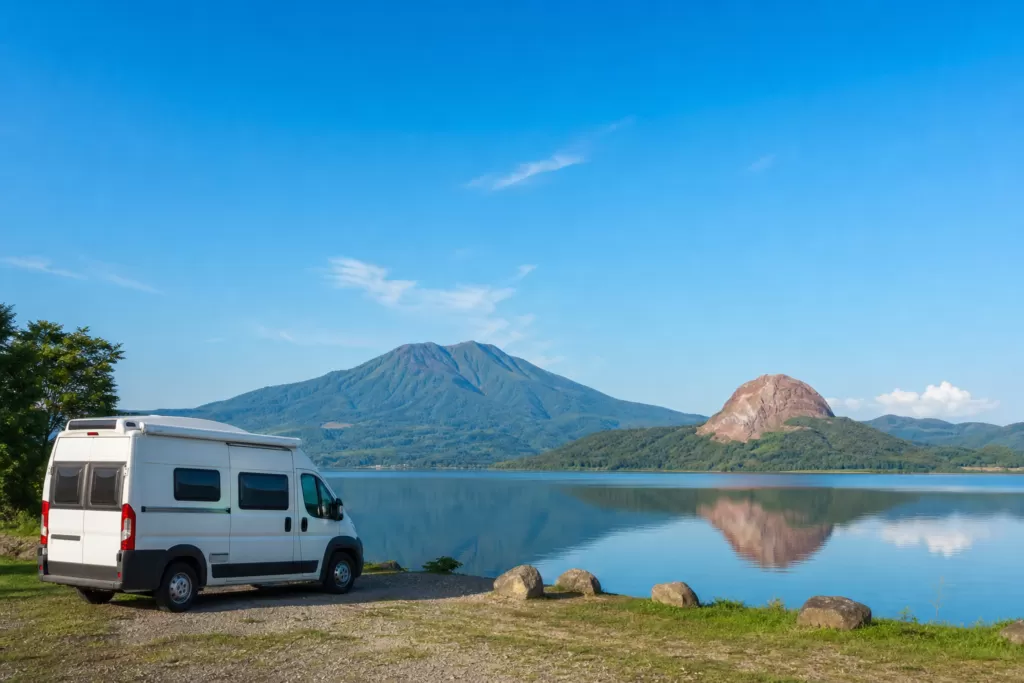
The Lake Toya and Mt. Usu area is one of the most distinctive destinations in Hokkaido — a place where you can feel the raw movement of the Earth. The volcanic ruins left by the 2000 eruption of Mt. Usu have been preserved as they were, and on the Former Nishiyama Crater Trail you can walk right alongside roads that buckled and sank during the blast. The Toyako Onsen resort lines the lakeshore, and the red lava dome of Showa-Shinzan looms dramatically close — scenery like this rewards a campervan trip, letting you linger at each spot at your own pace.
This article is for anyone planning a campervan trip through the Lake Toya and Mt. Usu area. It covers highlights, overnight spots, and model itineraries, focused on 1–2 night plans departing from New Chitose Airport. It also answers questions about access, costs, and common concerns. For rental options across Hokkaido, see Top 15 Hokkaido Campervan Rentals; first-time renters can also check the Beginner’s Guide.
Compare Hokkaido Campervan Rentals
Base yourself at New Chitose Airport and compare rates, vehicle types, and pickup locations all in one place.
Compare rental companies & prices →Access & Basic Information for the Lake Toya Area
Lake Toya is roughly 1.5 to 2 hours from New Chitose Airport via the Dō-ō Expressway (Hokkaido Expressway). It’s also about 1.5 hours from the Hakodate direction along the same expressway, making it a popular stopover on Hokkaido circumnavigation routes.
The Toyako Onsen resort is concentrated on the northern shore of the lake, lined with hot spring hotels and ryokan. For campervan travelers, the typical approach is to base yourself at a nearby campsite or RV park and use the hotels’ day-use bathing facilities rather than staying in the resort itself.
Roads & Parking Around Lake Toya
The lakeside road circling Lake Toya (about 43 km) is almost entirely paved two-lane road and is easy to drive in a campervan. The center of the Toyako Onsen resort can get congested during tourist season, and large cab-over campervans may find on-street parking difficult in some sections. The practical approach is to park in a large lakeside lot and explore on foot.
The Mt. Usu and Showa-Shinzan area has well-maintained parking facilities suitable for campervans. The Showa-Shinzan observation parking lot is paid (from ¥300 as of June 2026) and includes large-vehicle spaces.
Mt. Usu, Showa-Shinzan & the Volcanic Ruins — Scenery You Won’t Find Anywhere Else
Because of its volcanic history, the Mt. Usu area is packed with sights that simply don’t exist anywhere else.
Mt. Usu Ropeway
A ropeway carries you near the summit of Mt. Usu (round trip ¥1,800 as of June 2026). From the summit observation deck you can take in panoramic views of Lake Toya, Mt. Yotei, and the Pacific Ocean — on clear days even Mt. Komagatake is visible in the distance. Allow 1 to 1.5 hours for the round trip. Parking at the ropeway base is free, with spaces for large vehicles.
Showa-Shinzan
This lava dome was thrust up through farmland during eruptions from 1943 to 1945. Standing about 398 meters tall, its rust-and-gray surface looms dramatically close. Entry to the dome itself is not permitted, but you can view the whole formation from the tourist area. The Showa-Shinzan Bear Ranch in front of the dome is popular with children, though it draws mixed opinions on animal welfare — visiting is a personal choice.
Former Nishiyama Crater Trail (Volcanic Ruins)
The 2000 eruption of Mt. Usu buckled and collapsed roads near the crater, and those scars have been preserved as “ruins.” You can walk a maintained trail past asphalt roads that heaved 3–5 meters upward, crushed houses, and street lights still standing exactly where they were. Free admission (as of June 2026). Allow 30–60 minutes on foot. Parking is available and free. Steam vents are still active in places — if you’re up for it, the walk is absolutely worth it.
Toya-Usu UNESCO Global Geopark
The Lake Toya and Mt. Usu area was certified as a UNESCO Global Geopark in 2009, recognized for both its geological significance and the history of people living alongside the volcano. The Lake Toya Visitor Center & Volcanic Science Museum features eruption video exhibits and explanations of volcanic activity (admission fee applies as of June 2026). Visiting here before heading out on the trails is especially rewarding when traveling with children.
Toyako Onsen & Bathing Spots
The main spring type at Toyako Onsen is sodium-calcium sulfate-chloride. Lakeside hotels pipe in the hot spring water and several accept day-use bathers (approximately ¥800–¥1,500 per person as of June 2026). Looking up which hotels offer day-use bathing before your trip makes planning much easier.
During summer, Toyako Onsen hosts the “Toyako Long-Run Fireworks” — nightly fireworks over the lake from April through October (as of June 2026). The show is free to watch from the lakeshore. Pulling up to a lakeside parking area in your campervan, setting out chairs and a table, and watching the fireworks is one of those quintessential campervan moments.
Toyako Onsen Day-Use Bathing Guide | Prices & Hours for 8 Hotels
Based on the official day-use bathing list published by the Toyako Onsen Tourist Association (surveyed April 2026), here are the 8 lakeside hotels that welcome day visitors. With a campervan you can stop by whenever suits you — early morning or after dinner — so the differences in opening hours become your main criteria for choosing. Prices and hours can change, so confirm with each facility before visiting.
| Facility | Adult Price | Bathing Hours | Open-Air Bath | Sauna | Towels |
|---|---|---|---|---|---|
| Toya Manseikaku Hotel Lakeside Terrace | ¥1,200 weekdays / ¥1,500 weekends & holidays | 7:00–10:00 & 13:00–21:00 | Yes | Yes | Set ¥400 |
| Toya Kohantei | ¥1,200 | 13:00–19:00 (last entry 18:00) | Yes | Yes | Set ¥300 |
| Yutorelo Toyako | ¥1,000 | 15:00–20:00 | Yes | No | Free |
| Toya Kanko Hotel | ¥700 morning / ¥1,000 afternoon | 7:00–9:30 & 13:00–21:00 | Yes | Afternoon only | Set ¥400 |
| Hokkai Hotel | ¥500 | 14:00–21:00 | Yes | Yes | Face towel ¥200 |
| Hotel Grand Toya | ¥600 | 13:00–21:00 | Yes | No | Set ¥300 |
| Toya Onsen Hotel Hanabi | ¥800 | 5:00–9:00 & 12:00–20:00 | Yes | No | Set ¥300 |
| Toya Sun Palace Resort & Spa | ¥2,000 (weekends, holidays & peak periods only) | 10:00–15:00 | Yes | Yes | Face ¥100 / Bath ¥200 |
How to Choose on a Campervan Trip
For an early-morning soak, Toya Onsen Hotel Hanabi opens at 5:00, with Manseikaku and Toya Kanko Hotel following at 7:00 — a pre-departure bath after a night in the campervan is one of the great pleasures of this style of travel. In the evening, Manseikaku, Toya Kanko Hotel, Hokkai Hotel and Grand Toya accept bathers until 21:00, late enough to visit after watching the Long-Run Fireworks (April–October).
On a budget day, Hokkai Hotel (¥500) and Grand Toya (¥600) are the value picks — bring your own towel and a lakeside bath costs about the price of a coffee. The public parking lots in the onsen town accommodate larger vehicles, so parking is rarely an issue. Nearby Sobetsu Onsen and Kyogoku Onsen (within 30 minutes of the lake, from ¥500, as of June 2026) are quieter hidden-gem alternatives worth remembering.
Campsites & RV Parks Around Lake Toya and Mt. Usu
Several campsites are located around Lake Toya, many in excellent natural settings right on or near the lakefront.
| Facility | Location | Type | Power | Approx. Price | Notes |
|---|---|---|---|---|---|
| Toya Mizube no Sato Takarada Campsite | Toyako Town, lakeside | Auto campsite | Available | From ¥2,500/night (June 2026) | Prime lakeside location |
| Naka-Toya Campsite | Toyako Town, south shore | Auto campsite | None (confirm) | From ¥1,500/night (June 2026) | Quiet surroundings |
| Sobetsu Park Campsite | Sobetsu Town | Free-site camping | None | Free–¥1,000 (June 2026) | Hilltop with view of Showa-Shinzan |
| Michi-no-Eki “Sobetsu Johokan i” (Near Mt. Usu) | Sobetsu Town | Roadside station (overnight only) | None | Free (overnight) | No extended stays; for transit use only |
Check each facility’s official website or call ahead to confirm rates and availability. Overnight stays at roadside stations (michi-no-eki) are tolerated as brief stopovers, but reserving spots or staying multiple nights is considered bad etiquette. The certified RV park situation inside Toyako town is covered in detail in Lake Toya Overnight Parking Guide.
1–2 Night Model Itineraries from New Chitose
1-Night 2-Day Itinerary (Lake Toya Focus)
| Day | Itinerary | Overnight |
|---|---|---|
| Day 1 | New Chitose Airport → Dō-ō Expressway (Date IC) → Showa-Shinzan → Mt. Usu Ropeway → Former Nishiyama Crater Trail → Toyako Onsen (day bathing) → Toya Mizube no Sato Takarada Campsite | Lake Toya lakeshore |
| Day 2 | Early morning drive around the lake → Volcanic Science Museum → Dō-ō Expressway back to New Chitose (approx. 1.5 hrs) → Return campervan | (Return) |
2-Night 3-Day Itinerary (Lake Toya + Niseko / Mt. Yotei)
| Day | Itinerary | Overnight |
|---|---|---|
| Day 1 | New Chitose Airport → Dō-ō Expressway → Niseko area (drive around Mt. Yotei foothills) → Campsite near Niseko | Niseko area |
| Day 2 | Mt. Yotei / Hangetsu Lake Nature Park → Showa-Shinzan → Mt. Usu Ropeway → Former Nishiyama Crater Trail → Overnight at Lake Toya lakeshore | Lake Toya lakeshore |
| Day 3 | Drive around Lake Toya → Volcanic Science Museum → Dō-ō Expressway to New Chitose → Return campervan | (Return) |
Niseko is famous as a ski resort, but in summer it offers a full lineup of outdoor activities including rafting and canoeing. The farm roads winding around the base of Mt. Yotei open up the kind of vast rural scenery that defines Hokkaido.
Estimated Costs for a Lake Toya / Mt. Usu Campervan Trip
| Expense | Estimate (2 people, 1–2 nights) | Notes |
|---|---|---|
| Campervan rental | ¥30,000–¥80,000 | 1-night 2-day to 2-night 3-day |
| Fuel | ¥3,000–¥7,000 | Est. total distance 200–350 km |
| Campsite fees | ¥2,500–¥5,000 | 1–2 nights |
| Food | ¥5,000–¥10,000 | Mix of supermarket, roadside stations & dining out |
| Attraction entry fees | ¥3,000–¥5,000 | Ropeway, Science Museum etc. for 2 people |
| Total estimate | ¥43,500–¥107,000 | Combined for 2; varies by season and activities |
While Lake Toya is close enough for a day trip from New Chitose, if you want to fully enjoy the volcanic ruins, hot springs, and ropeway without rushing, at least one overnight stay is worth it. You simply can’t experience an early-morning Lake Toya from the lakeshore without staying the night.
Practical Information for a Lake Toya / Mt. Usu Trip
Grocery Shopping & Supermarkets Nearby
The Toyako Onsen resort has convenience stores and local food shops. The nearest large supermarkets are in Date City (about 20 minutes by car from Lake Toya) — Fukuhara Date Store is one option. If you’re making a longer campervan stay, it’s convenient to stock up in Date City or Toyura Town before heading to the lake. Michi-no-Eki “Toyoura” in Toyura Town has a well-stocked fresh produce and seafood direct-sales section.
Additional Highlights Around Lake Toya
In the center of Lake Toya sit the Nakajima islands, reachable by sightseeing boat (round trip from ¥1,500 as of June 2026). The islands are home to many Ezo deer, which are remarkably unafraid of people and may approach quite closely. The trail around the main island is about 4 km and takes 1–2 hours. The boat dock is on the Toyako Onsen lakeshore; sailings vary by season.
The “Silo Observatory” on the south shore of Lake Toya (Sobetsu Town) offers sweeping views of the lake, Showa-Shinzan, and Mt. Yotei all at once. It’s free and easy to stop at by campervan. The sunset views are especially striking — watching the sun drop into the surface of the lake is genuinely impressive.
Getting to the Mt. Usu Area & What to Keep in Mind
Mt. Usu is an active volcano under continuous monitoring by the Japan Meteorological Agency. If the eruption alert level rises, access restrictions may be put in place. Check the JMA and local government websites before your trip. It’s safe to visit under normal conditions, but keeping in mind that you’re traveling on an active volcano adds a genuinely different dimension to the experience.
At the foot of Showa-Shinzan, the Mimatsu Masao Memorial Museum documents the remarkable work of Mimatsu Masao, who meticulously recorded the birth of the new volcano (admission fee applies as of June 2026). His “Mimatsu Diagram” — charting the day-by-day rise of Showa-Shinzan from farmland — is recognized worldwide and is a compelling testament to the history of humans coexisting with volcanism.
Choosing the Right Campervan for This Area
The roads in the Lake Toya and Mt. Usu tourist area are relatively wide, making it comfortable for both cab-over and van-conversion campervans. If you’re using a powered campsite on the lakeshore, a cab-over gives you worry-free use of a fridge and air conditioning. For a day trip, a van conversion or kei camper will have less trouble finding parking. For family trips, a cab-over with permanent beds is the most comfortable choice for a Lake Toya night.
Dining & Food Shopping Around Lake Toya
The Toyako Onsen resort has many restaurants open in summer. Along the lakeshore you’ll find Hokkaido favorites like seafood, Jingisukan (Mongolian-style grilled lamb), and soup curry. Since restaurants tend to fill up during dinner hours (6–9 PM), many campervan travelers prefer arriving early, picking up ingredients, and cooking their own meal — which is perfectly comfortable in a campervan. Michi-no-Eki “Toya-ko” on the western side of the lake sells local produce and processed foods.
Michi-no-Eki “Date Rekishi no Mori” in Date City is right off the Toyako IC and has a strong selection of local produce, seafood, and regional sweets. It makes a convenient base to visit before or after exploring the Lake Toya and Mt. Usu area. The lot is large and campervan-friendly (as of June 2026).
Extending Your Trip to Neighboring Areas
From Lake Toya you have several options for extending your trip. Head north toward Niseko and Mt. Yotei for rural landscapes and hot springs. Head east toward Lake Shikotsu, which is also on the way back to New Chitose via the expressway. Lake Shikotsu is Japan’s northernmost unfrozen lake, with beautifully clear water and pleasant lakeshore drives (campsites available there too). Adding a night at Lake Shikotsu after Lake Toya makes for a satisfying 2-night 3-day loop through central Hokkaido’s natural highlights.
Heading south from Lake Toya toward Oshamanbe and Hakodate, you can combine the trip with Oshamambe’s famous “Kanaya Kani-meshi” crab bento (a legendary station bento) and coastal drives through Yakumo and Mori. With Hakodate about 1 hour 40 minutes down the expressway, Lake Toya sits in a convenient position as a waypoint on a southern Hokkaido circuit.
Why Campervans Are Well-Suited for Toyako Onsen
Toyako Onsen has its lakeside hotels clustered in one stretch of shore, and securing a room in summer is highly competitive. A standard room with two meals at a lakeside ryokan can easily run ¥15,000–¥30,000 per person (as of June 2026). With a campervan, you can stay at a lakeshore campsite for ¥2,500–¥3,500 and use a hotel’s day-use bath — experiencing Toyako Onsen at a fraction of the cost. You’ll also get to watch the nightly fireworks from the lakeshore at your own pace, which is more freeing than a hotel room view. It’s a different way of enjoying Lake Toya — one with advantages a ryokan simply can’t offer.
Common Mistakes on a Lake Toya Trip & How to Avoid Them
One common issue visitors run into at Lake Toya is not being able to find the entrance to the Former Nishiyama Crater Trail. The trailhead is at the western edge of the Toyako Onsen resort, with a dedicated free parking lot (including large-vehicle spaces). Searching “Former Nishiyama Crater Trail” in your car navigation will get you there, but signage along the way can be tricky — watch for roadside signs as you approach. Another common scenario: arriving at Showa-Shinzan and not knowing what to do. Showa-Shinzan is a “look at it” attraction — you cannot hike it. The main experience is standing in the parking area, looking directly at the lava dome, watching the steam rise, and taking photos. Visiting the Bear Ranch on-site is optional; you’ll get the full impact of Showa-Shinzan without going in.
Frequently Asked Questions (FAQ)
Q: Can I stay overnight in a campervan at a Lake Toya campsite?
A: Yes. Toya Mizube no Sato Takarada Campsite and others accommodate auto camping and offer powered sites. During peak season (July–August), reservations are required — check the official website or call ahead.
Q: Do I need to book the Mt. Usu Ropeway in advance?
A: Same-day tickets are available at the gate (as of June 2026). However, summer peak season, Obon holidays, and weekends can get busy. Arriving early in the morning (9–10 AM) is the best way to minimize wait times.
Q: Is the Former Nishiyama Crater Trail suitable for children?
A: The trail is well-maintained and manageable for elementary-school-age children and above. The surface is paved or gravel, with no particularly steep sections. With 30–60 minutes to spare, water, a hat, and comfortable shoes, you’re all set.
Q: When are the Lake Toya fireworks?
A: The “Toyako Long-Run Fireworks” are held nightly from April through October (approx. 20 minutes each night, as of June 2026). Launch times vary by season — check the official Toyako Tourism Association website before your visit. Viewing is free from anywhere along the lakeshore.
Q: How long does it take to drive from New Chitose Airport to Lake Toya by campervan?
A: Approximately 1.5 to 2 hours via the Dō-ō Expressway (Otaki IC or Date IC). Highway service areas can get crowded during summer tourist season, so build in some buffer time.
Compare Hokkaido Campervan Rentals
Base yourself at New Chitose Airport and compare rates, vehicle types, and pickup locations all in one place.
Compare rental companies & prices →Book a Campervan in Hokkaido
Moving Inn New Chitose Airport supports English booking and offers airport transfers.
Pick a campervan by what matters to you.
Rent at New Chitose Airport
See only the rental bases in Chitose, where the airport is.
![When and Where Can You See Harbor Seals at Cape Erimo? Kaze no Yakata Official Information, Viewing Season, and Windy-Day Notes [2026-27]](https://hokkaido-campingcar.jp/wp-content/uploads/2026/10/erimo-cape-lighthouse-768x511.jpg.webp)
![Where and Under What Conditions Can You See Diamond Dust in Hokkaido? How Cold a Morning It Takes, and Where It Appears [2026-27]](https://hokkaido-campingcar.jp/wp-content/uploads/2026/10/hokkaido-diamond-dust-nayoro-768x512.jpg.webp)
![Can You Drive to Hokkaido Jingu for Hatsumode? Parking, Crowds, and Where to Park and Walk [2027]](https://hokkaido-campingcar.jp/wp-content/uploads/2026/10/hokkaido-jingu-winter-torii-768x504.jpg.webp)
![Hokkaido Roads Over New Year [2026-27] | Expressway Sections Prone to Blizzard Closures, Forecast Congestion Days, No Holiday Discount, and New Chitose Airport Parking](https://hokkaido-campingcar.jp/wp-content/uploads/2026/10/hokkaido-winter-rural-road-edge-markers-768x432.jpg.webp)
![Where to See Sea Smoke (Kearashi) in Hokkaido: Rumoi’s Ogon-misaki and the Morning Conditions [2026-27]](https://hokkaido-campingcar.jp/wp-content/uploads/2026/10/rumoi-kearashi-sea-smoke-768x511.jpg.webp)
![Geminid Meteor Shower 2026 in Hokkaido: Peak Around 23:00 on December 14, Sapporo Moonset 20:40, and Staying Warm in a Winter Campervan [2026]](https://hokkaido-campingcar.jp/wp-content/uploads/2026/10/geminids-2026-hokkaido-768x575.jpg.webp)