Cab Conversion Campervan Rental in Hokkaido | Pricing, Top Operators & Differences from Van Conversions [2026 Edition]
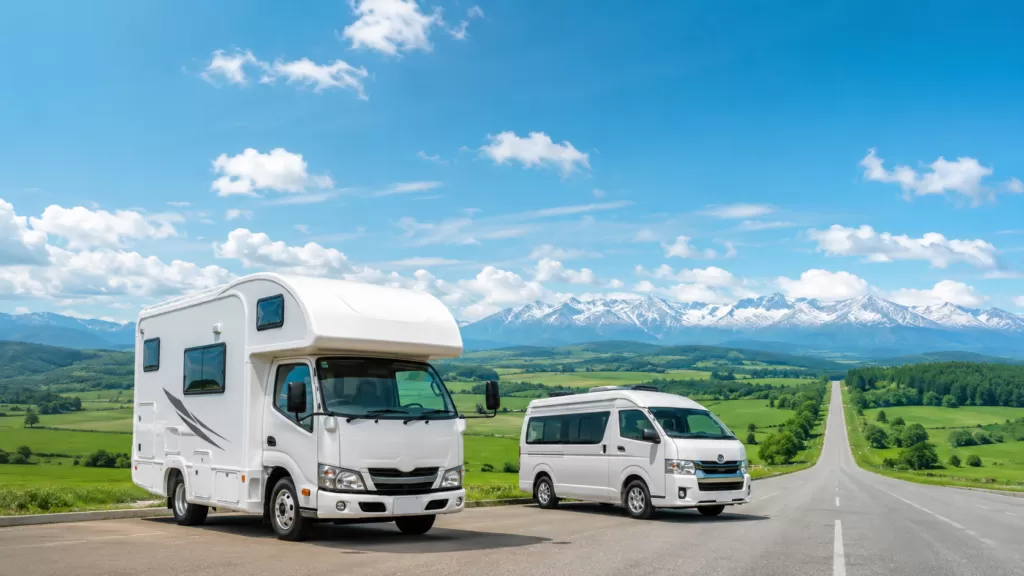
Cab conversion campervans (Cab Conversion) are built on a truck chassis with a dedicated living cabin fitted to the load bed, making them the most fully equipped type of campervan. Most come with a bunk bed, fixed bed, shower, toilet, and large refrigerator — ideal for long trips around Hokkaido with 4 to 6 people.
This article covers pricing benchmarks for renting a cab conversion campervan in Hokkaido, how it differs from van conversions, driving tips, and a cost simulation. Recommended reading for families and groups planning a trip.
What Is a Cab Conversion Campervan?
Cab conversions use a truck chassis — such as the Toyota Camuroad or Nissan Atlas — as their base, with a purpose-built living cabin mounted on the load bed. Because the base is a truck, the living space is considerably larger than a van conversion. Most models have a ceiling height of over 180 cm, allowing passengers to stand and walk around inside.
In the Hokkaido campervan rental market, cab conversions are one of the most popular categories alongside van conversions and camping trailers. One vehicle can sleep 4 to 6 people, covering all accommodation costs for family or group trips in a single rental.
In Japan, manufacturers such as Vantech (maker of the CORDE Bunks) and ANNEX (maker of the Liberty series) produce the main cab conversion models, and most rental operators stock vehicles from these brands. Floor plans and amenities vary by model, so checking the interior layout diagram before booking helps avoid disappointment.
Key Features of a Cab Conversion
- Fixed Bunk Bed: A fixed bed is fitted in the overhang above the cab (the “bunk”). No need to fold out seats every night — easy for children and older passengers alike.
- Dinette (Living Area): Sofas and chairs arranged around a table for dining and relaxing. Most models allow the seats to fold flat into an additional bed.
- Shower & Toilet: Many models include a compact shower room and cassette toilet, giving you peace of mind when staying in areas with few roadside stations or hot-spring facilities.
- Large Refrigerator & Cooking Equipment: Most models feature a 60–100 L refrigerator and a two-burner stove. Picking up ingredients at local supermarkets and cooking your own meals can dramatically cut food costs.
- Sub-Battery & Inverter: A sub-battery charged while driving supplies 100 V power for smartphones, lighting, and a fan. You can camp for 1–2 nights without an external power hookup.
- FF Heater: To handle cold nights and early mornings, most models come equipped with an FF heater (forced-air heater). Even in Hokkaido summer, morning and evening temperatures can drop below 10°C, making this an important feature.
Cab Conversion Rental Price Guide
Compare Hokkaido Campervan Rentals
Base yourself at New Chitose Airport and compare rates, vehicle types, and pickup locations all in one place.
Compare Rental Companies & Prices →| Type | Approx. Price per Night | Capacity |
|---|---|---|
| Cab Conversion (Standard) | Approx. ¥26,000–60,000 | 4–5 people |
| Cab Conversion (High-Grade) | Approx. ¥60,000–94,000 | 5–6 people |
Prices rise during peak season (July–August). For a detailed breakdown of Hokkaido campervan rental costs, see the Hokkaido Campervan Rental Price Simulator. For total costs by number of nights, refer to the 4-Night 5-Day Cost Simulation.
Main Factors That Affect Pricing
- Season: Some operators charge 1.5–2x the standard rate during the July–August peak season. June and September tend to have more availability and are often cheaper.
- Vehicle Grade: Fully equipped models with a shower and toilet tend to cost ¥10,000–20,000 more per night than models without a shower.
- Optional Add-ons: Most operators charge extra for items like chair and table sets, BBQ grills, or child car seats. Confirm these fees when booking.
- Loss Damage Waiver: A waiver fee (approx. ¥1,000–3,000 per day) may be added in case of an accident. Some operators don’t allow you to decline it, so check in advance.
Differences Between Cab Conversions and Van Conversions
| Comparison Item | Cab Conversion | Van Conversion |
|---|---|---|
| Base Vehicle | Truck (Camuroad, etc.) | Van (HiAce, NV350, etc.) |
| Overall Length | Approx. 5.0–6.5 m | Approx. 4.7–5.4 m |
| Overall Height | Approx. 2.8–3.2 m | Approx. 2.1–2.6 m |
| Capacity | 4–6 people | 2–4 people |
| Living Space | Spacious, high ceiling, stand-up headroom | Compact, slightly lower ceiling |
| Bunk Bed | Yes (most models) | No (varies by model) |
| Fixed Shower & Toilet | Yes (most models) | None or basic only |
| Price (per night) | Approx. ¥26,000–94,000 | Approx. ¥15,000–45,000 |
| Ease of Driving | Large; requires care when maneuvering | Closer to driving a regular car |
| Multi-story Parking / Height Restrictions | Rarely fits (2.8 m+) | Some models can fit |
For guidance on choosing between a van conversion and a cab conversion, see Van Conversion vs. Cab Conversion: Differences and How to Choose. The right vehicle type depends on your group size, trip length, and budget, so be sure to check this too.
Travel Styles Suited to a Cab Conversion
Family & Group Trips (4–6 People)
A cab conversion that comfortably sleeps 4–6 adults is well suited to family trips and trips with groups of friends. Since everyone can stay in a single vehicle, you can save on accommodation costs while moving freely around Hokkaido’s wide open spaces. Compared with booking multiple hotel rooms, the total cost is often considerably lower. If you’re traveling with children, also see the Hokkaido Campervan Rental Guide for Families with Kids.
Extended Long Trips (5+ Nights)
A cab conversion with a built-in shower and toilet really shows its value on trips of 5 nights or more. Even if you rely only on roadside stations or free campsites as your base, it’s easier to stay clean, giving you more freedom to move around. Many operators also lower the per-night rate the longer you rent, so it’s worth considering a 7–10 night plan.
Summer Traverse of Eastern and Northern Hokkaido
Some areas of eastern Hokkaido (Shiretoko, Kushiro, Abashiri) and northern Hokkaido (Wakkanai, Cape Soya) have relatively few places to stay. With a cab conversion, you can sleep using your own onboard facilities, so you don’t need to worry about finding accommodation. Scenic spots in eastern Hokkaido often still have plenty of campsite space even during busy periods, giving you far more freedom on your trip.
A Van Conversion May Suit You Better If…
On the other hand, if you’re traveling as a couple, on a two-person trip, or renting a campervan for the first time, a van conversion is easier to drive and more budget-friendly. Because a cab conversion is larger, you’ll have fewer parking options and need to take more care on narrow roads. If any of these apply — a small group, low confidence driving a large vehicle, or wanting to use sightseeing-spot parking lots — consider a van conversion first.
Major Operators Renting Cab Conversions in Hokkaido and Price Guide
Operators offering cab conversions are concentrated around Hokkaido’s main hubs, including New Chitose Airport, Asahikawa, and Obihiro. Below are the features and approximate price ranges of representative operators (as of June 2026, based on each company’s official website).
| Operator (Base) | Cab Conversion Price Guide (Peak Season, per Night) | Features |
|---|---|---|
| Moving Inn (New Chitose Airport) | Approx. ¥32,000–75,000 | Airport transfer included; extensive support for first-time renters |
| Hokkaido Campervan Rental Operators (Asahikawa area) | Approx. ¥28,000–65,000 | Conveniently located for combining with Asahikawa sightseeing |
| Eastern Hokkaido Operators (Obihiro / Kushiro) | Approx. ¥26,000–60,000 | Ideal for starting your trip from the eastern Hokkaido area |
For detailed vehicle lineups, reviews, and booking links for each operator, see Top 15 Recommended Hokkaido Campervan Rentals. Cab conversions are in limited supply during peak season (July–August) and get booked up early, so we strongly recommend reserving 3–4 months in advance.
Since June 2026, Moving Inn New Chitose Airport has started offering the “Cresson Journey” cab conversion. It includes free shuttle service from New Chitose Airport and is known for attentive support tailored to family trips.
Points to Check When Booking
- Vehicle Specifications: Whether a shower and toilet are fitted, refrigerator capacity, and whether an FF heater is included all vary by model. Check the vehicle detail page on the operator’s official website, or confirm by inquiry.
- Driving Licence Type and Date Obtained: The gross vehicle weight you can drive on a Japanese standard licence depends on when it was obtained: under 3.5 t if obtained on or after 12 March 2017, under 5 t if obtained between 2 June 2007 and 11 March 2017 (semi-medium, 5 t limited), and under 8 t if obtained on or before 1 June 2007 (medium, 8 t limited). Tell the operator your licence date before booking so they can confirm.
- Seating Capacity and Number of Seatbelts: Even if the listed capacity is 6, check whether there are enough seats with seatbelts for everyone while driving. Sleeping capacity and seating capacity can differ.
- Cancellation Policy: Since peak-season bookings need to be made 3–4 months in advance, confirm when cancellation fees kick in. Travel insurance is worth considering alongside your booking.
- One-Way Drop-Off Availability: If you want to pick up at one location and return at another — for example, rent at New Chitose and return at Asahikawa — check whether the operator allows this and what the additional charge is.
Points to Note When Driving a Cab Conversion
- Width & Height: Most models are roughly 2.1–2.3 m wide and 2.8–3.2 m tall. They won’t fit in multi-story car parks or car parks with height restrictions. Some general car parks at tourist spots also impose height limits (2.1 m, 2.3 m, etc.), so it’s worth checking in advance.
- Can You Drive on a Standard Licence?: A Japanese standard licence obtained on or before 1 June 2007 (medium, 8 t limited) covers vehicles under 8 t gross weight. Licences obtained between 2 June 2007 and 11 March 2017 cover under 5 t (semi-medium, 5 t limited), and those obtained on or after 12 March 2017 cover under 3.5 t. For full details, see the Campervan Licence Guide.
- Inner-Wheel Difference & Turning: The long wheelbase increases the inner-wheel difference. When turning at intersections, start swinging out earlier than you think necessary. Before heading into traffic after collecting your rental, find a quiet spot to get a feel for the vehicle.
- Back Camera Check: Most rental vehicles are fitted with a rear camera, but parking still takes practice with such a long body. Make a habit of choosing spacious car parks with plenty of room to manoeuvre.
- Ferry Loading: Models over 3 m tall may not fit in the vehicle deck of standard ferries. If you plan to take a ferry to Hokkaido, confirm with the ferry company before departure.
- Fuel Economy & Refuelling: Expect around 8–10 km/L for petrol models and 9–12 km/L for diesel. Some stretches of Hokkaido have few fuel stations, so get into the habit of refuelling when the tank drops below half.
Cost Simulation (4 People, 4 Nights / 5 Days)
Here’s an estimate of the actual costs involved, based on a standard-grade cab conversion. This assumes travel during the peak season (July–August).
| Cost Item | Approx. Amount | Notes |
|---|---|---|
| Rental Fee (4 nights / 5 days) | Approx. ¥180,000–240,000 | ¥45,000–60,000 per night × 4 nights (peak season) |
| Loss Damage Waiver Fee | Approx. ¥5,000–15,000 | ¥1,000–3,000 per day × 5 days |
| Fuel | Approx. ¥15,000–25,000 | Based on 600–1,000 km; calculated for diesel |
| Campsite / RV Park Fees | Approx. ¥10,000–20,000 | ¥2,000–4,000 per night × 4 nights (may include some free roadside station stays) |
| Food (half self-catering, half eating out) | Approx. ¥30,000–50,000 | 4 people, 5 days |
| Sightseeing, Admission Fees, Hot Springs, etc. | Approx. ¥20,000–40,000 | Including Shiretoko cruise, zoo, etc. |
| Total (Estimate) | Approx. ¥260,000–390,000 | Approx. ¥65,000–97,500 per person |
Compared with a hotel trip, booking two hotel rooms for 4 people over 4 nights costs ¥15,000–25,000 per room × 2 rooms × 4 nights = ¥120,000–200,000 in accommodation alone. Add dining out for every meal and the overall value of a campervan trip is almost always superior.
For detailed simulations broken down by number of nights, see the 4-Night 5-Day Cost Simulation.
Recommended Cab Conversion Route Examples in Hokkaido
Central & Eastern Hokkaido: 5 Days (Departing New Chitose)
Day 1: Rent at New Chitose Airport → Lake Shikotsu (lakeside campsite)
Day 2: Obihiro (pork bowl lunch, Tokachi farm visit) → Memuro Roadside Station
Day 3: Kushiro Marsh → Teshikaga (Lake Mashu) → Kawayu Onsen
Day 4: Shiretoko Five Lakes → Utoro Campsite
Day 5: Abashiri → Asahikawa direction → Return to New Chitose
This route covers approximately 800–1,000 km. It’s a course that lets you experience the exhilaration of driving across vast Hokkaido while making the most of a cab conversion’s spacious living quarters.
Northern Hokkaido Traverse: 4 Days (Departing Asahikawa)
Day 1: Rent at Asahikawa → Biei & Furano (rolling hills scenery) → Roadside station overnight
Day 2: Shibetsu → Nayoro → Wakkanai (Cape Soya) → Noshappu Cape campsite
Day 3: Rishiri Island (day trip by ferry) → Back to Wakkanai overnight
Day 4: Teshio → Rumoi → Return to Asahikawa
Northern Hokkaido sees relatively fewer tourists, so you can enjoy the scenery at a relaxed pace even in summer. Since accommodation is limited in this area, it pairs well with a cab conversion, and the large number of roadside stations means you won’t struggle to find a place to stay.
Advice for First-Time Cab Conversion Renters
Many first-time renters have never driven a large vehicle before, so a first cab conversion trip can feel daunting. Most rental operators provide a vehicle walkthrough and test drive before departure, so you can get used to the controls before setting off. It’s especially reassuring to confirm the following points before you leave.
- Check the back camera image and blind spots
- How to turn the FF heater, refrigerator, and inverter on and off
- Tank capacity for the toilet and shower, and when to drain them
- How to check the sub-battery charge level
- Emergency contact details and the roadside assistance number
Do not hesitate to ask the operator’s staff about anything that concerns you before driving off. Choosing an operator who explains things clearly is itself an important factor when deciding where to rent.
Frequently Asked Questions (FAQ)
Q. Can I drive a cab conversion on a standard licence?
The gross vehicle weight you can drive on a standard licence (automatic restriction may not apply) depends on when it was obtained: under 8 t if obtained on or before 1 June 2007, under 5 t if obtained between 2 June 2007 and 11 March 2017, and under 3.5 t if obtained on or after 12 March 2017. Tell the operator when you obtained your licence before booking so they can confirm.
Q. How much more expensive is a cab conversion rental compared to a van conversion?
It depends on the operator and model, but as a guide, expect roughly 1.3–2 times the price of a van conversion. However, when split among 4–6 people, the per-person cost is often lower than staying in hotels, making it a cost-effective option for group trips.
Q. Can I rent a cab conversion with a shower and toilet?
Many cab conversions come with a shower and toilet, but the equipment varies by model. Be sure to check the specifications when booking. Many travelers also use hot springs or bathing facilities at roadside stations, so a model without a shower can still work well for your trip.
Q. For a family of four, which is better — a cab conversion or a van conversion?
For a family of four with two children, a cab conversion tends to be the better fit. It has enough space for two adults and two children to sleep comfortably, and can carry more luggage. Van conversions tend to be sized for 2–3 adults.
Q. When should I book a cab conversion in Hokkaido?
For July–August, when vehicles are limited, aim to book 3–4 months in advance (i.e., during April–May). June and September tend to have better availability, and last-minute bookings are often possible. Popular models at popular operators sell out early, so book as soon as your travel plans are confirmed.
Q. Where can I stay overnight (car camping) in a cab conversion?
RV parks, campsites, and roadside stations (michi-no-eki) across Hokkaido are the main overnight options. Whether overnight stays are permitted at a given roadside station varies by facility — check each one’s official information before planning to stay there. Overnight parking in commercial car parks is generally not allowed.
Book a Campervan in Hokkaido
Moving Inn New Chitose Airport supports English booking and offers airport transfers.

![When and Where Can You See Harbor Seals at Cape Erimo? Kaze no Yakata Official Information, Viewing Season, and Windy-Day Notes [2026-27]](https://hokkaido-campingcar.jp/wp-content/uploads/2026/10/erimo-cape-lighthouse-768x511.jpg.webp)
![Where and Under What Conditions Can You See Diamond Dust in Hokkaido? How Cold a Morning It Takes, and Where It Appears [2026-27]](https://hokkaido-campingcar.jp/wp-content/uploads/2026/10/hokkaido-diamond-dust-nayoro-768x512.jpg.webp)
![Can You Drive to Hokkaido Jingu for Hatsumode? Parking, Crowds, and Where to Park and Walk [2027]](https://hokkaido-campingcar.jp/wp-content/uploads/2026/10/hokkaido-jingu-winter-torii-768x504.jpg.webp)
![Hokkaido Roads Over New Year [2026-27] | Expressway Sections Prone to Blizzard Closures, Forecast Congestion Days, No Holiday Discount, and New Chitose Airport Parking](https://hokkaido-campingcar.jp/wp-content/uploads/2026/10/hokkaido-winter-rural-road-edge-markers-768x432.jpg.webp)
![Where to See Sea Smoke (Kearashi) in Hokkaido: Rumoi’s Ogon-misaki and the Morning Conditions [2026-27]](https://hokkaido-campingcar.jp/wp-content/uploads/2026/10/rumoi-kearashi-sea-smoke-768x511.jpg.webp)
![Geminid Meteor Shower 2026 in Hokkaido: Peak Around 23:00 on December 14, Sapporo Moonset 20:40, and Staying Warm in a Winter Campervan [2026]](https://hokkaido-campingcar.jp/wp-content/uploads/2026/10/geminids-2026-hokkaido-768x575.jpg.webp)