Complete List of Extra Costs and Options for Hokkaido Campervan Rentals | Understanding the Total Price [2026 Edition]
A complete rundown of everything you pay beyond the base rental fee for a campervan in Hokkaido.
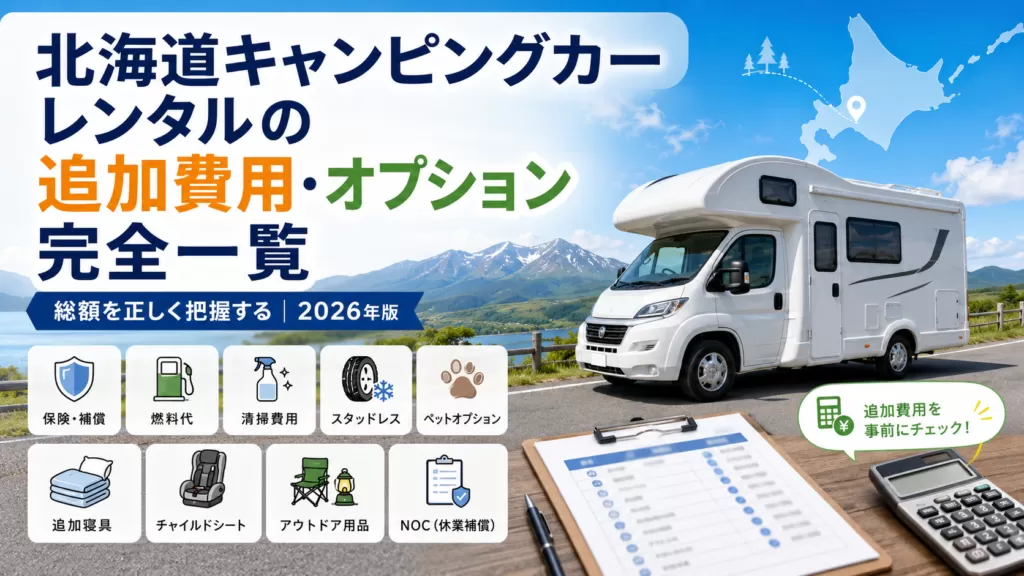
When you look at a campervan rental quote, it’s often unclear what costs beyond the base price you’ll actually pay. Without knowing the liability waiver, petrol, campsite, and option fees upfront, it’s easy to go over budget after departure.
This article lists every extra cost and option for Hokkaido campervan rentals. A simulation comparison table and a pre-booking checklist are included — use them as-is.
Costs You Will Always Pay
Liability Waiver (CDW): How It Works and What It Costs
Like rental cars, campervans have a Collision Damage Waiver (CDW) system. Without it, you could face a large out-of-pocket cost if there’s an accident or damage — so it’s effectively mandatory.
With CDW, your out-of-pocket liability in an accident is capped at a set limit. Without it, you may be billed for all or most of the vehicle repair costs — and campervans are expensive vehicles, so the risk is high.
| Operator | CDW Fee (per day) | 7-Day Total |
|---|---|---|
| R230 Car Share (Sapporo) | ¥1,100 | ¥7,700 |
| Ohana Hokkaido (Sapporo) | ¥1,100 | ¥7,700 |
| Fuji Cars Japan Chitose | ¥1,650 | ¥11,550 |
| Moving Inn (New Chitose Airport) | ¥2,200 | ¥15,400 |
| FOX Camper Chitose | ¥5,500 | ¥38,500 |
CDW fees vary dramatically between operators. For the most expensive operator, that’s an extra ¥38,500 over 7 days. When comparing operators with a lower advertised base price, always calculate the total including CDW.
NOC (Non-Operation Charge): What It Is
NOC is compensation paid to the operator for loss of business while the campervan is out of service due to an accident or damage. Even with CDW, most operators charge NOC separately.
NOC typically runs ¥20,000–100,000 per vehicle, varying by operator and extent of damage. Checking CDW and NOC together is very important. Some operators offer plans that bundle NOC into the insurance — always check what your plan covers before booking.
- CDW: caps your out-of-pocket liability for vehicle repair at a set amount
- NOC: compensation for the operator’s lost revenue during the repair period — often charged separately from CDW
- NOC range: approx. ¥20,000–100,000
Petrol and Mileage Overage Charges
Returning with a full tank is standard. Estimating your total driving distance in advance makes budgeting easier.
| Vehicle Type | Average Fuel Economy | Estimate for 500km | Estimate for 1,000km |
|---|---|---|---|
| Kei camper | 12–18km/L | Approx. ¥3,500–5,200 | Approx. ¥7,000–10,400 |
| Van conversion | 8–12km/L | Approx. ¥5,200–7,800 | Approx. ¥10,400–15,600 |
| Cab-over | 6–9km/L | Approx. ¥6,900–10,400 | Approx. ¥13,800–20,800 |
※ Calculated at ¥175/L. Some areas of Hokkaido have few petrol stations. In remote northern and eastern areas, refuel with a buffer.
Some operators also set a daily mileage cap (e.g. 200km/day), with excess charges (around ¥10–30/km). Driving 300–400km in a single day is not unusual in Hokkaido. If your chosen operator has a mileage limit, calculate your total route distance before booking.
New Chitose Airport / Tokachi-Obihiro Airport
Rent the Cabcon “Cresson Journey”
Base yourself at New Chitose Airport and compare rates, vehicle types, and pickup locations all in one place.
See details at Moving Inn →Costs That Vary by Operator
One-Way Drop-Off Fee
Some operators allow you to return the vehicle at a different location from where you picked it up — such as picking up in New Chitose and dropping off in Hakodate.
| Service | Approximate Fee |
|---|---|
| One-way within Hokkaido (between the same operator’s branches) | ¥5,500–33,000 |
| One-way to mainland Japan via ferry | Most operators do not support this |
One-way options are available from a limited number of operators. If you’re considering a New Chitose IN / Hakodate OUT route, always confirm availability and the fee before booking. One-way charges vary by distance and route, so ask for a written quote.
Late Night / Early Morning Pickup Fee
Some operators charge extra for pickups or returns outside normal business hours. Check if this applies before booking an early morning flight arrival.
- Early morning (before 8:00): approx. ¥1,100–5,500
- Late night (after 22:00): approx. ¥1,100–5,500
Some operators near airports (New Chitose area) offer 24-hour service, but extra charges vary by operator.
Child Seat / Junior Seat
Essential for families with children. Most operators offer rental, but advance booking is usually required. Don’t rely on walk-in availability — families should reserve alongside the vehicle booking.
- Child seat (up to approx. age 4): ¥330–550/day
- Junior seat (approx. age 4–12): ¥220–330/day
Renting one child seat for a 7-day trip adds ¥2,300–3,850. Budget double for two children.
Pet Option
Travelling with a pet? The first step is confirming whether the campervan is pet-friendly. Even pet-friendly operators typically charge an additional cleaning fee.
- Pet-friendly operators: limited (must confirm at booking)
- Additional cleaning fee: approx. ¥5,500–16,500
- Restrictions on pet type and number vary by operator
“Pets allowed” sometimes has fine print — dogs yes, cats no; large dogs no; etc. If you’re bringing a pet, contact the operator early for confirmation.
Accommodation Costs
Campsite and RV Park Price Guide
Approximate costs for the main overnight options available to campervans.
| Type | Per Night | Features |
|---|---|---|
| Auto campsite (no power) | ¥1,500–3,000 | Camping in nature |
| Auto campsite (with power hookup) | ¥2,500–5,000 | Supports summer air con, winter heating |
| RV park | ¥2,000–4,000 | Often includes power, water/waste, and bathing facilities |
| Michi-no-Eki (roadside station) | Free in principle | No power; good manners required |
| Motorway service areas | Free (toll road fee separate) | Suitable for rest/naps; not for extended stays |
Popular Hokkaido campsites in summer require early booking. Sites near Furano, Shiretoko, and Lake Toya in particular can turn you away without a reservation during peak season.
RV parks are paid campervan-specific facilities, and most are equipped with power and waste disposal. For running air conditioning or electrical appliances, RV parks are more reliable than campsites in terms of facilities. They’re scattered across Hokkaido — Asahikawa, Obihiro, Hakodate, etc. — so you can fit them into your route.
Ferry Costs (for Crossing from Mainland Japan to Hokkaido)
If you’re bringing a campervan from the mainland, the ferry is a major expense.
| Route | Vehicle (under 5m) + 1 adult (one-way estimate) |
|---|---|
| Oarai–Tomakomai (MOL Ferry) | ¥50,000–90,000 |
| Niigata–Otaru (Shin Nihonkai Ferry) | ¥40,000–80,000 |
| Aomori–Hakodate (Tsugaru Strait Ferry) | ¥20,000–35,000 |
※ Van conversions and cab-overs over 5m in length face higher vehicle fees. Confirm your vehicle size and calculate accurate fares on the ferry company’s website before booking. Note: if you rent from a Hokkaido-based operator, no ferry is needed.
Toll Roads and Parking
Hokkaido’s well-developed national and prefectural road network means you can travel without using expressways as much as in mainland Japan. However, expressways are often used for time efficiency on routes between major cities — Sapporo to Asahikawa, Obihiro, etc.
| Stretch (approximate) | Expressway Toll (standard car, one-way) |
|---|---|
| New Chitose Airport – Sapporo | Approx. ¥1,000–1,200 |
| Sapporo – Asahikawa | Approx. ¥2,500–3,000 |
| Sapporo – Obihiro | Approx. ¥3,500–4,000 |
| Sapporo – Hakodate | Approx. ¥5,500–6,500 |
Van conversions and cab-overs may be classified as “medium-size vehicles” and charged at a higher toll rate than standard cars. Check the toll classification for your vehicle at rental time to avoid calculation errors.
Paid parking at tourist spots typically costs ¥500–1,000 per visit. Popular spots like Asahiyama Zoo, Shirogane Blue Pond, and Shiretoko Goko often have only paid parking, so budgeting ¥5,000–10,000 for a 7-day trip covers this comfortably.
Optional Add-Ons
Camping Gear Rental
| Item | Per Day | 7-Day Estimate |
|---|---|---|
| Folding chairs (set of 2) | ¥220–550 | ¥1,540–3,850 |
| Folding table | ¥220–440 | ¥1,540–3,080 |
| BBQ grill | ¥550–1,100 | ¥3,850–7,700 |
| Tarp / side awning | ¥550–1,100 | ¥3,850–7,700 |
| Portable power station | ¥1,100–2,200 | ¥7,700–15,400 |
| Sleeping bag / blanket | ¥330–660 | ¥2,310–4,620 |
If you don’t bring your own camping gear, renting just chairs + table + grill for 7 days adds roughly ¥10,000–20,000. Purchasing or packing frequently-used items saves money over a longer trip.
Wi-Fi Router
- Per day: approx. ¥550–1,100
- 7 days: approx. ¥4,000–8,000
Bringing a SIM card or using smartphone tethering is an alternative. For map apps and reservation checks, tethering is usually sufficient.
Total Cost Simulation Comparison (Including Options)
Even for the same 7-night/8-day trip, the total additional costs vary widely depending on your setup. Here’s a comparison across three configurations.
| Cost Item | Minimal Setup | Standard Setup | Full-Kit Setup |
|---|---|---|---|
| CDW fee (7 days) | ¥7,700 | ¥11,550 | ¥38,500 |
| NOC protection (additional insurance etc.) | ¥0 | ¥5,000 | ¥10,000 |
| Petrol (700km) | ¥7,300 | ¥9,200 | ¥12,100 |
| Toll roads | ¥2,000 | ¥5,000 | ¥10,000 |
| Campsites (7 nights) | ¥10,500 | ¥21,000 | ¥35,000 |
| Hot springs/bathing (7 visits) | ¥3,500 | ¥4,900 | ¥5,600 |
| Child seat (1 child, 7 days) | ¥0 | ¥2,310 | ¥3,850 |
| Camping gear rental | ¥0 | ¥7,000 | ¥20,000 |
| Wi-Fi router (7 days) | ¥0 | ¥4,000 | ¥7,700 |
| Total additional costs | ¥31,000 | ¥69,960 | ¥142,750 |
The minimal setup assumes a low-CDW operator, bringing your own gear, and using Michi-no-Eki for most overnight stays. Standard is a typical family trip scenario. Full-kit is every option rented from the operator, choosing a premium operator.
These amounts are added on top of the base rental fee. With a van conversion base rate of roughly ¥80,000–150,000 for 7 nights, the total including additional costs spans ¥110,000–290,000. Always calculate including extras when comparing. Choosing a “cheap base price” operator and then finding the CDW and options cost more is not unusual. When comparing operators side by side, calculate all three cost categories — insurance, driving, and accommodation — for your travel style before deciding.
New Chitose Airport / Tokachi-Obihiro Airport
Rent the Cabcon “Cresson Journey”
Base yourself at New Chitose Airport and compare rates, vehicle types, and pickup locations all in one place.
See details at Moving Inn →Pre-Booking Cost Checklist
Confirming these points with the operator before booking prevents “I didn’t know there was a fee for that” surprises.
Insurance and Liability
- What is the daily CDW fee? (mandatory)
- Is NOC charged separately? If so, how much?
- Is an NOC-inclusive plan available?
- What is the out-of-pocket cap if you don’t take out CDW?
Driving and Return
- Is there a mileage cap? If so, how many km/day and what is the excess rate per km?
- How is petrol handled on return (full tank return, on-site top-up, etc.)?
- One-way drop-off: available and at what cost?
- Is there an extra fee for late-night or early morning pickup/return?
Equipment and Options
- Child seat / junior seat availability and cost
- Pet allowed? Additional cleaning fee?
- Camping gear and Wi-Fi rental availability and cost
- External power (hookup) compatibility
Other Costs
- When do cancellation fees kick in, and how much are they?
- Is there an additional cleaning charge if the interior isn’t clean enough on return?
- How is pre-existing damage confirmed at pickup (photos, etc.)?
At pickup, it’s recommended to photograph and video the vehicle’s condition. Checking existing scratches and marks together with a staff member before departure prevents disputes at return.
To compare Hokkaido operators on price, vehicle types, and conditions with extra costs in mind, see below.
FAQ
Q. What is the most commonly overlooked extra cost in campervan rentals?
The CDW fee. At ¥1,100–5,500/day, the difference between operators is large — over 7 days that’s a gap of ¥7,700 to ¥38,500. Always compare on the total including CDW.
Q. What’s the difference between CDW and NOC?
CDW caps the amount you pay out of pocket for vehicle repair in an accident. NOC is compensation to the operator for revenue lost while the vehicle is being repaired. You can be charged NOC even if you have CDW — check both conditions.
Q. How does petrol payment work?
In most cases, “full tank return” — fill up at a nearby station before returning, or at a station specified by the operator. Payment methods vary by operator, so confirm at pickup.
Q. Are there free places to stay overnight in a campervan in Hokkaido?
Yes — Michi-no-Eki (roadside station) car parks allow free overnight stays at many locations. However, extended stays and generator use are prohibited, and the intent is rest/transit stops, not camping. For power or water access, use RV parks.
Q. Can I travel Hokkaido by campervan with my pet?
Some operators are pet-friendly. An extra cleaning fee (approx. ¥5,500–16,500) is standard, and restrictions on pet type and number are common. Contact the operator directly before booking to confirm.
Q. Can I add options on the day of pickup?
Items like chairs and tables can sometimes be added on the day depending on stock. Child seats and specific equipment require advance booking. Confirm before arrival to be safe.
Q. Is one-way drop-off available at all operators?
One-way options are available from a limited number of operators. If you’re considering a New Chitose IN / Hakodate OUT route, confirm availability and the additional fee before booking.
Book a Campervan in Hokkaido
Moving Inn New Chitose Airport supports English booking and offers airport transfers.
![When and Where Can You See Harbor Seals at Cape Erimo? Kaze no Yakata Official Information, Viewing Season, and Windy-Day Notes [2026-27]](https://hokkaido-campingcar.jp/wp-content/uploads/2026/10/erimo-cape-lighthouse-768x511.jpg.webp)
![Where and Under What Conditions Can You See Diamond Dust in Hokkaido? How Cold a Morning It Takes, and Where It Appears [2026-27]](https://hokkaido-campingcar.jp/wp-content/uploads/2026/10/hokkaido-diamond-dust-nayoro-768x512.jpg.webp)
![Can You Drive to Hokkaido Jingu for Hatsumode? Parking, Crowds, and Where to Park and Walk [2027]](https://hokkaido-campingcar.jp/wp-content/uploads/2026/10/hokkaido-jingu-winter-torii-768x504.jpg.webp)
![Hokkaido Roads Over New Year [2026-27] | Expressway Sections Prone to Blizzard Closures, Forecast Congestion Days, No Holiday Discount, and New Chitose Airport Parking](https://hokkaido-campingcar.jp/wp-content/uploads/2026/10/hokkaido-winter-rural-road-edge-markers-768x432.jpg.webp)
![Where to See Sea Smoke (Kearashi) in Hokkaido: Rumoi’s Ogon-misaki and the Morning Conditions [2026-27]](https://hokkaido-campingcar.jp/wp-content/uploads/2026/10/rumoi-kearashi-sea-smoke-768x511.jpg.webp)
![Geminid Meteor Shower 2026 in Hokkaido: Peak Around 23:00 on December 14, Sapporo Moonset 20:40, and Staying Warm in a Winter Campervan [2026]](https://hokkaido-campingcar.jp/wp-content/uploads/2026/10/geminids-2026-hokkaido-768x575.jpg.webp)