Hokkaido Campervan Travel with Pets Guide | Dog & Cat-Friendly RV Parks, Campsites & Important Notes [2026]
A guide to Hokkaido campervan travel with pets. Lists dog and cat-friendly RV parks and campsites, with important notes for traveling with animals.
Pick a campervan by what matters to you.
Rent at New Chitose Airport
See only the rental bases in Chitose, where the airport is.
Rent in winter (Dec–Mar)
Companies that rent through winter, listed apart from those that close.
Guide price
Moving Inn New Chitose Airport: HIACE van conversion from ¥22,000 per night. 20–30% off when booked 60–90 days ahead (official rate table, checked 15 Oct 2026).
Before you book: with an International Driving Permit if your country is in the Geneva Convention (for example the US, Australia, Singapore); Taiwan, Switzerland, Germany, France, Belgium and Monaco need your licence plus a Japanese translation (Tokyo Metropolitan Police). Questions in English: Moving Inn on WhatsApp. Every roadside station (michi-no-eki) must have free 24-hour toilets, and Hokkaido has 128 of them (MLIT).
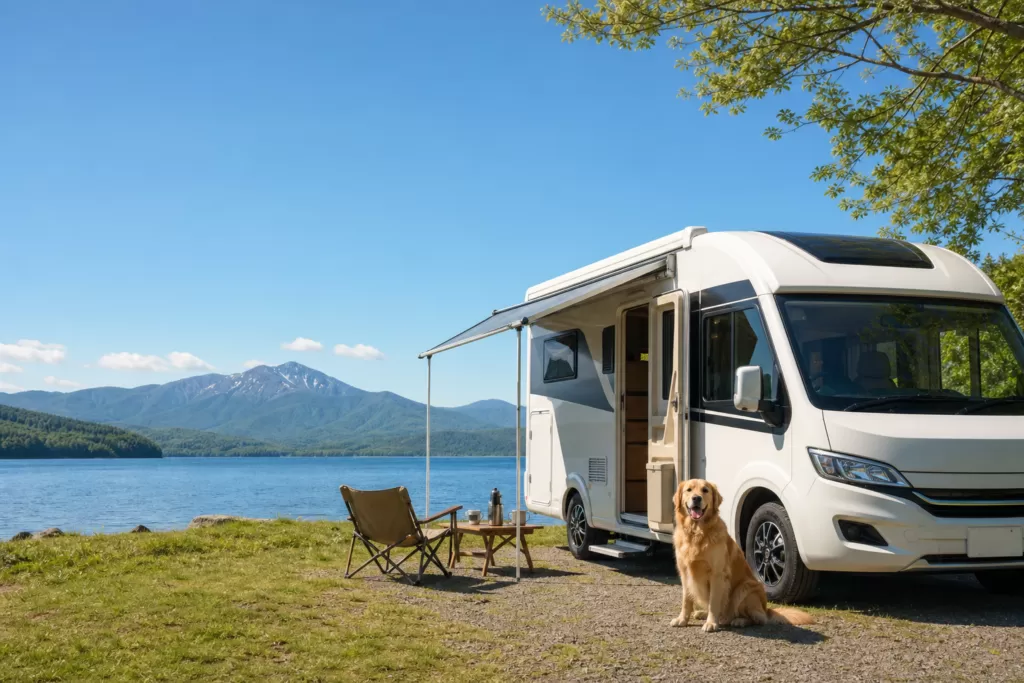
Traveling around Hokkaido in a campervan while bringing your dog or cat along sounds great — until you hit the real questions: which campsites actually allow pets, whether your pet will overheat inside the vehicle, and whether ticks are a concern. With a hotel, “pets allowed” usually settles the matter. Campsites and RV parks are different — rules vary site by site, and it’s common to find that tent sites allow pets while the auto-camp sites next to them don’t.
This guide covers everything you need to prepare when bringing a pet on a campervan trip in Hokkaido — from choosing facilities, to in-vehicle safety, to what to pack. It covers both dogs and cats, but since most Hokkaido facilities are “dogs only,” cat owners in particular should double-check the rules in advance.
For cost simulations, model routes, and Michi-no-Eki overnight parking rules — the fuller picture of Hokkaido campervan travel — see our Complete Guide to Hokkaido Campervan Travel.
Tap a dot on the map to see its name here.
Tap a dot to see its name and a link to where it appears in this article. 2 places whose location could not be confirmed are not shown. Dot positions are based on each facility’s address or officially published location. Lakes and expressways are from OpenStreetMap data.
Basic rules and preparation for bringing a pet in a campervan
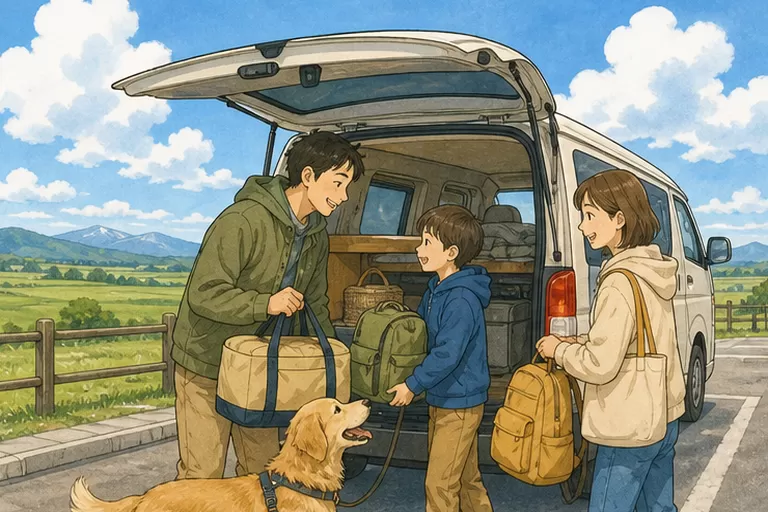
Traveling with a pet in a campervan is a different scale of preparation from a day trip in a regular car. Since driving, parking, and overnight stays all happen inside the vehicle across multiple nights, the top priority before you leave is building a plan that isn't a strain on either you or your pet.
Pets while driving: between the law and safety
Under Japan's Road Traffic Act, letting a pet ride unrestrained inside the vehicle isn't itself prohibited. But if a dog or cat gets thrown around the cabin during sudden braking or a collision, it risks serious injury — and can also block the driver's view and cause a secondary accident. As a rule, secure your pet during driving with a crate or a seatbelt-compatible harness.
Because cabcon-type campervans have a spacious living area, some owners let their pet loose in the back without securing the crate — but under hard braking, a crate can still be thrown several meters. Always secure the crate with a seatbelt or a lashing strap.
4 things to confirm before renting
Pet policies vary widely between campervan rental companies. To avoid discovering after booking that "this vehicle doesn't actually allow pets," confirm these four points before you reserve.
- Which vehicles allow pets: some companies allow pets in every vehicle, others only in specific grades
- Cleaning fee: an extra ¥2,200–¥11,000 or so per pet is common
- Breed and weight limits: more than half of bases turn away large dogs (10kg and up)
- Cats and other animals: most bases only allow dogs
Some rental companies also ask to see a vaccination certificate or a rabies vaccination tag. Gathering these documents before you leave keeps the paperwork quick.
Crossing by ferry: bringing a pet from Honshu to Hokkaido
If you're bringing your car (and pet) across from Honshu by ferry, pets generally can't come into the cabin — they stay in your car or in a paid pet room. Lines such as Taiheiyo Ferry and Shin Nihonkai Ferry offer dedicated pet rooms, but these sell out early during busy periods. If your plan involves a long-distance ferry crossing, reserve your pet's spot at the same time as your own.
Pet-friendly RV parks and campsites in Hokkaido
Whether pets are allowed varies by facility across Hokkaido's campsites and RV parks, and so do the conditions — "all sites OK," "leashed only," "tent area only," "no pets on-site at all." The facilities listed below all have a track record of welcoming pets, but always confirm the current rules directly when you book — rules can change from year to year.
RV parks (dedicated to overnight parking): major pet-friendly sites
RV parks are more specialized for overnight parking than general campsites, and many come with power, toilets, and showers — a good match for a campervan trip with a pet. Many sit next to a Michi-no-Eki roadside station, so you can enjoy a morning market or local produce during your stay.
- RV Park Toyako (Toyako): an RV park right on the shore of Lake Toya. Pets allowed on a leash. Close to hot springs, and you can stay overnight in your vehicle while watching the lake at dusk.
- RV Park Bifuka (Bifuka): located in the mountains of the northern/Asahikawa area. Known for a quiet setting well-suited to pet owners. A sturgeon aquarium nearby.
- RV Park Michi-no-Eki Shiranuka Koitoi (Shiranuka): on the Pacific side of the Do-to (eastern Hokkaido) area. Wide parking space makes walking a dog easy.
- RV Park Hokuto Shichisei (Hokuto): convenient access to the Hakodate area. Pets allowed, leash required.
RV parks tend to enforce rules more strictly than auto-campsites, and complaints about barking, waste disposal, or letting a pet loose outside at night come up easily in this environment. More consideration for neighboring guests is expected here than at an ordinary campsite.
Pet-friendly auto-campsites and free sites
Hokkaido has one of the highest numbers of auto-campsites in Japan, and many welcome pets. That said, conditions differ in detail from site to site — "leash required at all times," "designated pet relief area," "on-site dog run is an extra charge," and so on.
- Ningle Terrace area / around Furano Nature Club: a site surrounded by Furano's forest. Check in advance which sites allow campervans to drive in.
- Hokkaido Greenland Auto Campsite (Iwamizawa): spacious sites, pets allowed. Easy access from the Do-o Expressway, and convenient as a first-night stop.
- Auto Resort Tomakomai Alten (Tomakomai): 30 minutes from New Chitose Airport. Also commonly used as the first stop after a ferry arrival. A strong track record with pet owners.
- Lake Poroto Campsite (Shiraoi): a quiet site overlooking the lake. Easy to combine with sightseeing at Upopoy (National Ainu Museum and Park).
- Tokachigawa Onsen Daiichi Hotel Tokyotei RV Park (Otofuke): in the Tokachigawa Onsen area. Convenient with an attached hot spring facility. Pets allowed (confirm in advance).
Popular facilities fill up months in advance for the summer high season (July–August). Booking your summer stay right after Golden Week is a safe bet.
Compare Hokkaido campervan rentals
Base yourself at New Chitose Airport and compare rates, vehicle types, and pickup locations all in one place.
Compare rental companies and prices →Keeping your pet safe inside the vehicle (crate, ventilation, heatstroke)
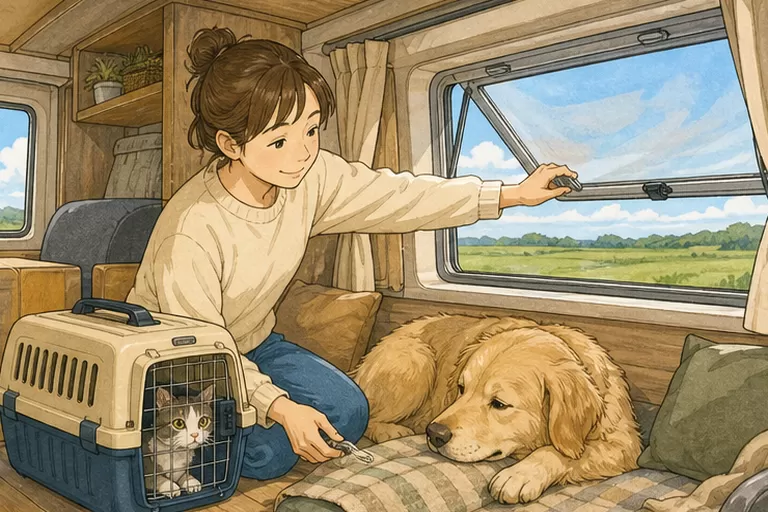
Unlike a tent or a hotel room, once you switch off the engine in a campervan, managing the cabin temperature is entirely on you. Despite the image of Hokkaido as "cool," on a sunny summer day the interior temperature can pass 60°C within a short time. Always take precautions before leaving your pet inside the vehicle to go sightseeing.
Summer cabin temperatures: know the numbers
Measurements show that on a day with an outside temperature of 30°C, a vehicle with the engine off and the windows shut reaches about 50°C after 15 minutes, and 60–70°C after an hour. Even in Hokkaido, summer days in the Do-to and Do-o areas increasingly reach 28–32°C, so assuming "it's fine because it's Hokkaido" is dangerous. A dog's normal body temperature is 38–39°C, and organ damage starts to occur above 42°C.
Leaving the engine running with the air conditioning on is the most reliable option, but idling while parked is banned at some facilities. Check the parking location, facility rules, and outside temperature before deciding.
Ventilation and shaded parking: the basics
- Park in the shade: avoiding direct sunlight alone can lower the cabin temperature by 10–15°C. Prioritize the shade of trees or buildings.
- Run the roof vent: many cabcon-type campervans have a roof vent that draws in airflow while driving to help with ventilation.
- Put reflective shades on the windows: these cut radiant heat through the windshield and side windows significantly. Even 100-yen-shop shades help.
- Use a cooling mat or ice packs: give your pet somewhere to cool off on its own.
- Keep outings short: plan sightseeing around "go back and check" cycles. As a rule of thumb, don't leave your pet alone in the vehicle for more than 30 minutes.
Signs of heatstroke: early detection saves lives
Signs of heatstroke common to both dogs and cats: heavy panting (mouth open, breathing hard), excessive drooling, lethargy and unresponsiveness, reddened gums, vomiting. If you see any of these, move your pet somewhere cool, cool the neck, armpits, and groin with a wet towel, and head to a vet. Don't force water into your pet's mouth — there's a risk of choking.
Animal hospitals in Hokkaido are concentrated in urban areas, and in parts of the Do-to and Do-hoku regions the nearest hospital can be over an hour away. Saving a few animal hospital numbers for your travel area on your phone before the trip means you won't have to scramble in an emergency.
Tick precautions: watch out in Hokkaido's tall grass
Ticks live in Hokkaido's grassland and forest edges. They wait at the tip of blades of grass and attach to any pet (or person) passing by. For dogs, check your pet's whole body carefully after a walk through grass, paying particular attention to the inside of the ears, between the toes, and the belly area.
Ticks carry a risk of transmitting infections such as SFTS (severe fever with thrombocytopenia syndrome). It's safest to have your vet prescribe a tick preventive (spot-on or oral) before you leave. Hokkaido's tick season is shorter than Honshu's, but ticks are still active from May through October.
Pet-friendly sightseeing spots and Michi-no-Eki stations
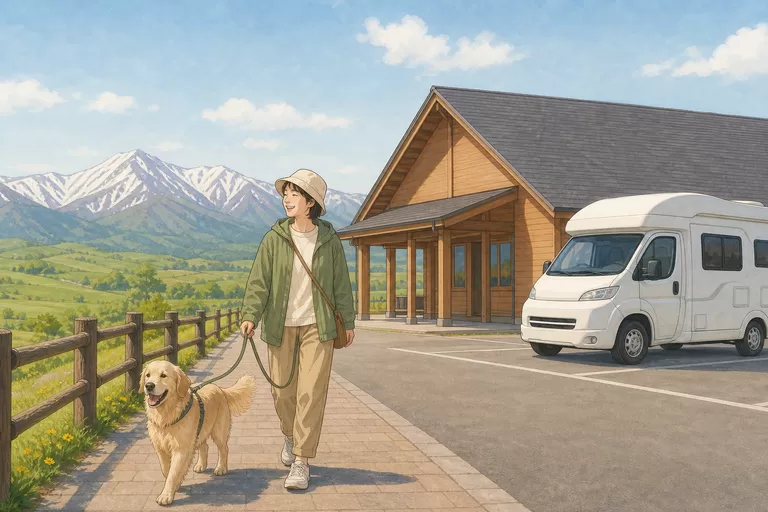
Many of Hokkaido's famous sightseeing spots don't allow pets, but a growing number of outdoor attractions and farm-type facilities do. Make a habit of checking a facility's website or calling ahead so you're not turned away after arriving.
Farms and nature spots: a good match for pets
- Tokachi Hills (Makubetsu): an expansive garden facility. Has an area where leashed pets are allowed. A classic stop for Do-to/Obihiro sightseeing.
- Facilities along the Hokkaido Garden Show route: the garden cluster spanning Taisetsu, Tokachi, and Furano. Rules differ by facility, but many outdoor areas allow pets.
- Around Lake Saroma (Saroma / Yubetsu): lakeside promenades and campsite areas make walking a dog easy. Uncrowded, so you can enjoy a quiet visit.
- Shiretoko Peninsula (Shari / Rausu): a World Heritage area. The Utoro side often bars pets from indoor facilities, but roadside areas and outdoor observation decks sometimes allow pets. Bears are present in this area, so follow local rules closely.
- Mt. Hakodate Ropeway (Hakodate): pets not allowed (small animals in a carrier may be permitted). Hakodate's port town streets are good for a dog walk.
Spending time with your pet at a Michi-no-Eki
Pets generally can't come inside a Michi-no-Eki's buildings (the produce hall, the restaurant), but you're free to walk or rest with your pet in the parking lot or outdoor areas. Hokkaido's roadside stations tend to have large parking lots and good restroom facilities, making them a convenient rest stop with a pet during a long drive.
Always take waste with you or dispose of it in a pet waste bin if one is provided. Leaving waste behind in the parking lot is the single most common complaint at Michi-no-Eki stations. Poor manners can lead to facilities cutting back on accepting pets, so please follow this closely for the sake of all pet owners.
Some Michi-no-Eki stations even have a dog run. Searching online for "Michi-no-Eki dog run Hokkaido" will bring up the latest listings.
Packing checklist (medicine, food, pet sheets)
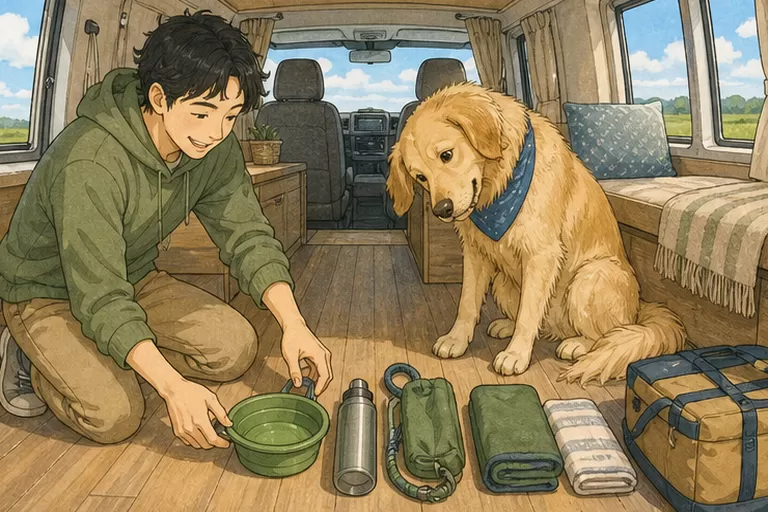
Campervan trips often run several nights to a week or more, and it's easy to end up somewhere in rural Hokkaido with no store selling pet supplies if you run out mid-trip. Load up everything you need before you leave.
Medical and health care
- Rabies vaccination tag and vaccination certificate (some facilities ask to see these)
- Any regular medication from your vet (enough for the trip plus 2–3 days' backup)
- Tick preventive (Frontline or a prescribed oral medication)
- Pet-safe insect repellent spray
- Thermometer (for pets)
- Eye drops and ear-cleaning supplies
- Pet-safe disinfectant and wound pads
Food and water
- Your pet's usual food (a sudden diet change on the road can easily cause digestive upset — bring enough for the trip plus extra)
- Wet food (as backup if your pet's appetite drops)
- A portable water bottle (one with a dog-friendly nozzle is easiest to use)
- A collapsible bowl (lightweight plastic is easiest to handle)
Hygiene and travel
- Pet sheets (bring plenty — these can double as an in-vehicle toilet)
- Waste bags (a large supply of plastic bags)
- Wet wipes and towels (several — useful for mud on rainy days)
- A crate (for securing your pet while driving — bring one your pet is already used to)
- A leash (a spare, in case one snaps)
- An ID tag (with your name and contact details) and a microchip check
In-vehicle comfort items
- Cooling mat / cooling sheet (a summer essential)
- A pet blanket (for cold nights — Hokkaido nights can drop below 15°C even in August)
- Reflective shades (for the front and side windows)
- Odor-eliminating spray (for in-vehicle odor)
New Chitose Airport / Tokachi-Obihiro Airport
Rent the Cabcon "Cresson Journey"
Base yourself at New Chitose Airport and travel all across Hokkaido by campervan.
See details at Moving Inn →At Moving Inn's New Chitose Airport location, pets are allowed in the Cresson Journey and EURO BOX models. As long as your pet stays in a cage, there is no extra fee (confirmed directly with the operator, August 4, 2026).
Frequently Asked Questions
Q: Can I travel with a cat in a campervan?
Yes, it's possible. But most Hokkaido campsites and RV parks that allow pets assume dogs, and bringing a cat may be turned down unless you check in advance. Cats tend to prefer a familiar spot for their litter box, and the stress of being in a moving vehicle tends to hit them harder than dogs, so it helps to start with a short trip and build up from there.
Q: Can a large dog (30kg or more) ride in a campervan?
The cabin itself is spacious enough, so it's physically possible, but some rental companies set weight limits. Policies vary — some bases turn away dogs over 10kg, others will discuss it case by case for dogs over 20kg. If you're bringing a large breed like a Labrador or Golden Retriever, confirm the weight and breed with the rental company before booking.
Q: Do Hokkaido campsites require dogs to stay on a leash at all times?
Almost every campsite requires a leash on-site. Sites with a dedicated dog run are the exception — most places prohibit letting a dog off-leash even in a free site or auto-camp area. Keep your dog leashed on-site at all times, both out of consideration for other campers and for your pet's safety.
Q: Can I leave my pet in the vehicle with the air conditioning running?
With a campervan, your options are to leave the engine running, or to run the air conditioning off an external power source (a powered site at an RV park). Idling is banned at many facilities, and fuel consumption is also a concern, so choosing an RV park or powered site as your overnight stop is the more realistic approach. Some vehicles can run just the air conditioning off a sub-battery-plus-inverter setup with the engine off, but whether this is supported depends on the vehicle and rental company.
Q: What should I do if my pet gets bitten by a tick?
Pulling it out forcefully can leave the mouthparts embedded in the skin. Grip the tick as close to the skin as possible with tweezers and pull it out slowly. Disinfect the bite site, and if fever or lethargy appears within a few days, see a vet — or a physician, if it's a person who was bitten. It's worth carrying a dedicated tick-removal tool.
Q: Are there illnesses pets are especially prone to during a Hokkaido trip?
Besides summer heatstroke and tick-borne infections (such as babesiosis and Lyme disease), unfamiliar surroundings can easily bring on stress-related digestive symptoms (diarrhea, vomiting) during the trip. Hokkaido is also home to Echinococcus, and pets can become infected by contact with stream water or soil contaminated with wild animal waste. Never let your pet drink directly from a river or lake.
Book a Campervan in Hokkaido
Moving Inn New Chitose Airport supports English booking and offers airport transfers.
Pick a campervan by what matters to you.
Rent at New Chitose Airport
See only the rental bases in Chitose, where the airport is.
![When and Where Can You See Harbor Seals at Cape Erimo? Kaze no Yakata Official Information, Viewing Season, and Windy-Day Notes [2026-27]](https://hokkaido-campingcar.jp/wp-content/uploads/2026/10/erimo-cape-lighthouse-768x511.jpg.webp)
![Where and Under What Conditions Can You See Diamond Dust in Hokkaido? How Cold a Morning It Takes, and Where It Appears [2026-27]](https://hokkaido-campingcar.jp/wp-content/uploads/2026/10/hokkaido-diamond-dust-nayoro-768x512.jpg.webp)
![Can You Drive to Hokkaido Jingu for Hatsumode? Parking, Crowds, and Where to Park and Walk [2027]](https://hokkaido-campingcar.jp/wp-content/uploads/2026/10/hokkaido-jingu-winter-torii-768x504.jpg.webp)
![Hokkaido Roads Over New Year [2026-27] | Expressway Sections Prone to Blizzard Closures, Forecast Congestion Days, No Holiday Discount, and New Chitose Airport Parking](https://hokkaido-campingcar.jp/wp-content/uploads/2026/10/hokkaido-winter-rural-road-edge-markers-768x432.jpg.webp)
![Where to See Sea Smoke (Kearashi) in Hokkaido: Rumoi’s Ogon-misaki and the Morning Conditions [2026-27]](https://hokkaido-campingcar.jp/wp-content/uploads/2026/10/rumoi-kearashi-sea-smoke-768x511.jpg.webp)
![Geminid Meteor Shower 2026 in Hokkaido: Peak Around 23:00 on December 14, Sapporo Moonset 20:40, and Staying Warm in a Winter Campervan [2026]](https://hokkaido-campingcar.jp/wp-content/uploads/2026/10/geminids-2026-hokkaido-768x575.jpg.webp)