Hokkaido Campervan Rental Weekend 1-Night 2-Day Cost Simulation | Total Cost by Vehicle Type [2026]
A cost simulation for renting a campervan in Hokkaido for a weekend 1-night 2-day trip. Breaks down total costs by vehicle type.
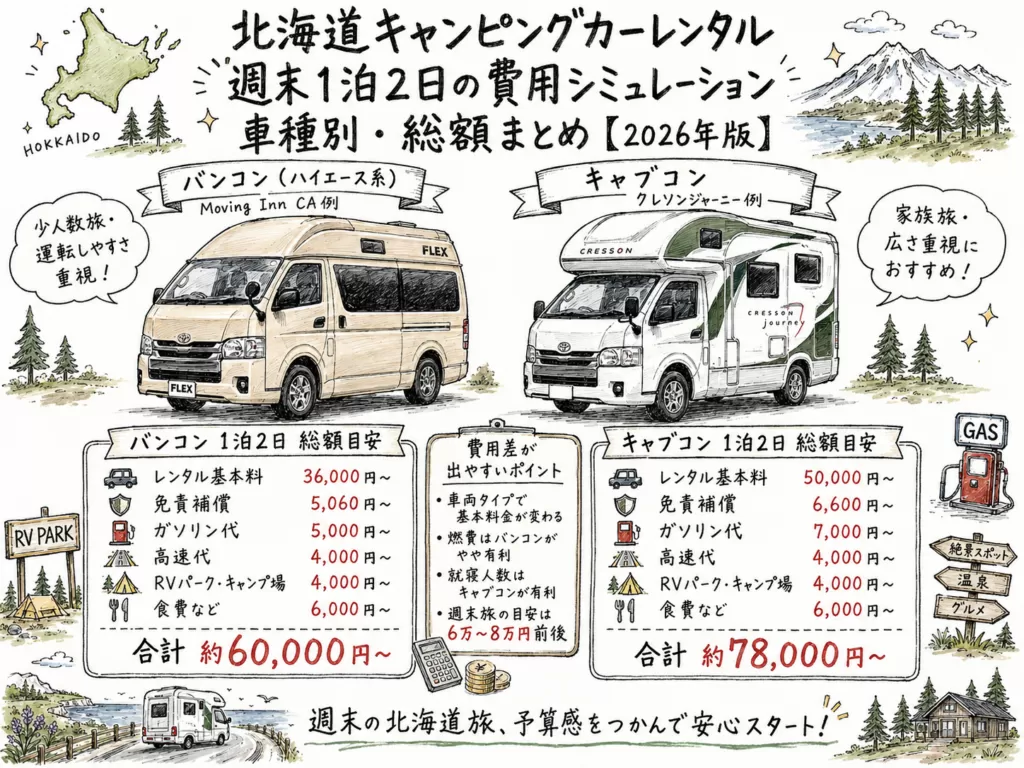
How much does it cost to rent a campervan in Hokkaido for a weekend 1-night 2-day trip? If you want to try it just once, or if you can only spare a single night off during a long weekend, knowing the cost in advance makes it much easier to plan.
In this article we simulate the total cost of a 1-night 2-day trip by vehicle type — kei-camper, vancon, and cabcon. We compare not just the rental fee and NOC (insurance waiver), but the full total including gasoline, campsite fees, and food costs. We also break down the price gap between peak and off-peak season, and how far you can realistically travel in 1 night 2 days.
New Chitose Airport / Tokachi-Obihiro Airport
Rent the Cabcon “Cresson Journey”
Base yourself at New Chitose Airport and compare rates, vehicle types, and pickup locations all in one place.
See details at Moving Inn →The bottom line first: total cost guide for 1 night 2 days
Costs vary by vehicle type and number of travelers. The combined rental fee and NOC (Non-Operation Charge) are as follows.
| Vehicle type | Rental fee (2 days) | NOC (2 days) | Estimated total |
|---|---|---|---|
| Kei-camper (up to 2 people) | ¥15,600–¥39,600 | ¥2,200–¥11,000 | ¥17,800–¥50,600 |
| Vancon (2–4 people) | ¥24,000–¥66,000 | ¥2,200–¥11,000 | ¥26,200–¥77,000 |
| Cabcon (4–6 people) | ¥33,000–¥114,000 | ¥2,200–¥11,000 | ¥35,200–¥125,000 |
*Prices include tax. Gasoline, toll roads, campsite fees, and food are not included.
We simulate the “all-inclusive trip cost” — adding gasoline, campsite fees within Hokkaido, and food — in the sections below.
Kei-camper for a weekend 1-night 2-day trip: cost for 2 travelers
The kei-camper is best suited to trips for 2 people, at ¥7,800–¥19,800 per night. It carries less luggage but handles narrow roads easily, making it a popular choice for a first campervan experience on a 1-night 2-day trip.
| Operator | Rental fee (2 days) | NOC (2 days, estimate) | Estimated total |
|---|---|---|---|
| Ado VAN’S (Hakodate) | ¥28,600 (¥14,300 × 2) | approx. ¥2,200 | approx. ¥30,800 |
| Tabisuru Kuruma New Chitose Airport BASE | ¥39,600 (¥19,800 × 2) | approx. ¥3,300 | approx. ¥42,900 |
| White Birch (Obihiro) | ¥35,200 (¥17,600 × 2) | approx. ¥3,300 | approx. ¥38,500 |
Split between 2 people, that comes to around ¥15,000–¥21,500 per person. Kei-campers typically sleep 1–2 people, so they aren’t suited to trips of 3 or more.
The actual equipment in a kei-camper is fairly basic — a folding bed, lighting, and a small table. Most models don’t have a fridge or toilet, so you’ll need to manage food in a cooler bag and use roadside stations (michi-no-eki) or convenience stores for the toilet. This isn’t a major inconvenience on a 1-night 2-day trip if the distances are short, but for longer drives a vancon or larger is more comfortable.
Vancon: the more people, the lower the per-person cost
The vancon is the most commonly used type in Hokkaido. Prices range widely from ¥12,000–¥33,000 per night, varying significantly depending on the operator you choose.
Renting for 2 people
| Operator | Rental fee (2 days) | NOC (2 days) | Estimated total | Per person |
|---|---|---|---|---|
| R230 Car Share (Sapporo) | ¥24,000 (¥12,000 × 2) | approx. ¥2,200 | approx. ¥26,200 | approx. ¥13,100 |
| Fuji Cars Japan Chitose | ¥25,800 (¥12,900 × 2) | approx. ¥3,300 | approx. ¥29,100 | approx. ¥14,550 |
| Moving Inn New Chitose Airport | ¥30,800 (¥15,400 × 2) | approx. ¥4,400 | approx. ¥35,200 | approx. ¥17,600 |
| FOX Camper Chitose | ¥35,200 (¥17,600 × 2) | approx. ¥11,000 | approx. ¥46,200 | approx. ¥23,100 |
Renting for 4 people (lowers the per-person cost)
Riding with 4 people brings the per-person cost down significantly.
| Operator | Estimated total | Split 4 ways |
|---|---|---|
| Fuji Cars Japan Chitose | approx. ¥29,100 | approx. ¥7,300 per person |
| Moving Inn New Chitose Airport | approx. ¥35,200 | approx. ¥8,800 per person |
| CANTAL (Chitose Airport SS) | approx. ¥40,500 (¥20,250 × 2) | approx. ¥10,100 per person |
With 4 travelers, a weekend campervan trip costs roughly ¥7,000–¥10,000-something per person — comparable to a room-only hotel stay (¥7,000–¥12,000 per person).
Cabcon for a weekend 1-night 2-day trip: for families and groups
The cabcon is a fully-equipped, full-scale type with a fridge, a fixed bed, and (depending on the model) a shower. Usable time is limited on a 1-night 2-day trip, but it’s especially popular with families traveling with kids and with group trips. It’s easy to load even with lots of luggage and clothing, and eating inside the vehicle is comfortable.
| Operator | Rental fee (2 days) | Estimated total | Split 4 ways |
|---|---|---|---|
| Ohana Hokkaido (Sapporo) | ¥33,000 (¥16,500 × 2) | approx. ¥35,200 | approx. ¥8,800 per person |
| GOODLUCK Campervan Rental | ¥33,000 (¥16,500 × 2) | approx. ¥36,300 | approx. ¥9,100 per person |
| Fuji Cars Japan Chitose | ¥49,800 (¥24,900 × 2) | approx. ¥54,200 | approx. ¥13,550 per person |
Split between 4–6 people, the per-person cost is similar to a vancon. For a family of 4 with 2 children and 2 adults, many operators don’t count children toward capacity, which can bring the real cost down further.
Full-cost simulation including gasoline, campsite, and food
The rental fee alone doesn’t show the full cost of the trip. Here’s a guide to the other costs involved in a 1-night 2-day Hokkaido trip.
Gasoline
Vancons typically get 8–10 km/L. Driving a round trip from New Chitose Airport around Lake Toya and Lake Shikotsu covers roughly 200–300 km. At ¥170 per liter (Hokkaido average as of June 2026), that works out to about 25–38 L of gasoline, costing ¥4,200–¥6,500.
Kei-campers get an excellent 12–15 km/L, so the same route can be covered for around ¥2,300–¥4,200. Cabcons get a lower 6–8 km/L, so budget around ¥6,000–¥9,000.
Campsite fees
A 1-night 2-day itinerary requires one night’s campsite fee. Here’s a price guide for pulling your campervan into an auto site (parking right next to your site).
| Facility type | Price guide per night | Features |
|---|---|---|
| Michi-no-eki / RV parks in Hokkaido | ¥1,000–¥2,000 | Often no power hookup or shower |
| Public campground (auto site) | ¥2,000–¥4,000 | Power-equipped sites available |
| Private campground (well-equipped) | ¥4,000–¥8,000 | Shower, power, and shop available |
Hokkaido’s public campgrounds are well-equipped for the price, and many auto sites at ¥2,000–¥3,000 include shower access. Popular sites cluster around Lake Toya Onsen and along Lake Shikotsu, and on summer weekends they can fill up 2–3 months in advance.
Food
Since campervans come equipped with cooking facilities (a portable or gas stove), cutting back on eating out in favor of cooking your own meals can significantly reduce food costs. Here’s a comparison of food-cost guidelines for 1 night 2 days, 2 people, eating out versus cooking.
| Style | Food cost guide, 1 night 2 days, 2 people | Breakdown |
|---|---|---|
| Mostly eating out | ¥12,000–¥20,000 | All 3 meals — lunch, dinner, breakfast — eaten out |
| Mostly self-catered | ¥4,000–¥8,000 | Groceries from the supermarket, cooked in the vehicle |
| Hybrid | ¥7,000–¥12,000 | Eat out for dinner only; self-catered breakfast and lunch |
A popular style in Hokkaido is picking up fresh seafood and vegetables at “Toretate Ichiba” fresh markets or local supermarkets for a barbecue. Ingredient costs go up, but you can enjoy a fairly lavish meal for about the price of a single restaurant meal.
Total cost summary for 1 night 2 days (example: 2 people, vancon)
| Cost item | Mostly self-catered | Mostly eating out |
|---|---|---|
| Rental fee + NOC | ¥29,000–¥35,000 | ¥29,000–¥35,000 |
| Gasoline | ¥4,200–¥6,500 | ¥4,200–¥6,500 |
| Campsite | ¥2,000–¥4,000 | ¥2,000–¥4,000 |
| Food (2 people) | ¥4,000–¥8,000 | ¥12,000–¥20,000 |
| Total (2 people) | approx. ¥39,000–¥54,000 | approx. ¥47,000–¥66,000 |
| Per person | approx. ¥20,000–¥27,000 | approx. ¥24,000–¥33,000 |
Covering the same itinerary with a hotel stay (¥8,000–¥15,000 per person per night) plus a rental car and eating out would run around ¥50,000–¥80,000 for 2 people. A campervan trip with some self-catering holds up well as a cost-effective option.
Price gap between peak season (summer, Golden Week) and off-peak season
For a weekend trip in Hokkaido, seasonal price swings have a big impact on the total cost.
| Period | Effect on price | Booking guideline |
|---|---|---|
| Weekdays (Mon–Thu) | Standard rate | Often available even 2–4 weeks ahead |
| Weekends/holidays (spring–autumn) | Roughly +10–20% | 1–2 months ahead is safest |
| Golden Week (late April–early May) | Roughly +20–40% | 2–3 months ahead |
| Late July–end of August (summer peak) | Roughly +20–50% | 3–4 months ahead; the earlier the better |
| September–October (autumn foliage season) | Roughly +10–20% | 1–2 months ahead |
| November–mid-April (winter, early spring) | Standard rate to discounted | Availability even at short notice |
On summer weekends, prices go up, and there simply may not be any vehicles available at all. If you’re planning for an August weekend, it’s realistic to book back in April or May. September, on the other hand, sees fewer typhoons and more stable weather in Hokkaido, plus autumn foliage — and prices often drop from peak season, making it one of the best-balanced times for cost and comfort.
Some operators lower prices in the off-peak season (November–March), but Hokkaido’s winter roads carry real risk if you don’t have 4WD driving experience, and driving a campervan in these conditions calls for particular caution. If it’s your first time renting, sticking to May–October is the safer choice.
How far you can go in 1 night 2 days, and recommended routes
Starting and ending at New Chitose Airport for a 1-night 2-day trip, a one-way radius of 100–150 km is a reasonable travel range. If you spend too much time on long-distance driving, you’ll have almost no time left for sightseeing — so narrowing your area and exploring it in depth makes for a more satisfying trip.
Lake Shikotsu & Lake Toya route (a classic, with minimal driving)
- Day 1: Pick up your rental at New Chitose Airport (10–11 AM) → lunch by Lake Shikotsu → check in and stay overnight at a campground by Lake Toya
- Day 2: Lake Toya → Mt. Usu / Showa-shinzan → return the vehicle at New Chitose Airport (5–6 PM)
- Distance: approx. 220 km / gasoline (vancon): approx. ¥3,700–¥4,600
Several campgrounds along Lake Toya have power-equipped auto sites. Hot springs are also nearby, making this a highly satisfying route even for just 1 night 2 days.
Furano & Biei route (summer only, flower fields)
- Day 1: Pick up your rental at New Chitose Airport → head toward Do-To Expressway / Asahikawa → stroll the hills of Biei → stay overnight at a campground near Furano
- Day 2: Farm Tomita (lavender) → lunch in Furano town → return the vehicle at New Chitose Airport
- Distance: approx. 280 km / gasoline (vancon): approx. ¥4,700–¥5,800
Roads get congested during the July lavender season, so traveling early in the morning is more comfortable. Campgrounds around Furano get crowded on summer weekends, and same-week bookings sometimes aren’t available.
Shakotan Peninsula route (enjoy the sea and its clarity)
- Day 1: Pick up your rental at New Chitose Airport → via Otaru → Cape Shakotan / Shimamui Coast → camp near Yoichi
- Day 2: Yoichi → stroll around Otaru town → return the vehicle at New Chitose Airport
- Distance: approx. 260 km / gasoline (vancon): approx. ¥4,400–¥5,400
The sea off Shakotan is famous for its striking clarity, known as “Shakotan blue.” From July to August you can even take a quick dip. Picking up ingredients in Otaru and cooking in the vehicle also helps keep food costs down.
Eastern Hokkaido (Shiretoko, Kushiro area) is 250–350 km one way from New Chitose, so a 1-night 2-day trip would eat up nearly all your time just driving. If you’re aiming for eastern Hokkaido, plan for 3 nights 4 days or more.
New Chitose Airport / Tokachi-Obihiro Airport
Rent the Cabcon “Cresson Journey”
Base yourself at New Chitose Airport and compare rates, vehicle types, and pickup locations all in one place.
See details at Moving Inn →How to keep costs down
Add more travelers
Renting a vancon with 4 people on board brings the weekend trip cost down to roughly ¥7,000–¥10,000-something per person — nearly half the cost for 2 people. If you can round up more travelers, using a vancon with 4 people is the single best move for cost efficiency.
Start on a weekday
Prices are lower on weekdays than weekends, and campgrounds and sightseeing spots are less crowded too. If you can get Friday off, starting the rental on Friday and returning on Sunday for a 2-night 3-day trip also improves the cost-performance.
Avoid peak season
July–August in Hokkaido has the best weather and the most popularity, but also the highest prices. Early June or September offer stable weather, flowers or autumn foliage to enjoy, and travel costs 20–30% less than summer.
Compare operators
Even for the same vancon, prices can differ by more than double between operators. Comparing based on the combined rental fee and NOC and picking the cheaper operator alone can make a difference of ¥5,000–¥15,000.
Cook your own meals
Simply eating out for dinner only, and self-catering breakfast and lunch, can save 2 people ¥5,000–¥8,000 on food. Hokkaido makes it easy to find fresh ingredients at supermarkets and roadside stations (michi-no-eki), so self-catered meals are plenty satisfying too.
If you’d like to compare operators across Hokkaido by vehicle type, area, and conditions, see the link below.
Frequently Asked Questions (FAQ)
Q. How much does it cost to rent a campervan in Hokkaido for a weekend 1-night 2-day trip?
It depends on the vehicle type. As a guide, a kei-camper runs ¥17,800–¥50,600, a vancon ¥26,200–¥77,000, and a cabcon ¥35,200–¥125,000 (NOC included). Gasoline is a separate ¥4,000–¥6,500, and campsite fees run about ¥2,000–¥4,000.
Q. How much does the price differ between 1 night 2 days and 2 nights 3 days?
With one fewer rental day, the total is lower. That said, some operators charge the same or a slightly higher per-day rate for shorter rentals. Given the driving distance and how much room you have for sightseeing, 2 nights 3 days or more tends to offer better value for the experience and the cost.
Q. What’s the minimum number of days I can rent for?
Most operators offer rentals starting at 1 night 2 days (2 days). Whether a same-day (day trip) rental is available depends on the operator, so check in advance.
Q. Is it easy to book for a weekend?
Summer (July–August) weekends get especially crowded. If you’re planning for an August weekend, we recommend booking 3–4 months ahead. From September onward, or in early June, availability opens up and you can sometimes book even at short notice.
Q. Can I drive a campervan on a regular driver’s license?
Most rental campervans can be driven with a regular license (including an automatic-only license). However, larger cabcon models may require a quasi-medium or medium-sized vehicle license. Check the license category with the operator before booking.
Q. Can we still enjoy a trip with kids in 1 night 2 days?
Yes. By keeping the driving distance to 100–150 km and staying focused around Lake Toya and Lake Shikotsu, you can build an itinerary that won’t bore your kids. Cabcons let everyone within capacity ride buckled in with seatbelts, and you can bring your own child seat (some models lack fixing hardware, so check in advance).
Q. Do I need to return the vehicle with a full tank?
Most operators use a full-to-full policy. You receive the vehicle with a full tank and return it the same way. Forgetting to refuel can result in an extra charge (actual cost plus a handling fee), so make sure to fill up at a nearby gas station before returning the vehicle. Since some areas of Hokkaido don’t have gas stations near roadside stations (michi-no-eki), it’s safest to refuel about 2–3 hours before your return time.
Q. Can I use a campsite without a reservation?
Some public campgrounds don’t require reservations (first-come, first-served), but they often fill up on summer weekends, so it’s safer to book ahead wherever reservations are accepted. Areas around Lake Toya, Niseko, and Furano get especially crowded on Saturday nights in July and August. Booking methods vary by facility — by phone, official website, or third-party booking services.
Book a Campervan in Hokkaido
Moving Inn New Chitose Airport supports English booking and offers airport transfers.

![When and Where Can You See Harbor Seals at Cape Erimo? Kaze no Yakata Official Information, Viewing Season, and Windy-Day Notes [2026-27]](https://hokkaido-campingcar.jp/wp-content/uploads/2026/10/erimo-cape-lighthouse-768x511.jpg.webp)
![Where and Under What Conditions Can You See Diamond Dust in Hokkaido? How Cold a Morning It Takes, and Where It Appears [2026-27]](https://hokkaido-campingcar.jp/wp-content/uploads/2026/10/hokkaido-diamond-dust-nayoro-768x512.jpg.webp)
![Can You Drive to Hokkaido Jingu for Hatsumode? Parking, Crowds, and Where to Park and Walk [2027]](https://hokkaido-campingcar.jp/wp-content/uploads/2026/10/hokkaido-jingu-winter-torii-768x504.jpg.webp)
![Hokkaido Roads Over New Year [2026-27] | Expressway Sections Prone to Blizzard Closures, Forecast Congestion Days, No Holiday Discount, and New Chitose Airport Parking](https://hokkaido-campingcar.jp/wp-content/uploads/2026/10/hokkaido-winter-rural-road-edge-markers-768x432.jpg.webp)
![Where to See Sea Smoke (Kearashi) in Hokkaido: Rumoi’s Ogon-misaki and the Morning Conditions [2026-27]](https://hokkaido-campingcar.jp/wp-content/uploads/2026/10/rumoi-kearashi-sea-smoke-768x511.jpg.webp)
![Geminid Meteor Shower 2026 in Hokkaido: Peak Around 23:00 on December 14, Sapporo Moonset 20:40, and Staying Warm in a Winter Campervan [2026]](https://hokkaido-campingcar.jp/wp-content/uploads/2026/10/geminids-2026-hokkaido-768x575.jpg.webp)