Hokkaido Campervan Multi-Night Camp Guide | How to Stay 3-5 Nights at One Base [2026 Edition]
A complete guide to multi-night campervan stays in Hokkaido. Covers auto site selection, power and water management, tarp setup, meals and daily routines, and recommended base camps.
Pick a campervan by what matters to you.
Rent at New Chitose Airport
See only the rental bases in Chitose, where the airport is.
Rent in winter (Dec–Mar)
Companies that rent through winter, listed apart from those that close.
Guide price
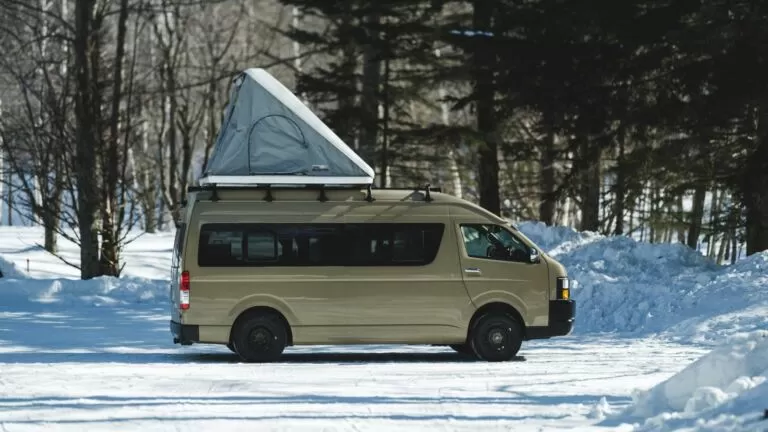
Moving Inn New Chitose Airport: HIACE van conversion from ¥22,000 per night. 20–30% off when booked 60–90 days ahead (official rate table, checked 15 Oct 2026).
Before you book: with an International Driving Permit if your country is in the Geneva Convention (for example the US, Australia, Singapore); Taiwan, Switzerland, Germany, France, Belgium and Monaco need your licence plus a Japanese translation (Tokyo Metropolitan Police). Questions in English: Moving Inn on WhatsApp. Every roadside station (michi-no-eki) must have free 24-hour toilets, and Hokkaido has 128 of them (MLIT).
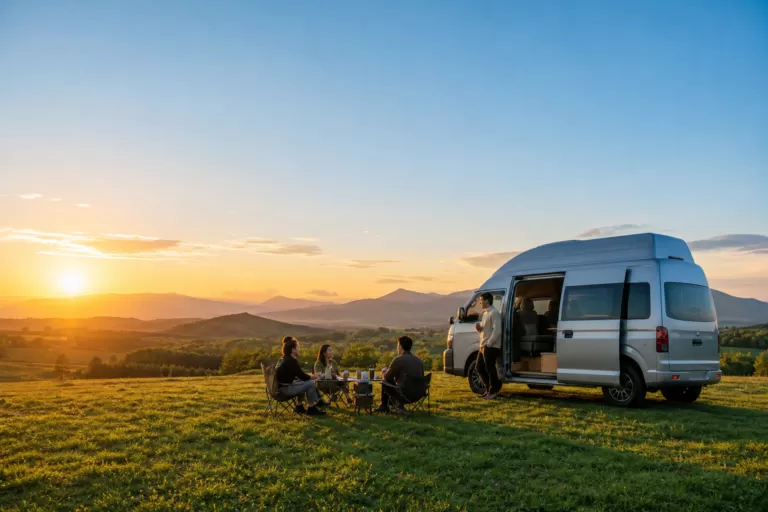
When planning a campervan trip through Hokkaido, it’s tempting to move to a new spot every day. But staying 3 to 5 nights at the same campsite — the “multi-night style” — offers a depth that constant travel simply can’t match. Wake up with your gear already spread out, explore the surroundings at your own pace, and return to your site by evening. This guide covers setup techniques, electricity and water management, and recommended base camps for comfortable multi-night campervan stays in Hokkaido.
Some people worry that staying in one place will get boring, but Hokkaido campsites are surrounded by activities — hot springs, hiking trails, cycling routes, and farm stands are often just 30 minutes away by car. If you prefer to rest after travel before sightseeing, the multi-night style is an ideal fit.
Benefits of Multi-Night Stays and Who They Suit
Multi-night camping means booking the same campsite for several consecutive nights without moving the vehicle. Without the daily cycle of packing up and driving, you’ll have significantly more energy.
Compared to the Touring Style
Hopping from site to site every 1–2 nights lets you cover a lot of Hokkaido efficiently, but the repeated setup and teardown wears you down — especially with children or older travelers. With multi-night stays, you can leave gear laid out and plan freely: “Hot spring today, cycling along the coast tomorrow.”
On a touring trip, you need to use up perishables before reaching the next camp. With a base camp, you can restock systematically and may even extend your stay by an extra night if availability allows.
Who Benefits Most
- Families with young children who find daily teardown exhausting
- Couples who want to explore one area in depth
- Activity-focused travelers — hikers, anglers, cyclists
- First-time campervan renters who need time to learn the ropes
- Travelers on week-long or longer Hokkaido trips who want to conserve energy
- Those who want to relax in a hot spring town or sightseeing area
Multi-Night Discounts Can Lower Your Cost
Many Hokkaido campsites offer multi-night discounts — 10–20% off for 3 or more nights is not uncommon at auto campsites and RV parks. Factor in the fuel and toll costs you avoid by not moving, and the total often matches or undercuts a touring trip.
For example: a site at ¥4,000/night with a 15% multi-night discount works out to ¥10,200 for 3 nights (¥3,400/night). Add in ¥1,000–2,000/day in fuel savings and the effective cost is very competitive.
Choosing the Right Auto Site or RV Park (Power / Water / Trash)
Comfort during a multi-night stay is largely determined at the booking stage. Cover these three points before you reserve: electricity, water, and trash disposal.
Choose a Site with Electrical Hookup
Hokkaido summers can push past 30°C. Running the refrigerator continuously and using air conditioning makes an external power connection (AC 100V, 15A or more) essentially a requirement. Without shore power, a sub-battery or solar panel setup may not keep up over 3+ consecutive nights.
Amperage standards vary by facility. Older installations at 10A or less may trip the breaker if you run the fridge and AC simultaneously. Ask the campsite for the amperage rating when you book.
→ For a full breakdown of electrical management, see: Hokkaido Campervan Electricity & Power Complete Guide.
Check Water Supply and Drainage Facilities
Water tank refilling and grey water disposal become daily tasks on a multi-night stay. Key facilities to confirm:
- Fresh water tap location: An individual tap at your site is ideal; confirm hours for shared taps
- Grey water drain: Is there a drain for sink/shower water? If not, you’ll need to haul it out
- Shower/kitchen facilities: If a hot spring is nearby, the kitchen area alone may be sufficient
- Dump station: Required for black tank disposal (cassette toilet vehicles may not need this)
→ See our Campervan Water Management Guide for detailed instructions.
Confirm Trash Disposal Rules in Advance
Hokkaido campsites handle trash in one of two ways:
- On-site disposal allowed: Separate your waste and use site bins — no stress over accumulating food scraps
- Pack it out: All trash must be taken home or to a paid disposal facility
Over 3–5 days, trash accumulates fast. At pack-out sites, plan meals around non-perishables — retort pouches, canned goods, individually packaged items — to minimize food waste. Some Michi-no-Eki sell paid garbage bags for disposal; plan a stop on your way out.
Compare Hokkaido Campervan Rentals
Base yourself at New Chitose Airport and compare rates, vehicle types, and pickup locations all in one place.
View Rental Companies & Rates →Setup Layout: Tarp and Chairs for Outdoor Comfort
On a multi-night stay, your initial setup defines your living space for the entire trip. Getting it right pays dividends every day.
Vehicle Orientation Matters
Before parking, consider which direction to face the vehicle:
- Sun angle: Avoid west-facing windows catching the afternoon sun — it heats the interior quickly
- Door orientation: Face the rear door toward the area where you’ll set up tables and tarps
- Neighbor consideration: Position doors and noisy activities away from adjacent sites
- Shore power access: Park so the electrical inlet is closest to the power post
Before parking, step out and walk around the site for a minute or two. A quick check of sun exposure, wind direction, and neighbor proximity can make every night significantly more comfortable.
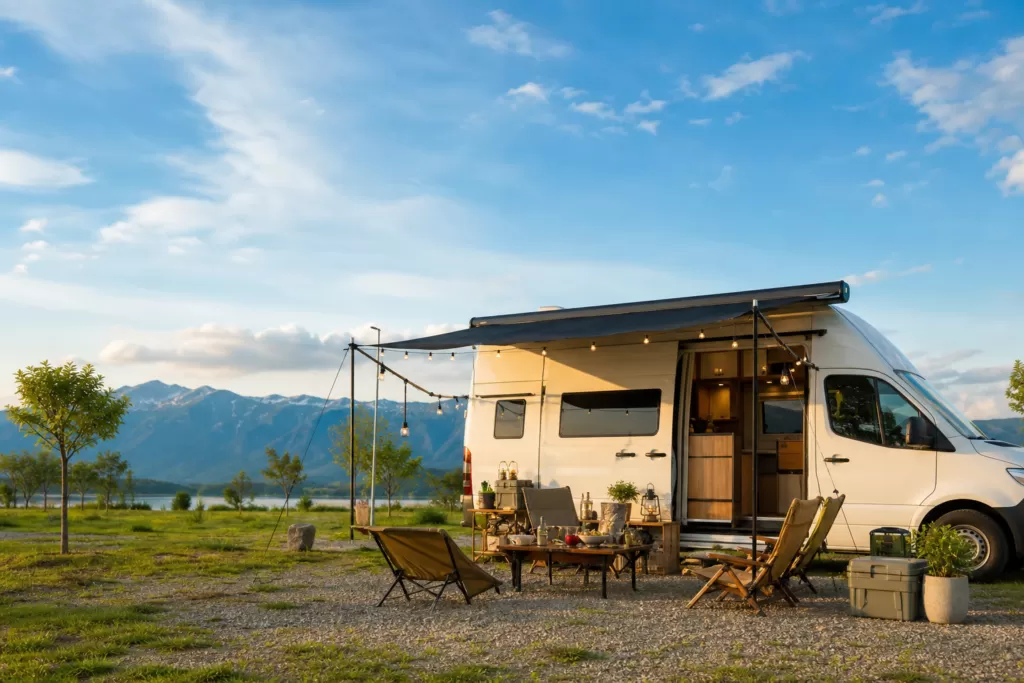
Set Up a Tarp for Outdoor Living Space
A tarp is essential for multi-night stays. Hokkaido summers bring intense UV and sudden rain showers. A properly pitched tarp lets you eat and relax outside regardless of weather.
The side awning built into many campervans is a basic sun shelter, but its coverage is limited. Attaching a hex tarp or screen tarp — or pitching one independently — gives far more usable space. For families of 4–5, a screen tarp wider than 5 meters lets everyone sit around the table even in rain.
Drive tent stakes firmly — Hokkaido nights can turn windy even inland. At lakeside or coastal sites, gusts can pick up suddenly in the evening, so always stake out the guy lines.
Build an Outdoor Living Room with Chairs and Tables
Multi-night stays mean spending more time outside. Set up 2–4 folding chairs and a camp table to create a living room outside the vehicle. Morning coffee in the open air and an evening campfire are the real pleasures of this travel style.
If gear is tight, a roof carrier or hitch cargo tray keeps the interior clear. Check whether your rental vehicle has optional accessories available.
Plan a Food Rotation Schedule
Minimize waste by using ingredients in order of perishability:
- Days 1–2: Fresh meat, fish, and leafy vegetables first
- Days 3–4: Root vegetables, eggs, tofu (longer shelf life)
- Day 5+: Shift to retort pouches, canned food, and dried noodles
Build in a restock run at a local supermarket or Michi-no-Eki mid-trip. Many Hokkaido roadside stations double as farm stands selling locally grown corn, potatoes, and dairy on the spot.
Managing Water, Electricity, and Waste on Multi-Night Stays
A campervan is self-contained, but resource consumption adds up over multiple nights. A five-minute morning check routine prevents unexpected water shortages or dead batteries.
Water Tank Management
Most campervans have a 50–100 liter fresh water tank. Per-person daily usage — cooking, washing dishes, brushing teeth — runs 10–15 liters. Two people over 3 nights need roughly 60–90 liters.
- Check the gauge each morning (or tap the tank and listen)
- Refill daily or every other day if a tap is available on site
- Save water: wash dishes in batches, use the hot spring for bathing
- Keep a separate supply of drinking water in bottles to extend the tank
A simple rule: refill when the tank drops below half. A full tank adds roughly 1 kg per liter in weight.
Electricity Management
With shore power connected, electricity is generally not a concern. Off-grid, watch your sub-battery consumption:
- Refrigerator: the largest draw — run continuously; use eco mode if available
- Lighting: most campervans use LED, but extended use does affect the battery
- Air conditioning: not usable without shore power (running the engine provides some charge)
- Phone/laptop charging via USB: negligible drain
If staying at a non-electric site, run the engine 30–60 minutes per day to recharge, or choose a vehicle with a solar panel option. Some rental companies offer a portable power station as an add-on.
Grey Tank (Waste Water) Management
The grey tank collects dish and shower drainage and has roughly the same capacity as the fresh water tank — nearly full after 3 nights.
- If an on-site drain is available: empty every 1–2 days
- If no drain: use a dump station at a Michi-no-Eki or RV park (search “dump station Hokkaido” on Google Maps)
For black tank disposal: cassette toilet systems can be emptied at designated disposal points or campsite toilet facilities. Flush toilet systems require a dump station. Confirm which system your rental vehicle uses before you depart.
Recommended Multi-Night Base Camps in Hokkaido
Given Hokkaido’s vast size, limiting yourself to 1–2 base camps lets you explore each area in depth. Here are the top zones and activities.
Furano & Biei Area
Famous for flower fields and rolling hills, this is the classic slow-travel destination. Several auto campsites near Furano and Biei offer powered sites. In July–August, lavender is in full bloom — with a campervan base, you can visit the fields at dawn or dusk to beat the crowds.
- Cycling from base: Ride through lavender fields and patchwork hills (rental bikes available)
- Hot spring circuit: Fukiage Onsen and Tokachidake Onsen are nearby; Fukiage’s outdoor bath is famously free
- Hiking: Day hike to Mt. Tokachidake (2,077 m); multiple routes via Furanodake and Biei-dake
- Farm produce: Melon, corn, lavender soft serve, and other local treats
Mt. Tokachidake has been at Volcanic Alert Level 3 (entry restrictions) since September 12, 2026. Prefectural Route 966 beyond Bogakudai is closed to traffic, so if you are heading toward Tokachidake Onsen or Fukiage Onsen, check the Japan Meteorological Agency volcano information for Tokachidake and the latest notices from Biei Town and Kamifurano Town (checked 2026-10-08).
Shiretoko & Shari Area
To explore the Shiretoko UNESCO World Heritage Peninsula, base yourself at a campsite in Utoro or Shari. Shiretoko is too large to cover in one day — multi-night is the right approach.
- Shiretoko Five Lakes trekking: Elevated boardwalk (free) or ground trail (paid, guide required) through brown bear habitat
- Kamuiwakka Hot Falls: Bathe in a natural hot spring waterfall (access may be restricted by season)
- Wildlife cruise: Sea cliffs and wildlife — brown bears and orcas are regularly spotted
- Rausu side: Whale watching and Rausu Onsen hot spring
Toya Lake & Niseko Area
Within two hours of New Chitose Airport, this area works well as a base for the start or end of your trip. Rich in hot springs, it’s also ideal for new campervan renters who want time to practice.
- Toya Onsen: Many hotels offer day-use bathing; the lakeside sightseeing boat is also enjoyable
- Niseko outdoor activities: Summer rafting, canoeing, and trekking; beginner-friendly rafting on the Shiribetsu River
- Farm produce: Cherry picking, melon, and corn in the Yoichi/Nishiki area
- Mt. Usu: Ropeway to the crater rim overlooking the caldera lake; Showa Shinzan is nearby
Eastern Hokkaido & Kushiro Wetlands Area
Ideal for travelers who want to immerse themselves in nature around Kushiro Wetlands, Lake Akan, and Lake Mashu. Even in busy summer, a campervan base lets you move at your own pace. The area is often foggy, but catching Lake Mashu clear in the morning is deeply satisfying.
- Canoeing: Half-day to full-day Canadian canoe trips on the Kushiro River
- Birdwatching: Spot Japanese cranes and white-tailed eagles; the wetlands observation tower offers a sweeping view
- Hot springs: Kawayu Onsen, Akan Onsen, and Teshikaga facilities dot the area
- Lake Mashu & Lake Kussharo: Japan’s clearest lake and its largest caldera lake — both reachable in a single day
New Chitose Airport / Tokachi-Obihiro Airport
Rent the Cab-Over Camper “Cresson Journey”
Base yourself at New Chitose Airport and travel all across Hokkaido by campervan.
View Details at Moving Inn →Frequently Asked Questions
Q: How far in advance should I book a multi-night campsite?
Popular sites fill up 1–3 months ahead for July and August, especially around Obon. Furano, Biei, and Shiretoko require early reservations. June and September have more availability. Aim to book 2 months out and confirm the cancellation policy.
Q: What if it rains for 3 or more consecutive days?
A tarp keeps outdoor space usable, but unlike touring, you can’t simply move to a drier location. On the other hand, the base camp approach lets you go out to a hot spring or roadside station and come back — which touring trips can’t replicate. Reading, cooking, and slow indoor days are also part of the experience. Hokkaido can see 3+ consecutive rainy days even in summer; bring something to do indoors.
Q: Do all campsites offer multi-night discounts?
No — check each facility’s website or call ahead. Some Japan RV Association–certified RV parks offer weekly long-stay rates. Simply asking “Do you have a multi-night discount?” at booking time usually gets a clear answer.
Q: I’m worried about water and trash management. Where do I start?
Start by choosing a facility with all three: shore power, on-site water tap, and on-site trash disposal. Hokkaido has RV parks and high-standard auto campsites in every region that offer all three. Top up water each morning, separate your trash carefully, and 5-night stays will rarely cause problems. For your first multi-night trip, try 2 nights and build from there.
Q: Is multi-night camping suitable for first-time campervan renters?
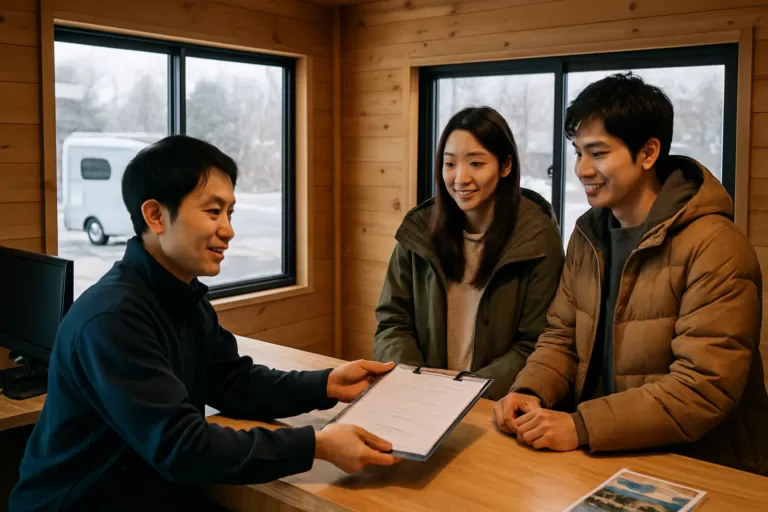
Multi-night is actually more beginner-friendly than touring. Without daily setup and teardown, you just need to learn the electrical, water, and setup systems once on day one — then repeat. Get a thorough walkthrough from the rental company before departure. Moving Inn at New Chitose Airport offers a detailed pre-departure briefing by the vehicle owner.
Q: What is the best season for multi-night campervan travel in Hokkaido?
Late June through September is ideal. June sees lavender beginning to bloom, fewer crowds, and easier site availability. July–August brings warm, sunny days but also peak congestion. September is cooler and quieter, with early autumn foliage in some areas. After October, most Hokkaido campsites close and multi-night options become limited.
Once you have setup and resource management down, multi-night campervan travel in Hokkaido offers a deeper sense of rest than constant movement. Staying in one place reveals the changing moods of morning mist, evening glow, and night skies. Small outings to a local hot spring or market take on a different quality when you have a home to return to. Sometimes reducing the distance you travel is exactly what raises the quality of the journey.
Book a Campervan in Hokkaido
Moving Inn New Chitose Airport supports English booking and offers airport transfers.
Pick a campervan by what matters to you.
Rent at New Chitose Airport
See only the rental bases in Chitose, where the airport is.