Watching the Salmon Run in Hokkaido by Campervan | Spots and Overnight Routes in Ishikari, Shiretoko, and Shiraoi [Autumn 2026]
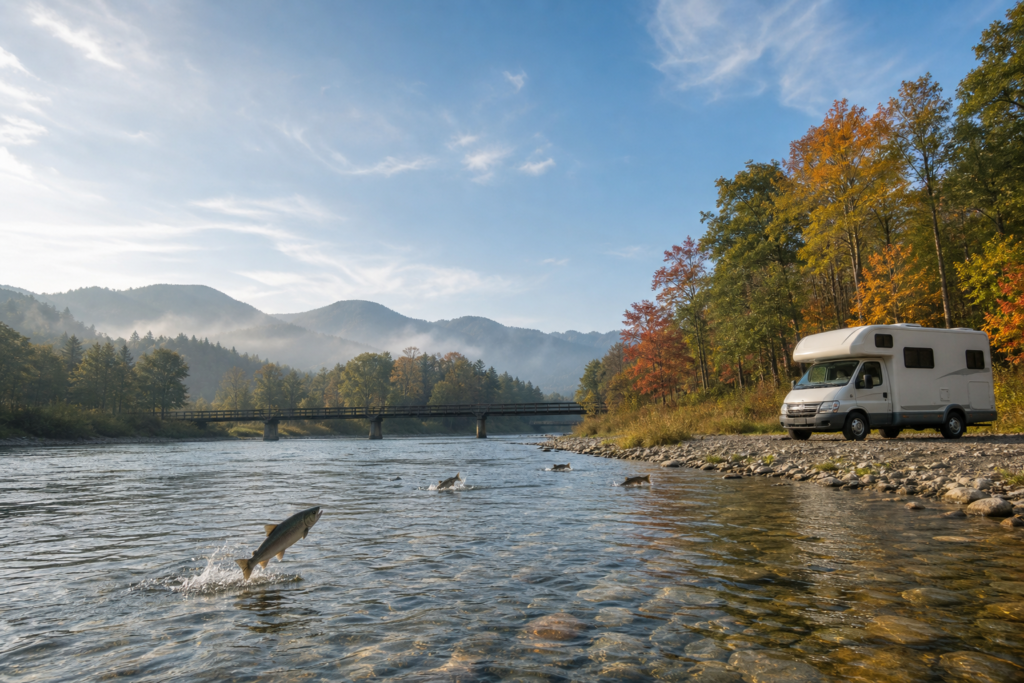
Every autumn, salmon that swam out to sea return to Hokkaido’s rivers and push upstream in schools to spawn. This “salmon run” (sojo) can be seen in rivers across the island from September through November — but the timing shifts from river to river. In Ishikari, the Atsuta and Hamamasu rivers run from early September to mid-October (Ishikari City official site, confirmed 2026-08-14); the guided tour in Shiretoko runs September 1 to November 20 (Shiretoko Naturalist Association SHINRA, confirmed 2026-08-14); and the Ayoro River in Shiraoi’s Kojohama area runs mid-October to early November (Shiraoi Tourism Association, confirmed 2026-08-14). In other words, which river you can watch depends on when you go.
That staggered timing is exactly what makes a campervan trip work well here. Without a fixed hotel, you can follow the peak: Ishikari or Shiretoko in September, Shiraoi in late October. This article rounds up the three areas where official sources confirm you can watch the run, how to camp overnight nearby, and how to build a route around the season. Dates and prices below were confirmed on each official site on August 14, 2026. This is a natural phenomenon, so timing shifts year to year and with the weather.
New from New Chitose Airport — Available from June 2026
Rent the Cabcon “Cresson Journey”
Base yourself at New Chitose Airport and compare rates, vehicle types, and pickup locations all in one place.
See details at Moving Inn →When and where can you see the salmon run? Comparing three areas
Line up the three areas where official sites confirm viewing windows, and they form a relay running from early September all the way to early November.
| Area | River | Viewing window | How to watch | Source |
|---|---|---|---|---|
| Ishikari (Atsuta / Hamamasu) | Atsuta River, Hamamasu River, Bokusanai River | Early September – mid-October | Free self-guided viewing from bridges, etc. | Ishikari City official site (confirmed 2026-08-14) |
| Shiretoko (Utoro) | Rivers around Utoro | September 1 – November 20 | Guided tour (paid, booking required) | Shiretoko Naturalist Association SHINRA official site (confirmed 2026-08-14) |
| Shiraoi (Kojohama) | Ayoro River | Mid-October – early November | Free self-guided viewing from bridges, etc. | Shiraoi Tourism Association official site, English page (confirmed 2026-08-14) |
For a September trip, Ishikari and Shiretoko are your candidates; for late October into early November, Shiraoi comes into play. Late September through October also overlaps with the autumn foliage moving down from the Daisetsuzan range, so pairing this trip with our complete guide to Hokkaido campervan autumn foliage drives lets you chase both on one trip.
Ishikari’s Atsuta and Hamamasu rivers: a day trip from Sapporo, 8 viewing spots
Where to watch (Ishikari City’s official viewing spots)
Ishikari City’s official site names specific viewing spots river by river (confirmed 2026-08-14). The window is “early September to mid-October,” and the site notes that “you’ll see more fish further upstream than near the river mouth.”
| River | Viewing spots |
|---|---|
| Atsuta River | Sakae Bridge / Atsuta Bridge (along Route 231) / Yamanami Bridge |
| Bokusanai River | Atsuta Park Campground |
| Hamamasu River | Hamamasu Bridge (along Route 231) / Mita-Hamanaka Bridge / Shin-Osatsunai Bridge / Mita Bridge |
Exact locations are mapped on Ishikari City’s official page. From the Sapporo area, it’s roughly 60–90 minutes via Route 231 (the Ororon Line) (same page, confirmed 2026-08-14). Atsuta Bridge and Hamamasu Bridge both sit right on Route 231, so you can watch the run as a stop on a drive up the Sea of Japan coast. The city’s official page also states that “fishing is prohibited in the Atsuta River to protect fishery resources” (confirmed 2026-08-14). The Hamamasu River has a separate survey-fishing program in September and October, but that’s not something visitors can cast a line into on a whim — check the city’s official page for details.
Where to stay: Atsuta Campground is the viewing spot itself
Here’s the interesting part: one of the eight official viewing spots is a campground. Ishikari City’s official page for Atsuta Campground states that the Bokusanai River running through the grounds sees “the salmon run from mid-September to mid-October,” close enough to reach out and touch (confirmed 2026-08-14). Waking up to watch salmon run right where you camped is a rare setup, even in Hokkaido. Overnight fees are ¥1,000 for adults and ¥500 for children, with check-in at 12:00 and check-out at 10:00 (confirmed 2026-08-14). Check the official page for autumn operating status and how to book.
Along Route 231 sits the Michi-no-Eki Ishikari “Airoad Atsuta,” which officially lists 24-hour restrooms and parking for about 200 vehicles. There is, however, no mention of overnight parking (Hokkaido Michi-no-Eki official portal, confirmed 2026-08-14). The absence of a mention doesn’t mean it’s allowed, so treat it as a rest/nap stop only. For how to think about overnight parking at Michi-no-Eki in general, see our 20 recommended Michi-no-Eki for overnight parking in Hokkaido. If you want a proper overnight stay with power hookups, browse certified RV parks nearby via our Hokkaido RV park list (47 JRVA-certified locations) (confirmed 2026-08-14).
Shiretoko / Utoro: a guided tour to see both the river and the sea
SHINRA’s salmon run watching tour
In Shiretoko, the Shiretoko Naturalist Association SHINRA, based in Utoro, runs a “salmon run watching” tour. According to its official site, the season runs September 1 to November 20, the tour takes about 1.5 hours, and pricing is ¥4,000 for junior-high age and up and ¥3,000 for elementary-age children, with a minimum of 2 participants to run (confirmed 2026-08-14). From September 24 to October 31, a 7:30 a.m. departure option adds a fish-landing viewing, so you can see both salmon swimming upstream and salmon being unloaded at the fishing port in a single tour. The site also states there may be days the tour can’t run due to run conditions or river flooding, so check the official page for the latest schedule when booking.
The riverbanks in Shiretoko overlap with brown bear range. Rather than the free-viewing style you get in Ishikari or Shiraoi, going with a guide to a safe vantage point is the practical reason to book a tour here. Meeting points are typically arranged as pickup from accommodation within the Utoro area, so if you’re traveling by campervan, confirm the meeting arrangement when you book.
Where to stay: Utoro and Shari overnight parking, already verified
Where you can spend the night around Utoro — including our verified check of the official notices at Michi-no-Eki Shari / Utoro Shiretoko — is covered in Can you park overnight at Michi-no-Eki Shari / Utoro Shiretoko? (confirmed 2026-08-14). For routing that also covers Shiretoko Pass and the sightseeing cruise, see our Shiretoko / Utoro campervan drive guide.
Shiraoi’s Ayoro River: the season starts mid-October, watch from a bridge by the shops
Three viewing spots in Kojohama
Along the Ayoro River running through Kojohama in Shiraoi Town, the Shiraoi Tourism Association’s official site (English page) lists three viewing spots. The window is mid-October to early November. The three spots are the bridge near the tarako shop “Tarakoya Kojohama,” the Shin-Ayoro Bridge near the fishery company “Takemaru Shibuya Fisheries,” and a point opposite a ranch (confirmed 2026-08-14). The season here starts about a month later than Ishikari, so it’s a good option even if you’re traveling in late October.
The tourism association’s page also notes that if you use a shop’s parking lot, you should shop there before you go watch (confirmed 2026-08-14). Kojohama is known for tarako (salted cod roe), so buying a souvenir as thanks for the parking, then heading to the river, is a natural way to combine the two. Check the Shiraoi Tourism Association’s page for exact spot locations.
About the Uyoro River
The Uyoro River in Shiraoi is also known for its salmon run, and appears as “Salmon Run (Uyoro River)” in the Shiraoi Tourism Association’s educational-tourism guide. However, we could not confirm an official page detailing the viewing season, location, or route (confirmed 2026-08-14). Since there isn’t official information set up for individual visitors, if you’re considering watching the run at the Uyoro River, contact the Shiraoi Tourism Association (0144-82-2216) directly.
Where to stay: bases in the Tomakomai / Shiraoi area
Kojohama sits between Tomakomai and Noboribetsu, an easy fit if your trip also involves arriving in Hokkaido by ferry. For routing the wider area and overnight parking spots, see our Tomakomai / Shiraoi campervan guide; for a nearby certified RV park, check our Tomakomai RV park guide (confirmed 2026-08-14). If RV parks are a new concept to you, start with What is an RV park? Rates, facilities, and how it differs from a Michi-no-Eki so nothing catches you off guard.
Rules for watching: catching them is illegal, watching is not
Watching a large fish swim past right in front of you makes you want to get closer, but salmon here are strictly a look-don’t-touch animal. Shiraoi Town’s official site states plainly that “capturing salmon and trout near river mouths is prohibited under the Fisheries Resources Protection Act and Hokkaido’s inland-water fishery adjustment rules,” naming the Shiraoi, Shikiu, and Ayoro rivers as covered (confirmed 2026-08-14). Ishikari City likewise officially bans fishing in the Atsuta River, as noted above. Touching, scooping up, or taking a fish home is out of the question — these are all acts that can carry legal penalties.
- Watch only from bridges or designated viewing points. Don’t climb down into the riverbed or the water on your own.
- Stay back from the water’s edge so you don’t trample spawning beds (redds) on the riverbed.
- Rivers near the mountains overlap with brown bear range. Check each municipality’s bear-sighting information before you set out, and don’t enter brush alone.
- Skip viewing during high water (SHINRA’s Shiretoko tour explicitly cancels during flooding, too).
- Park only in designated lots, or — where parking depends on a shop — buy something as a thank-you.
Season-by-season model routes: pick your river to match the run
Early September – mid-October: Sapporo to Ishikari, a 1-night, 2-day trip
Pick up your campervan at New Chitose Airport or Sapporo and head north on Route 231. Watch at Atsuta Bridge and Sakae Bridge, then settle in at Atsuta Campground, where you can watch the Bokusanai River run again the next morning. On day two, push further north to the Hamamasu River (Hamamasu Bridge, Mita Bridge, and others) before turning back. With shorter drives, you get more time actually watching. For what to pack and expect weather-wise in September, see our Hokkaido campervan autumn trip guide.
Late September – October: eastern Hokkaido and Shiretoko for both the run and the foliage
Base yourself in Utoro. In the morning, take SHINRA’s salmon-run tour with the fish-landing option (offered September 24 – October 31, confirmed 2026-08-14); spend the day at Shiretoko Pass or the Shiretoko Five Lakes. This window overlaps with the autumn foliage moving through eastern Hokkaido, so linking up with the eastern-Hokkaido section of our complete autumn foliage drive guide lets you fold the salmon run, the foliage, and the World Heritage site into one trip. Driving distances here are long, so check a route planner before you set out.
Mid-October – early November: fold Shiraoi’s Kojohama into a ferry trip
Late in the season, head for the Ayoro River. On the first or last day of a Tomakomai-port ferry crossing, stop in at Kojohama, watch from the bridge, and pick up some tarako on your way out — a half-day loop that fits neatly. Since it sits on the same route as Noboribetsu Onsen and Upopoy, the practical way to use this window is to build your trip around a different main attraction and slot the salmon run in as a worthwhile detour.
New from New Chitose Airport — Available from June 2026
Rent the Cabcon “Cresson Journey”
Base yourself at New Chitose Airport and compare rates, vehicle types, and pickup locations all in one place.
See details at Moving Inn →Pre-departure checklist
- Did you pick a river that’s actually running when you go? (Ishikari: early Sept – mid-Oct / Shiretoko tour: Sept 1 – Nov 20 / Shiraoi: mid-Oct – early Nov. All per official sources, confirmed 2026-08-14.)
- If you’re watching in Shiretoko, have you booked the tour and confirmed the meeting arrangement for campervan travelers?
- If staying at Atsuta Campground, have you confirmed autumn operating status and made a booking on the official page?
- Have you settled where you’ll actually sleep? (Campgrounds and RV parks as your base; treat Michi-no-Eki as a rest/nap stop only.)
- Have you checked each municipality’s bear-sighting information?
- Do you have binoculars and polarized sunglasses packed? (They make it much easier to spot fish through glare on the water.)
Frequently asked questions
When can you see the salmon run in Hokkaido?
It varies by river. Where official sources confirm a viewing window: Ishikari’s Atsuta and Hamamasu rivers run early September to mid-October, the guided tour in Shiretoko runs September 1 to November 20, and Shiraoi’s Ayoro River runs mid-October to early November (all confirmed 2026-08-14). Timing shifts with the year and weather, so check each official site right before your trip.
Are there any free viewing spots?
The bridges along Ishikari’s Atsuta and Hamamasu rivers (Sakae Bridge, Atsuta Bridge, Hamamasu Bridge, and eight spots total) and the three spots on Shiraoi’s Ayoro River are all listed on their respective official sites as places you can watch freely from public roads or bridges (confirmed 2026-08-14). Shiretoko requires a guided tour (¥4,000 for junior-high age and up, confirmed 2026-08-14).
Can I catch or touch the salmon in the river?
No. Shiraoi Town’s official site states that “capturing salmon and trout near river mouths is prohibited under the Fisheries Resources Protection Act and Hokkaido’s inland-water fishery adjustment rules” (confirmed 2026-08-14), and Ishikari City similarly bans fishing in the Atsuta River. Beyond taking one home, chasing or scooping fish is also off-limits — watch only from bridges or similar vantage points.
Can kids come along?
Ishikari City’s official site notes that at Atsuta Campground, you can watch the Bokusanai River’s run at close range right on the grounds (confirmed 2026-08-14). Bridge viewpoints are generally fenced but some sit close to traffic, so keep an eye on kids. SHINRA’s Shiretoko tour also has a set elementary-school price (¥3,000, confirmed 2026-08-14).
Can you park overnight near the viewing spots?
In Ishikari, Atsuta Campground doubles as a viewing spot. Around Shiretoko / Shari, see our verified guide to Michi-no-Eki Shari / Utoro Shiretoko. Around Shiraoi / Tomakomai, our Tomakomai RV park guide has you covered. Michi-no-Eki Airoad Atsuta has no official mention of overnight parking (confirmed 2026-08-14), so keep any stop there to a rest or nap, and book a campground or RV park for nights you actually need to sleep.
Can you still see the run after rain?
SHINRA officially states that its Shiretoko tour may be unable to run depending on run conditions or river flooding (confirmed 2026-08-14). Even at free-viewing spots, a swollen river runs cloudy and makes fish hard to spot, and it’s more dangerous besides — skip viewing during high water and come back once the water has dropped.
Book a Campervan in Hokkaido
Moving Inn New Chitose Airport supports English booking and offers airport transfers.

![Things to Do in Sapporo in Winter: Beyond the Snow Festival, Plus Seasonal Highlights and a Campervan Guide [2026-27]](https://hokkaido-campingcar.jp/wp-content/uploads/2026/10/sapporo-hl1841-768x576.jpg)
![Monbetsu Drift Ice Festival 2027 [Feb 11–14]: Dates, Ice Sculptures, Garinko-go Icebreaker, Parking and Access by Campervan](https://hokkaido-campingcar.jp/wp-content/uploads/2026/10/monbetsu-hl999-768x576.jpg)
![Hokkaido New Year Weather and What to Wear | Sapporo, Hakodate, Asahikawa, Obihiro Mornings and Evenings, and Heavy-Snow Years [2026-27]](https://hokkaido-campingcar.jp/wp-content/uploads/2026/10/hokkaido-new-year-holiday-weather-eyecatch-768x432.webp)
![Hokkaido Illumination 2026-27 [Dates]: Sapporo Starts Nov 20, Plus Otaru, Asahikawa, Obihiro & Hakodate for Campervan Trips](https://hokkaido-campingcar.jp/wp-content/uploads/2026/10/hokkaido-illumination-2026-eyecatch-768x432.webp)