Complete Guide to Campervan Rental Insurance & Coverage | How to Prepare for Accident Risk
A complete guide to campervan rental insurance in Hokkaido, covering basic insurance, CDW (Collision Damage Waiver), and NOC coverage.
Introduction | Why Insurance Matters for Campervan Travel
Traveling by campervan across the vast landscapes of Hokkaido offers countless attractions. But did you know that driving a rental vehicle comes with unique risks not found with regular cars?
At Moving Inn, insurance is included in the rental fee. Your maximum out-of-pocket is JPY 100,000 each for property and vehicle damage.
- Bodily injury liability: unlimited
- Property damage liability: unlimited, with a deductible of JPY 100,000
- Vehicle damage: up to the vehicle’s market value, with a deductible of JPY 100,000
- Personal injury: up to JPY 30,000,000 per person
- Optional damage waiver: reduces your liability for vehicle damage to zero; the FAQ lists it at JPY 2,530 including tax. Options can differ by vehicle, so check the vehicle’s booking page (Moving Inn rental cars, Moving Inn FAQ, checked 20 Oct 2026).
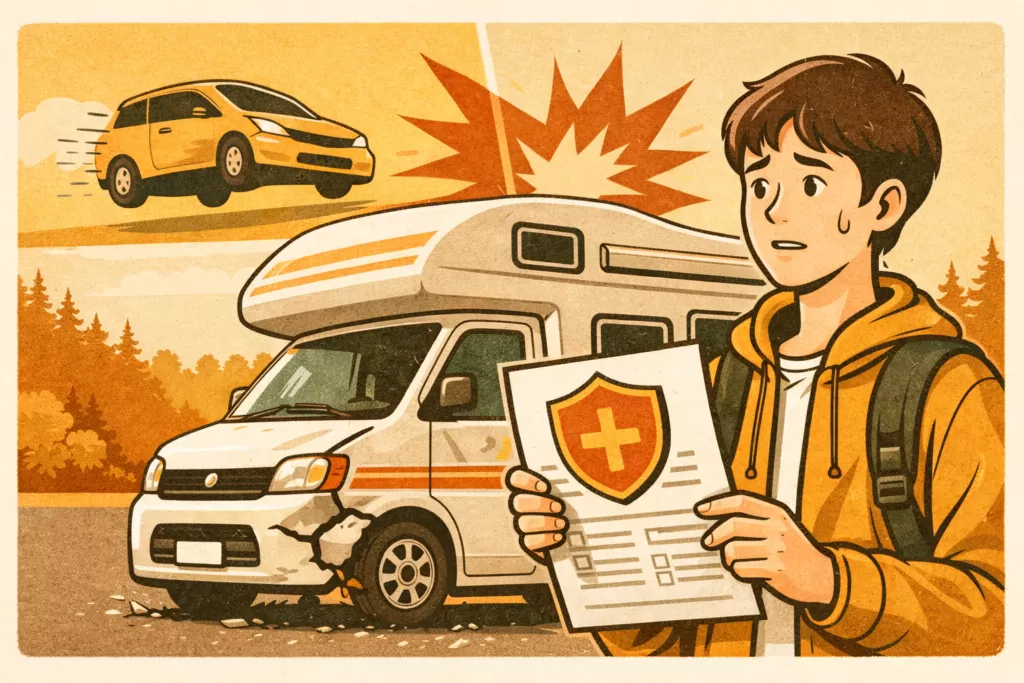
Campervans are large, sit high off the ground, and have significant blind spots when reversing. You will also encounter more situations involving height restrictions and narrow roads. All of these factors increase the risk of accidents.
To ease the worry of “what if I have an accident?”, it is important to understand how insurance and compensation work. This article clearly explains campervan types, the difference between basic insurance and optional add-ons, actual coverage details and price ranges, and key points for choosing the right insurance.
Understanding the Types of Insurance for Rental Campervans
Insurance for campervan rentals falls broadly into two categories: “basic insurance” and “additional coverage.” Understanding the role of each helps you choose the right plan.
The 5 Types of Basic Insurance
Basic insurance normally included in the rental fee consists of the following five types.
- Third-Party Liability (Bodily Injury): Covers medical and compensation costs if you injure someone in an accident. The limit is normally unlimited.
- Third-Party Liability (Property Damage): Covers repair costs if you damage another person’s building or vehicle. The limit is normally ¥10 million or more.
- Vehicle Insurance: Covers repair costs for the rental campervan itself. However, a deductible (excess) is almost always set.
- Personal Injury Protection: Covers medical costs and lost income if you or a passenger are injured.
- Passenger Injury Insurance: Pays a consolation amount for injuries suffered by passengers.
What is CDW (Collision Damage Waiver)?
CDW (Collision Damage Waiver), also called “deductible waiver,” is an option that reduces your out-of-pocket cost to zero in the event of an accident.
Normally, vehicle insurance includes a deductible—an amount you must pay yourself when an accident occurs. CDW covers that deductible portion.
Major rental companies in Hokkaido offer CDW for an additional ¥1,650–¥6,600 per day. Costs vary by plan and vehicle type, so always confirm when booking. The longer your trip, the more valuable this coverage becomes.
What is NOC (Non-Operation Charge) Coverage?
NOC covers the lost revenue a rental company suffers when a campervan cannot be operated due to an accident.
For example, if you cause an accident that takes two weeks to repair, the rental company cannot lend that campervan to other customers during that time, losing income. This loss is charged as the “non-operation charge.”
The amount varies depending on the extent of repairs, but the typical range is ¥20,000–¥50,000 if the vehicle can be driven to the repair shop, or ¥50,000–¥100,000 if it must be towed.
How CDW Works | Reducing Your Out-of-Pocket Cost to Zero
CDW is the most important coverage for campervan rentals. Let’s take a deep look at how it works.
Why CDW Is Essential
With basic insurance alone, you still face out-of-pocket costs in an accident. For example, if you back into a pillar and repairs cost ¥500,000, and the deductible is ¥200,000, you would owe ¥200,000 out of pocket.
With CDW, that ¥200,000 becomes zero. We recommend adding CDW so an accident doesn’t ruin the fun of your trip.
Coverage Amount and Daily Cost
The daily cost of CDW varies widely by rental company and plan. Here is the range seen at major companies in Hokkaido.
- Budget tier: ¥1,650–¥2,200/day (Japan Road Trip, Fujicars Japan, etc.)
- Standard tier: ¥2,530–¥3,300/day (Moving Inn Hiace models, ChikiChiki Normal, etc.)
- Comprehensive coverage: ¥5,500–¥6,600/day (Nomad Rentacar, ChikiChiki Wide, Ureska α Plan, etc.)
For a 7-day trip, expect an additional cost of ¥11,550–¥46,200. Choose based on the balance between coverage and cost.
3 Types of Waiver Plans (CDW Only, NOC Only, Full Package)
Waiver coverage isn’t one-size-fits-all — it generally comes in three tiers depending on what’s covered.
| Plan Type | Rate Estimate | Coverage |
|---|---|---|
| Basic collision damage waiver (CDW) | ¥1,000–¥2,000/day | Brings the vehicle damage deductible to ¥0 or reduces it |
| NOC waiver option | ¥1,000–¥3,000/day | Waives NOC (operational loss charge) in an accident |
| Full package (CDW + NOC) | ¥2,000–¥5,000/day | Waives both the deductible and NOC — highest peace of mind |
Some companies sell CDW and NOC waivers as separate plans. Enrolling in only one leaves the other risk uncovered, so always confirm exactly what’s included when you book.
What CDW Covers and What It Does Not
Covered cases:
- Collision with another vehicle
- Contact with a building or facility
- Damage while reversing
- Windshield damage from flying stones while driving
- Damage from hail
Not covered:
- Accidents caused by drunk driving
- Intentional damage
- Roof damage from ignoring height restrictions
- Flood/submersion damage
- Internal engine failure (normal wear)
Real Accident Examples Showing Coverage Impact
[Case 1] Backing into a pillar
If you back into a pillar at a campsite and cause a 30cm×20cm scratch on the side, repairs cost about ¥150,000. With a ¥100,000 deductible, you pay ¥100,000 without CDW—¥0 with CDW.
[Case 2] Collision with fallen debris while driving
If cargo falls from a truck on the highway and damages your bumper and body, with ¥250,000 in repairs, the value of CDW becomes clear.
NOC Coverage | How It Compensates for the Period the Vehicle Cannot Operate
Here is a detailed explanation of the “lost revenue” that arises during the repair period after an accident.
How the Non-Operation Charge Is Calculated
The NOC amount is determined by the following factors.
- Repair days: The time required for repairs
- Driveability: Whether the vehicle can be driven to the repair shop
- Vehicle type: Higher-value vehicles such as cab-overs tend to cost more
- Rental company policy: Each company sets its own rates
If the Vehicle Can Be Driven: ¥20,000–¥50,000
If the vehicle can still be driven to the repair shop after the accident, the NOC is relatively lower—typically ¥20,000–¥50,000.
This is because the rental company does not incur transport costs to the repair shop, keeping costs down.
If the Vehicle Cannot Be Driven: ¥50,000–¥100,000
If the engine won’t start or the frame is bent and the vehicle cannot be driven, NOC is higher—typically ¥50,000–¥100,000.
In this case, the rental company must arrange a specialized transport service to tow it to the repair shop, adding to the cost.
Situations That Commonly Trigger NOC
NOC isn’t limited to serious accidents — it can also apply in seemingly minor situations like these. Knowing them in advance makes it easier to see what to watch for while driving.
- Collision with another vehicle or object (NOC may still apply even if the other party is at fault, depending on circumstances)
- Contact or scrapes while reversing
- Door dings or hit-and-runs while parked (when the other party is unknown)
- Roof contact with low ceilings or signs
- Curb strikes or tire punctures (depending on circumstances)
Many travelers are surprised that “even a minor scratch can trigger NOC.” NOC isn’t a repair cost — it’s compensation for the “operational loss from not being able to rent out that vehicle during the repair period,” so it can be charged even for small damage.
Criteria for Deciding Whether to Enroll
Use the following criteria to decide whether to add NOC coverage.
- Limited driving experience: The relative risk of an accident is higher, so coverage is recommended.
- Lots of urban driving: Heavy traffic increases accident risk, so coverage is recommended.
- Many mountain or rough roads: Similarly high accident risk—coverage is recommended.
- Long-term rental (2 weeks or more): Higher risk of a lengthy repair period—coverage is recommended.
For what the deductible and NOC mean on a real booking, and what to check on the rental company’s own page before you pay, see our article on insurance, NOC and the deductible for a Hokkaido campervan.
Comparing Coverage at Major Campervan Rental Companies
Here is a comparison of insurance and coverage at major campervan rental companies in Hokkaido. Use it when choosing a rental company.
| Rental Company | Basic Insurance Includes | CDW | NOC Coverage Option | Other Features |
|---|---|---|---|---|
| Moving Inn | Third-party (bodily/property), vehicle, personal injury | ¥2,530/day (Hiace models) / ¥5,500/day (Cresson Journey) | Available — with it, no business-loss charge even if damage keeps the vehicle from its next rental (interview with Moving Inn, October 6, 2026) | Bases in New Chitose & Obihiro, covers all of Hokkaido |
| Japan Road Trip | Third-party (bodily/property), vehicle, personal injury | ¥1,650/day | Inquire directly | New Chitose Airport location, budget-tier CDW |
| Fujicars Japan | Third-party (bodily/property), vehicle, personal injury | ¥2,200/day | Inquire directly | Nationwide chain, New Chitose Airport compatible |
| ChikiChiki Campervan Rental | Third-party (bodily/property), vehicle, personal injury | ¥3,300–¥5,500/day (Normal/Wide) | Inquire directly | Two-tier coverage plans available |
| Ureska Sapporo BASE | Third-party (bodily/property), vehicle, personal injury | ¥3,300–¥6,600/day (Simple/α Plan) | Available (see official site for details) | Two-tier coverage plans, also operates Asahikawa BASE |
| Hokkaido Nomad Rentacar | Third-party (bodily/property), vehicle, personal injury | ¥5,500/day | Available (up to ¥200,000) | NOC clearly stated on official site, Chitose location available |
Key Takeaways from the Table
To keep CDW costs low: Japan Road Trip (¥1,650/day) and Fujicars Japan (¥2,200/day) are in the budget tier.
If you want a company that clearly states NOC coverage: Hokkaido Nomad Rentacar lists NOC up to ¥200,000 on their official site.
If you want to choose your coverage plan: ChikiChiki and Ureska offer two-tier plans, so you can choose based on your risk tolerance.
Coverage details are a very important factor when choosing a rental company. The information in the table was accurate at the time of writing—always check the latest coverage on each company’s official site before making a final decision, and contact each company directly for any questions.
Our rental company comparison page also compares other factors (vehicle types, number of locations, ratings), so check that too.
Common Trouble Cases | When Insurance Covers You and When It Doesn’t
Here are common trouble scenarios and how insurance applies in each case.
Backing Accident | Covered
Case: While reversing in a campsite parking space, you hit a nearby facility sign. Repair cost: ¥150,000.
Insurance response: This case is covered. Basic third-party property liability covers the sign repair, and vehicle insurance covers your campervan. With CDW, your out-of-pocket cost is zero.
Roof Damage from Exceeding Height Limit | Likely Not Covered
Case: Without checking the height limit, you damage the roof of a 2.5m cab-over at a point with a 2.3m restriction. Repair cost: ¥600,000.
Insurance response: This is very likely to be deemed gross negligence by the driver, meaning insurance may not apply or may be significantly reduced. Even CDW may not cover this. Please check the height restriction warnings on the cab-over guide page.
Puncture / Tire Replacement | Depends on Coverage
Case: A puncture on a rough road results in a ¥30,000 tire replacement cost.
Insurance response: Punctures from unpredictable road debris are not covered by most rental companies. Check whether your rental agreement includes a “tire coverage option” and enroll if needed.
Flood / Submersion Damage | Not Covered
Case: Heavy rain near a river causes the campervan to be temporarily submerged and the engine stops working.
Insurance response: Submersion damage is not covered by insurance. It may be classified as a natural disaster, and you would likely bear the full cost.
Drunk Driving Accident | Not Covered
Case: You drive after drinking at a campsite and cause an accident.
Insurance response: Accidents caused by drunk driving are illegal and no insurance applies whatsoever. You will also face criminal liability. Never drive a campervan under the influence of alcohol.
What Insurance Doesn’t Cover: Personal Belongings and Credit Card Travel Insurance
Separate from accident coverage, there’s a lot of confusion around personal belongings inside the vehicle and what credit card travel insurance actually covers. Worth checking before you depart.
Personal Belongings and Valuables Are Not Covered
Rental insurance and coverage only applies to the vehicle and third-party bodily injury/property damage — it does not cover personal items you leave inside the vehicle.
| Item | Situation | Countermeasure |
|---|---|---|
| Personal belongings/luggage inside the vehicle | No coverage for theft or damage | Don’t leave valuables in the vehicle |
| Lost keys / lockout | Billed at actual cost (tens of thousands of yen) | Keep a spare key separately; contact the operator immediately if lost |
| Smartphones, cameras, etc. | Damage inside the vehicle is also not covered | Consider separate travel insurance |
| Camping gear/food | Intentional damage to rented equipment is billed at cost | Handle equipment with care |
Does Credit Card Travel Insurance Cover Campervan Rentals?
Some travelers assume “my credit card has travel insurance, so I’m covered,” but applying card-based coverage to a campervan rental comes with important caveats.
- Often doesn’t apply: Most card-based insurance is designed for “private passenger cars” and, in most cases, does not extend to “commercial rental vehicles” (including campervans).
- Check the fine print: Check whether your card’s insurance terms mention “rental car coverage” or “non-operation charge coverage.” Some premium cards (gold tier and above) do include this.
- Where it can apply: A card’s “domestic travel accident insurance” typically covers your own injuries while traveling, so it may apply if you’re personally hurt. It does not cover vehicle damage or NOC.
- Confirm in advance: The safest approach is to ask your card’s insurer directly what coverage applies to “renting a campervan in Hokkaido.”
3 Key Points for Choosing Campervan Rental Insurance
Finally, here are three key points to keep in mind when choosing insurance.
Point 1: CDW Is Almost Essential
CDW, which reduces your out-of-pocket cost to zero in an accident, greatly increases your peace of mind during campervan travel. For an extra ¥1,650–¥3,300 per day, you can eliminate tens of thousands to hundreds of thousands of yen in potential costs—clearly worth it.
Especially for first-time campervan travelers, those driving in urban areas, or those with limited driving experience, we strongly recommend enrolling.
Point 2: Decide Upfront Whether You Need NOC Coverage
NOC coverage is valuable when there is a risk of a lengthy repair period. Consider enrolling if any of the following apply.
- Less than 3 years of driving experience
- No campervan driving experience
- Lots of mountain or rough road driving
- Long-term rental of 2 weeks or more
- Planning to share driving with multiple people (fatigue-related accident risk)
If any of the above apply, the enrollment cost is likely worth it compared to the potential risk of ¥50,000–¥100,000 in NOC charges.
Point 3: Confirm Coverage Details in Advance and Remove All Uncertainty
Most importantly, make sure you fully understand your coverage before departure.
- What is included in basic insurance
- What the deductible amount is
- Whether CDW is truly needed (and for how many days)
- NOC coverage conditions and amounts
- Whether tire or glass damage is covered
- Whether intentional or grossly negligent damage is covered
Confirm all of these, ask customer support about any concerns, and depart with peace of mind. Our beginner’s guide supports all aspects of trip preparation, so check that too.
Frequently Asked Questions (FAQ)
Q. What should I do first if an accident happens?
First, pull over somewhere safe and turn on your hazard lights. Call emergency services (119 for injuries, 110 for police in a property-only accident). Then call the rental operator’s emergency contact number. Never negotiate a settlement with the other party yourself — leave that to the insurer or the rental operator. NOC and deductible charges are often settled later, after the fact.
Q. Can my personal auto insurance be used for a rental campervan?
Generally, the “other-car driving rider” on a personal auto policy does not apply to rental vehicles (commercial-use vehicles). Some policies or riders are exceptions, so confirm with your own insurer before you depart. Personal coverage and the rental operator’s insurance plans often cannot be stacked, so it’s worth deciding in advance which one you’d rely on.
Q. Is a passenger’s injury covered by insurance?
Compulsory liability insurance (jibaiseki) covers injuries to “others” — anyone other than the person operating the vehicle for their own use and the driver — so injuries to passengers (family or friends) are in principle covered too. However, injury payouts are capped at ¥1.2 million, and the driver’s own injuries are not covered. Personal injury protection or passenger injury insurance covers the shortfall and the driver. Check before you depart whether the rental operator’s plan includes passenger coverage, or whether you need separate travel insurance for this.
Summary | Insurance Checklist for Safe and Enjoyable Travel Checklist
Let’s review the key points on campervan rental insurance and coverage.
Pre-Departure Insurance Checklist
☑ Confirmed basic insurance coverage
☑ Confirmed the deductible amount
☑ Decided whether to enroll in CDW
☑ Assessed the need for NOC coverage
☑ Confirmed other options (e.g. tire coverage)
☑ Understood what is not covered
☑ Confirmed emergency contact and accident procedures
☑ Asked customer support about any concerns
Completing this checklist will greatly reduce your insurance worries. With the right insurance choices, your campervan trip in Hokkaido will be even more enjoyable and worry-free.
Next step: Choosing a rental company
Once you have confirmed your insurance options, it is time to rent a campervan. Moving Inn’s rental service offers comprehensive insurance plans and attentive support to make your campervan journey worry-free.
If you plan to rent from New Chitose Airport, also check the guide to renting a campervan at New Chitose Airport.
New Chitose Airport / Tokachi-Obihiro Airport
Rent the Cabcon “Cresson Journey”
Base yourself at New Chitose Airport and compare rates, vehicle types, and pickup locations all in one place.
See details at Moving Inn →Related Articles
![When and Where Can You See Harbor Seals at Cape Erimo? Kaze no Yakata Official Information, Viewing Season, and Windy-Day Notes [2026-27]](https://hokkaido-campingcar.jp/wp-content/uploads/2026/10/erimo-cape-lighthouse-768x511.jpg.webp)
![Where and Under What Conditions Can You See Diamond Dust in Hokkaido? How Cold a Morning It Takes, and Where It Appears [2026-27]](https://hokkaido-campingcar.jp/wp-content/uploads/2026/10/hokkaido-diamond-dust-nayoro-768x512.jpg.webp)
![Can You Drive to Hokkaido Jingu for Hatsumode? Parking, Crowds, and Where to Park and Walk [2027]](https://hokkaido-campingcar.jp/wp-content/uploads/2026/10/hokkaido-jingu-winter-torii-768x504.jpg.webp)
![Hokkaido Roads Over New Year [2026-27] | Expressway Sections Prone to Blizzard Closures, Forecast Congestion Days, No Holiday Discount, and New Chitose Airport Parking](https://hokkaido-campingcar.jp/wp-content/uploads/2026/10/hokkaido-winter-rural-road-edge-markers-768x432.jpg.webp)
![Where to See Sea Smoke (Kearashi) in Hokkaido: Rumoi’s Ogon-misaki and the Morning Conditions [2026-27]](https://hokkaido-campingcar.jp/wp-content/uploads/2026/10/rumoi-kearashi-sea-smoke-768x511.jpg.webp)
![Geminid Meteor Shower 2026 in Hokkaido: Peak Around 23:00 on December 14, Sapporo Moonset 20:40, and Staying Warm in a Winter Campervan [2026]](https://hokkaido-campingcar.jp/wp-content/uploads/2026/10/geminids-2026-hokkaido-768x575.jpg.webp)