When Does Drift Ice Arrive in Hokkaido? 2027 Not Yet Announced: 14 Years of Abashiri Dates and Monbetsu Normals [JMA]
Abashiri's normal drift ice dates: first sighting Jan 22, shore Feb 4, sea opening Mar 15. JMA 2012-2025 table, 2027 outlook sources and cruise dates.
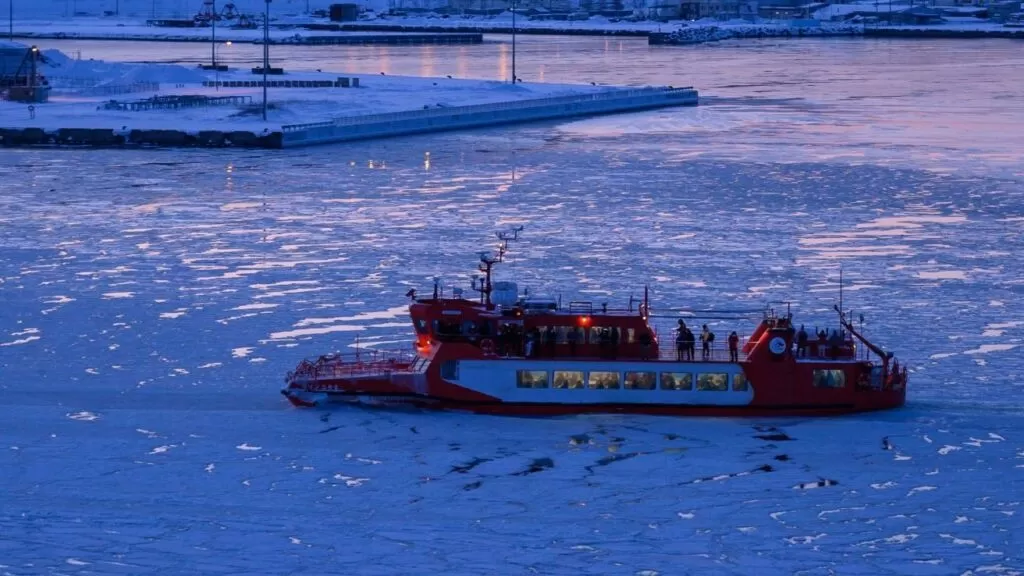
In Abashiri’s normal year (1991–2020), drift ice is first sighted around January 22, first reaches the shore around February 4, and the sea opens around March 15. This article tabulates the Abashiri dates the Japan Meteorological Agency (JMA) recorded for 2012–2025 and answers “which dates are best for seeing it?” by counting the years in the table.
As of 2026-11-04, nobody has announced dates for 2027. This article makes up no forecast numbers. It lists where outlooks will appear and when ships and experiences ran last season, with sources. Everything was checked on 2026-11-04.
Compare Hokkaido campervan rentals
Base yourself at New Chitose Airport and compare rates, vehicle types, and pickup locations all in one place.
Compare rental companies and vehicles →When does drift ice arrive? Abashiri’s normal dates are Jan 22 (first sighting), Feb 4 (first shore arrival) and Mar 15 (sea opening)
In JMA’s normal values (1991–2020), Abashiri’s first sighting of drift ice is January 22, the first day drift ice reaches the shore is February 4, sea opening is March 15, last sighting is April 6, and the drift ice period is 75 days. Monbetsu’s first sighting is January 24, first shore arrival February 9, sea opening March 10, last sighting March 30, and the period 66 days (JMA, “Sea ice observations along the Hokkaido coast (normal values and extremes)”, page updated 2025-12-09, checked 2026-11-04).
| Station | First sighting of drift ice | First day drift ice reaches the shore | Sea opening | Last sighting | Drift ice period |
|---|---|---|---|---|---|
| Abashiri | Jan 22 | Feb 4 | Mar 15 | Apr 6 | 75 days |
| Monbetsu | Jan 24 | Feb 9 | Mar 10 | Mar 30 | 66 days |
| Wakkanai | Feb 19 | No normal value | Not an observed item | Mar 4 | 14 days |
For Wakkanai, drift ice reached the shore in too few years for a normal value to be published. For Kushiro, no normal value is published for first sighting, last sighting or period. The same page lists the number of observation years behind each station’s normal values (checked 2026-11-04).
What is the difference between first sighting, first day at the shore and sea opening?
JMA’s glossary of sea ice terms defines the first sighting of drift ice as the first day drift ice that has drifted in from beyond the horizon is seen on the sea surface within sight. It defines the first day drift ice reaches the shore as the first day drift ice lands on the shore or fuses with fast ice, leaving no coastal channel, so ships cannot sail (JMA, “Explanation of sea ice terms”, checked 2026-11-04).
Sea opening is defined as the first day total ice cover falls to 5 or below and a coastal channel opens so ships can sail again. Last sighting is the last day drift ice is seen on the sea surface within sight, and the drift ice period runs from first sighting to last sighting (same page, checked 2026-11-04).
For planning a trip, the window that matters most is from the first day drift ice reaches the shore to sea opening, which falls between first and last sighting. Note, though, that these dates describe the sea as seen by weather stations and observers. Whether sightseeing ships sail is decided separately.
When did drift ice arrive in Abashiri in past years? A 2012–2025 table
The table below copies 14 years (2012–2025) from the Abashiri statistics JMA publishes (observations by the Abashiri Local Meteorological Observatory). Years are sea-ice years: 2013, for example, covers December 2012 through May 2013 (JMA, “Statistical data on coastal sea ice observations in Hokkaido”, checked 2026-11-04).
| Year | First sighting of drift ice | First day drift ice reaches the shore | Sea opening | Last sighting |
|---|---|---|---|---|
| 2012 | Jan 17 | Feb 17 | Mar 29 | Apr 16 |
| 2013 | Jan 12 | Jan 17 | Mar 13 | Apr 2 |
| 2014 | Jan 21 | Feb 9 | Mar 7 | Apr 30 |
| 2015 | Jan 12 | Jan 19 | Mar 3 | Mar 8 |
| 2016 | Jan 28 | Feb 22 | Feb 28 | Mar 18 |
| 2017 | Jan 31 | Feb 2 | Mar 6 | Apr 24 |
| 2018 | Jan 28 | Feb 2 | Mar 14 | Mar 31 |
| 2019 | Jan 13 | Jan 29 | Feb 27 | Apr 14 |
| 2020 | Feb 9 | Feb 11 | Mar 16 | Apr 3 |
| 2021 | Jan 17 | Jan 31 | Mar 5 | Mar 28 |
| 2022 | Jan 24 | Feb 3 | Not recorded | Not recorded |
| 2023 | Feb 2 | Feb 10 | Not recorded | Not recorded |
| 2024 | Jan 19 | Jan 22 | Not recorded | Not recorded |
| 2025 | Feb 15 | Feb 17 | Not recorded | Not recorded |
Last sighting and sea opening are blank from 2022 onward because Abashiri’s last-sighting observation ended in 2021 (Okhotsk Drift Ice Museum and Abashiri City, “Abashiri Sea Ice Report No. 3”, published 2026-04-30, checked 2026-11-04). The 2026 dates come from a different observer, so they get their own section below.
Counting the table, first sighting fell between January 11 and 20 in 6 years (2012, 2013, 2015, 2019, 2021 and 2024), between January 21 and 31 in 5 years (2014, 2016, 2017, 2018 and 2022), and in February in 3 years (2020, 2023 and 2025).
The first day drift ice reached the shore was in mid-January in 2 years, late January in 3, early February in 5, mid-February in 3, and late February in 1. The earliest was January 17, 2013 and the latest was February 22, 2016. It came earlier than the normal February 4 in 8 years and later in 6.
Sea opening is available for the 10 years 2012–2021. The earliest was February 27, 2019 and the latest was March 29, 2012. It came earlier than the normal March 15 in 8 years and later in 2.
When does drift ice reach Monbetsu? JMA observations stop at 2007, so only the normal values can be checked
JMA’s Monbetsu statistics end with the period January 1956 to May 2007 (JMA, “Statistical data on coastal sea ice observations in Hokkaido”, checked 2026-11-04). For this reason, a year-by-year table of recent dates like Abashiri’s cannot be built from JMA data.
Monbetsu’s normal values are those given in the earlier section: first sighting January 24, first shore arrival February 9, sea opening March 10 and last sighting March 30. They are derived from 17 observed years. Compared with Abashiri, Monbetsu’s first shore arrival is 5 days later and its sea opening is 5 days earlier.
For Monbetsu’s current drift ice, check the Sea Ice Information Center of the First Regional Coast Guard Headquarters, which publishes a year-by-year sea ice table (sea ice and drift ice information, checked 2026-11-04), and Okhotsk Garinko Tower, which operates the Garinko-go (official site).
Does drift ice reach Wakkanai or Kushiro?
In the same statistics, Wakkanai had a first sighting in 9 of the 14 years from 2012 to 2025, and in 5 years (2015, 2019, 2021, 2022 and 2024) no drift ice was observed. In the 7 years from 2012 to 2021 when drift ice came, the drift ice period ran from 1 day (2016) to 24 days (2013) (JMA, “Wakkanai” statistical data, checked 2026-11-04).
In Kushiro, the only year from 2012 to 2025 with a first sighting was 2017 (March 22 to April 5) (JMA, “Kushiro” statistical data, checked 2026-11-04). A trip aimed at drift ice is therefore planned around Abashiri, Monbetsu and the Shiretoko side.
Which dates give you the best chance of seeing it? Counting the years in the table
This section gives no “probability”, only the result of counting years. The count covers the 10 years 2012–2021 (the years with records through sea opening) and tallies the years in which the date fell on or after the first day drift ice reached the shore and before sea opening. It is based on visual observation records in Abashiri and does not account for sightseeing ship operations or where the ice can be seen.
| Date | Years it fell in the window (out of 10) | Years it did not |
|---|---|---|
| Feb 1 | 4 years | 6 years when the first shore arrival came after Feb 1 |
| Feb 10 | 7 years | 2012, 2016 and 2020 (first shore arrival on Feb 11 or later) |
| Feb 20 | 9 years | 2016 (first shore arrival on Feb 22) |
| Mar 1 | 8 years | 2016 and 2019 (sea opening on Feb 28 and Feb 27) |
| Mar 10 | 4 years | 6 years when sea opening came before Mar 10 |
By this count, February 20 fell in the window in 9 of 10 years and March 1 in 8. February 10 fell in it in 7 years and March 10 in 4. The years that missed were 2016, when the shore arrival was late, and 2016 and 2019, when sea opening was early.
The drift ice and campervan rental guide gives the best viewing period as late January to early March. By the count above, though, the two ends of that range, February 1 and March 10, fell in the window in only 4 of 10 years. If your dates are flexible, aiming for mid to late February leaves fewer missed years.
How was drift ice in 2026? Observation moved from the weather station to the Drift Ice Museum
JMA has announced that it will end visual observation and reporting of the first sighting of drift ice and the first day drift ice reaches the shore from the 2025 winter season. It cites years and places with no observations, and a move to area-wide information from the Himawari satellite and numerical forecasts (JMA, “Review of drift ice information services”, announced 2025-12-09, checked 2026-11-04).
In 2026, Abashiri was observed by the Okhotsk Drift Ice Museum and Abashiri City from the Tento-zan observation deck. First sighting was January 22, first shore arrival was February 1 (3 days earlier than normal), and last sighting was April 19 (13 days later than normal) (Drift Ice Museum and Abashiri City, “Sea Ice Report No. 2”, “No. 3”, checked 2026-11-04). The museum itself treats the difference from normal for last sighting as a reference value.
The Sea Ice Information Center of the First Regional Coast Guard Headquarters lists Abashiri’s 2026 first sighting as January 26 and last sighting as April 16 (Sea Ice Information Center, checked 2026-11-04). The dates differ because the observers differ, and they are shown here side by side as they are. They are not placed in the 2012–2025 table, because the observer is different.
When is drift ice in 2027? What is officially out, and where to check the outlook
As of 2026-11-04, no forecast of the 2027 first sighting or first shore arrival has been published by JMA, the Japan Coast Guard or the Drift Ice Museum. This article gives no forecast numbers either. What is published is the schedule for when outlooks will start to appear.
JMA’s “General sea ice information” ended last season on May 29, and its page lists the next release as December 1 (General sea ice information, checked 2026-11-04). The next release of the “Long-range sea ice information” (a one-month outlook for Sea of Okhotsk ice) is listed as December 23 (Long-range sea ice information, checked 2026-11-04).
Last season, the Sea Ice Information Center of the First Regional Coast Guard Headquarters began providing sea ice information on 2025-12-19 and sea ice bulletins on 2026-01-04 (Sea Ice Information Center, checked 2026-11-04). The page does not give a start date for the coming season.
For temperature outlooks, JMA’s seasonal forecasts show the cold-season forecast (December to February) by region. This article cites no figures from it, because we could not confirm its contents on the primary page. Abashiri’s observation results appear in the notices of the Okhotsk Drift Ice Museum; last season it posted first sighting on 2026-01-22 and first shore arrival on 2026-02-01 (checked 2026-11-04).
When do the ships and experiences run?
The last-season periods are those we could confirm on the listing pages. As of 2026-11-04, the 2027 periods are not on any operator’s official page. Every row is still waiting for an announcement for 2027.
| Place | Last season (2026) | 2027 | Contact |
|---|---|---|---|
| Abashiri icebreaker Aurora | January 20 to March 31, 2026 (Hokkaido Tourism Organization listing) | Not on the official page. Awaiting announcement | 0152-43-6000 (9:00–18:00) |
| Monbetsu Garinko-go | January 16 to March 31, 2026 (Hokkaido Tourism Organization listing) | No winter period on the official top page. Awaiting announcement | 050-1743-5848 (cruise bookings) |
| Shiretoko Utoro drift ice walk (Shinra) | No period listed. Winter only | Depends on drift ice arriving. Awaiting announcement | 0152-22-5522 |
| Okhotsk Drift Ice Museum (Abashiri, Tento-zan) | Nov–Apr 9:00–16:30, Dec 29–Jan 5 10:00–15:00, no regular closing day | As currently stated on the official page | 0152-43-5951 |
Aurora sails daily and is cancelled in rough weather. It may not sail on days with 15 or fewer bookings (Hokkaido Tourism Organization listing, checked 2026-11-04). The Garinko-go cruise takes about 60 minutes and can run up to 30 minutes longer (same listing, checked 2026-11-04). For fares, see each official page.
The drift ice walk only starts once drift ice has reached the shore. Conditions change daily, so you are less likely to miss it by watching the announcements in the previous section and booking then than by fixing your dates first.
Going by campervan: how do you get from the airport to the drift ice towns, and what about winter roads?
Moving Inn has two bases, New Chitose Airport and Tokachi-Obihiro Airport (checked 2026-11-04). Check winter rental conditions on the base pages. We have no officially confirmed figures for the distance or travel time from the airports to Abashiri, Monbetsu and Shiretoko, so this article does not give them. Check with an official route search before you leave.
A model route to eastern Hokkaido is in the 10-day winter Hokkaido itinerary. Companies that rent in winter are covered in the article on rental companies open in winter.
If you have never driven on snow, reading the snow driving Q&A and the article on blizzards and black ice first leaves fewer worries before departure. Where to stay is covered in the article on winter overnight parking and RV parks.
New Chitose Airport and Tokachi-Obihiro Airport
Rent the Cabcon “Cresson Journey”
Base yourself at New Chitose Airport and compare rates, vehicle types, and pickup locations all in one place.
See details at Moving Inn →How do you combine the drift ice festivals and winter itineraries with your dates?
The Abashiri festival is covered in the Abashiri Okhotsk Drift Ice Festival 2027 article and Monbetsu’s in the Monbetsu Drift Ice Festival 2027 article, with dates and parking. Festival dates are fixed, so you can lock them in first, independent of how the drift ice moves.
For February cold and clothing, see the February temperature and clothing article; for the winter trip as a whole, the winter travel guide; and for experiences only available in a Hokkaido winter, choose from the 43 things only in a Hokkaido winter.
Frequently asked questions
From when can you see drift ice in Hokkaido?
In Abashiri’s normal values, first sighting is January 22 and first shore arrival is February 4. From 2012 to 2025, first sighting came in January in 11 years and in February in 3 years (JMA, checked 2026-11-04).
When is the first sighting of drift ice in 2027?
As of 2026-11-04, no forecast for 2027 has been published. JMA’s General sea ice information is next due on December 1 and its Long-range sea ice information on December 23 (checked 2026-11-04).
Which comes first, Abashiri or Monbetsu?
In the normal values, first sighting is January 22 in Abashiri and January 24 in Monbetsu. First shore arrival is February 4 in Abashiri and February 9 in Monbetsu (JMA, checked 2026-11-04). Monbetsu’s normal values are derived from observations through 2007.
Can you still see drift ice if you go in March?
In all 10 years from 2012 to 2021, Abashiri’s last sighting was on March 8 or later, and the only year before March 10 was 2015 (March 8). Sea opening came before March 10 in 6 years (JMA, checked 2026-11-04). If you go in March, check whether a sea opening announcement has been made.
Are there years with no drift ice?
In Abashiri, both first sighting and first shore arrival were recorded in all 14 years from 2012 to 2025. In Wakkanai, no drift ice was observed in 5 of the same 14 years (JMA, checked 2026-11-04).
Where can you find drift ice information?
JMA’s General sea ice information and Long-range sea ice information, the Sea Ice Information Center of the First Regional Coast Guard Headquarters, and the notices of the Okhotsk Drift Ice Museum, which took over Abashiri’s observation (links in the text, checked 2026-11-04).
Can you go to see drift ice by campervan in winter?
Yes. Snow driving and where to park overnight in winter are covered in the articles linked in the text. Contact rental companies in advance to ask which ones rent in winter.
Pages to read next
- Drift ice and campervan rental: the complete guide to a Hokkaido winter trip [Abashiri, Monbetsu, Shiretoko 2026-27]
- When is the Abashiri Okhotsk Drift Ice Festival 2027? Dates, highlights, icebreaker cruises and parking by campervan
- When is the Monbetsu Drift Ice Festival 2027? Dates, ice sculptures, highlights, Garinko-go, parking and access
- A 10-day winter Hokkaido itinerary from New Chitose Airport [2027]
- Hokkaido temperatures and clothing in February: cold in the Snow Festival and drift ice season, and overnight parking tips [2027]
- For first-time snow drivers in Hokkaido: common worries answered one by one [2026-27]
- 43 things only in a Hokkaido winter, and where to stay nearby [2027]
Book a Campervan in Hokkaido
Moving Inn New Chitose Airport supports English booking and offers airport transfers.