Hokkaido Campervan Hire for the Ski Season (1–3 Months) | 4WD, Winter Tyres, Heater, Mileage & Insurance Checks [2026-27]
Hiring a campervan in Hokkaido for 1–3 months of ski season (Dec–Mar)? We checked winter gear, long-hire terms, mileage, insurance, NOC, IDP and ski storage.
See companies that rent in winter
This is for anyone who wants to rent a campervan in Hokkaido for one to three months of winter (December to March) to ski or snowboard.
The short answer first. Yes, some companies do hire out campervans in winter. For Camping Lines Hokkaido, BicUp, Shin-Chitose Camping Car Rental Center and Moving Inn, we could confirm winter equipment and long-hire terms on the official sites or by asking the operator (checked 2026-10-23).
That said, the long-hire discount tiers, mileage limits and insurance terms differ by company. For a long winter trip, five things to settle first are 4WD, winter tyres, an FF heater, the water system and mileage.
This article answers the worries people actually send us, in that order: “Are 4WD, snow tyres and an FF heater a must for 30 nights?”, “About 90 days, a couple on a ski trip”, “What happens with mileage limits, insurance, NOC and deposits?”, “Can I use an international licence?” and “Will my skis fit?” We do not list each company’s price table. We link to each company’s page and show the date we checked. For how to think about the cost of a one-month rental, see the one-month cost simulation.
Compare Hokkaido campervan rentals
Base yourself at New Chitose Airport and compare rates, vehicle types, and pickup locations all in one place.
Compare rental companies and vehicles →Can you hire a campervan for 1 to 3 months in winter?
Yes, but some companies do not hire out in winter. For the list of companies that close from December to March, see our article on companies that rent in winter and those closed for the season. Here we only line up the winter details and long-hire terms of the four companies that do hire out in winter.
| Company | Winter details (official) | Long-hire terms (official) | Base page |
|---|---|---|---|
| Camping Lines Hokkaido | Winter-season rate tier runs 2026/12/20 to 2027/2/28. All vehicles are automatic full-time 4WD, fitted with studless tyres from November to around the end of April | Long-hire discount tiers for 7+ days, 14+ days and 21+ days. No mileage limit | Camping Lines Sapporo BASE |
| BicUp | Studless tyres from October 1 to April 30 (the timing may shift). Winter-season rate tiers run January 1 to February 25 and December 25 to 31 | Rates are tiered as one week (up to 7 nights, 8 days) and one month (up to 30 nights, 31 days). No mileage limit | BicUp Sapporo Main Store |
| Shin-Chitose Camping Car Rental Center | All vehicles are studless-tyre ready, with an FF heater in the cabin. From November to March a 4WD with studless tyres is required | Long-hire discount tiers for 3, 5, 10 and 30+ days. The free mileage allowance grows with the hire period; excess is ¥55 per km including tax | Shin-Chitose CRC |
| Moving Inn (New Chitose Airport and Tokachi-Obihiro Airport) | Hires out from December to March as well. All vehicles have studless tyres and 4WD (confirmed with the operator) | Discount tier for stays of 2+ days. Up to 300 km per day; excess is ¥110 per km including tax | Moving Inn New Chitose Airport Branch |
For a total for two to three months, give each company your pick-up and return dates and get a quote through its booking page or by enquiry. Discount rates and the one-month price itself vary by company and the tiers switch over in winter, so we do not state them in this article.
How cold does Hokkaido get from December to March, and how much snow settles?
Using the Japan Meteorological Agency’s normals (1991–2020), here are six places that often serve as bases for a ski trip. These are typical figures, not a forecast for any given day. In the week before you leave, check the latest values with the Japan Meteorological Agency or local forecasts.
| Location | Dec min. temp. | Jan min. temp. | Feb min. temp. | Mar min. temp. | Max. snow depth (cm) Dec / Jan / Feb / Mar |
|---|---|---|---|---|---|
| Sapporo | -4.0 | -6.4 | -6.2 | -2.4 | 47 / 76 / 95 / 82 |
| Chitose (around New Chitose Airport) | -8.9 | -12.9 | -12.5 | -5.8 | 18 / 38 / 46 / 41 |
| Hakodate | -3.6 | -6.0 | -5.7 | -2.2 | 22 / 34 / 41 / 28 |
| Asahikawa | -8.0 | -11.7 | -11.8 | -6.1 | 58 / 72 / 84 / 82 |
| Furano | -10.2 | -14.4 | -14.0 | -7.8 | 46 / 64 / 73 / 71 |
| Obihiro | -8.9 | -13.0 | -12.0 | -5.4 | 36 / 57 / 63 / 57 |
There are three things to take from it. First, inland areas are a step colder: January minimums are -14.4°C in Furano and -12.9°C in Chitose, nearly double Sapporo (-6.4°C) or Hakodate (-6.0°C).
Second, snow is deepest in February: 95 cm in Sapporo, 84 cm in Asahikawa and 73 cm in Furano. Third, it does not let up in March. Asahikawa’s maximum snow depth in March is 82 cm, almost the same as February (84 cm), and the minimum temperature is still -6.1°C (checked 2026-09-24).
In other words, for the roughly 90 days from early December to the end of February, the monthly average minimum is below freezing at all six places. Choose your equipment on the assumption that you will spend weeks on end in the depths of winter, not at the start of it. For winter temperatures and how to prepare for the nights, see our article on Hokkaido winter temperatures; for road sections that close, see our article on winter road closures.
What should you check on 4WD, winter tyres and an FF heater for a long hire?
4WD and winter tyres are a condition set by some companies and an option at others. Shin-Chitose CRC says “from November to March, a 4WD fitted with studless tyres is required”, and you choose the studless and 4WD options when booking. At Camping Lines every vehicle is full-time 4WD and is switched to studless tyres from November to around the end of April (both checked 2026-10-23).
What long-term hirers tend to miss is whether the return date still falls within the winter-tyre period. If you are hiring into late March or early April, ask when you book whether the vehicle on that day will still be on studless tyres.
BicUp lists October 1 to April 30 as the studless-tyre period and notes that “the changeover time may shift” (checked 2026-10-23).
For why to choose 4WD, see our article on choosing a drive type for snowy roads; for how to judge when to change tyres, see our studless tyre article.
An FF heater is a heater you can use with the engine off. In Camping Lines’ guide,
fuel is fed automatically from the vehicle’s diesel tank, and even at maximum output it uses about 2 to 3 litres a day. However, it also draws on the sub-battery, so you need to plug into external power at a campsite or RV park, or run the engine to charge (user guide, checked 2026-10-23).
At 2 to 3 litres a day for 90 days, that is 180 to 270 litres, a figure for estimating how often you will refuel and what it will cost (calculated from the official estimate). For how it works and how to use it, see our FF heater article. For the equipment on each vehicle you might hire, check each company’s vehicle page.
No water in winter? How do you handle toilets and bathing for a month or more?
Camping Lines states: “From November to April, to prevent freezing, we do not load water. During this period the sink, shower and toilet cannot be used in any vehicle.”
BicUp also bans use of the water system from November 1 to April 30 (both checked 2026-10-23). Depending on the company you hire from, plan your itinerary on the assumption that neither water nor the toilet will work inside the vehicle in winter.
On a trip of a month or more, this becomes part of your daily routine. For bathing, you use onsen facilities or accommodation near the ski resort; for the toilet, you stop at a facility open 24 hours. To choose where to stay, you can use our article on winter RV parks, which have toilets and power, and our article on 13 facilities, where we checked winter-open RV parks and Michi-no-Eki one by one. If you hire from another company, always ask how it handles the water system in winter before you book.
How far will you drive if you ski every day? Checking mileage limits
On this site we plan itineraries with a limit of 200 km and 9 hours of driving a day. That is because the sun sets early in winter and snowy roads take longer than in summer. At that cap, 30 days of driving comes to at most 6,000 km (200 km × 30 days).
Here are each company’s official mileage terms next to that number (all checked 2026-10-23). Camping Lines and BicUp have no mileage limit.
Moving Inn allows up to 300 km a day, with excess at ¥110 per km including tax.
At Shin-Chitose CRC, 1,000 km is free for up to 72 hours and 3,000 km for up to 240 hours, then another 300 km is added for every 24 hours, with excess at ¥55 per km including tax.
For a long hire, around 300 km a day is a rough guide to the free allowance. A 200 km-a-day itinerary stays within the allowance at every company.
What matters before distance is how you structure your moves. Rather than changing ski resorts every day, staying two or three nights in the same area and mixing in day-trip ski days cuts driving time and makes it easier to manage heating and power in the vehicle. How a company handles mid-hire inspections and maintenance for hires over a month is something to ask when you get a quote.
New Chitose Airport · Tokachi-Obihiro Airport
Rent the Cabcon “Cresson Journey”
Base yourself at New Chitose Airport and compare rates, vehicle types, and pickup locations all in one place.
See details at Moving Inn →Are insurance, NOC and deposits the same for long hires?
The items listed on each company’s official price page differ. At Camping Lines you pick one of three basic cover plans, and the price page has tiers for the excess, the NOC (non-operation charge) and the deposit held in case of an accident or breakdown. If there is damage on return, however small, the full deposit is kept, and it is refunded after the deduction once the repair cost is settled (checked 2026-10-23).
BicUp states that all vehicles have unlimited third-party bodily injury and property damage cover, and passenger injury insurance of ¥100 million per person (checked 2026-10-23).
At Shin-Chitose CRC the NOC amount depends on whether you can return the vehicle under its own power, and it recommends its optional “Anshin Hosho Service” reassurance plan (checked 2026-10-23).
At Moving Inn, insurance cover is included in the rental fee, and there is an optional plan that waives the excess and the non-operation charge (checked 2026-10-23).
The longer you hire, the more days you spend on snowy roads, so it makes sense to know your out-of-pocket exposure in an accident beforehand.
There are three things to ask the company. Can you add the excess-waiver and NOC-waiver options? Is there a deposit, and when is it refunded? Under what conditions are contact or soiling damage on snowy roads covered by the non-operation charge? For what the terms mean and the costs you might actually pay, see our article on insurance, excess and NOC.
Can you drive for 3 months on an international licence (IDP)?
Yes. According to the National Police Agency, the foreign licences you can drive on in Japan are an international driving permit issued under the Geneva Convention, or a foreign licence with a Japanese translation attached (covering Switzerland, Germany, France, Belgium, Monaco and Taiwan).
You may drive for one year from the day you land in Japan or for the remaining validity of the licence, whichever is shorter, and an international driving permit is valid for one year from the date of issue (National Police Agency, checked 2026-10-23).
For a three-month stay, it is enough to check that it will still be valid when you leave Japan.
The thing to watch is the format. The Tokyo Metropolitan Police Department states that even an international driving permit issued by a Geneva Convention member country cannot be used to drive in Japan if it was issued in the format of another convention, such as the Vienna Convention (Tokyo Metropolitan Police Department, checked 2026-10-23).
Before you leave, check that your international permit is in the Geneva Convention format. On the rental company side, Camping Lines asks you to bring an international permit (or your home licence with a translation) and your passport (user guide, checked 2026-10-23). For the documents needed by country, see our article on whether you can rent with a foreign licence.
Can you fit skis in, and where do you stay?
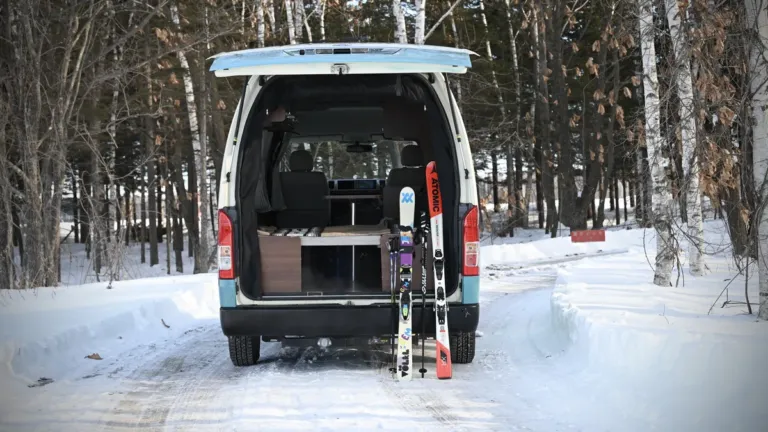
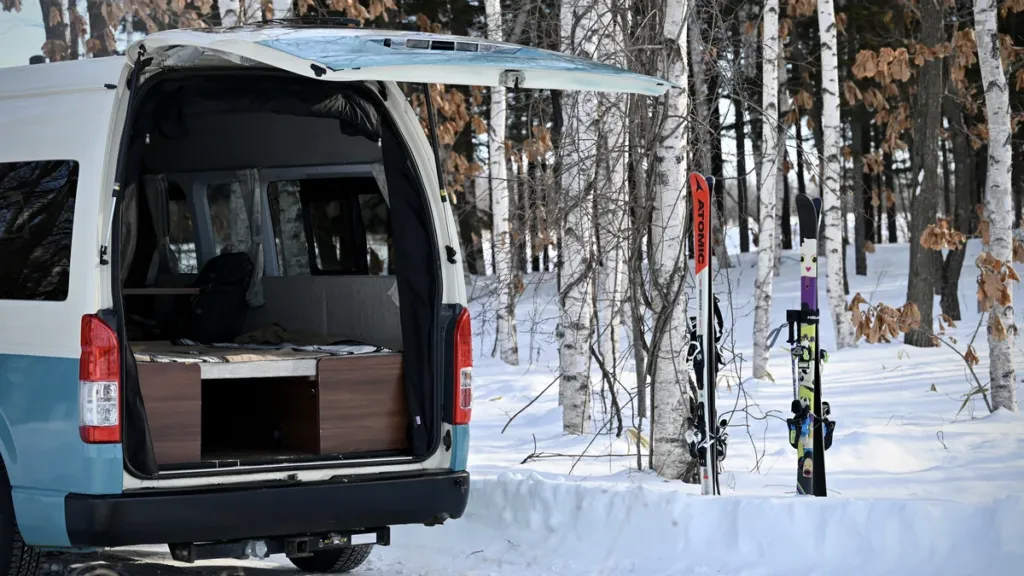
How many sets of skis fit depends on the vehicle. As far as Moving Inn told us, the HiAce LX, KAR and AS take up to 2 people’s worth and the Cresson Journey up to 4 people’s worth, with skis up to 2 m long (interview with Moving Inn, October 6, 2026). Where to put wet skis and boots and the rules for roof carriers are in our article on loading skis. On a long hire you carry more gear, so ask before you hire whether it can go under the bed or on the floor.
To choose where to ski, start with our article listing ski resorts by area. Opening dates change from year to year, so you can see the 2026-27 season schedule in our article on opening dates. For places you can stay in winter near the big ski resorts, our article on overnight parking near ski resorts in winter checks them one facility at a time.
Are airport pick-up and return times fixed in winter?
At some companies, yes. In winter only, Camping Lines fixes pick-up and return at New Chitose Airport to four slots: 9:00, 12:00, 15:00 and 17:00 (user guide, checked 2026-10-23).
Shin-Chitose CRC is open 9:30 to 18:00 from October to March and Moving Inn 9:00 to 18:00; both say they will discuss times outside those hours.
At BicUp, departure is from 11:00 and return is by 18:00 (each company’s official site, checked 2026-10-23).
On a trip of one to three months, the first and last days are the heavy ones. A delayed arrival flight could make you miss your pick-up slot, and on the last day your return time is worked back from your departure flight. For the arrival and departure days, the safe approach is to book accommodation near the airport and leave room around pick-up and return. You can check how early the sun sets in winter in our article on winter sunset times.
What should you ask the company before booking?
Here is everything above in a form you can use in an enquiry as it is. Give your dates and number of people first, then ask them to answer the items below.
- Is the vehicle for your dates (pick-up and return) included in winter hire?
- Does the vehicle for that period have 4WD and studless tyres? Will it still be on winter tyres on the return date?
- Does the vehicle you want to hire have an FF heater? How long can it run in one night?
- Can the winter water system (sink, toilet, shower) be used?
- The mileage limit and the charge for exceeding it
- A total quote from pick-up to return (including the long-hire discount)
- Excess-waiver and NOC-waiver options, whether there is a deposit and when it is refunded
- Whether airport pick-up and return time slots are fixed in winter
- How many people’s skis fit and where. Whether wet skis may go inside
Narrow it down to two or three companies and send them the same questions, and the answers are easier to compare. For worries about winter trips as a whole, start with our article on winter campervan trip worries.
FAQ
Can you hire a campervan in winter Hokkaido for 1 to 3 months?
There are companies that allow it. Camping Lines Hokkaido, BicUp and Shin-Chitose Camping Car Rental Center publish their winter equipment or rate tiers officially, and we could confirm Moving Inn’s winter hire with its operator (checked 2026-10-23). For two to three months, give your dates and get a quote.
How cold does Hokkaido get from December to March?
By the normals, the January average daily minimum is -14.4°C in Furano and -6.4°C in Sapporo. Snow is deepest in February: 95 cm in Sapporo and 84 cm in Asahikawa (Japan Meteorological Agency 1991–2020 normals, checked 2026-09-24).
Are 4WD, winter tyres and an FF heater a must?
Some companies make them a condition. Shin-Chitose CRC requires a 4WD with studless tyres from November to March, and Camping Lines vehicles are all full-time 4WD (checked 2026-10-23). An FF heater is a heater that works with the engine off; check on the vehicle page whether the one you hire has it.
Can you use the water and toilet in winter?
At some companies you cannot. Camping Lines stops use of the water system from November to April and BicUp from November 1 to April 30, to prevent freezing (checked 2026-10-23). Ask how the company you hire from handles it before you book, and build toilet and bathing stops into your itinerary.
Is there a mileage limit?
It differs by company. Camping Lines and BicUp have no limit, Moving Inn allows up to 300 km a day, and Shin-Chitose CRC has a free allowance based on the hire period (checked 2026-10-23). If you plan 200 km a day, you are inside the allowance at every company.
What happens with insurance, NOC and deposits on a long hire?
Each company’s official price page lists tiers such as the excess, NOC and deposit. Ask whether you can add the excess-waiver and NOC-waiver options, and when the deposit is refunded, along with your quote.
Can you drive for 3 months on an international licence?
With an international driving permit in the Geneva Convention format, yes. The period is one year from the day you land in Japan or the remaining validity of the licence, whichever is shorter (National Police Agency, checked 2026-10-23). Permits in other formats, such as the Vienna Convention, cannot be used to drive in Japan (Tokyo Metropolitan Police Department, checked 2026-10-23).
Can you fit skis in, and where do you stay?
At Moving Inn, the HiAce LX, KAR and AS take up to 2 people’s worth and the Cresson Journey up to 4 people’s worth, with skis up to 2 m long (interview, October 6, 2026). For places to stay, you can choose from RV parks that open in winter and facilities we have checked near ski resorts.
Are airport pick-up times fixed in winter?
Camping Lines fixes winter pick-up and return at New Chitose Airport to four slots: 9:00, 12:00, 15:00 and 17:00 (checked 2026-10-23). The other companies have set opening hours, so tell them your arrival flight time and agree a pick-up time.
Pages to read next
- Hokkaido campervan rentals open in winter (Dec–Mar) | Companies closed for the season, and what to check before a winter hire
- How do you load skis and snowboards into a campervan?
- Hokkaido ski resorts by area | Distance from the airport and a daily cost guide
- Overnight parking in winter Hokkaido: plan around RV parks
- Hokkaido one-month campervan rental guide
Book a Campervan in Hokkaido
Moving Inn New Chitose Airport supports English booking and offers airport transfers.