Hokkaido Fireworks Calendar & Campervans: A Summer Lineup and Overnight Parking Bases
A season-by-season guide to Hokkaido's 7 major fireworks displays (Toyako Longrun, Makomanai, Otaru, Abashiri, Hakodate, Kachimai, Kushiro) and how to plan parking, overnight stays, and drinking safely around them in a campervan.
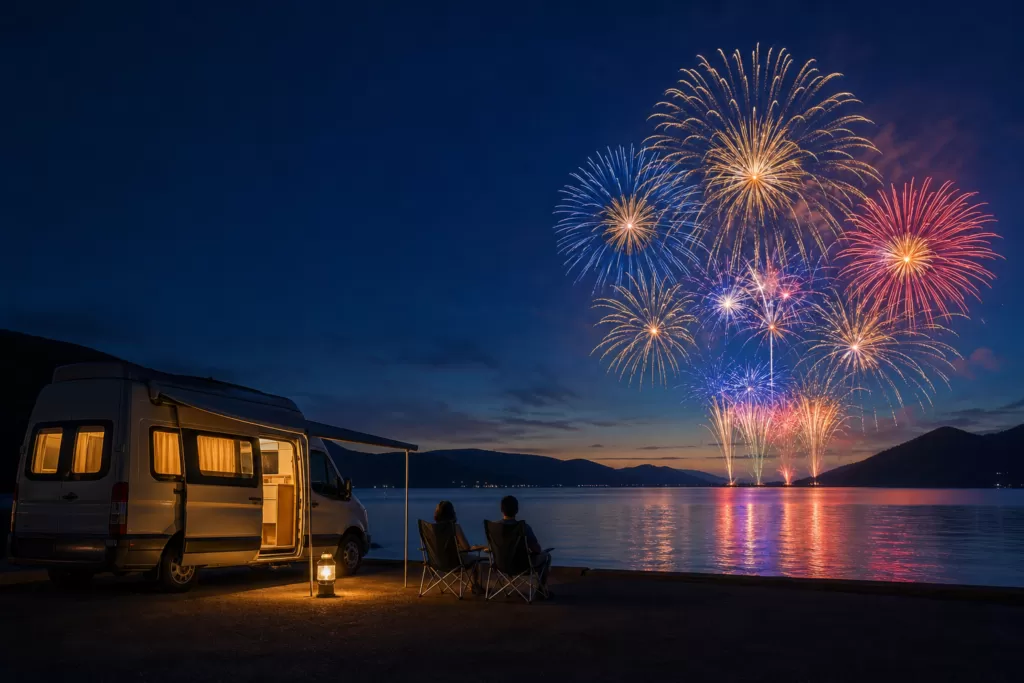
Hunting for fireworks in Hokkaido the way you would on Honshu leads to confusion fast. The island is simply too big. See a display in Otaru one week, then try to catch another in Kushiro the next, and you’re looking at 350 km in between. The realistic approach is to lay out where and when each show happens on a map and calendar first, then build the trip around the fireworks — not the other way around. And nothing fits that approach better than a campervan, since you’re never locked into a hotel reservation.
This article lines up seven of Hokkaido’s major fireworks displays in seasonal order and explains how to fold each one into a campervan trip. Since exact dates shift year to year, everything here is kept at the level of “roughly what time of year” rather than a fixed date. Always check each event’s official announcement for the current year’s schedule before you set out.
Hokkaido’s Fireworks Calendar — Seven Displays in Seasonal Order
| Event | Location | Typical Timing | In a Nutshell |
|---|---|---|---|
| Toyako Longrun Fireworks | Lake Toya Onsen (Central Hokkaido) | Late April–late October, nightly | Fireworks every night for half a year |
| Makomanai Fireworks | Minami-ku, Sapporo | Around July | One of Hokkaido’s largest single-night displays |
| Otaru Ushio Matsuri Grand Fireworks | Around Otaru Port | Late July | Closes out the port town’s summer festival |
| Abashiri Fireworks (Abashiri Okhotsk Summer Festival) | Abashiri (Okhotsk) | Late July | Bold displays built around large shells |
| Hakodate Minato Matsuri Doshin Fireworks | Hakodate Port / Midori-no-Shima | Early August | Lights up the opening night of the port festival |
| Kachimai Fireworks | Obihiro, along the Tokachi River | Mid-August (Obon) | The signature summer event of Tokachi |
| Kushiro Tairyo Donpaku Fireworks | Along the Kushiro River | Mid-September | Large shells and a port-town food festival |
Laid out this way, a clear pattern emerges: events cluster from late July through mid-August, bracketed by Lake Toya’s April–October run and Kushiro’s mid-September show. On a summer road trip around Hokkaido, almost any route lets you work in at least one night of fireworks.
Toyako Longrun Fireworks — Nightly, from Late April to Late October
Let’s start with the one display that stands apart from the rest. The Toyako Longrun Fireworks display lights up the lakeshore at Lake Toya Onsen roughly from late April through late October, going off almost every night around 8:45 PM except when bad weather forces a cancellation (confirmed with the Lake Toya Onsen Tourism Association, 2026-08-29). A single night’s show is smaller in scale than any of the one-off events below, but the fact that “wherever you happen to stay near Lake Toya on any given night, that night becomes a fireworks night” makes it an exceptional match for a campervan trip that isn’t tied to a fixed date.
If the other six events in this article are fireworks you plan your trip around, Lake Toya is fireworks that are already there on whatever day you show up. Miss your planned schedule, get rained out somewhere else — as long as it’s still the season, you can loop back to Lake Toya and make up for it. Think of it as a safety net for the whole calendar. For details on where to watch from, parking, and staying overnight at the lakeside campgrounds, see our dedicated guide to the Toyako Longrun Fireworks.
Makomanai Fireworks — One of Hokkaido’s Biggest Displays, Right in Sapporo
Held around July in Makomanai in Sapporo’s Minami ward, the 2026 edition was announced with more than 20,000 shells launched (confirmed 2026-08-29). It’s considered one of the largest single-night displays in the prefecture, known for its music-synced choreography. Viewing at the venue is typically ticketed, so check the official announcement for both the viewing arrangements and that year’s date before making plans.
Traveling by campervan, the fact that this is an urban-style event changes the calculus. Driving a large vehicle into central Sapporo and trying to move through the fireworks crowds is a hassle, so it works better to park your vehicle at an overnight base out in the suburbs and head toward the venue on the Nanboku subway line. Since fireworks are an evening event, decide your route back to the vehicle — including the post-show crush — before you head out.
Otaru Ushio Matsuri Grand Fireworks — Closing Out Three Days in a Port Town
Otaru’s biggest summer festival, the Ushio Matsuri, typically runs for three days on a late-July weekend, with the grand fireworks display closing out the final night. In 2026, the 60th edition ran from July 24–26, with the grand fireworks on the final day, July 26 (confirmed with the Otaru Ushio Matsuri official site, 2026-08-29). It’s fireworks over the harbor that wrap up the festival’s energy in one finale.
Otaru sits at the junction connecting Sapporo, Shakotan, and Niseko, and the timing of the Ushio Matsuri lines up nicely with the best season for Shakotan’s coastline. Spend the day touring the Shakotan Peninsula, come back to Otaru by evening, and spend the night at the festival and its fireworks — that kind of day is only possible because you’re carrying your transport and your bed as one unit. That said, the streets of Otaru get noticeably more crowded with people and cars during the festival, so plan to secure your parking spot while it’s still light out.
Abashiri Fireworks (Abashiri Okhotsk Summer Festival) — Big Shells Bloom Over an Okhotsk Night
The signature event of the Okhotsk region is the fireworks display at the Abashiri Okhotsk Summer Festival, known as Abashiri Fireworks. It’s typically held in late July, and 2026 was scheduled for July 25, built around large shells including 2-shaku fireworks (confirmed 2026-08-29). Rather than pushing volume, this is the kind of display that impresses through the sheer size of its shells.
If your route brings you as far as Abashiri, it’s almost certainly paired with other highlights of eastern Hokkaido — Shiretoko, Lake Saroma, Bihoro Pass — and the fireworks fit naturally as one night within that larger loop. Late July on the Okhotsk side is pleasantly cool compared to the brutal heat of Honshu, and some nights get cool enough that you’ll want a jacket. Grab an extra layer from inside the vehicle before you head out to watch, so you don’t end up shivering through the show in short sleeves.
Hakodate Minato Matsuri Doshin Fireworks — Early August, in a Port City of Harbor Lights
Hakodate’s summer opener, the Hakodate Minato Matsuri, typically runs for five days in early August, with the Doshin Fireworks launched over Hakodate Harbor on the festival’s opening night. In 2026 it was scheduled for August 1, launching from Midori-no-Shima Island between 7:45 and 8:50 PM (confirmed with the Hakodate Minato Matsuri official site, 2026-08-29). Fireworks set against the harbor’s water and the backdrop of Mt. Hakodate make for a scene unique to this city.
Because Hakodate is such a popular tourist destination, its city center gets crowded with both parking and traffic during the festival. For a campervan, it works better to skip finding a base in central Hakodate and instead park overnight in the suburbs, coming in only as far as the streetcar network reaches. For overnight spots and routing in southern Hokkaido, see our roundup of RV parks in Hokkaido, which covers facilities in the Donan area.
Kachimai Fireworks — Obon on the Tokachi Riverbank, One of Hokkaido’s Most Serious Displays
Held along the Tokachi River in Obihiro, the Kachimai Fireworks display has been hosted by the Katsu-Mai Newspaper Company every year on August 13. The official site likewise lists August 13 as the annual date (confirmed with the Kachimai Fireworks official site, 2026-08-29). Known for choreography synced to music and lighting, it draws visitors from both inside and outside Hokkaido during the Obon holiday period.
From a campervan traveler’s perspective, a fixed date of “August 13” is actually easier to work around. Every hotel in Hokkaido tends to be booked solid during Obon, but if you’re carrying your bed with you, all you need to account for is the crowding around Obihiro itself. The area around the venue gets heavily congested on the day, so plan to arrive in Obihiro early, park your vehicle, and head to the venue on foot or by public transit. After the fireworks, soaking in the hot springs at Tokachigawa Onsen before turning in makes for a very Tokachi way to close out the night.
Kushiro Tairyo Donpaku Fireworks — Big Shells Bloom Over the Kushiro River in September
Even after the summer displays wrap up, there’s one more peak waiting in September, out in eastern Hokkaido. Kushiro’s Tairyo Donpaku is a food festival typically held on a weekend in mid-September, and the fireworks display closing out its nights is known for its large shells. In 2026 it ran September 12–13 (confirmed 2026-08-14). It’s a distinctive festival where a port town’s food-and-drink blowout and fireworks share the same night.
This festival is more interesting paired with the string of food events that continue week after week through September across eastern and northern Hokkaido, rather than targeted on its own. For how to route between them and where to stay, see our Hokkaido autumn festival touring guide, which pulls the whole plan together — use it as your foundation if you’re building a September trip.
Fireworks Night: Where to Park and Where to Sleep in a Campervan
Before going further, here’s the routine that applies across all seven events. There are three set patterns that trip up the combination of fireworks and campervans: looking for a spot to park a large vehicle after dark has already fallen, trying to sleep overnight in the venue’s parking lot as-is, and trying to drive again the next morning after drinking.
Parking first. Traffic around the venue starts backing up from the evening on, so settle your vehicle while it’s still light — midday to early evening — and don’t move it again after that. Assume that once things get crowded, there’s essentially nowhere left to re-park a large campervan. Next, where you sleep. Event parking lots are meant for viewing, not for overnight stays. Treat parking and sleeping as two separate questions, and sleep at a facility built for overnight stays, like an RV park or campground. Aim for something within about 30 minutes of the venue, and if the facility takes reservations, let them know you’ll be returning after the show ends — it avoids friction over late-night arrivals.
Last, alcohol and fatigue. It’s tempting to watch with a beer in hand on festival night, but once you’ve had a drink, plan not to move the vehicle at all that day. The next morning matters too — if you didn’t sleep long, the alcohol may not be fully out of your system. Skip long-distance driving the day after fireworks and build in a slow morning; that also gives you a recovery day if the post-show traffic wore you out. For the bigger picture on touring Hokkaido in summer, see our summer trip guide as well.
FAQ
Q1: Which fireworks displays can I see in Hokkaido in August?
Among single-night events, the Doshin Fireworks tied to Hakodate’s Minato Matsuri (typically early August) and the Kachimai Fireworks in Obihiro (officially listed as August 13 every year) are the headline August events. On top of that, the Toyako Longrun Fireworks runs nightly from roughly late April through late October, so August falls right in the middle of that season — meaning that whichever week in August you go, staying near Lake Toya guarantees you a night of fireworks.
Q2: Can I sleep overnight in a fireworks venue’s parking lot?
Venue and nearby parking lots are set up with viewing in mind, and none of the events covered here have confirmed that overnight stays are permitted. Treat parking and sleeping as separate questions, and use a facility built for overnight stays, such as an RV park or campground. You can check facilities across Hokkaido in our roundup of RV parks in Hokkaido.
Q3: When are the exact dates announced?
It varies by event. Some, like the Kachimai Fireworks, are fixed every year on August 13, while others move from year to year to match a festival’s weekend. The timing in this article is only a general seasonal guide, so always confirm that year’s official announcement for each event before finalizing your itinerary.
Q4: What happens in rain or strong wind?
How postponements or cancellations are handled varies by event, and some build in a backup date. For a campervan trip, it’s easier to recover from a cancellation — extending your stay an extra day, or switching your destination to Lake Toya, which runs nightly — so it helps to build a day of slack before and after any trip centered on fireworks.
Book a Campervan in Hokkaido
Moving Inn New Chitose Airport supports English booking and offers airport transfers.

![When and Where Can You See Harbor Seals at Cape Erimo? Kaze no Yakata Official Information, Viewing Season, and Windy-Day Notes [2026-27]](https://hokkaido-campingcar.jp/wp-content/uploads/2026/10/erimo-cape-lighthouse-768x511.jpg.webp)
![Where and Under What Conditions Can You See Diamond Dust in Hokkaido? How Cold a Morning It Takes, and Where It Appears [2026-27]](https://hokkaido-campingcar.jp/wp-content/uploads/2026/10/hokkaido-diamond-dust-nayoro-768x512.jpg.webp)
![Can You Drive to Hokkaido Jingu for Hatsumode? Parking, Crowds, and Where to Park and Walk [2027]](https://hokkaido-campingcar.jp/wp-content/uploads/2026/10/hokkaido-jingu-winter-torii-768x504.jpg.webp)
![Hokkaido Roads Over New Year [2026-27] | Expressway Sections Prone to Blizzard Closures, Forecast Congestion Days, No Holiday Discount, and New Chitose Airport Parking](https://hokkaido-campingcar.jp/wp-content/uploads/2026/10/hokkaido-winter-rural-road-edge-markers-768x432.jpg.webp)
![Where to See Sea Smoke (Kearashi) in Hokkaido: Rumoi’s Ogon-misaki and the Morning Conditions [2026-27]](https://hokkaido-campingcar.jp/wp-content/uploads/2026/10/rumoi-kearashi-sea-smoke-768x511.jpg.webp)
![Geminid Meteor Shower 2026 in Hokkaido: Peak Around 23:00 on December 14, Sapporo Moonset 20:40, and Staying Warm in a Winter Campervan [2026]](https://hokkaido-campingcar.jp/wp-content/uploads/2026/10/geminids-2026-hokkaido-768x575.jpg.webp)