Campervan Rental from Shin-Chitose Airport | Choosing a Cab-Over & Location Comparison for Families [2026]
For families and groups wanting to rent a large campervan from Shin-Chitose Airport — covers cab-over features, price ranges, location comparisons, and routes.
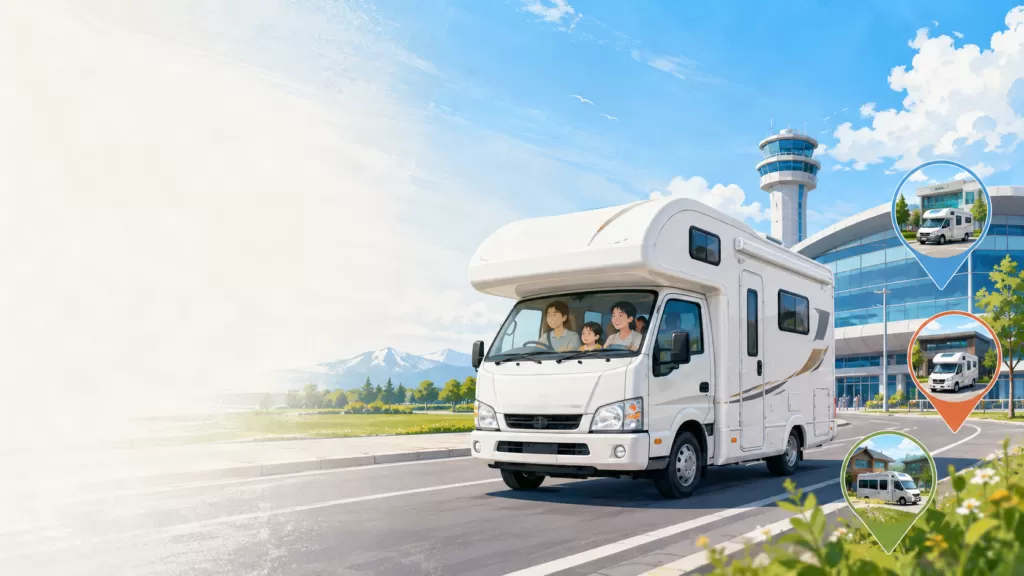
Landing at Shin-Chitose Airport and immediately hitting the roads of Hokkaido in a campervan. For those who want to make that trip “wider and more comfortable,” the type that comes to mind is the cab-over.
A more spacious living area than a van conversion, full-size beds, an independent kitchen and storage. There are reasons why families of 4–6 and long-trip travelers choose this type. However, there are not that many locations around Shin-Chitose Airport that handle cab-overs, and we often hear “I don’t know where to rent from.”
This article organizes everything about renting a cab-over from Shin-Chitose Airport — location comparisons, price ranges, recommended routes, and what to check on equipment.
New Chitose Airport / Tokachi-Obihiro Airport
Rent the Cabcon “Cresson Journey”
Base yourself at New Chitose Airport and compare rates, vehicle types, and pickup locations all in one place.
See details at Moving Inn →What Is a “Cab-Over”? How Is It Different from a Van Conversion?
Campervans fall into roughly 7 types, but the main options rentable around Shin-Chitose Airport are van conversions and cab-overs. Understanding the difference first makes choosing a location smoother.
| Comparison | Van Conversion | Cab-Over |
|---|---|---|
| Base vehicle | HiAce, Caravan, etc. | Camroad, etc. (truck-based) |
| Seating capacity | 4–6 | 5–8 |
| Sleeping capacity | 3–5 | 5–7 |
| Interior height | ~1.4–1.6m | 1.8–2.0m (can walk standing up) |
| Living space | Compact | Independent dinette + sofa |
| Rate estimate (per night) | ¥15,000–¥25,000 | ¥19,800–¥30,000 |
| Good for | 2–4 people, beginners, cost-conscious | 4–6 people, long trips, comfort-focused |
The biggest feature of cab-overs is being able to “stand and walk around inside.” On a Hokkaido trip of a week or more, this difference directly translates to comfort. Changing clothes in the vehicle on a rainy day, kids running around, going to the toilet in the middle of the night — these are the moments when the spaciousness of a cab-over is felt.
Also, since the cab (driver’s section) and living area are completely separate in a cab-over, you can relax in the back or put children to sleep while driving. This is a structural advantage that van conversions don’t have.
On the other hand, the larger vehicle size requires driving adjustment. With lengths of 5–7m and widths over 2m common, there are moments in roadside station parking lots and city areas that require care. Not a problem on Hokkaido’s wide roads, but caution is needed in the alleys of tourist areas like Hakodate and Otaru.
Where Can You Rent a Cab-Over Near Shin-Chitose Airport?
Here are the main locations within 30 minutes of Shin-Chitose Airport that handle cab-overs. Transfer conditions differ by location, so confirm before booking.
Shin-Chitose Camping Car Rental Center (Shin-Chitose CRC)
Free transfer from Shin-Chitose Airport. One of the few locations in Hokkaido with a “cab-over dedicated lineup.” They handle 3 cab-over models.
- Happy1 Premium: 4 passengers, sleeps 4, from ¥19,800 on weekdays. Compact and easy to handle, popular with couples and small families
- Cordvancs (Camroad): 6 passengers, sleeps 5, from ¥26,400 on weekdays. A standard cab-over with independent dinette and rear bed
- Robinson 771 (HiAce): 7 passengers, sleeps 7, from ¥26,400 on weekdays. Large type accommodating big families and group trips
From April 20 to October 31, a regular shuttle bus operates. All vehicles have FF heaters and studded tires are available. Pets can ride but may require taxi use. (Shin-Chitose CRC Official Site)
Fujicars Japan Chitose Rental Station
About 8 minutes by car from Shin-Chitose Airport. One of Hokkaido’s largest locations, with over 20 vehicles, offering a wide lineup of cab-overs, light cab-overs, van conversions, and kei-campers.
Cab-overs start from around ¥20,000/day. High season (Jul 1–Aug 31, Apr 29–May 10) adds a +¥3,100/day surcharge. Rentals are offered only at this Chitose store, and one-way drop-offs (returning the vehicle somewhere else) are not available (confirmed with the store in October 2026). (Fujicars Japan Chitose Official Site)
NEXT LIFE
Operates 3 locations including Shin-Chitose. Handles the cab-over “Amity B” at Shin-Chitose Airport, popular with travelers who prefer a garage-style overnight-parking approach.
CANTAL Chitose Airport SS
Known for fully covering transport costs from Chitose Station or Shin-Chitose Airport. Also offers substantial long-term discount plans, including a 30-day package rate, making it a good option for long-trip travelers.
Moving Inn Shin-Chitose Airport
Started offering the cab-over “Cresson Journey” from June 2026. Offers free transfer from Shin-Chitose Airport, letting you start your campervan trip the same day you land. Van conversions (HIACE CA, HIACE LX) are also available, so you can choose based on group size and style. See the Moving Inn Shin-Chitose Airport page for details.
New Chitose Airport / Tokachi-Obihiro Airport
Rent the Cabcon “Cresson Journey”
Base yourself at New Chitose Airport and compare rates, vehicle types, and pickup locations all in one place.
See details at Moving Inn →How Much Does a Cab-Over Cost? Building a Budget
Per-Night Rate Ranges
| Season | Van Conversion Estimate | Cab-Over Estimate |
|---|---|---|
| Off-season (Nov–Apr) | ¥15,000–¥20,000 | ¥19,800–¥26,000 |
| Regular season (May–Jun, Sep–Oct) | ¥18,000–¥25,000 | ¥22,000–¥30,000 |
| High season (Jul–Aug) | ¥25,000–¥35,000 | ¥30,000–¥40,000 |
(As of May 2026, based on each company’s official site)
Total Cost Estimate: 4 People, 6 Nights / 7 Days
The rental fee isn’t the only expense on an actual trip. Here’s a rundown of overall costs for a Hokkaido trip.
- Rental fee: ¥140,000–¥200,000 (high season)
- Fuel: ¥25,000–¥40,000 (for a loop around Hokkaido; cab-overs get roughly 8–10 km/L)
- Roadside stations / RV parks: ¥6,000–¥15,000 (roughly ¥1,000–¥2,500/night)
- Campsites: ¥10,000–¥20,000 (roughly ¥1,500–¥3,000/night)
- Total estimate: ¥180,000–¥280,000 (split 4 ways: ¥45,000–¥70,000 per person)
A campervan trip eliminates hotel costs in Hokkaido, making it easier to keep the total down compared with staying in hotels. That said, rental rates rise during summer vacation, so the total is larger than an off-season trip.
Easy-to-Miss Extra Costs
- One-way drop-off fee: Picking up in Shin-Chitose and returning in Hakodate, for example, can add ¥10,000–¥30,000
- NOC (Non-Operation Charge) / insurance waiver: Often ¥1,000–¥2,000/day. Strongly recommended in case of an accident
- Chairs / table: Outdoor sets are usually either brought from home or rented for a fee
- ETC / car navigation: Check ETC equipment if you plan to use Hokkaido’s expressways
- Studless tire fee: May add a surcharge for early spring or autumn trips in Hokkaido
Cost Simulation by Trip Length and Group Size
To answer “how much will this actually cost,” here are estimates for common itinerary patterns. Figures combine rental fee, fuel, and lodging (roadside stations / RV parks); they exclude food, admission fees, and expressway tolls.
| Itinerary | Group Size | Season | Rental Est. | Fuel Est. | Lodging Est. | Total Est. | Per Person |
|---|---|---|---|---|---|---|---|
| 2 nights / 3 days (Lake Shikotsu, Lake Toya) | 4 | Regular | ¥66,000 | ¥8,000 | ¥4,000 | ¥78,000 | ~¥19,500 |
| 4 nights / 5 days (Furano, Biei) | 4 | Regular | ¥110,000 | ¥16,000 | ¥8,000 | ¥134,000 | ~¥33,500 |
| 4 nights / 5 days (Furano, Biei) | 4 | High | ¥150,000 | ¥16,000 | ¥8,000 | ¥174,000 | ~¥43,500 |
| 6 nights / 7 days (loop around Hokkaido) | 4 | Regular | ¥154,000 | ¥28,000 | ¥12,000 | ¥194,000 | ~¥48,500 |
| 6 nights / 7 days (loop around Hokkaido) | 6 | Regular | ¥154,000 | ¥30,000 | ¥12,000 | ¥196,000 | ~¥32,700 |
| 7+ nights (Eastern Hokkaido traverse) | 4 | Regular | ¥180,000 | ¥40,000 | ¥14,000 | ¥234,000 | ~¥58,500 |
(Estimated using May 2026 rates; rental fee uses the midpoint of cab-over weekday rates)
For the same itinerary, splitting the cost across 6 people brings the per-person cost well below a hotel stay. High season pushes rental fees up 1.3–1.5x, so “can you shift to the regular season” is the single biggest lever on your budget.
Check the Equipment That Comes Standard on a Cab-Over
Answering “what actually comes with a campervan?” Equipment varies by model, but rental cab-overs commonly include or offer the following as an option. Worth checking before you book.
| Equipment | Overview | Importance for a Hokkaido Trip |
|---|---|---|
| FF heater | Heats using kerosene even with the engine off. No idling needed — safe | ★★★★★ Essential spring/autumn and at night |
| Sub-battery | Charges while driving, powers lights, fridge, phone charging etc. while parked | ★★★★☆ Needed for nights away from campsites |
| Refrigerator | Keeps food and drinks cool. Usually 30–80L capacity | ★★★★☆ Essential for long trips |
| Sink / water tank | Water tank enables cooking and washing up inside the vehicle | ★★★☆☆ Refill at roadside stations |
| Cassette toilet | Usable inside the vehicle in emergencies or at night. Empty at designated disposal points | ★★★★☆ Convenient with kids or late at night |
| Backup camera | For checking behind the vehicle. Nearly essential given a cab-over’s limited rear visibility | ★★★★★ Indispensable when parking |
| Solar panel | Charges the sub-battery during the day. Only available on some models | ★★★☆☆ A comfort boost on long trips |
An FF heater matters a lot on a Hokkaido trip. Even in June, September, and October, nighttime temperatures can drop below 10°C, and having an FF heater that warms the cabin without running the engine makes a big difference in comfort. Confirm “FF heater included” when booking.
3 Recommended Routes for a Cab-Over Trip from Shin-Chitose Airport
Where to go once you’ve rented a cab-over. Here are 3 itinerary patterns starting and ending at Shin-Chitose Airport.
2 Nights / 3 Days: Lake Shikotsu, Lake Toya, Niseko Loop
A route where you can enjoy lakes, onsen, and mountain scenery within an hour of Shin-Chitose Airport. Driving distance is a compact ~300km, making it suitable for a first cab-over trip. Adding the Usu-zan / Showa-shinzan geopark or Niseko’s night views rounds out the trip.
- Day 1: Depart Shin-Chitose Airport → Lake Shikotsu (canoeing, lakeside walk) → stay near Lake Shikotsu
- Day 2: Lake Toya (lake cruise, Usu-zan ropeway) → stay in Niseko (onsen)
- Day 3: Otaru (canal, seafood) → return at Shin-Chitose Airport
4 Nights / 5 Days: Furano, Biei, Mt. Daisetsu
Summer (Jun–Aug) is Hokkaido’s most popular season for this area. A route combining lavender fields, rolling hills, and Asahiyama Zoo. You’ll also find popular farmers markets and local food across the region. Arrive early at the crowded Farm Tomita.
- Day 1: Shin-Chitose Airport → Asahikawa (Asahiyama Zoo) → stay in Biei
- Day 2: Biei’s hills (Blue Pond, Shirogane) → Furano (Farm Tomita) → stay at a campsite
- Day 3: Sounkyo (Mt. Daisetsu) → Kamikawa → stay at a roadside station
- Day 4: Furano → Yubari → stay at a roadside station
- Day 5: Lake Shikotsu → return at Shin-Chitose Airport
7+ Nights: Eastern Hokkaido Traverse (Shiretoko, Kushiro, Obihiro)
An essential route if you’re serious about driving Hokkaido. From the World Heritage site of Shiretoko to Kushiro Marsh and the plains of Tokachi, the scenery stays vast and unmistakably Hokkaido the whole way. A cab-over’s space really pays off on a trip of 7+ nights. Many areas along the way have few lodging options, so the advantage of a cab-over — being able to stay almost anywhere — shows up most clearly on this route. Total driving distance runs 1,400–1,600km, so it’s best to plan generously, keeping daily driving under 200km.
- Shin-Chitose Airport → Sapporo → Asahikawa → Abashiri → Shiretoko (Rausu) → Nemuro / Notsuke Peninsula → Kushiro (marsh) → Obihiro (Tokachi) → return at Shin-Chitose Airport
- Highlights: Shiretoko Goko Lakes, Oshinkoshin Falls, Cape Nosappu, Koufuku Station, Obihiro Racecourse
Seasonal Points for a Cab-Over Trip from Shin-Chitose Airport
Hokkaido’s character changes completely with the season. Here are the seasonal points to know when traveling by cab-over.
- May–Jun (Spring): Comfortable temperatures around 15–20°C and relatively few crowds — an off-the-radar season. Nights still drop to 5–10°C, so an FF heater is essential. Enjoy cherry blossoms (early May) and tulip fields.
- Jul–Aug (Summer): Lavender, sunflowers, and potato fields — Hokkaido summer in full swing. The most visitors, and the hardest time to book a cab-over. Booking 3–4 months ahead is recommended.
- Sep–Oct (Autumn): Beautiful autumn foliage and a high point for food — seafood, mushrooms, potatoes. Some areas drop to near 0°C at night, so don’t forget the FF heater and a sleeping bag.
- Nov–Apr (Winter to early spring): Always confirm studless tires are equipped. Trips to see drift ice (Abashiri, Mombetsu, Jan–Mar) or the Snow Festival (Feb) are also possible. Cab-over availability is limited this season, so check early.
What to Confirm Before You Book
License Check: What Can You Drive on a Regular License?
Whether you can drive a cab-over on a regular license (including AT-only) depends on when you got it. A regular license obtained on or after March 12, 2017 covers vehicles with a gross vehicle weight under 3.5 tons; one obtained between June 2, 2007 and March 11, 2017 is treated as a semi-medium license limited to under 5 tons; and one obtained on or before June 1, 2007 is treated as a medium license limited to under 8 tons. Some cab-overs weigh more than 3.5 tons, and large models like the Robinson 771 class may require a medium license. Confirm your license type with each location before booking.
Transfer Conditions and How to Apply
Free transfer from Shin-Chitose Airport requires advance application at booking for most locations. It helps to provide your flight arrival time and terminal (domestic or international). Many locations can’t accommodate late-night/early-morning transfers (around 11pm–7am), so if you’re on a late flight, plan your itinerary around pickup the following day.
Booking Timing for High Season
Jul–Aug summer vacation is the hardest time to book a cab-over. Popular models fill up 3–4 months in advance. As a guideline, book by April for a trip that includes Obon (around Aug 13–15). Assuming “it’ll probably still be available” often means missing out on your preferred model or dates, so act early.
Can You Bring a Pet?
Pet policy varies by location. Shin-Chitose CRC allows pets, though taxi use may be required for the transfer in some cases. Always confirm the number, type, and size of pets before booking. You may be asked to bring a carrier, waterproof sheets, or a deodorizing spray.
New Chitose Airport / Tokachi-Obihiro Airport
Rent the Cabcon “Cresson Journey”
Base yourself at New Chitose Airport and compare rates, vehicle types, and pickup locations all in one place.
See details at Moving Inn →Frequently Asked Questions (FAQ)
Q. Cab-over or van conversion — which suits a trip from Shin-Chitose?
A cab-over is more comfortable for families of 4 or more, or trips of 7+ nights. For 2–3 people on a roughly 3-night trip, a van conversion is more cost-effective and easier to drive. When in doubt, choosing based on “sleeping capacity plus a one-person margin” tends to work out well.
Q. Is a cab-over difficult to drive?
At 5–7m long, it’s genuinely bigger than a regular passenger car. However, most cab-overs come with a backup camera, and driving becomes manageable once you get used to it. Hokkaido’s roads are wide and relatively easy to park on even in town, so many first-timers say it wasn’t as intimidating as expected. Be sure to take the handover walkthrough, and spend the first hour getting a feel for the vehicle in a large parking lot or open space before heading out.
Q. Which locations offer free transfer from Shin-Chitose Airport?
Shin-Chitose CRC, Fujicars Japan Chitose, and Tabisuru Kuruma Shin-Chitose Airport BASE, among others, offer free transfer. All require advance application at booking. Providing your arrival flight details and group size in advance helps things go smoothly.
Q. How much more expensive is Jul–Aug pricing?
High season is often 1.3–1.5x the regular-season rate. Fujicars Japan explicitly adds +¥3,100/day (tax included) from July 1 to August 31 — which works out to +¥21,700 over a week. Booking early gives you more model choices and makes comparing rates easier.
Q. Can young children ride in a cab-over?
You’ll need to bring a child seat or rent one separately. Some cab-over models don’t have seatbelts on the rear seats while driving, so tell the location the number, age, and weight of the children when booking. The spacious interior gives families much more room to move around than a van conversion, and many travelers say kids stay entertained even on long drives.
Q. Can I pick up a cab-over at Shin-Chitose and return it in Asahikawa or Hakodate?
Some locations offer one-way drop-off, but a surcharge of ¥10,000–¥30,000 is common. Shin-Chitose CRC handles this on inquiry. Fujicars Japan Chitose does not offer one-way drop-offs. A round-trip route returning to the same location generally keeps costs lower.
Q. What’s the ideal trip length for touring Hokkaido by cab-over?
At minimum 4 nights / 5 days; 7+ nights if you’re heading to Eastern Hokkaido, gives you room to travel without rushing. Distances between areas in Hokkaido are long, and 2 nights / 3 days tends to mean rushing between sights. Keeping daily driving to 150–200km reduces fatigue and leaves more freedom to make stops along the way. Using paid leave for a relaxed 10-night trip lets you really feel Hokkaido’s scale.
Q. How do I find places to park a cab-over overnight in Hokkaido?
Roadside stations, RV parks, and auto campsites are the three main options. Hokkaido has 128 roadside stations offering free parking, but power and flush-toilet facilities are limited at many. RV parks typically cost ¥1,500–¥2,500/night for a site with power, and are worth using actively on a campervan trip. Registering candidate spots in advance using apps like “Shachuhaku Map” or “Choitabi.com” is a practical approach.
Q. Can I use a microwave or rice cooker in a cab-over?
What you can run depends on the sub-battery’s capacity. Most rental vehicles have a 100V-output inverter, but high-draw appliances like microwaves or IH heaters aren’t suited to sustained use. The basic approach is to use a cassette stove and cooler box, and limit electricity use to essentials like phone charging, LED lighting, and the FF heater. On nights at an RV park with a powered site, you can use electricity without worrying about it.
Q. How much cash should I carry while traveling by cab-over in Hokkaido?
Roadside stations, farmers markets, and small local diners are sometimes cash-only. Having ¥20,000–¥30,000 in cash per person as a trip-wide reserve is a reasonable safety margin. Card payment works at nearly every gas station for fuel, but remote areas of Hokkaido have many unmanned self-service stations where cards may not work, so it’s wise to plan your refueling stops ahead of time.
Book a Campervan in Hokkaido
Moving Inn New Chitose Airport supports English booking and offers airport transfers.
![When and Where Can You See Harbor Seals at Cape Erimo? Kaze no Yakata Official Information, Viewing Season, and Windy-Day Notes [2026-27]](https://hokkaido-campingcar.jp/wp-content/uploads/2026/10/erimo-cape-lighthouse-768x511.jpg.webp)
![Where and Under What Conditions Can You See Diamond Dust in Hokkaido? How Cold a Morning It Takes, and Where It Appears [2026-27]](https://hokkaido-campingcar.jp/wp-content/uploads/2026/10/hokkaido-diamond-dust-nayoro-768x512.jpg.webp)
![Can You Drive to Hokkaido Jingu for Hatsumode? Parking, Crowds, and Where to Park and Walk [2027]](https://hokkaido-campingcar.jp/wp-content/uploads/2026/10/hokkaido-jingu-winter-torii-768x504.jpg.webp)
![Hokkaido Roads Over New Year [2026-27] | Expressway Sections Prone to Blizzard Closures, Forecast Congestion Days, No Holiday Discount, and New Chitose Airport Parking](https://hokkaido-campingcar.jp/wp-content/uploads/2026/10/hokkaido-winter-rural-road-edge-markers-768x432.jpg.webp)
![Where to See Sea Smoke (Kearashi) in Hokkaido: Rumoi’s Ogon-misaki and the Morning Conditions [2026-27]](https://hokkaido-campingcar.jp/wp-content/uploads/2026/10/rumoi-kearashi-sea-smoke-768x511.jpg.webp)
![Geminid Meteor Shower 2026 in Hokkaido: Peak Around 23:00 on December 14, Sapporo Moonset 20:40, and Staying Warm in a Winter Campervan [2026]](https://hokkaido-campingcar.jp/wp-content/uploads/2026/10/geminids-2026-hokkaido-768x575.jpg.webp)