Complete Guide to Renting a Camper Van in Hokkaido | From Booking to Return
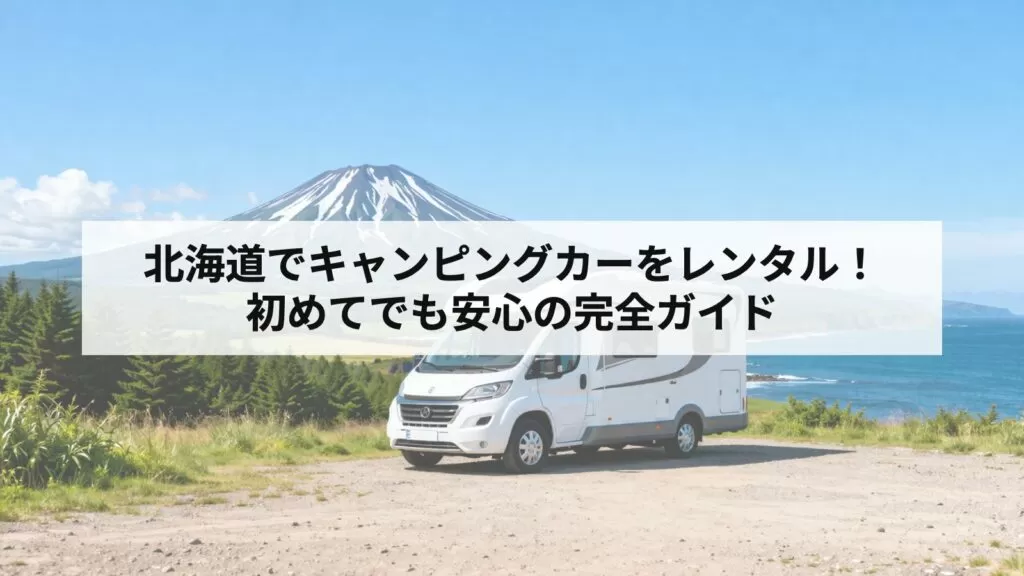
Vast nature, scenic drives, hot springs, and incredible food. Hokkaido is the ultimate destination for a camper van road trip. If you’ve ever dreamed of exploring Hokkaido in a camper van, this guide covers everything — from the rental process and vehicle selection to pricing, recommended routes, and overnight parking spots. Even first-timers will be ready to hit the road after reading this.
Why Hokkaido Is Perfect for a Camper Van Trip
Camper van enthusiasts across Japan call Hokkaido a “sacred destination” — and for good reason. The roads are wide, with long straight stretches that make driving even a large motorhome easy and relaxed. The narrow residential streets and sharp curves common on Honshu are rarely encountered here.
Hokkaido also has the most Michi-no-Eki (roadside stations) in Japan — 128 in total — detailed in our Hokkaido Michi-no-Eki overnight guide. Hot springs are scattered across the island, and the food scene — fresh seafood, Genghis Khan lamb BBQ, ramen — never disappoints. Summers are cooler than Honshu, meaning comfortable overnight stays without air conditioning on most nights.
The unique strength of a camper van is that you sleep where you drive. You’re not tied to hotel bookings — stay an extra night at a favourite spot, make spontaneous detours, and travel with total freedom. Accommodation costs drop dramatically, making it easier to manage your budget even on a long trip.
Wondering why overseas travelers pick Hokkaido in the first place? See the reasons — nature, food, snow, and hot springs — backed by primary-source data in Why Do People from Overseas Visit Hokkaido? [2026 Edition].
How to Rent: 5 Steps from Booking to Return
STEP1: Plan Your Dates and Route
Hokkaido is bigger than it looks on a map. It’s about 350 km from Sapporo to Shiretoko, and about 300 km to Hakodate. To avoid spending an entire day just driving, aim for no more than 200 km per day.
Narrowing down your destinations helps too. Choosing a theme — “experience the wilderness of Eastern Hokkaido” or “enjoy hot springs and food in Central Hokkaido” — keeps the itinerary efficient. Start with 1–2 areas you most want to visit and build the route around them. If you’re starting from the Hakodate / Southern Hokkaido area, check our Hakodate camper rental comparison as well.
STEP2: Choose Your Vehicle
Match the vehicle to your group size and travel style. A cab-over (キャブコン) is ideal for a family of 4 with its full equipment; a van conversion (バンコン) suits a couple or pair for ease of driving; a kei camper is the budget-friendly solo option. See the “Vehicle Selection” section below for details.
Different vehicle types may require different licence categories. A cab-over over 3.5 tonnes GVW may require a semi-medium (準中型) or higher licence — check before booking. See our Camper Van Licence Guide for details.
STEP3: Make a Reservation
During peak season (July–August) popular vehicles fill up fast. Booking 2–3 months in advance is ideal. Your licence will be verified at booking, so confirm the GVW you’re permitted to drive beforehand.
Also check the insurance coverage, cancellation policy, and whether one-way drop-off is available. Hokkaido weather can cause sudden plan changes — knowing when cancellation fees kick in saves stress when it matters.
STEP4: Pick Up the Vehicle on Departure Day
Staff will walk you through the vehicle at the shop — typically a 30-minute to 1-hour orientation covering the controls, power system, water supply/drainage, and toilet operation. Ask any questions at this stage.
Before driving off, inspect the vehicle for any existing scratches or marks and photograph them. This protects you at return. Also check the sub-battery level, fridge operation, and remaining gas supply before departure.
STEP5: Enjoy Your Trip and Return the Vehicle
When the rental period ends, return the vehicle with a full tank and a clean interior. If grey water tank emptying is required, use a dump station before returning or ask the shop to handle it.
Pre-return checklist: ① Full tank of fuel, ② Remove all rubbish from the interior, ③ Empty the fresh water tank, ④ Empty grey water and toilet tank, ⑤ Check all accessories (ETC card, keys, documentation). Full details in our Rental Return Checklist.
Compare Hokkaido Camper Van Rentals
Compare pricing, vehicle types, and equipment across all 42 bases at a glance.
Compare Rental Companies & Prices →How to Choose a Rental Company: 5 Key Criteria
Hokkaido’s camper van rental companies differ in base locations, pricing structures, and vehicle lineups. Choosing based on price alone can leave you without the vehicle type you want or a return location that’s inconvenient. Comparing on these 5 points helps you find the right match for your trip.
① Base Location (Pick-up & Return)
Companies with bases near New Chitose Airport or central Sapporo are convenient if you’re flying in. Some operators have multiple bases across Hokkaido — at Hakodate Airport, Asahikawa Airport, and beyond — and offer one-way drop-off plans. Confirm the base locations after deciding your route.
② Pricing, Insurance & Cancellation Policy
Compare total cost including optional insurance (liability waiver / CDW), roadside assistance, and additional driver fees — not just the base rate. Without a liability waiver, you face potentially large repair costs in the event of an accident. Cancellation fee timelines (e.g. 50% from 3 days prior) vary by company — essential to check if your plans might change.
③ Vehicle Lineup
Some companies offer a wide range of cab-overs, van conversions, and kei campers; others specialise in specific types. If you need pet-friendly vehicles, solar panels, or a bunk bed, confirm availability in advance.
④ Ease of Booking & Support
Online booking with real-time availability is a plus. Companies offering 24-hour roadside assistance for tyre punctures or engine trouble provide extra peace of mind — especially recommended for first-timers.
⑤ First-Timer Support
For first-time renters, choose a company known for thorough pre-departure orientation. Some offer test drives; others provide post-return question support. Check reviews and reputation. To compare pricing, equipment, and reviews across all companies at once, use our Hokkaido Budget Camper Rental Comparison Guide.
Choosing Your Vehicle: Cab-over, Van Conversion & Kei Camper
There are three main types of rentable camper vans. Compare their features to find the right match for your trip.
| Type | Best For | Sleeping Capacity | Equipment | Ease of Driving |
|---|---|---|---|---|
| Cab-over | Family trips | 4–6 people | ◎ (Kitchen, toilet, etc.) | △ (Watch vehicle height) |
| Van Conversion | Couples, weekend trips | 2–4 people | ○ | ○ (Feels like a regular car) |
| Kei Camper | Solo, budget travel | 1–2 people | △ | ◎ (Very manoeuvrable) |
Cab-overs are large vehicles with living space built above the truck cab. They come fully equipped with a living/dining area, toilet, and shower — a true “hotel on wheels.” Great for family and long-distance trips, but note that vehicle height of 2.5–3m+ means multi-storey car parks are off-limits.
Van conversions are converted wagons that drive much like a regular car. Easy to handle even on narrow streets or in cities, they’re a great size for two people. Equipment is simpler than a cab-over, but sleeping, cooking, and a fridge are all covered.
Kei campers are the smallest type, based on a kei (light) vehicle. Excellent fuel economy and very easy to park. Best for solo trips or couples on a budget — the most affordable rental rates. Equipment is minimal, so the style is essentially “drive and sleep.”
Detailed pros and cons for each type are in our Camper Van Types Comparison Guide. For more on cab-overs specifically, see What Is a Cab-over? Features & Trade-offs.
Pricing Guide & Cost-Saving Tips
Camper van rental rates vary by vehicle type and season.
| Type | Standard Season (per day) | Peak Season (per day) | Weekly Package |
|---|---|---|---|
| Cab-over | ¥20,000–¥30,000 | ¥25,000–¥40,000 | ¥100,000–¥180,000 |
| Van Conversion | ¥15,000–¥25,000 | ¥20,000–¥35,000 | ¥80,000–¥150,000 |
| Kei Camper | ¥8,000–¥15,000 | ¥12,000–¥20,000 | ¥50,000–¥90,000 |
Three ways to save: (1) Choose a company with early-booking discounts, (2) Use a weekly package for long-term savings, (3) Travel in June or September to avoid peak-season pricing. Full pricing breakdown in our Rental Price Guide.
Early-booking discounts are offered by many companies — typically 10–20% off when booking 2–3 months ahead. Popular vehicles in peak season sell out early, so booking early is a win on both price and availability.
Long-term discounts often apply for stays of 7 nights or more via weekly packages, which work out 20–30% cheaper per day than standard rates. If you’re planning a Hokkaido circuit of 7+ days, check for weekly packages first.
Off-season (June & September) offers stable weather, fewer crowds, and lower prices. You can still enjoy Hokkaido’s iconic scenery — lavender in Furano peaks in July, and autumn foliage runs September–October — by shifting your dates slightly.
Recommended Hokkaido Itineraries
3 Nights / 4 Days: Central Hokkaido Highlights
Day 1: New Chitose Airport rental guide → Otaru sightseeing → Overnight at an RV park near Otaru
Day 2: Nikka Whisky Distillery in Yoichi → Shakotan Peninsula & Cape Kamui views → Niseko hot springs → Overnight near Niseko
Day 3: Lake Toya drive → Mt. Usu Ropeway → Noboribetsu Onsen → Overnight near Noboribetsu
Day 4: Lake Shikotsu walk → Return at New Chitose Airport
Total distance: approx. 350 km. A relaxed pace of around 100 km per day, with plenty of time for sightseeing and food.
1 Week: Hokkaido Grand Circuit
Day 1: New Chitose Airport → Furano & Biei hill drive → Overnight in Furano area
Day 2: Asahiyama Zoo → Sounkyo Onsen → Overnight in Kamikawa area
Day 3: Daisetsuzan National Park → Lake Saroma → Overnight near Abashiri
Day 4: Shiretoko Peninsula (Shiretoko Five Lakes, Oshinkoshin Falls) → Overnight in Utoro
Day 5: Lake Mashu & Lake Kussharo → Kushiro Wetlands → Overnight near Kushiro
Day 6: Obihiro (buta-don pork rice bowl) → Tokachi hot springs → Overnight in Hidaka area
Day 7: Cape Erimo → Via Tomakomai → Return at New Chitose Airport
Starting from Obihiro-Tokachi? See our Obihiro-Tokachi Camper Drive Guide and Obihiro-Tokachi Rental Comparison. Total distance: approx. 1,200 km — a classic route covering Hokkaido’s major highlights efficiently.
Finding Overnight Parking Spots
In Hokkaido, location selection is key for overnight stays. The three main options are RV parks, Michi-no-Eki roadside stations (for short rests), and auto campsites.
For beginners, RV parks with power hookups, toilets, and rubbish disposal are the best choice. Rates are typically ¥2,000–¥5,000 per night. See our Complete RV Park Guide. For a broader overview of overnight options including roadside stations and campsites, see our Hokkaido Overnight Parking Complete Guide.
Auto campsites offer a more natural environment at similar or slightly lower prices than RV parks. Many sites lack power hookups, so battery management matters. Michi-no-Eki car parks are intended for short rest stops — extended stays or multi-night use inconvenience other visitors.
What to Pack: Pre-Departure Checklist
Rental camper vans typically include basic equipment (bedding, cooking utensils, table, etc.), but there are items you’ll need to bring yourself. Hokkaido-specific preparation is also worth reviewing.
Essentials
- Driver’s licence (for all drivers — no photocopies)
- Credit card (may be required for deposit or insurance)
- Health insurance card & regular medication (for medical access on longer trips)
- Smartphone charger & car charger (essential for navigation and communication)
- Cash (some Michi-no-Eki and campsites in Eastern/Northern Hokkaido are cash-only)
Nice to Have
- Folding table & chairs (transforms outdoor meals and breaks)
- Insect repellent & mosquito coils (mosquitoes can be present in some Hokkaido areas even in summer)
- Large-capacity portable battery (conserves the sub-battery when parked)
- Sandals / indoor slippers (essential for changing footwear inside the vehicle)
- Sun protection gear (sun shade, UV-blocking curtains, etc.)
Hokkaido-Specific Preparation
- Warm layers / fleece (even in summer, mountain areas and nights get cold — below 10°C in August in the Daisetsuzan range)
- Bear bell (essential when walking in mountain areas such as Shiretoko or Daisetsuzan)
- Fuel awareness (gaps of 50+ km between petrol stations in Eastern and Northern Hokkaido — refuel when the tank hits half)
- Paper road map (smartphone navigation can fail in areas without mobile signal)
Hokkaido-Specific Things to Watch Out For
Don’t Underestimate Distances
Hokkaido covers about 83,450 km² — roughly 4.5 times the size of Shikoku. What looks close on a map is often 100+ km away. A comfortable rule of thumb: no more than 200 km per day, no more than 3–4 hours of driving.
Watch for Gaps Between Petrol Stations
In Eastern and Northern Hokkaido, petrol stations can be 50+ km apart. Make it a habit to refuel whenever the gauge drops below half. Some stations are closed on Sundays and public holidays.
Wildlife Crossing the Road
Over 4,000 Ezo deer (Hokkaido Sika) road incidents are reported annually in Hokkaido. Extra care is needed during early morning, evening, and night driving. Slow down wherever “Watch for Animals” signs are posted.
Know the Toilet Situation in Advance
You may not always find a toilet on long stretches. Having one built into the vehicle is reassuring. For toilet types and how to use them, read our Complete Guide to Camper Van Toilets.
Check Bear Sighting Information
Brown bears (Higuma) live in Hokkaido, with sightings reported annually near Shiretoko, Daisetsuzan, and the Hidaka mountain range. Check the Hokkaido Government’s official Higuma sighting map before departing, and carry a bear bell and travel with others when hiking or walking near rivers.
Know the Return Checklist Before You Leave
A self-check before returning prevents disputes. On the final day of your trip, complete the return checklist with time to spare: full fuel tank, grey water tank emptied, interior clean, all accessories accounted for. See our Rental Return Checklist for the full procedure.
Frequently Asked Questions (FAQ)
Q. How much does it cost to rent a camper van in Hokkaido?
It depends on the vehicle type and season, but as a rough guide: van conversions run ¥15,000–¥25,000 per day in standard season, and cab-overs ¥20,000–¥30,000. Weekly packages often offer better value.
Q. Can a first-timer drive a camper van?
Yes — Hokkaido’s wide roads and long straight stretches make it one of the easiest places to drive a camper van as a beginner. Van conversions handle much like a regular car, and cab-overs become comfortable with a little practice. Staff provide a thorough orientation at pick-up.
Q. When is peak season?
Mid-July to late August is the busiest period, with higher rates. June and September are recommended — good weather, fewer crowds, and lower prices.
Q. Where can I park overnight during the rental?
RV parks and auto campsites are ideal. Michi-no-Eki car parks should only be used for short rests. RV parks offer power, toilets, and rubbish disposal.
Q. Can I rent a camper van in winter?
Some companies operate year-round, but winter driving on icy, snowy roads is for experienced travellers. First-timers are advised to visit between June and September.
Q. What insurance is included?
Third-party liability insurance is generally included in the basic rate, as with a standard rental car. Vehicle damage liability (typically ¥50,000–¥100,000 excess) can be covered by adding a Collision Damage Waiver (CDW) for around ¥1,000–¥2,000 per day. Strongly recommended for first-timers.
Q. Can I bring my pet?
Some companies and vehicles allow pets, but not all operators offer this option. Confirm before booking. When permitted, a crate is usually required and an additional cleaning fee may apply. See our Hokkaido Pet-Friendly Camper Guide.
Q. How far in advance should I book?
For peak season (July–August), 2–3 months in advance is ideal. Large and popular vehicles like cab-overs can be fully booked by June. Off-season (June, September–October) often has availability 2–4 weeks out, but earlier is always safer. Our guide to early booking and peak-season timing breaks down the timing by season.
Q. Can multiple people share the driving?
Yes — register additional drivers at pick-up. A small fee per driver (typically a few hundred to ¥1,000) usually applies. On Hokkaido’s long-distance routes, sharing the driving reduces fatigue significantly — recommended for groups of 2 or more.
Compare Hokkaido Camper Van Rentals
Compare pricing, vehicle types, and equipment across all 42 bases at a glance.
Compare Rental Companies & Prices →Summary
Renting a camper van in Hokkaido comes together easily once you’ve sorted three things: which company to use, which vehicle to choose, and which route to take. For company comparisons, see our Budget Rental Comparison Guide; for pricing details, our Rental Price Guide; for area-specific itineraries, our Beginner’s Guide.
To compare pricing, equipment, and reviews for all companies side by side, visit our Hokkaido Camper Rental Detailed Comparison page.
Book a Campervan in Hokkaido
Moving Inn New Chitose Airport supports English booking and offers airport transfers.
![When and Where Can You See Harbor Seals at Cape Erimo? Kaze no Yakata Official Information, Viewing Season, and Windy-Day Notes [2026-27]](https://hokkaido-campingcar.jp/wp-content/uploads/2026/10/erimo-cape-lighthouse-768x511.jpg.webp)
![Where and Under What Conditions Can You See Diamond Dust in Hokkaido? How Cold a Morning It Takes, and Where It Appears [2026-27]](https://hokkaido-campingcar.jp/wp-content/uploads/2026/10/hokkaido-diamond-dust-nayoro-768x512.jpg.webp)
![Can You Drive to Hokkaido Jingu for Hatsumode? Parking, Crowds, and Where to Park and Walk [2027]](https://hokkaido-campingcar.jp/wp-content/uploads/2026/10/hokkaido-jingu-winter-torii-768x504.jpg.webp)
![Hokkaido Roads Over New Year [2026-27] | Expressway Sections Prone to Blizzard Closures, Forecast Congestion Days, No Holiday Discount, and New Chitose Airport Parking](https://hokkaido-campingcar.jp/wp-content/uploads/2026/10/hokkaido-winter-rural-road-edge-markers-768x432.jpg.webp)
![Where to See Sea Smoke (Kearashi) in Hokkaido: Rumoi’s Ogon-misaki and the Morning Conditions [2026-27]](https://hokkaido-campingcar.jp/wp-content/uploads/2026/10/rumoi-kearashi-sea-smoke-768x511.jpg.webp)
![Geminid Meteor Shower 2026 in Hokkaido: Peak Around 23:00 on December 14, Sapporo Moonset 20:40, and Staying Warm in a Winter Campervan [2026]](https://hokkaido-campingcar.jp/wp-content/uploads/2026/10/geminids-2026-hokkaido-768x575.jpg.webp)