Hokkaido Campervan Model Course Complete Guide | Recommended Routes by Number of Days [2026]
A complete guide to Hokkaido campervan model courses. Recommended travel routes organized by trip duration.
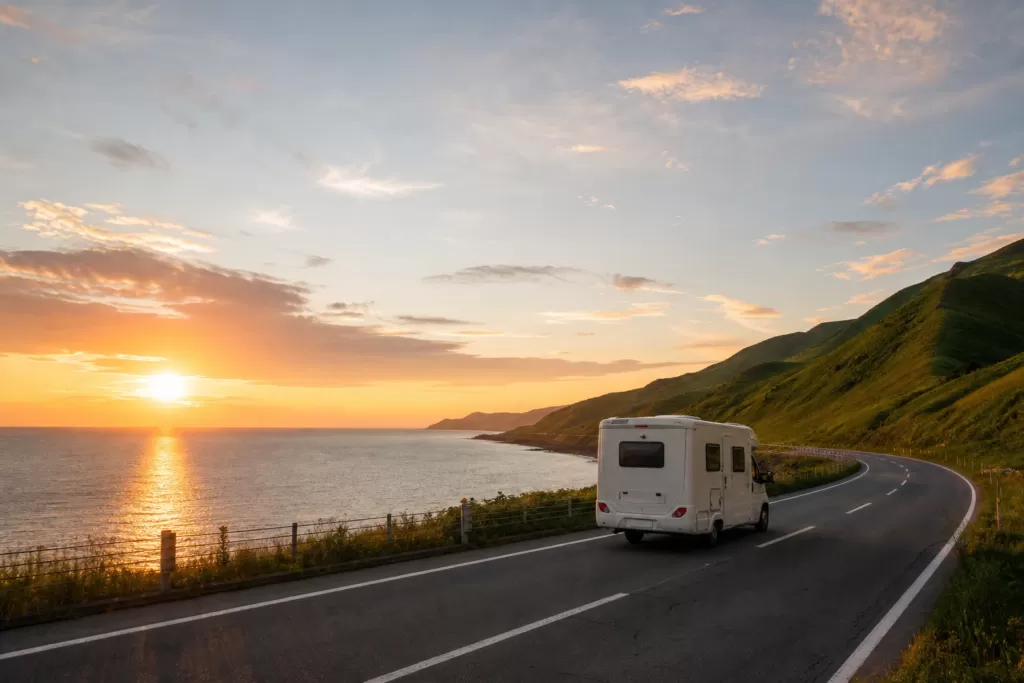
When traveling around Hokkaido by campervan, “how many nights to stay” and “which route to drive” make a big difference to how satisfying your trip feels. This article brings together model courses by length of stay, starting from New Chitose Airport, complete with specific place names, driving distances, recommended overnight parking spots, and cost simulations. Use it as a starting point for planning your first Hokkaido campervan trip, or as a base for reworking your route if you’re a repeat traveler.
Tap a dot on the map to see its name here.
Names are hidden because there are many dots. Tap a dot to see its name and a link to where it appears in this article. 9 places whose location could not be confirmed are not shown. Dot positions are based on each facility’s address or officially published location. Lakes and expressways are from OpenStreetMap data.
How to Plan Your Trip (Duration, Departure Point, Season)
Hokkaido covers roughly 2.2 times the area of Honshu. A distance of about 550km — equivalent to the distance between Tokyo and Osaka — can sometimes count as a "short trip" within Hokkaido. Before planning your route, settle these three points first: how many nights you'll stay, where you'll return the rental, and what season you're traveling in.
Guideline for Length of Stay
For 2–3 nights, it's realistic to focus on the Central Hokkaido area (Lake Shikotsu, Niseko, Lake Toya). With daily driving of around 200km, you can fully enjoy the comfort of a campervan. With 4–5 nights, you can extend your trip to Eastern Hokkaido (Shiretoko, Kushiro). With 7 nights or more, a full loop around Hokkaido comes into view. However, since a loop course means a longer average daily driving distance, it's best suited to those who enjoy driving.
Departure Point and Return Location
Most travelers use New Chitose Airport as both their departure and return point. Picking up the campervan right after your flight lands and returning it on the last day of your trip before boarding makes it easy to plan your itinerary. Some rental companies support one-way drop-off in Hakodate or Asahikawa, but this incurs an extra one-way drop-off fee, so be sure to confirm in advance.
Seasonal Notes
The best season for a campervan trip is mid-June through the end of September. June is when the lavender fields are getting ready to bloom, while July and August are peak season — expect crowded campgrounds and be prepared to book ahead. September sees crowds ease off and is a hidden-gem period as the autumn foliage begins. From October onward, there's a risk of icy roads and snowfall, so you'll need to either choose a cold-weather-equipped vehicle with an FF heater or plan your itinerary carefully. In May, some mountain passes still have leftover snow. It's reassuring to check the Hokkaido Regional Development Bureau's road information website before you set off.
If you are leaving in winter, our 10-day winter itinerary lays out a January course and a February course from New Chitose Airport, with every day within 200 km and a place to stay each night.
2–3 Nights: Central Hokkaido, Lake Shikotsu & Niseko Loop Course
This course lets even travelers with a short itinerary fully enjoy Hokkaido's nature and hot springs. Since it forms a single loop starting and ending at New Chitose Airport, it's efficient to drive and easy on the body.
Route Overview
New Chitose Airport (departure) → Lake Shikotsu (approx. 40km, approx. 50 min) → Niseko/Kutchan (approx. 120km, approx. 2 hr) → Lake Toya (approx. 60km, approx. 1 hr) → New Chitose Airport (approx. 110km, approx. 1 hr 30 min)
Total driving distance is about 330km, which works out to roughly 110km per day over 3 nights — a comfortable pace even if you mostly stick to regular roads.
Day 1: New Chitose Airport → Lake Shikotsu
Pick up your campervan at the airport and head to Lake Shikotsu via National Routes 276 and 453, without using the Doo Expressway. Lake Shikotsu is a crystal-clear caldera lake, and the lakeside campground "Shikotsuko-han Yaeijo" is one of the few spots where you can park right in front of the lake. Most auto sites have no power hookup, but that's no problem for a campervan. After arriving, enjoy a stroll along the lakeshore and the sunset. There are several hot springs in the Shikotsuko Onsen area (day-use bathing costs roughly ¥800–¥1,200).
Day 2: Lake Shikotsu → Niseko/Kutchan
Head west on National Route 276 to the Niseko area. Niseko is known for its stunning view of Mt. Yotei (also called "Ezo Fuji"), and the roadside station "Niseko View Plaza" is a popular photo spot with Mt. Yotei right in front of you. For overnight parking, use an RV park around "Niseko Grand Hirafu" or a roadside station near "Hirafu-zaka." A typical routine is to bathe at Kutchan Onsen (Yakushi Onsen) and then pick up dinner ingredients at a nearby supermarket.
Day 3: Kutchan → Lake Toya → New Chitose Airport
Take National Route 230 to Lake Toya. The lakeside "Toya Mizube-no-Sato Takarada Campground" offers stunning sites facing the lake, with the "Takarada Onsen" bathing facility right next door (bathing fee around ¥500). Lake Toya also has a cycling road that loops around the lake, making it a great spot for a morning stroll. After that, take the Doo Expressway back to New Chitose Airport. Return the campervan in time for your flight and head to the boarding gate.
Highlights of This Course
- Enjoy all three hot springs (Lake Shikotsu, Kutchan, Lake Toya)
- The route works even with minimal expressway use
- In August, campgrounds in Niseko and Lake Toya get crowded, so booking by the day before is recommended
- Lake Toya's fireworks display (nightly from April to October) can be enjoyed right from your campervan
The route from Lake Shikotsu through the foot of Mt. Yotei to Kutchan also offers plenty of activity options. In the Niseko area, several operators offer rafting and canoeing even in summer (around ¥5,000–¥8,000 per person). Also, on the way from Kutchan to Lake Toya, you'll pass "Nakayama Pass," where the roadside station "Boyo Nakayama" lets you look out over Mt. Yotei as you cross the pass. Its deep-fried potatoes are a local specialty (around ¥200 each). If staying 3 nights, spending Day 2 relaxing in Niseko and moving to Lake Toya on Day 3 gives your schedule some breathing room.
Cost Simulation for the 2–3 Night Course
Here’s a rough cost breakdown for driving this approx. 330km course over 2 nights/3 days. Rental rates vary by operator and season, so figures are shown as a range.
| Item | Estimated Cost (2 nights/3 days) | Notes |
|---|---|---|
| Rental fee + NOC (insurance waiver) | Kei-camper ¥26,700–¥75,900 Vancon ¥39,300–¥115,500 Cabcon ¥52,800–¥187,500 |
Tax included. Peak season (late July–end of August) runs roughly +20–40% |
| Fuel | Around ¥4,000–¥5,000 | For approx. 330km in a Vancon (fuel economy 8–10km/L) |
| Tolls | Around ¥2,000–¥4,000 | If using the expressway. This course can also be driven mostly on regular roads |
| Lodging (using RV parks) | ¥1,000–¥4,500 per night | The most common price range in Hokkaido is ¥2,000–¥3,300 |
*Food, bathing, and sightseeing costs aren’t included here, since they vary widely depending on your travel style.
With 4 people sharing a Vancon, vehicle-related costs start from the low ¥10,000s per person. Actual figures by rental company and per-person cost splits are in our 2-Night/3-Day Cost Simulation, and the total if you extend to 3 nights is in our 3-Night/4-Day Cost Simulation. RV park rates and facilities can be checked site-by-site in our Hokkaido RV Park Directory.
4–5 Nights: Eastern Hokkaido, Shiretoko, Kushiro & Obihiro Course
This Eastern Hokkaido course connects the Shiretoko World Natural Heritage site, the fog-shrouded Kushiro Marsh, and Obihiro, a town famous for its sweets. The distances are longer, but you get to experience Hokkaido's grand scenery in concentrated form.
Route Overview
New Chitose Airport → Obihiro (approx. 170km, approx. 2 hr via the Doto Expressway) → Kushiro/Kushiro Marsh (approx. 120km, approx. 1 hr 40 min) → Shiretoko/Utoro (approx. 160km, approx. 2 hr 20 min) → Abashiri (approx. 70km, approx. 1 hr) → New Chitose Airport (approx. 340km, approx. 3 hr 30 min via expressway)
Total driving distance is about 860km. Over 5 nights, that works out to around 170km per day on average. Using the expressway wisely can ease driving fatigue.
Day 1: New Chitose Airport → Obihiro
Drive straight to Obihiro via the Doto Expressway. Obihiro is the central city of the Tokachi Plain, packed with culinary highlights like butadon (pork bowl), Rokkatei, and Ryugetsu. For overnight parking, the roadside station "Otofuke (Natsuzora no Furusato)" is convenient — it has wide parking spaces and clean facilities, so you can use it safely at night.
Day 2: Obihiro → Kushiro/Kushiro Marsh
Head toward Kushiro on National Route 38. Take a break at the roadside station "Shiranuka Koitoi" on the way to Kushiro Marsh. The view from the Kushiro Marsh Observatory (Hosooka Observatory) is spectacular, and in the early morning mist rolls in to create a dreamlike landscape. At night, stay overnight around the roadside station "Akan Tancho no Sato" in Kushiro or near the "Kushiro City Kottaro Marsh Observatory." Enjoy fresh seafood at Kushiro Fisherman's Wharf MOO.
Days 3–4: Shiretoko/Utoro
Head north on National Route 391 to Utoro, the gateway to the Shiretoko Peninsula. Popular activities include walking the Shiretoko Five Lakes (the elevated boardwalk is free; the ground-level trail requires a booked guided tour) and touring the sheer cliffs by cruise boat. For campervan overnight stays, use "Shiretoko Ryojo Campground" (near Utoro Onsen) or an RV park along the national highway. Day-use bathing (reservation required) at the Utoro Onsen "Iwaobetsu Onsen Hotel Chi-no-Hate" is also popular. Shiretoko is a highly popular tourist destination, and the Shiretoko Five Lakes ground-level trail gets crowded in July and August. It's reassuring to book guided tours at least a week in advance.
Day 5: Abashiri → New Chitose Airport
From Shiretoko to Abashiri takes about 1 hour on National Route 334. The Abashiri Prison Museum (admission ¥1,500) is a classic Eastern Hokkaido sightseeing spot. From there, return to New Chitose Airport via the Doo Expressway through Asahikawa, or the Doto Expressway through Shihoro. Using the expressway, it takes about 3 hr 30 min to 4 hours. On the way back, stopping at Asahikawa's Asahiyama Zoo (admission ¥1,000) is also an option.
Cost Simulation for the 4–5 Night Course
Here’s a rough cost breakdown for driving this approx. 860km Eastern Hokkaido course over 4 nights/5 days.
| Item | Estimated Cost | Notes |
|---|---|---|
| Rental fee + NOC (4 nights/5 days) | Kei-camper ¥44,500–¥126,500 Vancon ¥65,500–¥192,500 Cabcon ¥88,000–¥312,500 |
Tax included. Peak season (late July–end of August) runs roughly +20–40% |
| Same (5 nights/6 days) | Kei-camper ¥53,400–¥151,800 Vancon ¥78,600–¥231,000 Cabcon ¥105,600–¥375,000 |
Each extra night adds one more day of rental fee + NOC |
| Fuel | Around ¥9,000–¥13,000 | For approx. 860km in a Vancon (fuel economy 8–10km/L) |
| Expressway (flat-rate pass) | Standard car: ¥8,000 (2 days)–¥13,700 (7 days) | The "HOKKAIDO LOVE! Do-Toku Free Pass." Not valid during congested periods like Golden Week or Obon (confirmed 2026-08-03) |
| Lodging (using RV parks) | ¥1,000–¥4,500 per night | The most common price range in Hokkaido is ¥2,000–¥3,300 |
*Food, bathing, and sightseeing costs aren’t included here, since they vary widely depending on your travel style.
With 4 people sharing a Vancon, vehicle-related costs work out to roughly ¥20,000 per person. Actual figures by rental company are in our 4-Night/5-Day Cost Simulation and 5-Night/6-Day Cost Simulation; flat-rate pass pricing by number of days and campervan vehicle classes are in our Hokkaido Expressway Toll Guide.
Compare Hokkaido Campervan Rentals
Base yourself at New Chitose Airport and compare rates, vehicle types, and pickup locations all in one place.
Compare Rental Companies & Rates →6–7+ Nights: Around-Hokkaido Loop Course
If you have plenty of time and stamina, take on the full loop around Hokkaido. Starting from New Chitose Airport and driving counterclockwise, you'll experience Hokkaido's many faces in this order: the Sea of Japan coastline → the northernmost point → the Okhotsk coast → Eastern Hokkaido → the Pacific coast. Total driving distance is about 1,700–2,000km, averaging 240–280km per day. For a relaxed pace, 9–10 nights is ideal, but even 7 nights is enough if you narrow down the key highlights.
7-Night Model Schedule (Counterclockwise)
Day 1: New Chitose Airport → Otaru (approx. 70km)
Drive to Otaru via the Doo Expressway. Stroll along the Otaru Canal, then stay overnight at parking near Canal Park or "RV Park Otaru." Celebrate the start of your trip with Otaru's seafood rice bowls and sushi.
Day 2: Otaru → Rumoi → Wakkanai (approx. 340km)
Head north on the "Orolon Line" (National Route 231). Driving straight north with the Sea of Japan on your left is the quintessential Hokkaido driving experience. Take a break in Rumoi, and consider stopping at the "Kunikoto Sake Brewery" in Mashike. From Teshio, take National Route 232 into Wakkanai city. The roadside station "Wakkanai" (adjacent to Wakkanai city) is a convenient overnight parking spot.
Day 3: Wakkanai/Cape Soya (stay in the area, approx. 50km)
Visit Cape Soya, the northernmost point in Japan. Take photos at the cape's monument and take in distant views of Rebun and Rishiri islands. After enjoying the rolling scenery of the Soya Hills, relax your tired muscles at Wakkanai Onsen "Domu" (bathing fee around ¥700). Spend this day taking it easy in Wakkanai city or around Cape Noshappu.
Day 4: Wakkanai → Monbetsu → Abashiri (approx. 320km)
Head south on the "Okhotsk Line" (National Route 238). Head toward Abashiri while taking in views of Lake Saroma (Japan's largest brackish lake). Stay overnight in Abashiri city or around the roadside station "Ryuhyo Kaido Abashiri."
Day 5: Abashiri → Shiretoko/Utoro (approx. 80km)
Keep the driving distance short and take your time exploring the Shiretoko Peninsula. Visit spots like the Shiretoko Five Lakes, Oshinkoshin Falls, and Furepe Falls (on the Utoro side). Stay overnight at Shiretoko Ryojo Campground.
Day 6: Shiretoko → Kushiro (approx. 200km)
Head to Kushiro via National Routes 244 and 272. Have lunch at the Akkeshi oyster hut "Maruemon" (BBQ oysters are the specialty). Visit Kushiro Marsh in the evening to experience the foggy wetlands. Stay overnight in Kushiro city.
Day 7: Kushiro → Obihiro → New Chitose Airport (approx. 340km)
Take the Doto Expressway via Obihiro to New Chitose Airport. In Obihiro, enjoy your last meal at Rokkatei's flagship store (Marusei Butter Sand) or Indian Curry. About 2 hr 30 min to the airport via expressway.
Notes on the Around-Hokkaido Loop Course
- Day 2's drive to Wakkanai (approx. 340km) is a long drive, so having 2 or more people to take turns driving is recommended
- The Orolon Line has stunning views, but gas stations are scarce along the way — be sure to refuel in Rumoi city
- The area around Cape Soya is windy, and temperatures can drop to around 15°C even in July and August, so bring warm clothing
- Campgrounds in the Shiretoko and Kushiro areas require reservations in July and August — book 2–3 weeks in advance
- From September onward, frost can form in the early morning in the Wakkanai/Soya area
With the loop course, the longer driving distance also means higher costs. Campervan rental fees (for 7 nights) depend on the vehicle type, but a Cabcon runs roughly ¥100,000–¥200,000 as a guideline (fuel and campground fees not included). Totals broken down by group size (2–4 people) are worked out in our 1-Week Cost Simulation. On the other hand, since hotel costs drop to zero for every night you stay in the campervan, the cost balance can actually flip in your favor compared with a family of four staying at a ryokan or hotel. The loop course is a travel style for "experiencing Hokkaido to the fullest." It suits people who enjoy the driving itself.
Gas Stations on Long-Distance Drives in Hokkaido
Once you leave a town center in Hokkaido, the distance to the next gas station is often longer than what you're used to on Honshu. This is especially true on the rural routes of northern and eastern Hokkaido, where the gap between refueling points can stretch out — so it helps to build the habit of refueling early, while you still have plenty of fuel left. A good rule for the whole trip: refuel once the tank drops below half.
Among the model courses above, here are the areas where you'll especially want to keep an eye on your fuel level:
- Northern Hokkaido / the Orolon Line (Rumoi–Wakkanai, National Route 231): A long drive north along the Sea of Japan coast. As mentioned for Day 2 of the 7-night loop course, gas stations are scarce along this stretch, so it's reassuring to fill up in Rumoi city.
- Shiretoko Peninsula (around Utoro–Rausu): Once you leave Utoro, the gateway town for sightseeing, refueling points become limited. Fill up in Utoro before touring the peninsula.
- Eastern Hokkaido / the Konsen Plateau (around Betsukai–Shibetsu): An area of continuous ranchland where the gaps between towns stretch out. It's hard to judge the distance to the next gas station, so check a map or your navigation system before setting out.
In these areas, gas stations can be spaced 50–100km or more apart. Many campervans get lower fuel economy than regular cars (roughly 6–10km/L) and have limited tank capacity, so it helps to ask yourself "should I fill up here?" every time you pass through a town — this cuts down the anxiety of running low. Rural gas stations can also keep shorter hours and may be closed early in the morning or at night. On long-driving days, finishing your refueling earlier in the daytime lets you drive with more peace of mind.
Model Plan Departing from New Chitose Airport with the Cresson Journey
Starting in June 2026, rental of the Cabcon "Cresson Journey" began at a base about 10 minutes by car from New Chitose Airport. The Cresson Journey is a full-fledged cab-conversion vehicle based on the Toyota Camroad. It comes standard with a fixed bed (roughly double-size), a refrigerator, a sink, and an FF heater, and is characterized by a living space tall enough to stand up in while traveling. Just like at a hotel, you can leave your belongings unpacked as you move between locations, so there's no daily check-out hassle — letting you focus on Hokkaido's vast natural beauty.
Cresson Journey 5-Day/4-Night Eastern Hokkaido Plan
Below is a concrete example itinerary for a 5-day, 4-night Eastern Hokkaido trip making the most of the Cresson Journey.
Day 1 (driving distance: approx. 170km)
New Chitose Airport → Doto Expressway → Obihiro IC → overnight parking at roadside station "Otofuke (Natsuzora no Furusato)"
Even arriving in the evening, you can relax and prepare dinner inside the vehicle. Since the fixed bed needs no setup, you can go straight to sleep even when tired.
Day 2 (driving distance: approx. 200km)
Obihiro → National Route 38 → Lake Akan → overnight parking at roadside station "Akan Tancho no Sato"
Visit the Lake Akan Marimo Exhibition and Observation Center (free admission) and bathe at the "Marimo no Yu" hot spring (around ¥500). The lakeside Ainu Kotan (Ainu village) is also within walking distance.
Day 3 (driving distance: approx. 160km)
Lake Akan → Teshikaga/Lake Mashu → National Route 334 → Shiretoko/Utoro, overnight at "Shiretoko Ryojo Campground"
After viewing the misty lake surface from the Lake Mashu No. 1 Observatory, walk the elevated boardwalk of the Shiretoko Five Lakes (free, approx. 1.6km). The view of the Shiretoko mountain range from the Cabcon's high vantage point is truly special.
Day 4 (driving distance: approx. 130km)
Shiretoko → Rausu → Shibetsu → Betsukai → the Konsen Plateau → Akkeshi, overnight at roadside station "Akkeshi Gourmet Park"
The view of Kunashiri Island from the Rausu side is one of the most special in all of Shiretoko. At the Akkeshi Gourmet Park roadside station, you can grill and eat oysters and scallops on the spot. Being able to prep the seafood at the Cresson Journey's sink before putting it over the charcoal grill is a perk unique to a Cabcon.
Day 5 (driving distance: approx. 250km)
Akkeshi → Kushiro → Doto Expressway → return at New Chitose Airport
Have breakfast at Kushiro's Washo Market (the build-your-own "katte-don" rice bowl is the specialty). After that, take the expressway to New Chitose Airport. With an afternoon flight, you'll have plenty of time to return the vehicle.
The total driving distance over these 5 days is about 710km, averaging around 142km per day. Combining this with expressway driving lets you secure plenty of sightseeing time. The Cresson Journey's FF heater fully covers the early-morning chill even in June.
New Chitose Airport / Tokachi-Obihiro Airport
Rent the Cabcon "Cresson Journey"
Base yourself at New Chitose Airport and travel all across Hokkaido by campervan.
See Details at Moving Inn →Frequently Asked Questions (FAQ)
Q: How many nights do you recommend for a Hokkaido campervan trip?
If you want to reach Eastern Hokkaido (Shiretoko, Kushiro), 5 days/4 nights is a comfortable guideline; for Central Hokkaido only, 3 days/2 nights works well. First-timers will find it easier to balance sightseeing and driving by keeping daily driving distance to 150–200km.
Q: Can I do overnight parking (car camping) at roadside stations (michi-no-eki)?
Overnight parking at roadside stations is tacitly tolerated as a "nap stop" at many locations, but the rules vary by facility. Some roadside stations prohibit using a generator or leaving the engine running while parked. Check the roadside station's official website or a "car camping map" in advance, and be sure to park in an orderly manner and stay quiet so as not to become a nuisance. We recommend actively combining this with RV parks and dedicated campgrounds.
Q: Do Hokkaido campgrounds require reservations?
During the July–August peak season, an increasing number of campgrounds — especially in the Shiretoko, Niseko, and Lake Toya areas — require advance reservations. It's reassuring to check and book 2–4 weeks ahead through sites like "Nap" or a campground reservation site. June and September are relatively uncrowded, and many places accept same-day sign-ups.
Q: Are there areas in Hokkaido with few gas stations?
In parts of northern and eastern Hokkaido (the Orolon Line, the Shiretoko Peninsula, the Konsen Plateau, etc.), gas stations can be spaced 50–100km or more apart. Make it a habit to refuel once your tank drops below half, and it's reassuring to check for a gas station every time you pass through a rural roadside station or town center. Campervans get lower fuel economy than regular cars (roughly 6–10km/L), so choose a vehicle with a larger tank capacity or be mindful about refueling frequently.
Q: Are there times of year I should avoid for a Hokkaido campervan trip?
From November through April, there's a high risk of snowfall and icy roads, and most campgrounds are closed. We strongly recommend mid-June through the end of September, especially for beginners. Golden Week (early May) sees crowded roads, but if the weather is good, it can also be an easy time to drive. That said, mountain pass roads can still have ice or leftover snow even in May, so checking road information is essential.
Q: Where can I rent the Cresson Journey?
The Cresson Journey can be rented through Moving Inn, based at New Chitose Airport. Cabcon rentals there started in June 2026. Bookings can be made through the official Moving Inn website (moving-inn.com). Since airport shuttle service is available, you can start your campervan trip right after your flight lands.
Book a Campervan in Hokkaido
Moving Inn New Chitose Airport supports English booking and offers airport transfers.

![When and Where Can You See Harbor Seals at Cape Erimo? Kaze no Yakata Official Information, Viewing Season, and Windy-Day Notes [2026-27]](https://hokkaido-campingcar.jp/wp-content/uploads/2026/10/erimo-cape-lighthouse-768x511.jpg.webp)
![Where and Under What Conditions Can You See Diamond Dust in Hokkaido? How Cold a Morning It Takes, and Where It Appears [2026-27]](https://hokkaido-campingcar.jp/wp-content/uploads/2026/10/hokkaido-diamond-dust-nayoro-768x512.jpg.webp)
![Can You Drive to Hokkaido Jingu for Hatsumode? Parking, Crowds, and Where to Park and Walk [2027]](https://hokkaido-campingcar.jp/wp-content/uploads/2026/10/hokkaido-jingu-winter-torii-768x504.jpg.webp)
![Hokkaido Roads Over New Year [2026-27] | Expressway Sections Prone to Blizzard Closures, Forecast Congestion Days, No Holiday Discount, and New Chitose Airport Parking](https://hokkaido-campingcar.jp/wp-content/uploads/2026/10/hokkaido-winter-rural-road-edge-markers-768x432.jpg.webp)
![Where to See Sea Smoke (Kearashi) in Hokkaido: Rumoi’s Ogon-misaki and the Morning Conditions [2026-27]](https://hokkaido-campingcar.jp/wp-content/uploads/2026/10/rumoi-kearashi-sea-smoke-768x511.jpg.webp)
![Geminid Meteor Shower 2026 in Hokkaido: Peak Around 23:00 on December 14, Sapporo Moonset 20:40, and Staying Warm in a Winter Campervan [2026]](https://hokkaido-campingcar.jp/wp-content/uploads/2026/10/geminids-2026-hokkaido-768x575.jpg.webp)