What Do You Do With Trash on a Campervan Trip? Disposal Rules at Michi-no-Eki and RV Parks (2026 Edition)
A guide to trash disposal on a Hokkaido campervan trip: how rules differ at Michi-no-Eki, RV parks, service areas, and convenience stores, the Waste Management Act's take-it-with-you principle, and practical in-vehicle sorting and odor tips.
Pick a campervan by what matters to you.
Rent at New Chitose Airport
See only the rental bases in Chitose, where the airport is.
Rent in winter (Dec–Mar)
Companies that rent through winter, listed apart from those that close.
Guide price
Moving Inn New Chitose Airport: HIACE van conversion from ¥22,000 per night. 20–30% off when booked 60–90 days ahead (official rate table, checked 15 Oct 2026).
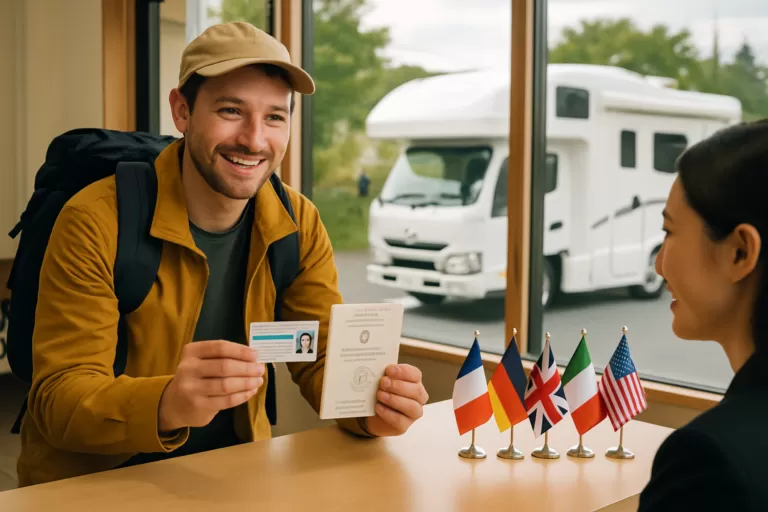
Before you book: with an International Driving Permit if your country is in the Geneva Convention (for example the US, Australia, Singapore); Taiwan, Switzerland, Germany, France, Belgium and Monaco need your licence plus a Japanese translation (Tokyo Metropolitan Police). Questions in English: Moving Inn on WhatsApp. Every roadside station (michi-no-eki) must have free 24-hour toilets, and Hokkaido has 128 of them (MLIT).
What Do You Do With Trash on a Campervan Trip? Disposal Rules at Michi-no-Eki and RV Parks (2026 Edition)
Article 16 of Japan’s Waste Management Act (the law governing disposal and public cleansing of waste) states that “no person shall dispose of waste carelessly,” and violations are subject to penalties (Ministry of the Environment, overview of the Waste Management Act, checked 2026-08-27). This applies directly to campervan travel: dumping several days’ worth of trip trash into a Michi-no-Eki or convenience store bin is both a violation of that facility’s own rules and an act that can qualify as illegal dumping under this law. “Waste disposal available” is also one of the conditions the Japan RV Association requires for RV park certification (Japan RV Association, RV park certification conditions, checked 2026-08-27), so trash disposal is treated as basic infrastructure for an overnight parking base.
This article covers how trash handling differs across Michi-no-Eki, RV parks, highway service areas/parking areas, and convenience stores, practical tips for sorting and storing trash inside the vehicle, and what to do with it just before returning the vehicle. General overnight parking rules are covered in our complete guide to overnight parking in Hokkaido, and how to use Michi-no-Eki is covered in overnight parking at Hokkaido’s Michi-no-Eki — but both only touch on trash disposal briefly. This article focuses on that one action alone, and organizes the rules and practicalities by location.
Why trash disposal is a real issue on a campervan trip
At home you have a set collection day, but there’s no such system on the road. And on a multi-day trip, trash from meals, cooking, and washing up piles up inside the vehicle a little more each day. If you assume “I’ll find somewhere to throw it away” without planning ahead, you can end up struggling to find storage space for trash later in the trip, or leaving it somewhere it shouldn’t be because you couldn’t take it with you. Trash disposal isn’t the glamorous part of the trip, but it’s also one of the biggest reasons overnight parking gets banned at a given spot — so deciding “where and how” as part of your itinerary planning saves you from scrambling later.
How trash handling differs by location
Just because a bin exists somewhere doesn’t mean it’s fine to use. Most bins at these facilities are meant for trash generated on-site by shoppers or overnight guests — they’re not intended for travelers bringing in several days’ worth of accumulated trash. Here’s how the general principle breaks down by location:
| Location | General principle | Notes |
|---|---|---|
| Michi-no-Eki | Take it with you | Facility bins are for shop and restaurant customers. Bringing in trip trash from overnight parking isn’t what the facility expects |
| RV park | Waste disposal available, paid or free depending on the facility | “Waste disposal available” is a Japan RV Association certification condition. Whether it’s paid or free and how much they’ll take varies, so confirm at booking |
| Highway service areas / parking areas | Bins for facility users only | Same as Michi-no-Eki — not intended for dumping several days’ worth of trip trash at once |
| Convenience stores | Only trash from items purchased in-store | Don’t use store-managed bins as a general dumping ground for trip trash |
The common thread is “take with you anything that wasn’t generated on-site.” As a rule, trash from daily life on the road should be stored inside the vehicle and disposed of at a paid waste facility at an RV park, or at a municipal disposal facility.
Overnight parking at Hokkaido’s Michi-no-Eki
See our separate guide to Michi-no-Eki that allow overnight parking, plus etiquette.
See the Michi-no-Eki guide →Why “take it with you” is the principle
Both law and etiquette sit behind the “take it with you” principle. Article 16 of the Waste Management Act states, regardless of location, that “no person shall dispose of waste carelessly” (Ministry of the Environment, cited above, checked 2026-08-27), so leaving trash behind in violation of a facility’s rules can both break that facility’s rules and potentially run afoul of this law. On top of that, in Hokkaido there’s a recognized risk that the smell of food scraps and food waste attracts wildlife — bears in particular. Leaving trash behind doesn’t just make overnight parking conditions worse for the next traveler; it can also draw wild animals into areas where people live, which is a real, tangible harm — not just a matter of manners.
Practical tips for sorting, storing, and containing odor in the vehicle
Once you accept that you’ll be storing several days’ worth of trash inside the vehicle, how you sort it and control odor makes a big difference to how comfortable the trip feels. Some practical points:
- Bring plenty of odor-blocking trash bags: choose ones a step stronger than what you’d normally use at home, and bring enough on the assumption you’ll be storing all your trip’s trash
- Keep food waste separate from dry trash: food waste is a common source of odor and insects, so seal it in its own container or bag and keep it away from other belongings
- Minimize cooking to reduce how much trash you generate in the first place: mixing in simple meals or eating out cuts down on food waste volume
- Keep trash bags somewhere you can grab and go quickly, not tucked away out of sight: so you can deal with it the moment you reach somewhere you can dispose of it
- Keep recyclables like cans and PET bottles separate: some disposal facilities require sorting, so don’t store everything mixed together
A campervan also has separate systems that need managing — greywater from daily use and toilet waste — which are easy to confuse with trash but are entirely different things. See our complete guide to campervan water systems for the plumbing side, and our complete guide to campervan toilets for toilet use and waste disposal.
What to check about paid/free waste disposal at RV parks
RV parks are required to have “waste disposal available” as a Japan RV Association certification condition, but whether it’s free or paid, and how much or what type of trash they’ll accept, varies by facility (Japan RV Association, cited above, checked 2026-08-27). The booking site “RV-Park.jp” shows a facilities column for individual locations, but the level of detail on pricing and sorting rules varies from listing to listing, so if you want to be sure, confirm directly when booking or checking in. As of this writing we couldn’t find a comprehensive nationwide list of which RV parks offer waste disposal versus take-it-with-you-only, so we’re not publishing a definitive list here. For dump station and water refill locations within Hokkaido, see our list of dump stations and water refill spots in Hokkaido, which is also useful for planning around water systems alongside trash disposal.
Things not to do
- Dumping several days’ worth of trip trash into a bin at a Michi-no-Eki, service/parking area, or convenience store
- Leaving trash in a parking lot, on a roadside shoulder, or in a forest or vacant lot and walking away (this can qualify as illegal dumping)
- Leaving food waste unsealed inside the vehicle or trunk (risk of attracting wildlife via odor)
- Ignoring a facility’s rules on the assumption that “no one’s watching here”
Violating the Waste Management Act carries penalties including imprisonment and fines. Because the specific penalty depends on the individual case, this article won’t state exact figures, but the underlying fact you should know is this: dumping trash outside a proper disposal location can constitute a legal violation (Ministry of the Environment, cited above, checked 2026-08-27).
A one-week trash management simulation
Here’s a picture of how this actually plays out. The amount of trash will vary by itinerary and group size, so use this as a rough reference for planning your own trip.
| Days | Situation | What to do |
|---|---|---|
| Days 1–2 | Trash is still minimal | Sort into odor-blocking bags as you go. Keep food waste in a sealed container |
| Days 3–4 | Trash builds up and starts taking up cabin space | Work a stop at an RV park with paid waste disposal into your route |
| Days 5–6 | Recyclables (cans, PET bottles) accumulate | Keep sorting consistent, and dispose of it all at a facility that accepts it |
| Final day | Before returning the vehicle | Take all remaining trash with you so the vehicle is trash-free at return |
Forgetting to remove trash before returning the vehicle can also result in an additional cleaning charge. For the full pre-return process, including refueling and cleaning, see our pre-return checklist for rental campervans — worth checking on the final day of your trip.
New Chitose Airport / Tokachi-Obihiro Airport
Rent the Cabcon “Cresson Journey”
Base yourself at New Chitose Airport and travel all across Hokkaido by campervan.
See details at Moving Inn →FAQ
Q: Can I throw trip trash into a Michi-no-Eki bin?
We don’t recommend it. Michi-no-Eki bins are meant for trash generated on-site by shop and restaurant customers, not for travelers dumping several days’ worth of accumulated trip trash. Take your trip trash with you and dispose of it at a paid waste facility at an RV park or a municipal disposal facility.
Q: Can I dispose of trash for free at any RV park?
No. “Waste disposal available” is a Japan RV Association certification condition, but whether it’s free or paid, and how much or what type they’ll accept, varies by facility. If you want to be sure, confirm directly when booking or checking in.
Q: How should I store food waste?
Keep it in a sealable container or an odor-blocking bag. Food waste odor is known to attract insects and wildlife (bears, in particular, in Hokkaido), so we recommend storing it away from your other belongings.
Q: Can I handle trash disposal and wastewater disposal at the same spot?
It depends on the facility. Trash disposal and a campervan’s greywater or toilet waste disposal are separate systems, and which facilities support which varies. See our water systems guide and toilet guide for details.
Q: What happens if I dump trash somewhere inappropriate?
Article 16 of the Waste Management Act states that “no person shall dispose of waste carelessly,” and violations are subject to penalties. The specific penalty varies by case, but it’s never true that “dumping it won’t lead to any penalty” (Ministry of the Environment, overview of the Waste Management Act, checked 2026-08-27).
Q: Any tips for reducing how much trash I generate?
Keeping in-vehicle cooking to a minimum and mixing in meals out or food from Michi-no-Eki helps cut down food waste in particular. Avoiding over-packaged products when shopping also helps.
Q: What happens if trash is still in the vehicle at return?
Depending on the company, you may be charged an additional cleaning fee. Make sure all trash has been disposed of or taken with you before returning the vehicle. See our pre-return checklist for the full process.
Book a Campervan in Hokkaido
Moving Inn New Chitose Airport supports English booking and offers airport transfers.
Pick a campervan by what matters to you.
Rent at New Chitose Airport
See only the rental bases in Chitose, where the airport is.
![Hokkaido Winter Trip: Shoes & Packing List [2026] – 2,060 Sapporo Fall Transports and a Pre-Departure Checklist](https://hokkaido-campingcar.jp/wp-content/uploads/2026/10/hokkaido-winter-trip-shoes-packing-eyecatch-768x432.webp)
![Snow Cancels Your New Chitose Airport Flight? Rebooking Rules and Campervan Rental Delays [2026]](https://hokkaido-campingcar.jp/wp-content/uploads/2026/10/new-chitose-airport-snow-cancellation-eyecatch-768x432.webp)