Eastern Hokkaido Campervan Route | Complete 5–7 Night Guide: Shiretoko, Kushiro, Abashiri & Obihiro [2026]
A model campervan route traversing eastern Hokkaido.
Pick a campervan by what matters to you.
Rent near Tokachi-Obihiro Airport
See only the rental bases in Tokachi and Obihiro.
Rent in winter (Dec–Mar)
Companies that rent through winter, listed apart from those that close.
Guide price
Moving Inn New Chitose Airport: HIACE van conversion from ¥22,000 per night. 20–30% off when booked 60–90 days ahead (official rate table, checked 15 Oct 2026).
Hokkaido RV parks, one by one →
Before you book: with an International Driving Permit if your country is in the Geneva Convention (for example the US, Australia, Singapore); Taiwan, Switzerland, Germany, France, Belgium and Monaco need your licence plus a Japanese translation (Tokyo Metropolitan Police). Questions in English: Moving Inn on WhatsApp. Every roadside station (michi-no-eki) must have free 24-hour toilets, and Hokkaido has 128 of them (MLIT).
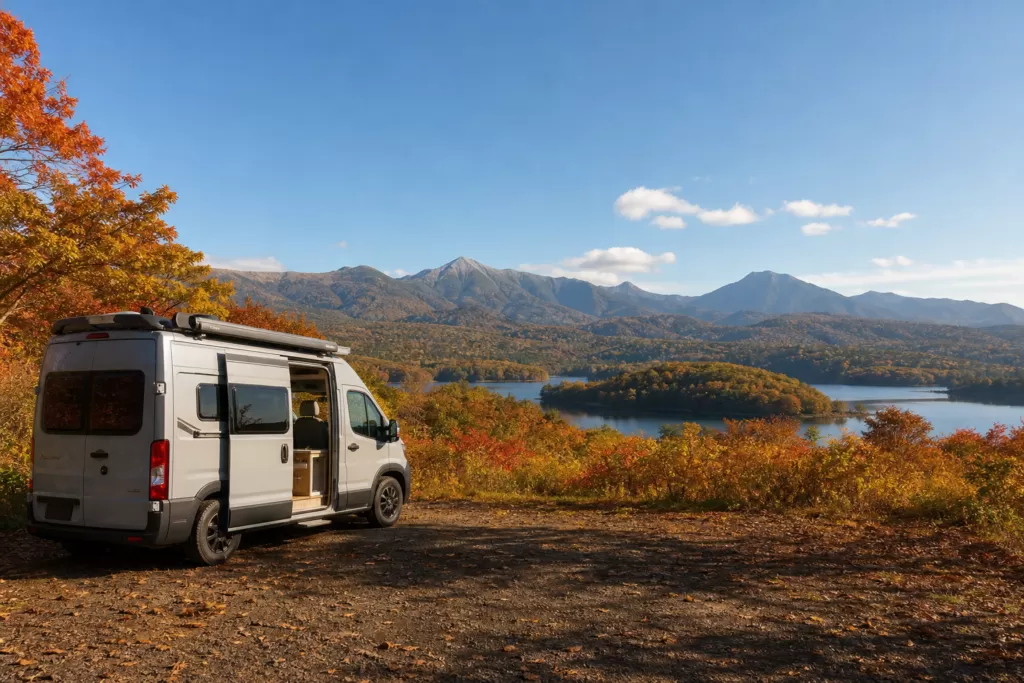
Eastern Hokkaido—encompassing Shiretoko, the Kushiro Wetlands, Lake Akan, Abashiri, the Notsuke Peninsula, and Obihiro—is the region with the highest density of natural attractions anywhere in Hokkaido. In a campervan you can explore the early-morning Shiretoko Five Lakes or the evening Kushiro Wetlands at your own pace, without worrying about checking in or out. A 5-night–6-day to 7-night–8-day itinerary is ideal for this area.
This guide walks through a 5-night–6-day route departing from Memanbetsu Airport, a 7-night–8-day route from Obihiro, estimated costs, accommodation options, and driving-distance considerations.
Tap a dot on the map to see its name here.
Outside this map: Rokkatei Obihiro Main Store, Cape Nosappu. Names are hidden because there are many dots. Tap a dot to see its name and a link to where it appears in this article. 4 places whose location could not be confirmed are not shown. Dot positions are based on each facility’s address or officially published location. Lakes and expressways are from OpenStreetMap data.
What you can see in eastern Hokkaido
Eastern Hokkaido is the most concentrated expression of what makes Hokkaido feel like Hokkaido. The character of each spot is distinctly different, making it easy to build an itinerary.
- Shiretoko Peninsula: UNESCO World Natural Heritage Site. Walking the boardwalk at the Shiretoko Five Lakes, the Kamuiwakka Hot-spring Falls, and the view of Kunashiri Island from Shiretoko Pass. Brown bears frequent the area—follow the rules
- Notsuke Peninsula and Nemuro: Todowara (a peninsula of standing dead trees), Cape Nosappu (the easternmost point of the Japanese mainland). For those who love the "edge of the world" feeling with few crowds
- Kushiro Wetlands: Japan's largest wetland. You can survey the entire wetland from the Hosooka Observatory. In summer, the Norokko sightseeing train crosses the wetlands
- Lake Akan, Lake Mashu, and Lake Kussharo: The three lakes of eastern Hokkaido—each with a different character: Marimo balls, mist, and sand springs. The Kotan hot spring at Lake Kussharo is a free open-air bath
- Abashiri and the Okhotsk coast: Abashiri Prison Museum (adult admission ¥1,500), scallop direct sales at Lake Saroma, and the Oshinkoshin Falls
- Tokachi and Obihiro: Vast agricultural land. Obihiro's butadon (pork rice bowl), sweets, and the Kofuku Station ruin. A fine way to close out an eastern Hokkaido trip
How much will it cost?
The main fixed costs are the rental fee, fuel, and overnight fees at RV parks and campsites. A rough breakdown looks like this:
| Vehicle type | Capacity | 5-night–6-day estimate | 7-night–8-day estimate |
|---|---|---|---|
| Kei camper / small van conversion | 2–3 people | ¥60,000–¥90,000 | ¥80,000–¥120,000 |
| Van conversion (standard) | 3–4 people | ¥90,000–¥140,000 | ¥120,000–¥180,000 |
| Cab conversion (with beds) | 4–6 people | ¥130,000–¥200,000 | ¥170,000–¥260,000 |
| Large bus conversion | 6–8 people | ¥180,000–¥280,000 | ¥240,000–¥360,000 |
The figures above are for the rental fee only. Fuel for traversing eastern Hokkaido is roughly ¥5,000–¥12,000 (varies by vehicle and route). Paid admission fees for attractions (Shiretoko Five Lakes, Lake Akan cruise, etc., roughly ¥5,000–¥10,000 total) and food are additional. Rental fees rise 1.2–1.5× during peak season (July–August). The earlier you book, the more options you have.
For four or more people, a cab conversion keeps per-person costs lower. For two people, a kei camper or small van conversion is easier to handle in terms of fuel economy and maneuverability.
Clockwise or counter-clockwise?
The eastern Hokkaido traverse has two patterns: "clockwise (Memanbetsu → Shiretoko → Nemuro → Kushiro → Obihiro)" and "counter-clockwise (Obihiro → Kushiro → Nemuro → Shiretoko → Memanbetsu)." Which direction you choose significantly changes the feel of the trip.
| Clockwise (from Memanbetsu) | Counter-clockwise (from Obihiro) | |
|---|---|---|
| First highlight | Starting with Shiretoko makes for a strong opening | A gentler warm-up around Obihiro/Tokachi |
| First-day fatigue | Longer drive towards Shiretoko right after pick-up while tired | Shorter driving distance around Obihiro makes the first day easier |
| When using Moving Inn | From the New Chitose Airport shop, a drive of about 5 hours to Memanbetsu is needed | Can start right away from the Tokachi Obihiro Airport shop |
| Weather at Shiretoko | Shiretoko in the first half of the trip—weather risk consumed early | Shiretoko later in the trip, but fatigue may be an issue |
Moving Inn has two shops: New Chitose Airport (about 10 minutes by car from the airport, with a free shuttle) and Tokachi Obihiro Airport (free shuttle from Obihiro Airport). If renting from the New Chitose Airport shop, you drive to Memanbetsu Airport (about 5 hours) or Obihiro (about 2.5 hours) to start. If you start from Obihiro, renting from the Tokachi Obihiro Airport shop lets you set off right away. Picking up from a local shop near Memanbetsu is another option. If using the New Chitose Airport shop, keep in mind that a long drive on the first day is involved.
Model route 1: 5 nights–6 days departing from Memanbetsu Airport
The most popular single-stroke route connecting Abashiri, Shiretoko, Nemuro, Kushiro, Akan, and Obihiro. Total driving distance: 900–1,000 km. An average of 150–180 km per day is a standard pace for eastern Hokkaido.
The official word on overnight parking at the Utoro Shirietoku roadside station you pass on Day 1 is covered in Can You Sleep in Your Van at Michi-no-Eki Shari or Utoro Shirietoku? Official Check and Where to Stay Around Shiretoko.
Day 1: Memanbetsu Airport → Abashiri → overnight at Utoro (approx. 100–120 km)
- Pick up the campervan at Memanbetsu Airport (around 13:00–14:00)
- Visit Abashiri Prison Museum (allow 1.5–2 hours, adult admission ¥1,500)—reachable on pick-up day
- Pass the Oshinkoshin Falls (a waterfall along the national highway to Shiretoko, takes 5 minutes to see)
- Arrive at an RV park in Utoro Onsen (Shiretoko) or near the roadside station "Utoro Shirietoku" for the night
- If arriving late in Utoro, don't forget to refuel for the next morning—there are only 1–2 gas stations in Utoro and they close at night
Day 2: Shiretoko Five Lakes → Shiretoko Pass → overnight at Utoro (approx. 80–100 km)
- Shiretoko Five Lakes: elevated boardwalk course (free, under 1 hour) or ground trail course (confirm bear activity reports, guided or pre-registered). Arriving at the entrance by 7:00 in peak season is advisable
- The Shiretoko Crossing Road (Shiretoko Pass, 738 m elevation) to the Rausu side—on a clear day you can see Mt. Rausu and Kunashiri Island. Closed late October to late April
- Bathe at Rausu Onsen, then return to the Utoro side (or stay in Rausu and adjust the next day's route)
- Don't leave food in the vehicle—brown bears approach unattended cars too
Day 3: Rausu → Notsuke Peninsula → Nemuro/Cape Nosappu (approx. 200–220 km)
- Rausu fishing port morning market (direct sales of fresh fish and seafood—busy in the early morning)
- Notsuke Peninsula: a 4 km round-trip walk to Todowara—a unique landscape of standing dead trees. Free parking
- Head south through Betsukai-cho to Nemuro—the longest driving day in eastern Hokkaido, so proceed at a comfortable pace
- Cape Nosappu: the easternmost point of the Japanese mainland. See the easternmost monument, the observation deck overlooking the Northern Territories, and the lighthouse
- Stock up on food for the next day at a supermarket in Nemuro. Large supermarkets are sparse between here and Kushiro
- Overnight: near the roadside station "Swan 44 Nemuro" or accommodations in Nemuro city
Day 4: Akkeshi → Kushiro Wetlands → overnight in Kushiro (approx. 130–150 km)
- Akkeshi: famous for oysters. Grilled oysters at Akkeshi Gourmet Park (Conchiglie)—gets busy around 10:00 opening time
- Kushiro Wetlands, Hosooka Observatory: a free viewpoint with a panoramic view of the entire wetland. Takes 10–15 minutes
- The summer Norokko train (between Kushiro and Toro) requires advance reservation if you want to ride it
- Dinner at a kushiro-style robata grill in Kushiro city. The "Katte Don" at Wasso Market is lunchtime only
- Overnight: an RV park in Kushiro city or the roadside station "Akan Tancho no Sato" (Kushiro city outskirts)
Day 5: Lake Akan → Lake Mashu → Lake Kussharo → overnight in Obihiro (approx. 210–240 km)
- Lake Akan: cruise boat to the Marimo Exhibition and Observation Center (round trip ¥1,870). Ainu Kotan for crafts and food. The foot bath in the hot spring district is free
- Lake Mashu: Observation Deck No. 1 (free to enter; parking ¥500 per car, valid for Mt. Io parking too). A caldera lake with high transparency often shrouded in mist. Clear days offer a view to the bottom
- Lake Kussharo: Sunayu (dig in the sand to find hot spring water—free), Kotan Onsen (free open-air bath, mixed-gender)
- Head to Obihiro via Prefectural Road 53 and National Highway 241 (about 2.5 hours)
- Try butadon (pork rice bowl) in Obihiro at Panchyo or Hana to Kachi, or sweets from Rokkatei
- Overnight: an RV park in Obihiro city or Shiawasenomori Campsite
Day 6: Obihiro → return to Memanbetsu Airport (approx. 220–240 km)
- Morning: Kofuku Station (former JR Kofuku Station, photo spot, free entry)
- Buy Marsei Butter Sandwiches at Rokkatei Obihiro Main Store for the journey home
- Head to Memanbetsu Airport via National Highways 241–244 (2.5–3 hours)
- Refuel before returning—there are gas stations near the airport
- Allow yourself to be in the vicinity of the airport 30 minutes before the return time
Estimated total driving distance for 5 nights–6 days: approx. 900–1,000 km
Model route 2: 7 nights–8 days departing from Obihiro (relaxed itinerary)
With 7 nights–8 days, you gain half-a-day to a full day at each spot. Staying two nights at Shiretoko means you can adjust the route depending on the weather.
| Day | Itinerary | Overnight area | Estimated driving |
|---|---|---|---|
| Day 1 | Arrive Obihiro → Kofuku Station → Obihiro butadon | Obihiro city RV park | ~50 km |
| Day 2 | Kushiro Wetlands (Hosooka / Norokko) → Kushiro robata grill | Kushiro city | 150 km |
| Day 3 | Akkeshi oysters → Nemuro / Cape Nosappu | Around Nemuro | 180 km |
| Day 4 | Notsuke Peninsula → Rausu fishing port | Rausu Onsen | 130 km |
| Day 5 | Shiretoko Five Lakes → Shiretoko Pass (two-night stay, relaxed) | Utoro Onsen | 80 km |
| Day 6 | Abashiri Prison → Lake Saroma (scallop direct sales) | Lake Saroma area | 150 km |
| Day 7 | Lake Akan → Lake Mashu → Lake Kussharo Sunayu | Lake Kussharo shore | 200 km |
| Day 8 | Sightseeing in Obihiro → return to Obihiro Airport or Memanbetsu Airport | — | 50–120 km |
The highlight of the 7-night–8-day route is Lake Saroma on Day 6. You can have lunch at a scallop direct-sales outlet and enjoy a leisurely drive along the Okhotsk coast. Also use the Abashiri / Lake Saroma area guide.
Compare Hokkaido campervan rentals
See prices, vehicle types, and bases side by side, including areas beyond eastern Hokkaido.
See details at Moving Inn →Accommodation options in eastern Hokkaido
Eastern Hokkaido uses a combination of RV parks, campsites, and roadside stations (Michi-no-Eki). If you need electricity, RV parks are the only option. Roadside stations are places for "rest and napping"—do not stay multiple nights.
| Area | Accommodation options | Type | Electric hookup |
|---|---|---|---|
| Utoro (Shiretoko) | Near Michi-no-Eki "Utoro Shirietoku" / Utoro Onsen RV park | Roadside station / RV park | Available at RV park |
| Rausu | Rausu Onsen Wild Camping Area | Campsite | None |
| Nemuro | Michi-no-Eki "Swan 44 Nemuro" / Shunkunitai Primeval Wildlife Park | Roadside station / wild camping | None |
| Kushiro | RV park Kushiro / Michi-no-Eki "Akan Tancho no Sato" | RV park / roadside station | Available at RV park |
| Lake Akan / Lake Mashu | Lake Akan Shore Campsite / Mashu Onsen roadside station | Campsite / roadside station | Available at campsite |
| Lake Kussharo | Sunayu Campsite / Kawayu Auto Campsite | Campsite | Electric-hookup pitches available |
| Obihiro | Shiawasenomori Campsite / Obihiro city RV park | Campsite / RV park | Available at RV park |
During peak season (July–August), the roadside stations "Utoro" and "Mashu Onsen" can fill up by around 17:00. Plan your itinerary so you arrive by that time. Book popular campsites around key spots 1–2 months in advance to be safe.
Best time of year by season
What you can see in eastern Hokkaido changes considerably by season.
| Season | Highlights | Notes |
|---|---|---|
| Late June–September | Shiretoko Five Lakes ground trail open, sunflower fields, less fog and more sunny days | July–August is peak season—book accommodation and sightseeing early |
| September–October | Autumn foliage (Shiretoko Pass, Lake Mashu), crowds ease | Shiretoko Crossing Road closes late October. Cold mornings and evenings |
| April–June | Fresh greenery, bird breeding season, red-crowned crane watching | Possible snow and icy roads until May. Shiretoko Crossing Road closed until late April |
| January–March | Drift ice at Abashiri (peak in February), icebreaker ship Garinko-go | Winter tires and FF heater essential. Almost all campsites closed |
Foods to eat in eastern Hokkaido
Eastern Hokkaido stands out even within Hokkaido as a food production region. The strength of a campervan trip is being able to combine cooking in the vehicle with eating out.
- Shiretoko / Rausu: Rausu kelp (arguably Japan's finest), fresh fish and seafood from Rausu. On some mornings you can buy directly from fishermen at the Rausu fishing port morning market. Local diner set meals using Rausu kelp broth are also excellent
- Akkeshi: Famous for oysters—shipped year-round. The "Maruemon" variety in autumn and winter is especially rich. Grilled oysters and coppe-pan (soft bread) at Akkeshi Gourmet Park (Conchiglie) are the classics. Canned and processed oyster products also make good souvenirs
- Nemuro: Eskaroppu (a Nemuro specialty: butter rice topped with demi-glace sauce). Hanamaru Shokudo is well known. Nemuro's hanatsu crab is in season in summer and served at local diners
- Kushiro: Robata grill. Kushiro's robata culture is nationally famous, with robata grill restaurants clustered around the port. The "Katte Don" at Wasso Market (choose your own seafood toppings) is morning-only
- Obihiro / Tokachi: Butadon (pork rice bowl—Pancho and Hana to Kachi are long-established restaurants), Indian curry, and sweets from Rokkatei, Yanagi, and Cranberry. Obihiro is known as a "sweets town" with many confectionery shops
- Abashiri / Lake Saroma: Scallops (Lake Saroma is Japan's largest scallop producer). Buying fresh scallops at a direct-sales outlet on the lakeshore and butter-frying them in the vehicle is becoming a travel tradition
There are areas in eastern Hokkaido with few supermarkets, so stocking up on provisions in urban centers like Kushiro, Nemuro, and Obihiro is recommended. A campervan with a fridge lets you bulk-buy 3–4 days' worth of food.
Compare Hokkaido campervan rentals
See prices, vehicle types, and bases side by side, including areas beyond eastern Hokkaido.
See details at Moving Inn →Driving considerations
- Long distances: It is about 150 km just between Shiretoko and Nemuro. Day 3 (Rausu to Cape Nosappu) exceeds 200 km. On driving days, limit sightseeing and save your energy
- Gas station spacing: No gas stations on the Notsuke Peninsula. Always fill up before the Nemuro–Rausu stretch and before crossing Shiretoko Pass. A full tank in Utoro will get you to Nemuro without refueling (approx. 180 km)
- No mobile coverage: The deep interior of the Shiretoko Peninsula, the Notsuke Peninsula, and the area around Lake Mashu can be out of signal range. Download offline maps (Google Maps, Mapion, etc.) in advance
- Road closures: Shiretoko Crossing Road is closed late October to late April. Beware of dense fog and wildlife darting into the road in the early morning
- Brown bear precautions: Brown bears are common throughout Shiretoko. Do not leave food outside the vehicle, retreat quietly if a bear approaches, and carry a bear bell
Also use the Shiretoko campervan guide, Nemuro/Cape Nosappu campervan guide, and Obihiro/Tokachi campervan guide for detailed area information.
Campervans suited to traversing eastern Hokkaido
Traversing eastern Hokkaido involves long daily drives and mountain roads (Shiretoko Crossing Road). Choosing based on the following criteria minimizes regrets.
- Capacity and sleeping space: For four or more people, a cab conversion is recommended. Fixed beds make daily setup and pack-down much easier
- FF heater: Even in summer, eastern Hokkaido nights can drop below 15°C. An FF heater ensures a good night's sleep
- Refrigerator: Large supermarkets are sparse between Nemuro and Kushiro. A fridge lets you bulk-buy 2–3 days' worth of provisions
- Sub-battery: When staying at roadside stations or wild camping areas, external power is unavailable. Sub-battery capacity directly affects travel comfort
- Vehicle height and length: Some roadside station and tourist-spot car parks in eastern Hokkaido have height restrictions. Check before renting
Frequently asked questions (FAQ)
Q1: How many nights do I need for just eastern Hokkaido?
A minimum of 5 nights–6 days is needed to cover the main spots (Shiretoko, Abashiri, Kushiro, Akan, and Obihiro). Add 1–2 days if you want to extend to Nemuro and the Notsuke Peninsula. Rather than rushing, building one "easy travel day" into a 7-night–8-day itinerary tends to improve overall satisfaction.
Q2: What is the best season to visit?
Late June to September is the main season for eastern Hokkaido trips. The Shiretoko Five Lakes ground trail is also open in summer. September is less crowded and comfortable, but the Shiretoko Crossing Road closes late October. Winter (January–February) is drift-ice season and Abashiri is popular, but campervan travel requires cold-weather and ice-driving preparation, raising the difficulty level.
Q3: Where should I refuel?
There are no gas stations on the Notsuke Peninsula or deep in the Shiretoko Peninsula. The basic rule is to fill up every time you pass through an urban area: Utoro, Rausu, Nemuro, Nakashibetsu, Kushiro, and Obihiro. A full tank in Utoro will get you to Nemuro without refueling (approx. 180 km). Rental campervan fuel economy is typically 8–12 km/L, with tank capacities often around 60–80 L.
Q4: Can I start an eastern Hokkaido trip from Moving Inn (New Chitose)?
If renting a campervan from Moving Inn's New Chitose Airport shop (about 10 minutes by car from the airport, with a free shuttle) and heading to eastern Hokkaido, you need about 5 hours of self-driving to reach Memanbetsu Airport or about 2.5 hours to Obihiro. Picking up the vehicle after your flight and heading directly to eastern Hokkaido makes for a long first day. Staying overnight at a regular hotel and departing the next morning, or renting from Moving Inn's Tokachi Obihiro Airport shop (free shuttle from Obihiro Airport) or a local shop near Memanbetsu, is easier on the body.
Q5: What should I do if I encounter a brown bear?
If you see one in the distance, quietly back away, don't approach, don't run—these are the basics. Checking brown bear activity reports before entering the Shiretoko Five Lakes ground trail is mandatory. Always be aware of your distance from the vehicle. Local tourist offices also recommend carrying bear spray.
Book a Campervan in Hokkaido
Moving Inn New Chitose Airport supports English booking and offers airport transfers.
Pick a campervan by what matters to you.
Rent near Tokachi-Obihiro Airport
See only the rental bases in Tokachi and Obihiro.

![When and Where Can You See Harbor Seals at Cape Erimo? Kaze no Yakata Official Information, Viewing Season, and Windy-Day Notes [2026-27]](https://hokkaido-campingcar.jp/wp-content/uploads/2026/10/erimo-cape-lighthouse-768x511.jpg.webp)
![Where and Under What Conditions Can You See Diamond Dust in Hokkaido? How Cold a Morning It Takes, and Where It Appears [2026-27]](https://hokkaido-campingcar.jp/wp-content/uploads/2026/10/hokkaido-diamond-dust-nayoro-768x512.jpg.webp)
![Can You Drive to Hokkaido Jingu for Hatsumode? Parking, Crowds, and Where to Park and Walk [2027]](https://hokkaido-campingcar.jp/wp-content/uploads/2026/10/hokkaido-jingu-winter-torii-768x504.jpg.webp)
![Hokkaido Roads Over New Year [2026-27] | Expressway Sections Prone to Blizzard Closures, Forecast Congestion Days, No Holiday Discount, and New Chitose Airport Parking](https://hokkaido-campingcar.jp/wp-content/uploads/2026/10/hokkaido-winter-rural-road-edge-markers-768x432.jpg.webp)
![Where to See Sea Smoke (Kearashi) in Hokkaido: Rumoi’s Ogon-misaki and the Morning Conditions [2026-27]](https://hokkaido-campingcar.jp/wp-content/uploads/2026/10/rumoi-kearashi-sea-smoke-768x511.jpg.webp)
![Geminid Meteor Shower 2026 in Hokkaido: Peak Around 23:00 on December 14, Sapporo Moonset 20:40, and Staying Warm in a Winter Campervan [2026]](https://hokkaido-campingcar.jp/wp-content/uploads/2026/10/geminids-2026-hokkaido-768x575.jpg.webp)