3 Hokkaido Insect Museums by Campervan: Papillon Château, Maruseppu, and Higashi Taisetsu (Family Guide 2026)
If your kids are wild about insects, put an “insect museum” on your Hokkaido itinerary. There’s Papillon Château (パピヨンシャトー) in Toma, home to a world-spanning collection of insect specimens; Maruseppu Insect Ecology Museum in Engaru, with a greenhouse where butterflies fly free; and Higashi Taisetsu Nature Museum in Kamishihoro, free to enter and covering the whole natural world of the Eastern Taisetsu region. All three are publicly run, professionally managed exhibition facilities — rain or shine, you’re guaranteed to meet the insects.
Let’s be upfront about this article’s stance. This is a trip built around watching insects, not catching them. We won’t be planning any expeditions to catch wild insects and take them home. Depending on the location and species, collecting can be restricted by law or local ordinance, and catching bugs without doing your homework first can turn into a real headache for a family trip. Managed insect museums, on the other hand, let you get close to rare and living insects with total peace of mind. The three museums are spread across the Asahikawa area, the Okhotsk region, and northern Tokachi, so a campervan that covers both lodging and transport in one vehicle is a great match. All opening information below comes straight from each facility’s official site, with the date we checked it.
New from New Chitose Airport — Available from June 2026
Rent the Cabcon “Cresson Journey”
Base yourself at New Chitose Airport and compare rates, vehicle types, and pickup locations all in one place.
See details at Moving Inn →Skip the bug net. Decide as a family before you go: it’s a museum trip
It’s only natural for a kid to say “I want to catch a beetle in Hokkaido.” Still, we don’t recommend that travelers catch wild insects on the spot. In national parks and other protected areas, and for rarer species, collecting can be restricted, and it’s genuinely hard to judge on the fly, mid-trip, exactly where and what you’re allowed to take. Factor in caring for the insect after you get it home, and the bar gets even higher.
An insect museum makes things simple. You can visit on a rainy day, the exhibits come with explanations that get into the “why” behind each insect, and you can meet foreign species you’ve only ever seen in a picture book. Before you go, it’s worth making two promises with your kids: don’t touch the exhibits on your own, and only touch a living insect when staff on-site say it’s okay. Keep those two rules and it’s a good day for the facility, the insects, and your kids alike.
All three museums at a glance: location and opening details
| Facility | Location | Open | Admission | What makes it special |
|---|---|---|---|---|
| Papillon Château | Toma (near Asahikawa) | 4th Saturday of April – 4th Sunday of October, 9:00–17:00 (closed for winter) | ¥600 high school age and up, ¥400 elementary/junior high | World insect specimen collection and a live-observation room |
| Maruseppu Insect Ecology Museum | Maruseppu, Engaru (Okhotsk) | 9:00–17:00 (10:00–16:00 Nov–Mar), closed Tuesdays | ¥420 adults, ¥160 elementary–high school, free for preschoolers | A greenhouse where butterflies fly free, plus live beetles and stag beetles from around the world |
| Higashi Taisetsu Nature Museum | Nukabira Gensenkyo, Kamishihoro (northern Tokachi) | 9:00–17:00, closed Wednesdays | Free | Eastern Taisetsu and world insects, with quizzes and puzzles to learn from |
Opening details and admission fees were all checked on each facility’s official page on 2026-08-14. Temporary closures and exhibit changes are possible, so check the official site again right before you go.
Papillon Château (Toma): start with a world-class specimen collection
This insect museum sits in Toma, right next to Asahikawa city. Toma’s official site describes it as displaying “insect specimens from around the world, some of them academically valuable… it also has an attached live-observation room where you can watch insects up close” (Toma official page, checked 2026-08-14). You take in the sheer diversity of the world’s insects through the specimens first, then head to the observation room to see them moving. It’s the kind of layout that keeps kids who love field guides lingering the longest.
One thing to watch for is the opening season. The official page states clearly, “4th Saturday of April through 4th Sunday of October (closed for winter)” (checked 2026-08-14). Of the three museums, it’s the only one that shuts down completely for winter, so if you’re planning an autumn trip, build it in by mid-October to stay safe. Opening hours are 9:00–17:00, and admission is ¥600 for high-school age and up, ¥400 for elementary/junior-high students (same source, checked 2026-08-14).
Nearby overnight parking
・ RV Park Johnny Base (Higashi-Asahikawa, Asahikawa) — from ¥3,000/night, power hookups at every site, phone reservation only (Kurumatabi official page, checked 2026-08-14).
Asahikawa city also has RV Park Ezosumika Asahikawa (listed on the Kurumatabi official site, checked 2026-08-03). If neither has space, search nearby options from Hokkaido’s RV Park List (47 JRVA-certified sites). Starting your trip from Asahikawa Airport? See How to Rent a Campervan at Asahikawa Airport. Heading up into the mountains from Toma, try the Mt. Daisetsuzan & Sounkyo Drive Guide.
Maruseppu Insect Ecology Museum (Engaru): a butterfly greenhouse, plus living beetles and stag beetles
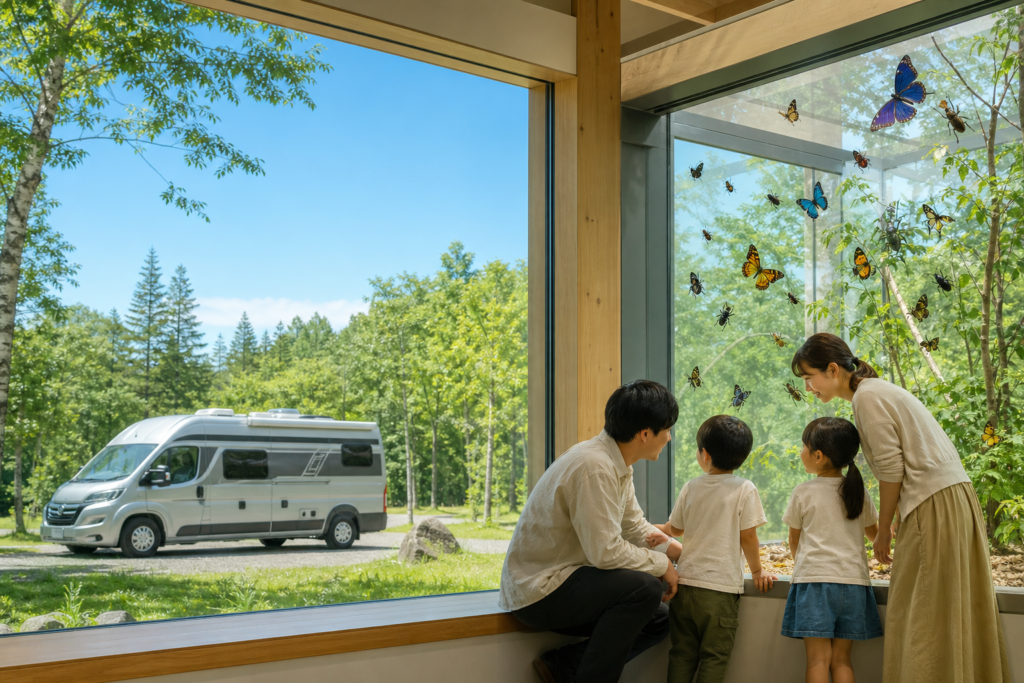
This insect museum in Maruseppu, Engaru, in inland Okhotsk, puts live exhibits front and center. Inside are three zones: a greenhouse where Okinawan butterflies fly free, “Insects of the World,” where you can watch live beetles and stag beetles, and “Creatures Living in Engaru,” which also keeps salamanders and fish (Engaru official page, checked 2026-08-14). Watching a butterfly from the tropics drift past you in the middle of a Hokkaido autumn — that contrast alone is enough to stick in a kid’s memory.
It’s open 9:00–17:00, shortened to 10:00–16:00 from November through March. Closed every Tuesday (the following day if Tuesday is a holiday; open daily during summer break and Golden Week) and over New Year’s, December 31–January 5. Admission is ¥420 for adults, ¥160 for elementary through high-school students, and free for preschoolers (same source, checked 2026-08-14). It’s a museum you can visit even in winter, just on shorter hours.
Right next door is Maruseppu Forest Park Ikoi-no-Mori, and Engaru’s official page notes “there’s also a hot spring and the insect ecology museum close by,” making this one spot where play, a hot spring, and an insect museum all sit together (Ikoi-no-Mori official page, checked 2026-08-14).
Nearby overnight parking
・ Maruseppu Forest Park Ikoi-no-Mori Auto Campsite (right next to the insect ecology museum) — open for the 2026 season April 29–October 18, all sites by online reservation only (Engaru official page, checked 2026-08-14).
・ RV Park Engaru-cho Hotel Sunshine (Engaru town center) — ¥3,300/night, phone reservation, the RV Park itself is closed December through March (Kurumatabi official page, checked 2026-08-14).
If you want to be first through the door at the insect museum, staying at the auto campsite next door the night before means zero travel time. Once the campsite’s season ends in mid-October, switch to the RV Park in central Engaru.
Higashi Taisetsu Nature Museum (Kamishihoro): free admission, insects and earth science together in a hot spring town
This natural history museum sits in the hot-spring town of Nukabira Gensenkyo, in northern Tokachi. It doubles as Nukabira Gensenkyo’s visitor center and the Higashi Taisetsu museum and archive hall, explaining the eastern Taisetsu region and world insects through graphic panels, real specimens, and live exhibits, with quizzes and puzzles for learning how an insect’s body is built (official site, checked 2026-08-14). It’s open 9:00–17:00, closed every Wednesday, and admission is free (same source, checked 2026-08-14).
Free admission with this much content means you can drop in casually alongside a soak in the hot springs. Even a sibling who isn’t that into insects will find plenty to hold their attention, thanks to the geology and animal displays rounding things out.
Nearby overnight parking
There’s no JRVA-certified RV Park inside Kamishihoro town (confirmed against the 45-site JRVA-certified list, as of 2026-08-03). Tokachi’s certified RV Parks are 4 facilities including Moving Inn Tokachi Kita-no-Mori (Taiki), all within the Tokachi region. See Obihiro & Tokachi’s 4 Certified RV Parks for details.
・ Michi-no-Eki Kamishihoro (Kamishihoro town center) — the official page has no mention of overnight parking (official page, checked 2026-08-14). Treat it as a stop for shopping and rest breaks, and follow the facility’s own guidance on whether overnight stays are allowed.
Head south from Nukabira Gensenkyo and you connect to Lake Shikaribetsu and Tokachigawa Onsen. For how to plan that route, see the Lake Shikaribetsu & Tokachigawa Onsen Campervan Guide.
Go in September to early October. From November on, confirm everything in advance
The best season for this trip is September through early October. The reason is simple: all three museums are open during this window, and Maruseppu’s Ikoi-no-Mori auto campsite is still running too (through October 18). It’s also past the summer-holiday crowds, giving families a calmer pace to take in the exhibits.
Options start narrowing after mid-October. Papillon Château closes for winter after the 4th Sunday of October, the Ikoi-no-Mori auto campsite ends its season on October 18, and Engaru’s RV Park is closed December through March (all checked 2026-08-14). On top of that, live insect exhibits can change with the season or time of year. If you’re going in November or later, always confirm with each facility in advance that the exhibit you’re after will actually be on display. The two sure bets in winter are Maruseppu Insect Ecology Museum, which stays open year-round on shortened hours, and Higashi Taisetsu Nature Museum, open every day except Wednesday (opening details per each official page, checked 2026-08-14; reconfirm the latest winter status before you visit).
The three museums sit far apart — near Asahikawa, in Okhotsk, and in northern Tokachi — so if you want to hit all three in one trip, either build in extra days or commit to just one or two and make the most of what’s around them. For how to structure the days, see the Complete Guide to Hokkaido Campervan Model Routes. Pairing it with Michi-no-Eki stays? The Michi-no-Eki Overnight Parking Guide covers the etiquette too.
Frequently Asked Questions
Q1: Can I catch wild beetles or stag beetles on the trip and take them home?
We don’t recommend it in this article. Depending on the location and species, collecting can be restricted by law or local ordinance, and it’s genuinely hard for a traveler to judge that line on the spot. If you want a close-up look at living insects, use a managed facility instead, such as the live exhibits at Maruseppu Insect Ecology Museum or the observation room at Papillon Château.
Q2: Can I visit an insect museum in winter?
Maruseppu Insect Ecology Museum stays open November through March too, 10:00–16:00 (closed Tuesdays and New Year’s). Higashi Taisetsu Nature Museum is closed only on Wednesdays (both checked 2026-08-14). Papillon Château’s official page states it’s open “4th Saturday of April through 4th Sunday of October (closed for winter)” — it’s shut for the winter (checked 2026-08-14). Even at museums that are open, live-exhibit content can change, so confirm with each facility before you set out.
Q3: Can I visit all three museums on a single trip?
It’s possible, but the three sit in separate areas — near Asahikawa, in Okhotsk, and in northern Tokachi — so travel time alone eats up a good chunk of your trip. With young kids along, you’ll likely be happier picking one or two and pairing them with a nearby hot spring or campsite.
Q4: Is there somewhere to park overnight near the museums?
Yes. For Papillon Château in Toma, there’s RV Park Johnny Base in Asahikawa city; for Maruseppu Insect Ecology Museum, there’s the adjoining Ikoi-no-Mori auto campsite (open April 29–October 18) or an RV Park in central Engaru; Kamishihoro has no certified RV Park in town, so the 4 facilities in the Tokachi region are your candidates (each checked 2026-08-03 to 2026-08-14). See Hokkaido’s RV Park List for the full picture.
Q5: How much does admission cost?
Papillon Château is ¥600 for high-school age and up, ¥400 for elementary/junior high; Maruseppu Insect Ecology Museum is ¥420 for adults, ¥160 for elementary through high school, free for preschoolers; Higashi Taisetsu Nature Museum is free (each official page, checked 2026-08-14). Even visiting all three, a family of four can expect to spend just a few thousand yen total — easy on the wallet.
Decide to watch, not catch, and your insect trip opens right up
Swap the bug net for an insect museum as your destination, and you get an insect trip that isn’t at the mercy of the weather or the rulebook. Papillon Château dazzles with sheer specimen numbers, Maruseppu lets you meet living butterflies, beetles, and stag beetles, and Higashi Taisetsu Nature Museum is free and surprisingly deep. Talk it over as a family, decide which one to build your trip around, and start by booking the campervan that’ll be your bed for the night.
New from New Chitose Airport — Available from June 2026
Rent the Cabcon “Cresson Journey”
Base yourself at New Chitose Airport and compare rates, vehicle types, and pickup locations all in one place.
See details at Moving Inn →Book a Campervan in Hokkaido
Moving Inn New Chitose Airport supports English booking and offers airport transfers.

![What to Do in Tokachi in Winter: Dog Sledding, Snowshoeing, the Shikaribetsu Ice Village, and Staying at Kitanomori [2027]](https://hokkaido-campingcar.jp/wp-content/uploads/2026/10/tokachi-winter-dogsled-1-768x432.jpg)
![Where to See Snow for the First Time in Hokkaido: Snow Play Spots and When Snow Is Guaranteed [2026-27]](https://hokkaido-campingcar.jp/wp-content/uploads/2026/10/hokkaido-snow-play-first-snow-eyecatch-768x432.webp)
![10 Days in Hokkaido in Winter: Campervan Itinerary from New Chitose Airport, Skiing in Jan, Snow Festival and Drift Ice in Feb [2027]](https://hokkaido-campingcar.jp/wp-content/uploads/2026/10/winter10days-eyecatch-a-0-mi-js1v1qqiiz0aaaaaaaclwq-768x432.jpg)