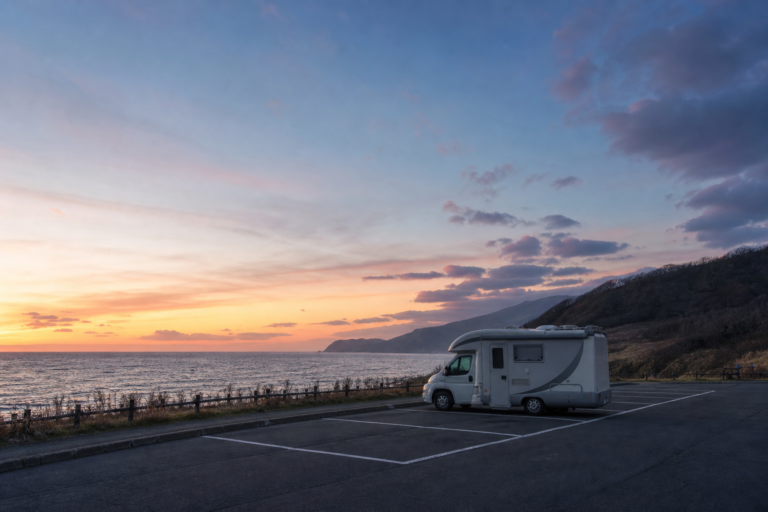
Hokkaido’s 2026 Michi-no-Eki Stamp Rally by Campervan: How to Design a 3-Night or 1-Week Touring Route [124 Planned Stations]

Hokkaido’s “Michi-no-Eki” Stamp Rally 2026 is underway. It runs from April 18, 2026, through March 22, 2027, and covers roadside stations (Michi-no-Eki) across the island — about 124 planned stations (official site, confirmed 2026-08-14). The target stations are spread across the whole island, so this fits well with a campervan: you’re not tied to a hotel’s location, and you can sleep wherever your driving ends up taking you.
There’s a time constraint to collecting stamps, though. Stamping is generally only possible during each station’s opening hours, and the official site itself notes that opening hours and closed days vary by station and should be checked in advance (confirmed 2026-08-14). In other words, there’s a daily cap on how many you can collect, and driving around without a plan won’t get you there. You need to build your route around a campervan’s real advantage: moving overnight and stamping first thing in the morning.
This article covers the rally rules and how to build a route by number of days — “3 nights / 4 days” and “1 week.” For which individual Michi-no-Eki have good facilities or allow overnight parking, see how to tell which Michi-no-Eki allow overnight parking or the top 20 recommended Michi-no-Eki; this article sticks to linking out to those rather than repeating the details.
New from New Chitose Airport — Available from June 2026
Rent the Cabcon “Cresson Journey”
Base yourself at New Chitose Airport and compare rates, vehicle types, and pickup locations all in one place.
See details at Moving Inn →Tap a dot on the map to see its name here.
Tap a dot to see its name and a link to where it appears in this article. Dot positions are based on each facility’s address or officially published location. Lakes and expressways are from OpenStreetMap data.
The Rules First: The Rally Runs Through March 22, 2027, and You Can Only Stamp During Opening Hours
Hokkaido’s “Michi-no-Eki” Stamp Rally 2026 is an official campaign where you collect stamps by visiting roadside stations around the island. It runs from April 18, 2026, to March 22, 2027. The condition for full-completion recognition is, in the official page’s own words, to “collect every stamp installed at every roadside station across Hokkaido (about 124 planned)” (official site, confirmed 2026-08-14). Collected stamps can be entered into prize drawings, and the drawing is said to take place in early May 2027 (same page, confirmed 2026-08-14).
To Join on Paper, You Need the 2026 Stamp Booklet
The official guidance states that “stamps must be collected in the 2026 Stamp Booklet,” and stamps on any other paper don’t count (confirmed 2026-08-14). The price and where to buy the Stamp Booklet weren’t stated on the official page (confirmed 2026-08-14), so check the official site for the latest information before you set out. The worst outcome is realizing mid-trip that you can’t stamp because you don’t have a booklet.
If You Prefer Your Phone, There’s a Digital Version: Michi Re Po
Separate from the paper Stamp Booklet, there’s a digital stamp rally for Hokkaido’s Michi-no-Eki called Michi Re Po (confirmed 2026-08-14). You can join with just your phone, with no risk of forgetting a booklet. Registration and how prizes are handled are run separately from the paper rally, so decide which one you’ll use (or both) on the official site before you start collecting — that way you won’t have to backtrack.
Some Stations May Go Unstamped — Watch for Renovation Work at Shinshinotsu
Michi-no-Eki Shinshinotsu (Shinshinotsu Village) has renovation work scheduled from October 2026, and stamping will be unavailable there for the duration (confirmed 2026-08-14). It’s a station near Sapporo, so if you’re touring central Hokkaido, plan to stop by before September to be safe. The official site also has a dedicated page for what to do “when you can’t stamp,” so if you hit a station that’s closed or under construction, check the official guidance on the spot. Renovations and temporary closures can happen at any point in the fiscal year — the later a station falls in your route, the more it pays to check official information right before you get there.
Why Campervans Make It Easier to Collect Stamps
Stamping is only possible during each station’s opening hours. That means the number you can collect in a day comes down to how many stations you can be in front of while they’re open. The more of your available time gets eaten up by driving during opening hours, the fewer stamps you get. That’s the core of the design problem.
If you’re staying in hotels, you get an evening drive back to your hotel after closing time, and the next morning you lose the first stretch of opening hours just getting from the hotel to station one. A campervan lets you do the opposite. After closing time, keep driving toward the next morning’s first station, sleep there, and stamp the moment it opens before heading to the next one. Do this “camp near tomorrow’s first station tonight” move every night, and the number of stamps you collect over the same number of days changes dramatically.
One thing worth separating out: “sleeping nearby” and “sleeping at the Michi-no-Eki” aren’t the same thing. A Michi-no-Eki is a rest facility for road users, not a lodging facility. How overnight parking is treated varies by station, so choose where you actually sleep based on the official-source way to tell which stations allow it. More on this in the second half of this article.
Before You Build a Route, Decide the Number of Days, the Area, and How You’ll Sleep
There are only three things to decide, and doing them in this order is fastest.
First, let the number of days set your number of areas. One area for 3 nights / 4 days; 2–3 areas for a week. Don’t try to chase all 124 stations in a single trip — get greedy here and stamping turns into a chore that crowds out the actual sightseeing.
Second, your start and end point. If you’re coming from outside Hokkaido, New Chitose Airport or Sapporo will be your base. For the flow from booking to return, see the complete first-time rental guide; for a sense of cost, see the rate guide.
Third, how you’ll sleep. Rather than spending every night at a Michi-no-Eki, build in an RV park or campground with power and waste disposal every other night — it cuts down on both the fatigue of consecutive nights and any etiquette concerns.
For 3 Nights / 4 Days, Stick to a Single Area
Here are three representative plans that work well for 3 nights / 4 days, all assuming a New Chitose Airport / Sapporo start and end. The station names in each itinerary are anchor examples — there are more target stations along the way. Flesh out which ones to stop at using the purpose-based ranking.
Plan 1: Central Hokkaido Loop (Sorachi – Yoichi – Niseko – Lake Toya)
| Day | Route | Stamp-collecting axis |
|---|---|---|
| Day 1 | New Chitose/Sapporo → toward Sorachi | Michi-no-Eki Shinshinotsu and other stations near Sapporo (visit Shinshinotsu before September 2026) |
| Day 2 | Sapporo → Otaru → toward Yoichi/Shakotan | Space Apple Yoichi, Akaigawa, and others |
| Day 3 | Niseko → Lake Toya | Niseko View Plaza, Toya-ko, and others |
| Day 4 | Lake Toya → Nakayama Pass → return | Bouyou Nakayama and others on the way back |
Driving distances are relatively short, so even first-time campervan drivers won’t feel overwhelmed. This stretch also has plenty of hot springs and food stops, making it easy to balance stamping with sightseeing. The first half of the southern Hokkaido route guide covers driving around Lake Toya in more detail.
Plan 2: Southern Hokkaido Round Trip (Hakodate, Esashi, Matsumae)
| Day | Route | Stamp-collecting axis |
|---|---|---|
| Day 1 | New Chitose → along Lake Toya and Funka Bay | Collect stations heading south along National Routes 37 and 5 |
| Day 2 | Onuma → Hakodate | Stations around Hakodate, plus sightseeing |
| Day 3 | Hakodate → toward Matsumae/Esashi | Stations on the west coast of the Oshima Peninsula |
| Day 4 | Esashi → return via inland roads | Pick up any stations you missed on the way out |
Southern Hokkaido has stations relatively close together, but push out to Matsumae or Esashi and your driving distance grows. To fit it into 3 nights / 4 days, decide up front whether you’ll go “as far as the Hakodate area” or “out to the west coast but keep sightseeing light.” For an itinerary that takes it slower over 5 nights / 6 days, see the southern Hokkaido campervan route guide.
Plan 3: Northern Hokkaido — Heading North on the Ororon Line (Rumoi – Teshio – Wakkanai)
| Day | Route | Stamp-collecting axis |
|---|---|---|
| Day 1 | Sapporo → north along the Sea of Japan coast (Mashike, Rumoi) | Stations along the Ororon Line |
| Day 2 | Rumoi → Teshio → Wakkanai | Teshio, Wakkanai, and others |
| Day 3 | Wakkanai → south inland (Otoineppu, Bifuka, Nayoro) | Stations along National Route 40 |
| Day 4 | Nayoro → return via Asahikawa | Pick up any stations you missed on the way out |
Go up the coast and come back inland, and you avoid retracing the same road. The scenic coastal leg is covered in our Mashike & Rumoi article, and the inland leg in our Bifuka & Nayoro article. Options for where to sleep in Wakkanai are limited, so read the Wakkanai RV park situation before you go.
With a Week, You Can Loop All the Way from Central to Eastern Hokkaido
This is a 6-night / 7-day eastern Hokkaido loop model. Starting from New Chitose, you go clockwise: Tokachi → Kushiro → Shiretoko → Abashiri → Sounkyo → Furano/Biei, and back.
| Day | Route | Stamp-collecting axis |
|---|---|---|
| Day 1 | New Chitose → via Hidaka to Tokachi | Stations in Hidaka and southern Tokachi (Nakasatsunai, etc.) |
| Day 2 | Obihiro → Lake Shikaribetsu & Tokachigawa Onsen → toward Kushiro | Inland Tokachi stations |
| Day 3 | Kushiro → Akan → toward Nemuro/Nakashibetsu | Akan Tancho no Sato and other eastern Hokkaido stations |
| Day 4 | Nakashibetsu → Shiretoko | Shari, Utoro Shiretoko, and others |
| Day 5 | Shiretoko → Abashiri → Lake Saroma | Ryuhyo Kaido Abashiri, Lake Saroma, Gurutto Panorama Bihoro Pass, and others |
| Day 6 | Inland Okhotsk → Sounkyo → Asahikawa | Stations toward Sekihoku Pass |
| Day 7 | Asahikawa → Biei/Furano → return | Biei and other stations along the Furano rail line |
Eastern Hokkaido has long stretches between stations, and daily driving tends to run long. “Only stamp the stations right on your route; leave the side trips for next time” is the mindset that keeps 7 days from falling apart. For the detailed driving on each leg, use the eastern Hokkaido cross-country model route as your backbone, and fill in with Lake Shikaribetsu & Tokachigawa Onsen, Shiretoko & Utoro, Abashiri & Lake Saroma, Mt. Daisetsuzan & Sounkyo, and Furano & Biei. For how to think about splitting up the days in general, our complete guide to model courses by trip length is the foundation.
Going for Full Completion: Do It in One Push, or Spread It Out?
As noted above, the condition for full completion is to “collect them all” (official site, confirmed 2026-08-14). The rally runs for about 11 more months through March 22, 2027, so you don’t need to finish it in a single trip. Splitting it across seasons — eastern Hokkaido in summer, southern Hokkaido in autumn — makes full completion realistic even if you can’t take long stretches off work. Check the official site for the detailed rules on entries and recognition if you’re splitting the rally across multiple trips.
If you want to go for it in one push, a long-term rental is the way. For how to budget it, see our 1-month rental guide; if you want to change your return location partway through, see our one-way (drop-off) plan article.
The back half of the rally period falls in winter. Winter driving and gear are a different game from summer, so if any area on your route falls after November, read our complete winter driving guide first. Some stations may also change their opening hours or closed days in winter, which makes checking opening hours in advance matter even more that time of year.
Where Do You Sleep at Night? Stamping Efficiency and Overnight-Parking Etiquette Are Separate Issues
If you only optimize for rally efficiency, “sleep at the next morning’s first station every night” looks like the fastest option. But a Michi-no-Eki is a rest facility for road users, not a lodging facility, and how overnight parking is treated varies station by station. For how to read the official listings, see Which Roadside Stations Allow Overnight Parking? How to Check the Official Rules; for the etiquette to follow and how some stations came to ban it, see our roadside station overnight-parking etiquette guide.
In practice, mixing Michi-no-Eki, RV parks, and campgrounds is the realistic way to choose where to sleep. For comfortable summer nights, see our 20 recommended roadside stations for overnight parking; for how to check facilities, see our roadside-station overnight-parking guide; and for the full picture including bear safety, start with our complete Hokkaido overnight-parking guide. Stamping is the rally; sleeping is etiquette. Plan the two separately, and you’ll enjoy collecting stamps without the friction.
New from New Chitose Airport — Available from June 2026
Rent the Cabcon "Cresson Journey"
Base yourself at New Chitose Airport and compare rates, vehicle types, and pickup locations all in one place.
See details at Moving Inn →Frequently Asked Questions
Q1: When does Hokkaido’s 2026 Michi-no-Eki Stamp Rally end?
It runs through March 22, 2027. It started on April 18, 2026, and covers roadside stations across the island — about 124 planned (official site, confirmed 2026-08-14).
Q2: Where can I get the Stamp Booklet?
The price and where to buy it weren’t stated on the official page (confirmed 2026-08-14). Check the official site for the latest information before you set out. If you join with the digital version, Michi Re Po, you can start without a Stamp Booklet at all.
Q3: Can I stamp at night?
Stamping is only possible during each station’s opening hours. The official site notes that opening hours and closed days vary by station and should be checked in advance (confirmed 2026-08-14). Build your route assuming you can’t stamp at night or on closed days, and use the night to drive toward the next morning’s first station.
Q4: Can I stay overnight at Michi-no-Eki while collecting stamps?
A Michi-no-Eki is a rest facility for road users, and how overnight parking is treated varies by station. For the official-source way to tell, see our 20 stations that allow overnight parking; for etiquette, see our etiquette guide. On nights you need power or waste disposal, pairing it with an RV park works well.
Q5: Where’s the best place to rent a campervan?
If you’re coming from outside Hokkaido, the area around New Chitose Airport is the easiest base. For the flow from booking to return, see our complete rental guide. You can compare rates and pickup locations for vehicles departing New Chitose Airport at Moving Inn.
Start by Picking Where Your First 3 Nights / 4 Days Will Be
The rules are simple: get a Stamp Booklet (or use Michi Re Po), and stamp your way around during opening hours. With rules this simple, what actually separates a good trip from a great one is where you drive overnight and where you position yourself for the next morning’s first station — and that’s where a campervan owns the field. Full completion can be split across trips within the rally period, so start by picking one area — central, southern, or northern Hokkaido — and lock in the dates for your first 3 nights / 4 days.
Book a Campervan in Hokkaido
Moving Inn New Chitose Airport supports English booking and offers airport transfers.

![Hokkaido Winter Trip: Shoes & Packing List [2026] – 2,060 Sapporo Fall Transports and a Pre-Departure Checklist](https://hokkaido-campingcar.jp/wp-content/uploads/2026/10/hokkaido-winter-trip-shoes-packing-eyecatch-768x432.webp)
![Snow Cancels Your New Chitose Airport Flight? Rebooking Rules and Campervan Rental Delays [2026]](https://hokkaido-campingcar.jp/wp-content/uploads/2026/10/new-chitose-airport-snow-cancellation-eyecatch-768x432.webp)