Hiace Campervan Rental in Hokkaido | Rates, Features & Comparison with Cabcon [2026 Guide]
A complete guide to renting a HiAce-based campervan in Hokkaido. Covers rental rates, key features, and how it compares to a cabover camper — the best option for 2–4 person trips.
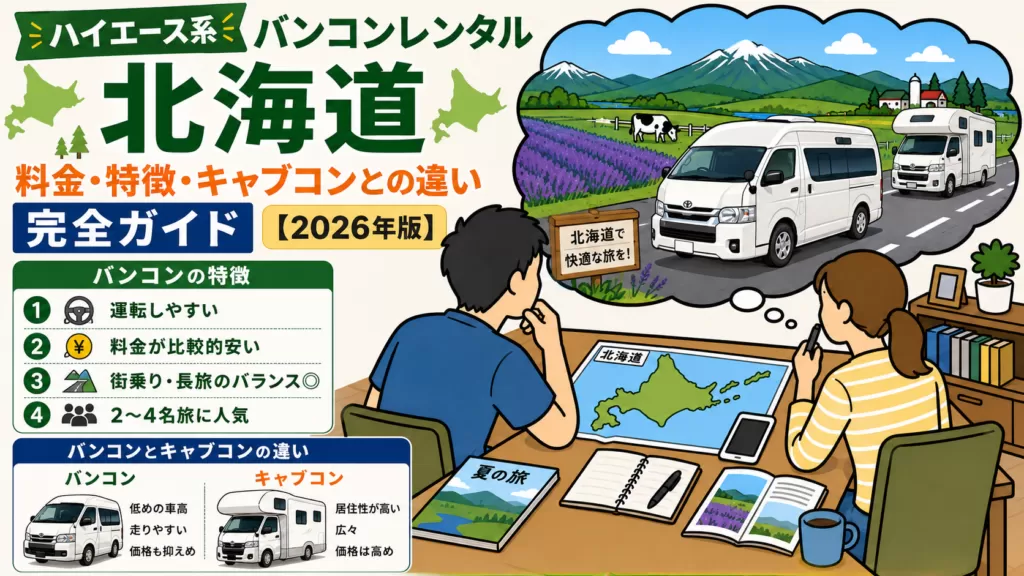
The HiAce- and NV350 Caravan-based campervan (bancon) is the most popular rental category in Hokkaido — and for good reason. It drives like a standard passenger vehicle, fits 2–4 people comfortably, and packs a sleeping area, refrigerator, and electrical system into a compact frame.
This guide covers rental rates, key features, how it compares to a cabover camper, and how to choose the right fit for your Hokkaido trip. Whether you’re renting a campervan for the first time or still deciding between vehicle types, this should help.
Rental Rate Guide for HiAce-Based Campervans
Rental rates in Hokkaido vary by grade and operator. Here’s a general breakdown from standard to premium:
| Type | Approx. rate per night | Capacity | Features |
|---|---|---|---|
| Campervan (Standard) | ¥20,000–¥30,000 | 2–3 people | Standard HiAce body, basic equipment |
| Campervan (Mid-grade) | ¥30,000–¥40,000 | 2–3 people | Fixed bed, refrigerator, inverter included |
| Campervan (High-grade/Extended) | ¥40,000–¥58,000 | 3–4 people | Sink, diesel heater, solar panel |
Rates vary by operator, model, and season. During peak season (July–August), some operators charge 1.5–2x the standard rate. For a full cost simulation, see our Hokkaido campervan rental cost calculator, and for tips on finding affordable rentals, check the budget campervan rental guide.
New Chitose Airport / Tokachi-Obihiro Airport
Rent the Cabcon “Cresson Journey”
Base yourself at New Chitose Airport and compare rates, vehicle types, and pickup locations all in one place.
See details at Moving Inn →Features and Advantages of HiAce-Based Campervans
Drives Like a Regular Car
The HiAce is widely used for taxis and shuttle services across Japan, so many drivers already have experience with it. The standard body is about 1.88m wide — 40–50cm narrower than a cabover camper — making it manageable on narrow roads and in car parks with height restrictions (2.3m or less). This is a major advantage on tight roads around Shakotan Peninsula and in mountain areas.
Many operators now include rear-view cameras and side cameras as standard, making it easier for first-time campervan renters to drive with confidence.
Better Fuel Economy, Lower Running Costs
Diesel engine models typically return 10–12km/L, which makes a real difference on long Hokkaido drives. Compared to a cabover camper (7–9km/L), you’ll save roughly 20–30% on fuel for the same distance.
A full loop of Hokkaido often covers 1,500–2,000km. In a diesel campervan, that translates to roughly ¥10,000–¥15,000 in fuel savings over a cabover (based on diesel at ¥140/L in 2026).
Standard Driver’s License Is Sufficient
Most HiAce-based campervans are under 3.5 tonnes GVW and can be driven even with a standard license obtained on or after March 12, 2017. No special endorsement or pre-trip training required, which makes it easy to book on short notice. Just confirm with the operator whether the vehicle is manual or automatic if you hold an AT-only license.
Compact Yet Fully Equipped
Most models have either a fixed bed or a convertible living/sleeping layout (2-way), and typically include a small refrigerator, sink, and inverter. It’s not as spacious as a cabover, but for 2–3 people, there’s plenty of room.
The compact body also means you can park in regular spaces at convenience stores and roadside stations — not just dedicated RV parks — giving you more flexibility on the road.
Campervan vs Cabover: Full Comparison
If you’re undecided between the two types, use this table to match your travel style and group size:
| Comparison | Campervan (HiAce-based) | Cabover Camper |
|---|---|---|
| Length | ~4.7–5.4m | ~5.8–7.5m |
| Width | ~1.88m (standard body) | ~2.2–2.4m |
| Height | ~2.1–2.8m (varies by roof) | ~2.8–3.2m |
| Sleeping capacity | 2–4 people | 4–8 people |
| Approx. rate per night | ¥20,000–¥58,000 | ¥40,000–¥100,000+ |
| Fuel economy | 10–12km/L (diesel) | 7–9km/L |
| License required | Standard (varies by model) | Standard to medium (varies) |
| Shower/toilet | No (use external facilities) | Yes (in fully equipped models) |
| Maneuverability | ◎ Easy to handle | △ Watch width and height |
| Interior space | △ Smaller than cabover | ◎ Full living/dining area |
Campervans win on driveability, cost, and maneuverability. Cabovers win on living space, sleeping capacity, and on-board facilities. For 2–3 people, the campervan offers better value; for groups of 4–6, the cabover tends to be the preferred choice. For a deeper dive, see our campervan vs. cabover comparison guide.
What’s Inside: Interior Layout Explained
Sleeping Space
HiAce campervans generally come in two sleeping layouts:
Fixed bed type: The rear seat has been removed and a permanent bed installed. No nightly setup — arrive tired and go straight to sleep. Typically single to semi-double size, which is comfortable for two adults.
Convertible (2-way) type: During the day it’s a dinette for eating and relaxing; at night the seats fold into a bed. Slightly more setup involved, but you get more usable daytime space. Common in 3–4 person configurations.
Kitchen and Cooking Equipment
Even standard models usually include a small sink and a 1–2 burner gas or cassette stove. High-grade models may come with an IH cooktop, microwave, and full cooking utensils. Buying fresh local ingredients at Hokkaido supermarkets and cooking on board is one of the best ways to keep food costs down.
Electrical System and Refrigerator
Most models have an inverter that provides AC100V power for charging phones and laptops or running an electric blanket. Refrigerators are typically 20–50L — enough for food and drinks. Solar-equipped models can recharge the sub-battery while driving or parked, reducing dependency on powered campsites.
Storage Space
Storage is more limited than in a cabover. You’ll need to use under-bed compartments, overhead space, and side storage efficiently. A rough guide: 2–3 suitcases plus several soft bags. If you’re bringing a lot of gear, choose a high-grade model with more storage or pare down what you pack.
Why It Works So Well for 2–4 Person Trips
Three reasons the campervan suits small groups so well:
First, cost-sharing efficiency. A ¥30,000/night campervan split two ways is ¥15,000 per person — often cheaper than a hotel room, and that’s before factoring in savings on breakfast and transport.
Second, schedule flexibility. No hotel reservations means you can change your route based on weather or mood. In Hokkaido, where conditions shift quickly, being able to pivot on the fly — sunny day for the mountains, rainy day for hot springs and roadside stations — is a major advantage of campervan travel.
Third, sleep where you explore. You can pull up next to a scenic view, eat dinner watching the sunset, and sleep right there — no checking in or out, no racing the clock. That’s a travel style that’s hard to replicate any other way.
Driving Tips and Drawbacks
Things to Watch While Driving
HiAce campervans are taller than standard minivans, with a slightly higher center of gravity. Be cautious of strong crosswinds on highways — Hokkaido gets windy, and keeping your speed in check helps.
High-roof models (2.5–2.8m) won’t fit in multi-story parking structures or under low bridges and tunnels. Check height clearances at your planned stops before you set out.
Limited Interior Space
The biggest drawback of a campervan is space. Three or four adults with luggage can feel cramped, especially on longer trips (7+ nights) when gear tends to accumulate. Packing light matters more than you think.
There’s also no shower or toilet on board. Hokkaido has abundant hot spring facilities and roadside stations with bathing options, so daily bathing is very manageable. That said, families with young children may want to consider a cabover with an on-board toilet.
Rental Operators and Rates in Hokkaido
HiAce campervan rentals are available from operators across Hokkaido — near New Chitose Airport, Asahikawa, Obihiro, Hakodate, and more. Here’s a general overview by region:
To compare every campervan rental base in Hokkaido side by side, see the Hokkaido campervan rental & hire comparison.
| Operator area | Approx. rate per night (campervan) | Notes |
|---|---|---|
| New Chitose Airport area (Chitose/Tomakomai) | ¥25,000–¥55,000 | Airport shuttle available, wide selection |
| Sapporo city/suburbs | ¥20,000–¥45,000 | Easy access, on-site parking |
| Asahikawa | ¥22,000–¥40,000 | Good base for northern/Taisetsu routes |
| Obihiro | ¥22,000–¥38,000 | Ideal for Tokachi and eastern Hokkaido |
| Hakodate | ¥20,000–¥35,000 | Starting point for routes heading north |
Insurance coverage, mileage limits, and included equipment vary by operator. Compare beyond price. For full operator details and reviews, see our top 15 Hokkaido campervan rental guide.
Cost Estimate: 2 People, 4 Nights 5 Days
Here’s a sample cost breakdown for a 2-person, 4-night trip in a mid-grade campervan:
| Item | Estimated cost | Notes |
|---|---|---|
| Campervan rental (4 nights, mid-grade) | ¥120,000–¥140,000 | ¥30,000–¥35,000/night × 4 |
| Insurance/coverage options | ¥8,000–¥16,000 | ¥2,000–¥4,000/day |
| Fuel (est. 800km) | ~¥11,000 | Diesel at ¥140/L, 10km/L |
| Toll roads | ¥5,000–¥10,000 | Varies by route |
| RV park/campsite fees | ¥8,000–¥16,000 | ¥2,000–¥4,000/night × 4 |
| Food (supermarkets and roadside stations) | ¥20,000–¥30,000 | 3 meals/day for 2 people |
| Hot springs and bathing | ¥3,000–¥6,000 | ¥500–¥800/person × 4 days |
Total estimate: ¥175,000–¥229,000 (2 people, 4 nights 5 days)
That’s ¥87,500–¥114,500 per person. Compare that to a hotel trip for the same period — accommodation alone for 2 people × 4 nights would run ¥60,000–¥120,000 — and the campervan option holds up well on value.
Who It’s For and Points to Note
Couples and Pairs
Campervans are an excellent fit for couples. Models with a fixed double bed require no nightly setup and offer a comfortable night’s sleep. See our couple/partner campervan rental guide for more.
Solo Travel
Renting a large cabover alone is expensive and harder to drive. For solo trips, a compact campervan or kei camper is the better fit. See the solo Hokkaido campervan guide.
Families with Young Children (3–4 people)
Some 4-person campervans can accommodate two adults and two young children. A common path is to start with a campervan while kids are small, then upgrade to a cabover as the family grows.
What to Confirm Before Booking
1. Sleeping capacity and layout: “4-person capacity” doesn’t mean all 4 sleep comfortably. Confirm whether it has a fixed bed or a convertible layout.
2. License class and transmission: Confirm you can drive it with your license, especially if AT-only. Some larger models require a semi-medium license.
3. Vehicle height and parking restrictions: High-roof models (2.5m+) won’t fit in multi-story car parks. Check clearances at places you plan to visit.
4. Mileage limits and overage fees: Some operators cap daily mileage at 200–300km. Hokkaido distances add up quickly, so look for an unlimited or high-cap plan.
5. Insurance coverage: Confirm that personal liability, third-party property damage, and vehicle damage coverage are included. Know the excess amount, and consider adding excess waiver coverage.
6. Airport shuttle: For New Chitose Airport arrivals, check if the transfer from the airport to the rental depot is free or paid.
7. Included equipment: Confirm what’s provided: bedding, cooking utensils, tableware, table and chairs. In some seasons, the presence or absence of a diesel heater or fan makes a big difference.
New Chitose Airport / Tokachi-Obihiro Airport
Rent the Cabcon “Cresson Journey”
Base yourself at New Chitose Airport and compare rates, vehicle types, and pickup locations all in one place.
See details at Moving Inn →Campervan vs. Cabover: Quick Decision Guide
| Best for | Recommended type |
|---|---|
| 2–3 people / not confident driving large vehicles | Campervan (HiAce-based) |
| 4–6 person groups or families | Cabover camper |
| Routes with narrow roads (Shakotan, Shiretoko) | Campervan |
| Need shower and toilet on board | Cabover (fully equipped) |
| Keeping costs down | Campervan or kei camper |
| Long-term stay with a focus on comfort | Cabover camper |
FAQ
Q. Can I drive a HiAce-based campervan with a standard driver’s license?
Yes, as long as the GVW is under 3.5 tonnes and the license was obtained on or after March 12, 2017 (older standard licenses cover heavier vehicles too). AT-only licenses cannot be used for manual transmission vehicles. Most rentals are automatic, but confirm before booking. See our campervan license guide.
Q. Can a HiAce campervan fit in a multi-story car park?
Standard-roof models (2.1–2.3m) can enter car parks with a 2.3m or higher clearance. High-roof models (2.5–2.8m) may not. Confirm the vehicle’s height at pickup.
Q. Can it handle mountain and forest roads in Hokkaido?
Paved public roads are generally fine. Unpaved forest tracks aren’t ideal for campervans with lower ground clearance. The main tourist areas — Shiretoko, Daisetsuzan — are all fully paved.
Q. How much luggage can a campervan hold?
Enough for 2–3 people on a 5–7 night trip. A rough guide: 2–3 suitcases plus several soft bags. Load and unload through the large rear and side doors.
Q. How much does the rate change between peak and off-peak seasons?
Peak season in Hokkaido is July–August, when many operators charge 1.5–2x the weekday rate. June and September are less crowded with more stable pricing — and still great for lavender and autumn foliage, respectively.
Q. Is a campervan hard to drive for a first-timer?
No — it’s one of the most beginner-friendly categories. The vehicle size is close to a standard car, and most operators give a walk-through of all systems (inverter, refrigerator, bed setup) before you leave. You’ll feel comfortable quickly.
Q. Can I shower inside the campervan?
Most campervans do not have a built-in shower or toilet. Hokkaido has plenty of hot spring facilities, super sentō, and roadside station bathing options — daily bathing is very easy to arrange. Many RV parks and campsites also have shower facilities.
Book a Campervan in Hokkaido
Moving Inn New Chitose Airport supports English booking and offers airport transfers.

![When and Where Can You See Harbor Seals at Cape Erimo? Kaze no Yakata Official Information, Viewing Season, and Windy-Day Notes [2026-27]](https://hokkaido-campingcar.jp/wp-content/uploads/2026/10/erimo-cape-lighthouse-768x511.jpg.webp)
![Where and Under What Conditions Can You See Diamond Dust in Hokkaido? How Cold a Morning It Takes, and Where It Appears [2026-27]](https://hokkaido-campingcar.jp/wp-content/uploads/2026/10/hokkaido-diamond-dust-nayoro-768x512.jpg.webp)
![Can You Drive to Hokkaido Jingu for Hatsumode? Parking, Crowds, and Where to Park and Walk [2027]](https://hokkaido-campingcar.jp/wp-content/uploads/2026/10/hokkaido-jingu-winter-torii-768x504.jpg.webp)
![Hokkaido Roads Over New Year [2026-27] | Expressway Sections Prone to Blizzard Closures, Forecast Congestion Days, No Holiday Discount, and New Chitose Airport Parking](https://hokkaido-campingcar.jp/wp-content/uploads/2026/10/hokkaido-winter-rural-road-edge-markers-768x432.jpg.webp)
![Where to See Sea Smoke (Kearashi) in Hokkaido: Rumoi’s Ogon-misaki and the Morning Conditions [2026-27]](https://hokkaido-campingcar.jp/wp-content/uploads/2026/10/rumoi-kearashi-sea-smoke-768x511.jpg.webp)
![Geminid Meteor Shower 2026 in Hokkaido: Peak Around 23:00 on December 14, Sapporo Moonset 20:40, and Staying Warm in a Winter Campervan [2026]](https://hokkaido-campingcar.jp/wp-content/uploads/2026/10/geminids-2026-hokkaido-768x575.jpg.webp)