What Is a Bus Conversion Campervan? Features, Appeal, and How to Use One in Hokkaido
Pick a campervan by what matters to you.
Rent at New Chitose Airport
See only the rental bases in Chitose, where the airport is.
Rent in winter (Dec–Mar)
Companies that rent through winter, listed apart from those that close.
Guide price
Moving Inn New Chitose Airport: HIACE van conversion from ¥22,000 per night. 20–30% off when booked 60–90 days ahead (official rate table, checked 15 Oct 2026).
Before you book: with an International Driving Permit if your country is in the Geneva Convention (for example the US, Australia, Singapore); Taiwan, Switzerland, Germany, France, Belgium and Monaco need your licence plus a Japanese translation (Tokyo Metropolitan Police). Questions in English: Moving Inn on WhatsApp. Every roadside station (michi-no-eki) must have free 24-hour toilets, and Hokkaido has 128 of them (MLIT).
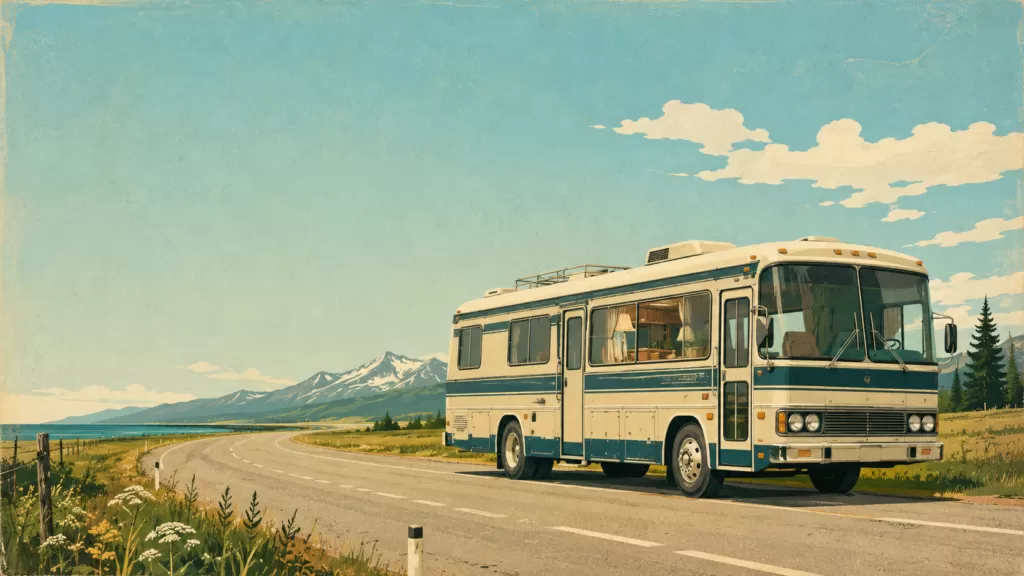
A bus conversion is the largest class of campervan. Converted from a route bus or microbus, some models accommodate 10 or more passengers. Compared to cab conversions or van conversions, this is less a “house on wheels” and more a “hotel on wheels.”
This article covers the basics of bus conversions: features, advantages, disadvantages, comparison with other vehicle types, and how to use one on a Hokkaido trip.
New Chitose Airport / Tokachi-Obihiro Airport
Rent the Cabcon “Cresson Journey”
Base yourself at New Chitose Airport and compare rates, vehicle types, and pickup locations all in one place.
See details at Moving Inn →What Is a Bus Conversion?
A bus conversion (bus conversion campervan) is a campervan created by converting the interior of a route bus, microbus, or coach into a living space. “Conversion” means the vehicle has been rebuilt to function as a home.
Based on the type of base vehicle, there are two main categories:
- Microbus-based (5–7 m): Built on Toyota Coaster, Hino Liesse, etc. Relatively compact, suited to groups of around 10.
- Full-size bus-based (8–12 m): Converted from route buses and coaches. The largest class, able to sleep 15 or more.
Basic Specifications (Microbus-Based)
| Specification | Typical Values |
|---|---|
| Length | 5.5–7.0 m (microbus-based) |
| Height | 2.7–3.2 m |
| Interior headroom | 175–200 cm |
| Passenger capacity | 6–10 |
| Sleeping capacity | 6–15 |
| License required | Medium (type 2) or larger |
| Fuel economy | 4–8 km/L |
| Rental rate guide | ¥40,000–¥80,000/day |
4 Unique Advantages of Bus Conversions
① The Largest Living Space in the Campervan Class
The defining feature of a bus conversion is its overwhelming interior space. Even a microbus-based model gives you the full interior of a 5–7 m vehicle, exceeding even cab conversions in spaciousness.
Sitting around a large dining table, having children run around inside, traveling without worrying about luggage — things impossible in a van conversion or cab conversion come naturally in a bus conversion. Groups praise the ability to spend evenings comfortably at a roadside station in Hokkaido.
② Exceptional Sleeping Capacity
Even microbus-based models sleep 6–10; full-size bus-based models can accommodate 15 or more. Being able to travel and overnight with no hotel costs for a large party is a strength only bus conversions offer.
The math can work out: “Chartering one bus conversion can be cheaper than booking 10 hotel rooms.”
③ Fully Equipped Living Facilities
Most bus conversions include:
- Full kitchen (2+ burner stove, sink, large refrigerator)
- Shower room (hot water)
- Cassette or water-flush toilet
- High-capacity house battery and solar panels
- Diesel heater (FFH) (full cabin heating) and air conditioning
- TV and Wi-Fi router
Hotel-level facilities in a vehicle you can park wherever you want — that is the core value of a bus conversion.
④ Lower Cost Per Person for Longer Trips
The daily rental fee of ¥40,000–¥80,000 sounds high, but shared among 10 people, it is ¥4,000–¥8,000 per person per day. Compare that to hotel rates of ¥8,000–¥15,000 per person per night, and a bus conversion wins significantly on longer trips.
Model calculation for 10 people, 7 nights 8 days in Hokkaido:
- Bus conversion rental: approx. ¥420,000 (¥60,000/day × 7 days)
- Per person: ¥42,000 (equivalent to 7 nights of accommodation)
- Hotel comparison: 10 people × 7 nights × ¥10,000 = ¥700,000
- Difference: ▲¥258,000 (bus conversion is cheaper)
Disadvantages and Cautions
① Medium or Larger License Required
Most bus conversions have a gross vehicle weight of 5 tonnes or more, requiring a medium license (for those who obtained their standard license after 2007) or the old-style standard license (pre-2007, covering up to 8 tonnes GVW). Full-size bus models require a large vehicle license.
Those who obtained a standard license after 2007 generally cannot drive a bus conversion — always verify license requirements before booking. Having someone in your group with a medium or large license is a prerequisite.
② Limited Parking Options
At 5–7 m+ in length and 2.7 m+ in height, parking options are severely limited. Small tourist car parks and narrow roads are often inaccessible. Plan ahead and use spacious parking lots, roadside stations (michi-no-eki), and RV parks.
Hokkaido has many large flat car parks that are bus conversion-friendly, but some areas — such as the central tourist district of Hakodate — require extra care.
If you are starting your trip from Hakodate or the southern Hokkaido area, check the Hakodate campervan rental comparison as well.
③ Poor Fuel Economy, High Fuel Costs
Fuel economy is 4–8 km/L. Driving 200 km/day in Hokkaido costs approximately ¥5,000–¥8,500 in diesel (¥170/L). For a 7-day trip, fuel alone can total ¥35,000–¥60,000 — factor this into your group cost calculation.
④ Driving Requires Practice
A nearly 7 m-long vehicle handles very differently from a standard car at corners and when parking. Backup cameras and careful mirror checks are essential — receive a thorough briefing from the rental company before departure.
Bus Conversion vs Cab Conversion vs Van Conversion vs Kei Campervan
| Feature | Bus Conversion | Cab Conversion | Van Conversion | Kei Campervan |
|---|---|---|---|---|
| Length | 5.5–7 m+ | 5.3–6.5 m | 4.7–5.4 m | 3.4–3.6 m |
| Sleeping capacity | 6–15+ | 4–8 | 2–4 | 1–2 |
| License required | Medium–large | Standard | Standard | Standard (auto OK) |
| Fuel economy | 4–8 km/L | 6–9 km/L | 8–10 km/L | 10–13 km/L |
| Rental rate/day | ¥40,000–¥80,000 | ¥25,000–¥45,000 | ¥18,000–¥30,000 | ¥12,000–¥18,000 |
| Facility level | ◎ (highest) | ◎ | ○ | △ |
| Best group size | 6–15 | 4–6 | 2–4 | 1–2 |
See our article comparing all campervan types.
Who Is a Bus Conversion For?
| Good fit | Not a good fit |
|---|---|
| Groups of 6+ or large family trips | Solo or small groups of 1–4 (cost doesn’t work out) |
| Groups with a medium or large license holder | Groups where everyone has only a standard license |
| Long Hokkaido trips of 1 week or more | Short 2–3 night trips |
| Groups looking to dramatically cut accommodation costs | Itineraries with many narrow roads or tight parking |
| Training camps, film crews, team events | Urban sightseeing focused trips |
New Chitose Airport / Tokachi-Obihiro Airport
Rent the Cabcon “Cresson Journey”
Base yourself at New Chitose Airport and compare rates, vehicle types, and pickup locations all in one place.
See details at Moving Inn →Using a Bus Conversion in Hokkaido
Hokkaido is ideally suited for bus conversion travel. Large flat car parks are common, and roadside stations are among the most abundant in Japan. The long straight roads of central, northern, and eastern Hokkaido are easy to navigate even in a large vehicle.
For large group travel plans in Hokkaido, or to compare rental companies offering bus conversions and other campervan types:
FAQ
Q. Can I drive a bus conversion with a standard license?
Most models require a medium license or larger. Those who obtained their standard license before 2007 may be covered under the old-style standard license (up to 8 tonnes GVW) in some cases — always confirm with the rental company.
Q. How much is the per-person rental cost for a bus conversion?
For 10 people, roughly ¥4,000–¥8,000 per person per day. Over 7 nights and 8 days, that is ¥28,000–¥56,000 per person. Compared to the same number of hotel nights, a bus conversion is usually cheaper for groups of 6 or more.
Q. Where can a bus conversion be parked?
The vehicle’s length and height rule out multi-story car parks and height-restricted areas. Plan your route around roadside stations, RV parks, and large flat commercial parking lots. Hokkaido has many such options, making it well suited for bus conversion travel.
Q. Which is better for Hokkaido travel — a bus conversion or a cab conversion?
Think by group size: 4–6 people → cab conversion; 6+ people → bus conversion. If everyone in your group has only a standard license, a cab conversion is the only option.
Q. Can I rent a bus conversion in Hokkaido?
Bus conversion rental companies are rare nationwide, and Hokkaido locations are limited. Availability during peak season (July–August) fills up months in advance — check and reserve early.
Summary: Bus Conversions Are the One-of-a-Kind Choice for Large Groups in Hokkaido
Key points about bus conversions:
- The largest campervan class, built on a bus base. Sleeping capacity 6–15+
- Full kitchen, shower, toilet, heating — the highest facility level
- Medium or larger license required; large license mandatory for full-size bus models
- ¥40,000–¥80,000/day, but shared by 10 people it is ¥4,000–¥8,000/person — cheaper than hotels
- Hokkaido’s flat open parking and abundant roadside stations make it ideal for bus conversion travel
Solo or couples → kei campervan; families or small groups → cab conversion; large groups → bus conversion. Start with the people count and license situation to quickly narrow down your choice.
Book a Campervan in Hokkaido
Moving Inn New Chitose Airport supports English booking and offers airport transfers.
Pick a campervan by what matters to you.
Rent at New Chitose Airport
See only the rental bases in Chitose, where the airport is.

![When and Where Can You See Harbor Seals at Cape Erimo? Kaze no Yakata Official Information, Viewing Season, and Windy-Day Notes [2026-27]](https://hokkaido-campingcar.jp/wp-content/uploads/2026/10/erimo-cape-lighthouse-768x511.jpg.webp)
![Where and Under What Conditions Can You See Diamond Dust in Hokkaido? How Cold a Morning It Takes, and Where It Appears [2026-27]](https://hokkaido-campingcar.jp/wp-content/uploads/2026/10/hokkaido-diamond-dust-nayoro-768x512.jpg.webp)
![Can You Drive to Hokkaido Jingu for Hatsumode? Parking, Crowds, and Where to Park and Walk [2027]](https://hokkaido-campingcar.jp/wp-content/uploads/2026/10/hokkaido-jingu-winter-torii-768x504.jpg.webp)
![Hokkaido Roads Over New Year [2026-27] | Expressway Sections Prone to Blizzard Closures, Forecast Congestion Days, No Holiday Discount, and New Chitose Airport Parking](https://hokkaido-campingcar.jp/wp-content/uploads/2026/10/hokkaido-winter-rural-road-edge-markers-768x432.jpg.webp)
![Where to See Sea Smoke (Kearashi) in Hokkaido: Rumoi’s Ogon-misaki and the Morning Conditions [2026-27]](https://hokkaido-campingcar.jp/wp-content/uploads/2026/10/rumoi-kearashi-sea-smoke-768x511.jpg.webp)
![Geminid Meteor Shower 2026 in Hokkaido: Peak Around 23:00 on December 14, Sapporo Moonset 20:40, and Staying Warm in a Winter Campervan [2026]](https://hokkaido-campingcar.jp/wp-content/uploads/2026/10/geminids-2026-hokkaido-768x575.jpg.webp)