Hokkaido Campervan Spring Travel Guide | June Highlights, Costs & What to Watch Out For [2026]
Complete guide to spring campervan travel in Hokkaido (May and June).
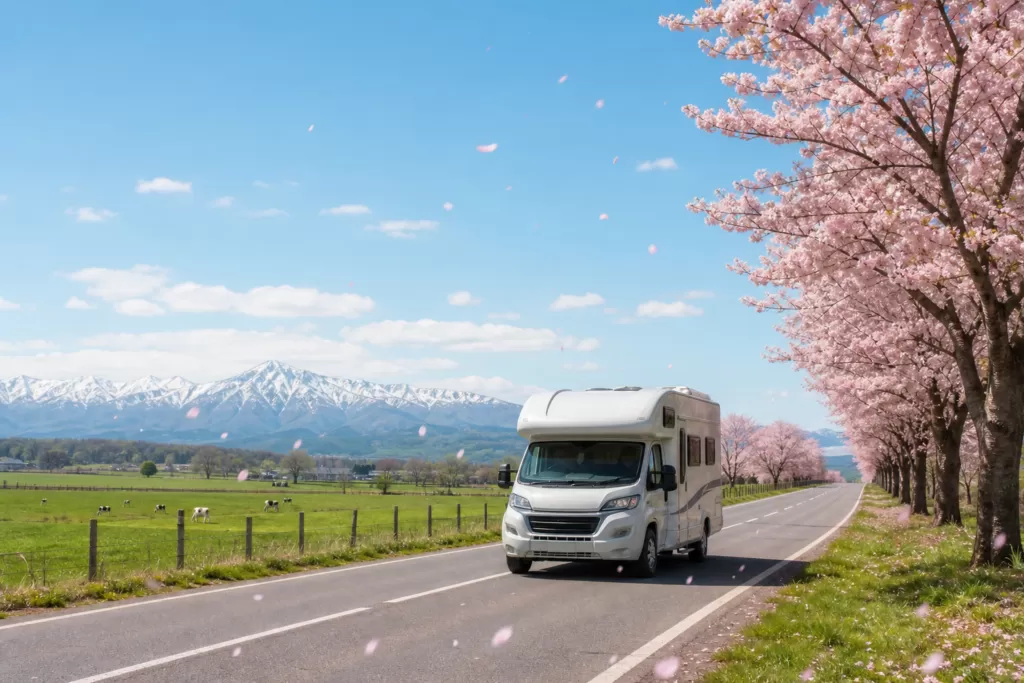
There is a season when Hokkaido campervan travel rivals summer — and that is the spring window from May through June. Attractions are uncrowded, cherry blossoms give way to shibazakura and lupine and then early lavender, and roadside stalls overflow with fresh asparagus and wild vegetables at prices that feel almost too good. The value is remarkably strong compared to summer, yet spring Hokkaido is still largely underrated.
This guide covers climate, clothing, accommodation, costs, and recommended routes for spring, broken down into May and June. It also covers what to watch for during Golden Week and why travel becomes noticeably easier once Golden Week is over.
New Chitose Airport / Tokachi-Obihiro Airport
Rent the Cabcon “Cresson Journey”
Base yourself at New Chitose Airport and compare rates, vehicle types, and pickup locations all in one place.
See details at Moving Inn →Why more people are choosing spring campervan trips — the simple reasons
- Lower prices: The same vehicle can be around 50–70% of the peak-season rate. Over a 3-night trip, the difference can amount to tens of thousands of yen.
- Popular spots are quiet: Farm Tomita, Blue Pond, Shiretoko — far fewer visitors than summer, so you can take your time.
- Flowers in quick succession: Ezo Yamazakura, shibazakura, tulips, lupine — the best of each comes and goes over two months, with no gaps.
- Spring produce at rock-bottom prices: Sansai (mountain vegetables), fresh asparagus, and early potatoes are available cheaply at roadside stations and farm stalls — perfect for cooking in the van.
- Relaxed roadside stations and RV parks: No peak-season crowds, no full car parks. Easier overnight parking throughout the trip.
That said, “the spring in Hokkaido is cold,” “some campsites are still closed,” and “Golden Week is crowded” are real considerations. Each one is explained in detail below.
Spring trip costs (May–June)
| Vehicle type | Estimated nightly rate (May–June) | vs. July–August peak |
|---|---|---|
| Kei camper | approx. ¥13,000–20,000 | approx. 50–70% of peak |
| Van conversion | approx. ¥20,000–35,000 | approx. 50–65% of peak |
| Cab-over | approx. ¥26,000–50,000 | approx. 50–60% of peak |
Note that Golden Week (late April to early May) is treated as peak season by most operators. From mid-May through late June, rates return to off-peak levels — the best combination of price and comfort in the whole year. For a 3-night, 4-day total cost, see the Hokkaido Campervan 3 Nights 4 Days Cost Simulation. For budget operators, the Budget Campervan Rental Guide is also useful.
For a season-independent overview — cost simulations, model routes, and Michi-no-Eki overnight parking rules — see our Complete Guide to Hokkaido Campervan Travel.
What to see in May versus June
Spring means different things in May compared to June — the climate, flowers, and what is open all shift considerably.
May: Cherry blossoms and shibazakura (mainly south and central Hokkaido)
- Matsumae Castle & Matsumae Park (southern Hokkaido): Hokkaido’s largest cherry blossom site, with 250 varieties and 10,000 trees. Peak: late April to mid-May.
- Ezo Yamazakura (all over Hokkaido): Deeper pink than mainland Somei Yoshino. Blooms late April to early May across the island.
- Shibazakura at Higashimokoto (near Abashiri): A whole hillside turns pink. Peak: mid-May. About 45 min by car from Memanbetsu Airport.
- Tulips at Kamiyubetsu Tulip Park (near Monbetsu): 2 million tulips. Peak: early to mid-May.
- Shiretoko sightseeing cruises begin: Running from May, offering the blue sea and dramatic cliffs after the sea ice melts.
June: Lupine and the start of lavender (central and northern Hokkaido)
- Lupine (around Kamifurano): Peak early to mid-June. Purple, pink, and white against the rural backdrop.
- Early lavender at Farm Tomita (Nakafurano): Early-blooming varieties start from late June. The main lavender peaks in early July, but late June to early July is before the crowds and worth targeting.
- Sarobetsu Plain – Ezo day lily (Toyotomi, Horonobe): Peak late June to early July. Orange flowers spread across the vast wetland.
- Rebun Island alpine flowers: June–July is peak season for rare species including Rebun Atsumori Sou (lady’s slipper orchid). Accessible by Heartland Ferry from Wakkanai.
- Ezo lily: Blooms mid to late June across Hokkaido. Vivid orange colour.
Spring flower calendar (timeline)
| Period | Flowers / highlights | Main areas |
|---|---|---|
| Late April – early May | Ezo Yamazakura, Matsumae cherry blossoms | All over / southern Hokkaido |
| Early – mid-May | Tulips (Kamiyubetsu), shibazakura (Higashimokoto) | Okhotsk region |
| Mid – late May | Late-blooming Matsumae cherries, lilac (syringa) | Southern Hokkaido / Sapporo |
| Early – mid-June | Lupine, Ezo lily | Kamifurano, various |
| Late June | Early lavender (Farm Tomita), Ezo day lily (Sarobetsu) | Furano / northern Hokkaido |
The honest truth about spring weather and what to wear
“Spring in Hokkaido is cold” is something you hear a lot — but knowing specifically how cold is what really matters. Showing up with only summer clothes, especially in May, can be genuinely miserable.
May temperatures
- Central Hokkaido (Sapporo, Asahikawa): Max 10–15°C, mornings and evenings 5–8°C
- Eastern Hokkaido (Kushiro, Shiretoko): Max 5–12°C, mornings and evenings 3–7°C
- Northern Hokkaido (Wakkanai, Monbetsu): Max 8–13°C, mornings and evenings 3–7°C
For a more detailed location-by-location, ten-day breakdown of May temperatures and overnight gear, see our guide to Hokkaido’s Golden Week and May temperatures.
June temperatures
- Central Hokkaido: Highs can reach 15–22°C on warmer days, but lows are still 8–12°C
- Eastern and northern Hokkaido: Even in June, lows can drop below 5°C, and fog is frequent
Eastern Hokkaido (Kushiro, Shiretoko) is famously resistant to warming up — they say summer barely arrives. Even in June, a fleece and outer layer are necessary in the mornings and evenings.
Clothing tips
- Fleece plus windproof outer layer as the base combination
- A light down or insulated jacket as one extra layer is reassuring
- Summer clothes alone are not enough in May — and barely enough on May evenings in June
- Rain gear is essential — spring in Hokkaido is frequently overcast with light rain
Why you should choose a vehicle with an FF heater
For a spring campervan trip in Hokkaido, a vehicle with an FF heater (forced combustion heater) is strongly recommended. In May, temperatures with the engine off at night can drop to around 5°C — an electric blanket alone often is not enough. An FF heater keeps the interior comfortable while you sleep. When booking, specify “FF heater equipped” or confirm with the operator before committing.
What to know about Golden Week before you plan
Golden Week (late April to early May) is busy in Hokkaido too. If you are planning a spring trip, knowing the specific Golden Week risks in advance is important.
Roadside stations and accommodation filling up
Major roadside stations in central Hokkaido — Asahikawa, Obihiro, and others — can fill their car parks during Golden Week. Arriving after late afternoon can leave you without a spot. During Golden Week, arriving at your intended overnight location by 3 p.m. is the safe rule.
Rental rates at peak pricing
Most campervan operators treat Golden Week (late April to early May) as peak season. Some charge rates equivalent to midsummer. If you come in expecting “spring prices” and book during Golden Week, the total will likely be higher than you anticipated.
After Golden Week (from mid-May onward) is the sweet spot
Once Golden Week ends, traffic drops sharply and campervan rates return to off-peak levels. If you want to avoid the rush and keep costs down, departing from May 15th onward offers the best balance across the whole spring period.
Three types of accommodation to mix in spring
Campsites (most open from early to mid-May)
Most Hokkaido campsites open between late April and mid-May. But the opening date changes each year, so always check each site’s website before you go. In early May, many sites are still closed — this is when “drove all the way there and it was shut” tends to happen.
Spring campsites are uncrowded, and popular pitches that fill up in summer are often available. But cold mornings and evenings mean an FF heater or proper sleeping bag is essential.
Roadside stations (open year-round, comfortable outside of Golden Week)
Hokkaido roadside stations are generally suitable for overnight parking. Stations with attached hot spring facilities (e.g. Michi-no-Eki Nakasatsunai, Michi-no-Eki Misogi-no-Sato Kikonai) are especially useful on cold spring evenings.
RV parks (open year-round, power hookup especially useful in spring)
RV parks are mostly open year-round with powered pitches. Electric blankets and FF heaters on hook-up handle the cold spring mornings and evenings well. RV parks adjacent to hot spring facilities are ideal for spring campervan trips — the routine of bathing and then stepping directly back into a warm van is genuinely useful when it is cold.
What makes spring campervan travel enjoyable
Post-snowmelt farm road drives
By May, the snow has melted from Hokkaido’s farm roads and fresh green spreads across the fields. The rural landscape before the tourist season is quietly beautiful in a way that is distinct from summer. The rolling hills of Biei and Furano, photographed across fields of crops rather than flowers, are still very much worth seeing.
Spring ingredients for cooking in the van
These are cheap and available at roadside stations and farm stalls in spring:
- Mountain vegetables (sansai): Aralia sprouts (tara no me), butterbur shoots (fuki no to), Japanese angelica (udo) — late April to mid-May
- Asparagus: Hokkaido spring asparagus peaks May–June. Often available at roadside stalls at a third of supermarket prices.
- Early-season potatoes: New potatoes start appearing from around June. Fresh from the farm, the flavour is incomparable.
Asparagus sautéed in butter, fuki no to miso, sansai soba — spring Hokkaido cooking on the campervan stove is one of the quiet highlights of this style of travel.
Unhurried sightseeing
Farm Tomita, Blue Pond, Shiretoko Five Lakes — all of these are overrun in summer. In spring they are quiet. No standing around waiting for a clear shot. Hokkaido spring is brief — just those two months — and the chance to see seasonal flowers without the crowds is exactly why return visitors often say spring is their favourite season.
New Chitose Airport / Tokachi-Obihiro Airport
Rent the Cabcon “Cresson Journey”
Base yourself at New Chitose Airport and compare rates, vehicle types, and pickup locations all in one place.
See details at Moving Inn →Routes that work well in June
New Chitose base: Central & northern Hokkaido flower loop, 4 nights 5 days (June)
- Day 1: New Chitose – pick up campervan → Lake Shikotsu → overnight near Niseko (RV park or roadside station)
- Day 2: Niseko → Biei hills (lupine) → Furano (early lavender) → overnight near Asahikawa
- Day 3: Asahiyama Zoo → Sounkyo (Kurodake ropeway) → overnight near Monbetsu
- Day 4: Sarobetsu Plain (Ezo day lily) → overnight in Wakkanai (RV park)
- Day 5: Cape Soya → return campervan in Asahikawa (fly out of Asahikawa Airport)
New Chitose base: Eastern Hokkaido loop, 4 nights 5 days (May–June)
- Day 1: New Chitose – pick up → Hidaka → overnight near Obihiro
- Day 2: Obihiro (Rokkatei main store, Obihiro Racecourse) → Lake Akan → overnight near Kushiro
- Day 3: Kushiro Wetlands → Shibecha → overnight in Shiretoko (Utoro)
- Day 4: Shiretoko cruise → Shiretoko Pass (check road conditions) → overnight in Abashiri
- Day 5: Shibazakura (Higashimokoto, if mid-May) → return in Asahikawa or New Chitose
Note: Shiretoko Pass may be closed in May — check road condition information from the Hokkaido Development Bureau before departing.
For Furano and Biei in detail, use the Furano & Biei Campervan Drive Guide.
Spring trip booking & preparation checklist
- Golden Week trips: book the campervan 2–4 weeks in advance (earlier is better)
- After Golden Week (mid-May to June): many operators have availability with less notice
- Choose a vehicle with an FF heater (or confirm with the operator)
- Pack fleece, windproof outer, light down jacket — summer clothes alone are not enough
- Check campsite opening dates directly before your trip
- Confirm road conditions for Shiretoko Pass, Mikuni Pass, and other high mountain roads before departure
- Mixing roadside station and RV park overnights gives flexibility when campsites are not yet open
FAQ
Is there a rainy season in Hokkaido in June?
Hokkaido does not have a rainy season (tsuyu). However, June does tend to be cloudy and wet at times. “No rainy season” does not mean clear skies — rain gear is necessary.
Is an FF heater essential for spring campervan travel?
Not strictly essential, but May nights can reach 5°C, and having one is a significant comfort upgrade. For eastern and northern Hokkaido in May especially, an FF heater vehicle is strongly recommended. An electric blanket plus sleeping bag can work, but the difference in comfort is real.
How much cheaper is a campervan after Golden Week compared to during it?
It depends on the operator, but the difference between Golden Week (peak) and mid-May onward (off-peak) can be ¥5,000–15,000 per night. Over a 3–4 night trip, the total savings can be ¥20,000–30,000. If your dates are flexible, post-Golden Week travel is substantially better value.
Can I see Farm Tomita lavender in June?
Early-blooming varieties start from late June. The main lavender fields peak in early to mid-July, so June is the “just starting” phase. If you want to avoid the summer rush, late June to early July is actually a good compromise.
Can I visit Shiretoko in May?
Shiretoko sightseeing cruises begin in May and offer the blue sea and dramatic cliffs after the ice melts. However, Shiretoko Pass (Route 334) may still be closed in May if you are planning to cross between Utoro and Rausu. Check road conditions before building this into your route.
Are campervan operators generally open in spring?
Most operate normally through spring. However, some smaller operators have extended maintenance periods in April through May and only start operating from mid-May. Always confirm the start date of the rental season before booking.
Book a Campervan in Hokkaido
Moving Inn New Chitose Airport supports English booking and offers airport transfers.

![When and Where Can You See Harbor Seals at Cape Erimo? Kaze no Yakata Official Information, Viewing Season, and Windy-Day Notes [2026-27]](https://hokkaido-campingcar.jp/wp-content/uploads/2026/10/erimo-cape-lighthouse-768x511.jpg.webp)
![Where and Under What Conditions Can You See Diamond Dust in Hokkaido? How Cold a Morning It Takes, and Where It Appears [2026-27]](https://hokkaido-campingcar.jp/wp-content/uploads/2026/10/hokkaido-diamond-dust-nayoro-768x512.jpg.webp)
![Can You Drive to Hokkaido Jingu for Hatsumode? Parking, Crowds, and Where to Park and Walk [2027]](https://hokkaido-campingcar.jp/wp-content/uploads/2026/10/hokkaido-jingu-winter-torii-768x504.jpg.webp)
![Hokkaido Roads Over New Year [2026-27] | Expressway Sections Prone to Blizzard Closures, Forecast Congestion Days, No Holiday Discount, and New Chitose Airport Parking](https://hokkaido-campingcar.jp/wp-content/uploads/2026/10/hokkaido-winter-rural-road-edge-markers-768x432.jpg.webp)
![Where to See Sea Smoke (Kearashi) in Hokkaido: Rumoi’s Ogon-misaki and the Morning Conditions [2026-27]](https://hokkaido-campingcar.jp/wp-content/uploads/2026/10/rumoi-kearashi-sea-smoke-768x511.jpg.webp)
![Geminid Meteor Shower 2026 in Hokkaido: Peak Around 23:00 on December 14, Sapporo Moonset 20:40, and Staying Warm in a Winter Campervan [2026]](https://hokkaido-campingcar.jp/wp-content/uploads/2026/10/geminids-2026-hokkaido-768x575.jpg.webp)