Niseko Campervan Guide: Winter Powder Snow, Mt. Yotei, Hot Springs & Overnight Parking [2026]
Niseko's charms: winter powder snow, Mt. Yotei, hot springs, and Michi-no-Eki overnight parking, with Grand Hirafu's 2026-27 dates and winter road closures.
Pick a campervan by what matters to you.
Rent at New Chitose Airport
See only the rental bases in Chitose, where the airport is.
Rent in winter (Dec–Mar)
Companies that rent through winter, listed apart from those that close.
Guide price
Moving Inn New Chitose Airport: HIACE van conversion from ¥22,000 per night. 20–30% off when booked 60–90 days ahead (official rate table, checked 15 Oct 2026).
New Chitose Airport map for campervan travellers →
Before you book: with an International Driving Permit if your country is in the Geneva Convention (for example the US, Australia, Singapore); Taiwan, Switzerland, Germany, France, Belgium and Monaco need your licence plus a Japanese translation (Tokyo Metropolitan Police). Questions in English: Moving Inn on WhatsApp. Every roadside station (michi-no-eki) must have free 24-hour toilets, and Hokkaido has 128 of them (MLIT).
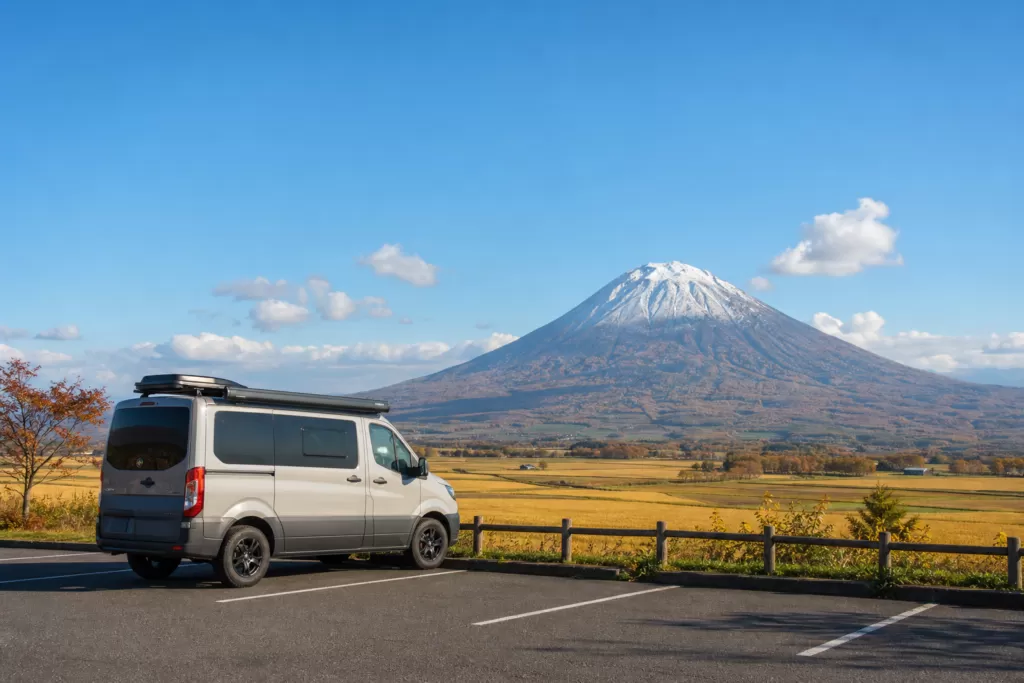
If you’re renting a campervan in Niseko, it’s easiest to build your route around Route 5, where Mt. Yotei and Niseko Annupuri come into view at the same time. The base is about a 2-hour drive from New Chitose Airport, roughly 120km one way — a distance that fits well with a 1-night/2-day to 2-night/3-day trip combining a day hike, Goshiki Onsen, and “Yukichichibu” at Niseko Yumoto Onsen. This guide starts with what makes Niseko appealing (winter in particular), then covers where the Mt. Yotei viewpoints are, the Niseko Annupuri trailhead and campground, what overnight parking at a Michi-no-Eki is really like, and what to watch for when driving in winter, all with actual place names and numbers.
Compare Hokkaido Campervan Rentals
Base yourself at New Chitose Airport and compare rates, vehicle types, and pickup locations all in one place.
Compare rental companies and vehicles →What is Niseko like? Mt. Yotei, the Niseko mountain range, powder snow, and hot springs
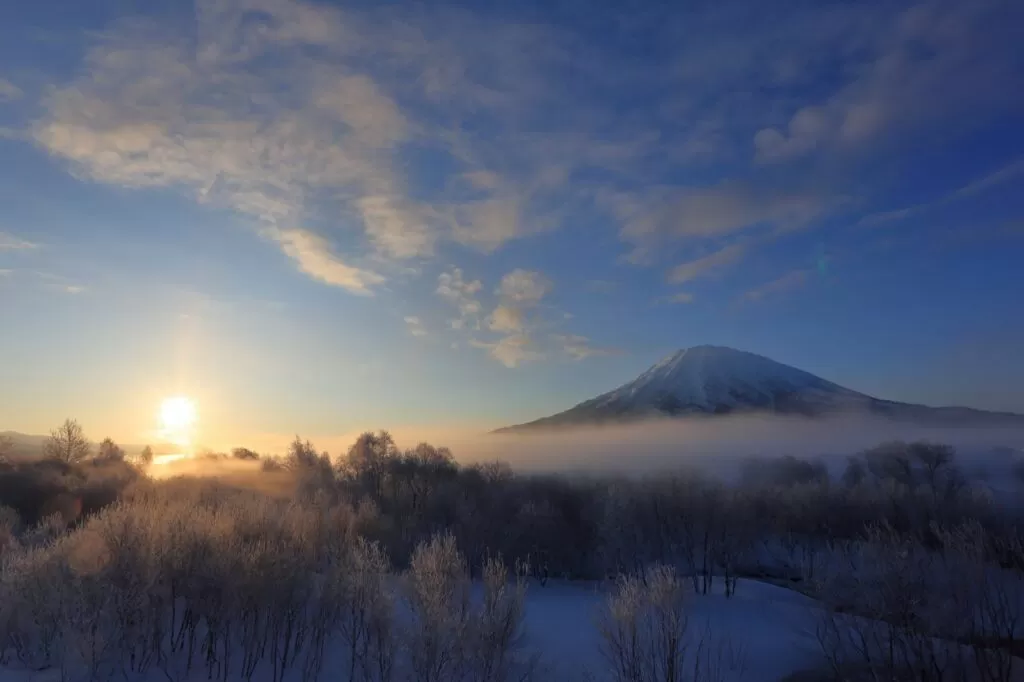
Niseko is an area surrounded by Mt. Yotei (elevation 1,898m) and the Niseko mountain range. Mt. Yotei is called “Ezo Fuji” for its resemblance to Mt. Fuji, and it is one of Japan’s 100 Famous Mountains (Kutchan Town: Mt. Yotei information, checked 2026-10-07). Winter is about skiing and snowboarding; summer is about alpine flowers and hiking on Mt. Yotei.
For winter snow, Niseko United (official site) describes Niseko as “known as one of the world’s leading powder-snow meccas” (checked 2026-10-07). That light, fluffy snow is why skiers and snowboarders from Japan and abroad come. The details of winter are in the next section, “What makes Niseko appealing in winter?”
The area also has plenty of hot springs. The Niseko Tourism Association states that it is “certified as a national health resort hot spring area,” and that of the 10 spring-quality categories, Niseko has 7 (Niseko Tourism Association: Niseko Onsen-kyo, checked 2026-10-07).
In summer, more than 100 species of alpine flowers bloom on Mt. Yotei at elevations above 1,700m from early July to early August (Kutchan Town, checked 2026-10-07).
It is also a place that draws people from overseas. Of Niseko Town’s 5,086 residents, 669 are foreign residents, about 13% (Niseko Town, end of August 2026, checked 2026-10-07). This area spans three towns — Kutchan, Niseko, and Rankoshi — and it helps to know in advance that Michi-no-Eki and hot spring facilities tend to get crowded during peak season.
If you want to compare beyond Niseko, check the area-by-area list of more than 90 Hokkaido ski resorts.
What to decide first when renting a campervan in Niseko
The Niseko area spans the three towns of Kutchan, Niseko, and Rankoshi. Trying to cover Mt. Yotei’s views, Niseko Annupuri’s nature, and Niseko Yumoto Onsen all in one day is a stretch, so deciding in advance what the “main event” of the trip will be makes it much easier to agree on a plan in the vehicle.
- If the Mt. Yotei view is the priority, build the route around the viewpoints on the Niseko side of Route 5
- If hiking and nature are the main focus, stay a night near the Niseko Annupuri trailhead
- If hot springs and overnight parking are the goal, pair Niseko Yumoto Onsen with Michi-no-Eki Niseko View Plaza
If you rent a campervan at New Chitose Airport, the common route is to take the expressway from Sapporo-Kita IC via Otaru IC toward Kutchan. Sticking to local roads instead means more mountain passes and traffic lights, making travel time harder to predict. There’s no need to rush over mountain roads in an unfamiliar vehicle, so it’s fine if day one is spent entirely on the drive.
Vancon or Cabcon: which suits Niseko’s roads better?
Niseko’s main roads are mostly single-lane in each direction, and roads like the Iwanai-Toya Prefectural Road or those leading to trailheads have curves with trees pressing in close. A wide Cabcon can drive these roads fine, but a Vancon is easier to handle in tight parking lots or when turning around in front of a ryokan. If you plan to shop often in central Kutchan, many people choose a Vancon for its maneuverability.
On the other hand, if you’re basing yourself at a Michi-no-Eki and don’t plan to move around much, a Cabcon with more sleeping space and better equipment will be more comfortable. For a quick stop at a Mt. Yotei viewpoint, vehicle size barely matters, so choose based on whether interior space or ease of parking matters more to you.
Which route gives the best drive with Mt. Yotei in view?
Mt. Yotei (elevation 1,898m) is a solitary peak known as “Ezo Fuji.” Since no other mountains block the view around it, the stretch of Route 5 from Kutchan to Niseko offers good views from almost anywhere. One well-known spot where you can pull over and take it in properly is the “Niseko Miyata Viewpoint Parking,” on the left side about 2.7km toward Rankoshi from Michi-no-Eki Niseko View Plaza. It’s about an 8-minute drive from JR Niseko Station.
Another 1.8km further toward Rankoshi, on the right, is the Kurokawa-area Mt. Yotei viewpoint. Both have parking space, so stopping a campervan just to take photos isn’t a problem. That said, neither is meant for long-term parking or overnight stays — treat them as a brief stop to enjoy the view.
Mt. Yotei’s appearance changes a lot with the seasons. In summer, the green fields at the base contrast sharply with the snow still on the peak; in autumn, the classic shot is the mountain seen over golden rice fields. In winter the road surface freezes completely, so even when stopping on the shoulder for photos, slow down and check for traffic behind you first.
Niseko Annupuri, Goshiki Onsen, and Niseko Campground
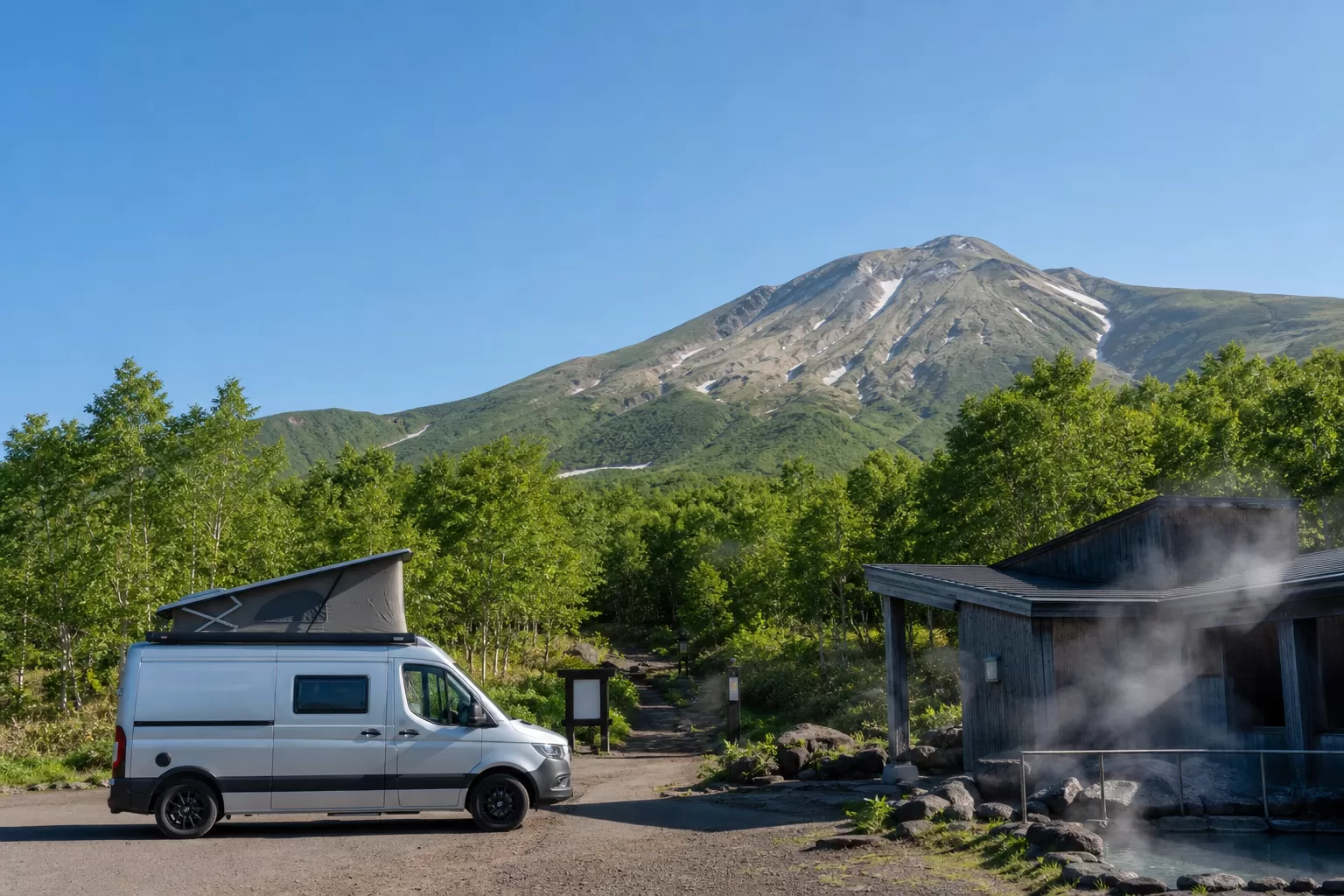
Niseko Annupuri stands at 1,308m. It’s the main peak of the Niseko mountain range, facing Mt. Yotei, and its trailhead is right next to Goshiki Onsen. In summer, the round-trip hike takes roughly 3–4 hours as a guide, though this varies with fitness and weather, so plan a schedule with some time to spare.
“Niseko Campground,” next to the trailhead, typically operates from early June through late October. The grass campsite sits on a rise reached by stairs from the parking lot, the toilets and water points are well regarded, and Goshiki Onsen is within walking distance. It’s popular as a hiking base camp; if you’re bringing a campervan, it’s worth confirming vehicle size and parking space with the site in advance.
The foot of Niseko Annupuri turns into an international ski and snowboard area in winter. How the roads are used at the summer trailhead entrance versus the winter ski-slope entrance is different, so going in with the same mindset across seasons can be confusing. Check the season before you go.
How to combine hot springs and overnight parking
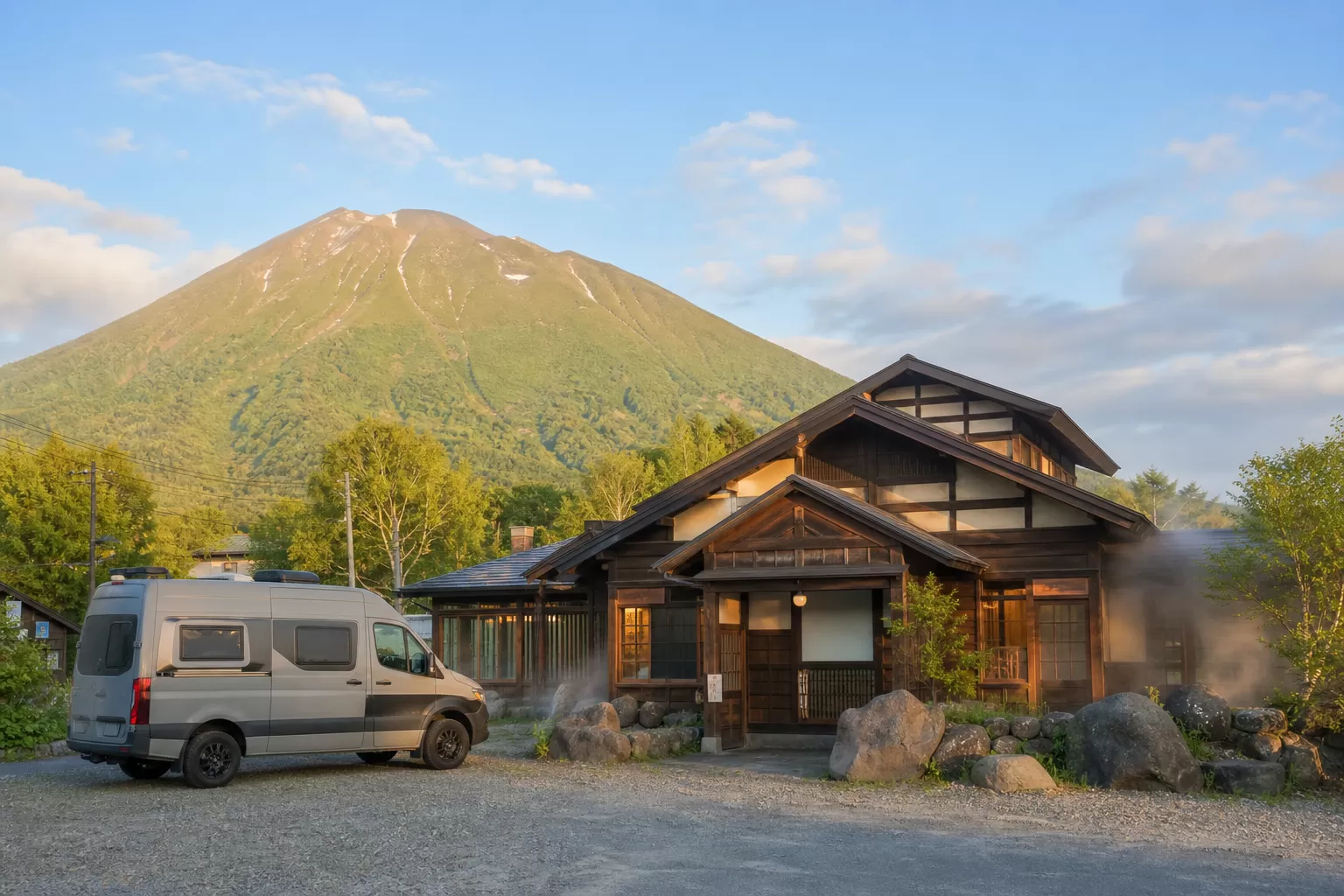
“Yukichichibu” (Rankoshi Town Exchange Promotion Center), at Niseko Yumoto Onsen, is a town-run day-use bathhouse with seven open-air baths overlooking Nitonupuri. As confirmed in July 2026, hours are 10:00–19:00 (subject to change in winter), admission is ¥900 for adults and ¥300 for children, and it’s closed on Tuesdays (or the following day if Tuesday is a holiday). Phone: 0136-58-2328. There are two spring types, a simple sulfur spring (hydrogen sulfide type) and a simple spring, and the dining hall is also open 12:00–15:00.
For a campervan trip, a realistic combination is “bath at Yukichichibu, night at a Michi-no-Eki.” Yukichichibu is not an accommodation facility, so plan on taking just a day-use bath and resting somewhere else. Prices and hours can change, so call ahead before you leave to avoid trouble on the day.
New Chitose Airport / Tokachi-Obihiro Airport
Rent the Cabcon “Cresson Journey”
Check vehicle types, rates, and availability on the official site.
See details at Moving Inn →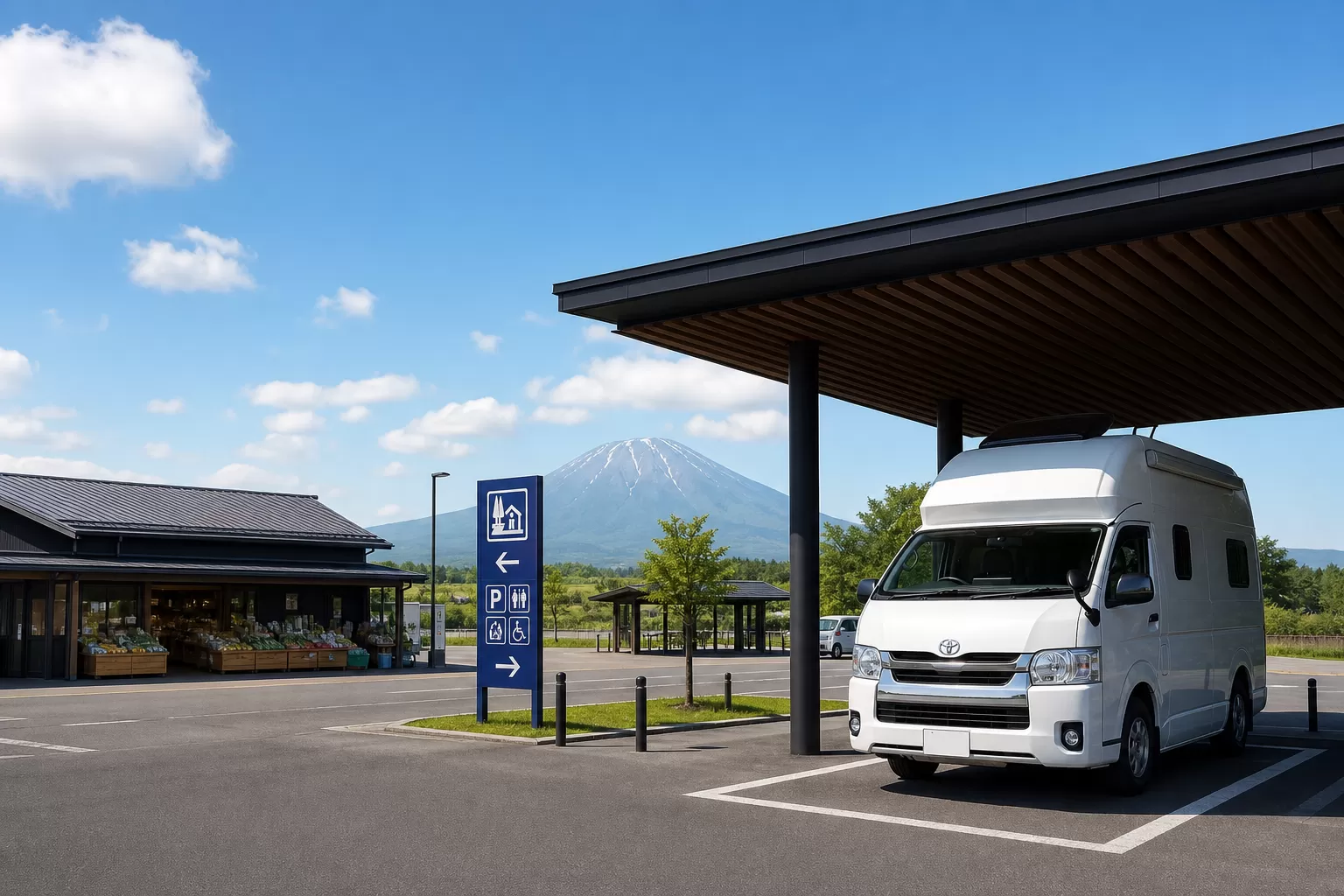
For overnight parking, Michi-no-Eki Niseko View Plaza is the base
Michi-no-Eki “Niseko View Plaza” sits where Route 5 meets the Iwanai-Toya Prefectural Road, at 77-10 Aza Motomachi, Niseko Town. It has three buildings: an information plaza, a free-space building, and a restroom building that is open 24 hours. The toilets have bidet seats, and free Wi-Fi is available. The information plaza is open 9:00–18:00 with no regular closing days. The farm-produce shop is open 8:30–18:00 from late April to October, and 9:00–17:00 from November to late April (checked July 2026).
The parking lot slopes slightly, but there are two covered spaces. That said, the basic premise is that a Michi-no-Eki parking lot is a place for “napping and resting.” Setting out tables and chairs and staying for a long time counts as camping and leads to trouble with other users and the local community. Do not leave the engine running, take your trash with you, and do not spread your belongings outside. Please follow these three rules without exception.
It is also said that there are 7 Michi-no-Eki around Niseko, but considering the distance from the Mt. Yotei viewpoints, whether there is a 24-hour restroom, and the stability of the Wi-Fi, the easiest approach is to make Niseko View Plaza your first choice and move to a nearby Michi-no-Eki if it is crowded.
Getting from New Chitose Airport to Niseko: travel time and rates
From New Chitose Airport to Niseko Town is about 120km, or around 2 hours by expressway. As a guide, a Vancon runs from the ¥20,000s to ¥30,000s per night and a Cabcon from the ¥30,000s per night, and rates tend to rise in the peak season from late July to August and in winter over the New Year and ski season (typical levels as of July 2026; check actual rates directly with the operator when booking).
Using OSRM (OpenStreetMap road data), the route from New Chitose Airport to near Michi-no-Eki Niseko View Plaza comes to 119.7km and 106 minutes of driving (no snow, no breaks, calculated 2026-10-07). This is within this site’s guideline of “200km and 9 hours of driving per day,” but that is not an official standard, and we do not build itineraries that stretch beyond that limit. In winter it takes longer than shown.
The round trip from the airport alone uses up a day’s worth of driving distance, so it works well to get the vehicle briefing near the airport on the first day before heading to Niseko, and to leave time to return the vehicle after midday on the last day. In winter, travel time is hard to predict depending on road conditions, so it’s safest to plan on returning 30 minutes to 1 hour earlier than you think you need to.
For touring Mt. Yotei and Niseko Annupuri
Campervan rental from New Chitose Airport to Niseko
Check vehicle types, rates, and availability on the official site.
See details at Moving Inn →What makes Niseko appealing in winter? Powder snow, night skiing, a snow-covered Mt. Yotei, and winter hot springs
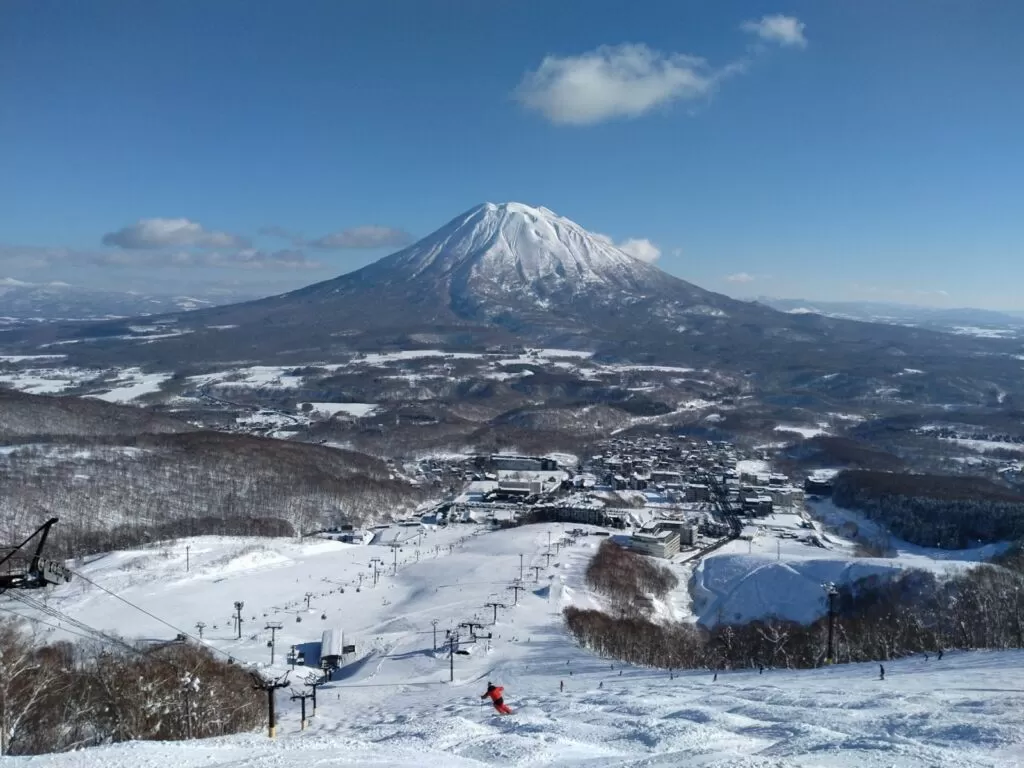
The official site of Niseko Tokyu Grand Hirafu describes Niseko’s snow as “light, fluffy, and smooth” and says it is highly rated by skiers and snowboarders around the world (Niseko Tokyu Grand Hirafu, checked 2026-10-07). The ski area has four resorts — Grand Hirafu, HANAZONO, Niseko Village, and Niseko Annupuri — known collectively as Niseko United (Niseko United (official site), checked 2026-10-07).
For the 2026-27 season, Grand Hirafu is the only resort whose schedule we could confirm on its official site. For the other three areas, we could not find the schedule published on their official sites as of 2026-10-07. A list of opening dates for each ski resort is in Hokkaido Ski Resort Opening Dates for the 2026-27 Season.
| Area | 2026-27 operating period | Night skiing |
|---|---|---|
| Niseko Tokyu Grand Hirafu | Nov 28, 2026 – May 5, 2027 (planned) | Dec 12, 2026 – Mar 22, 2027 (planned) |
| Niseko HANAZONO | Not confirmed on the official site | Not confirmed on the official site |
| Niseko Village | Not confirmed on the official site | Not confirmed on the official site |
| Niseko Annupuri | Not confirmed on the official site | Not confirmed on the official site |
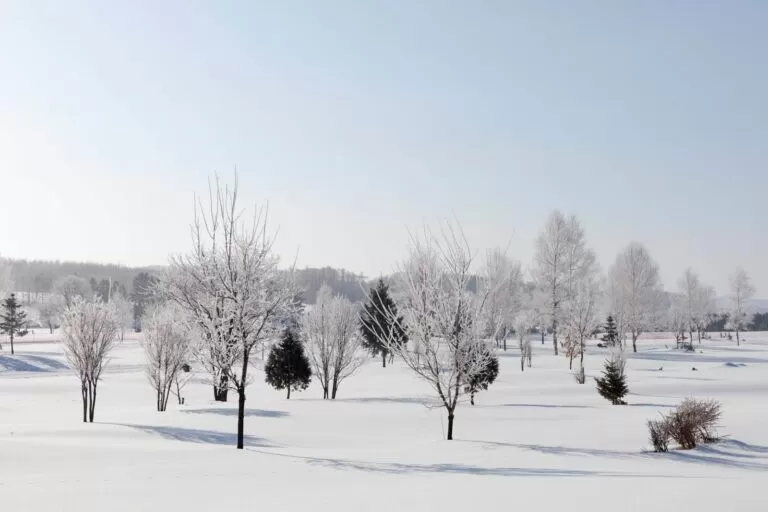
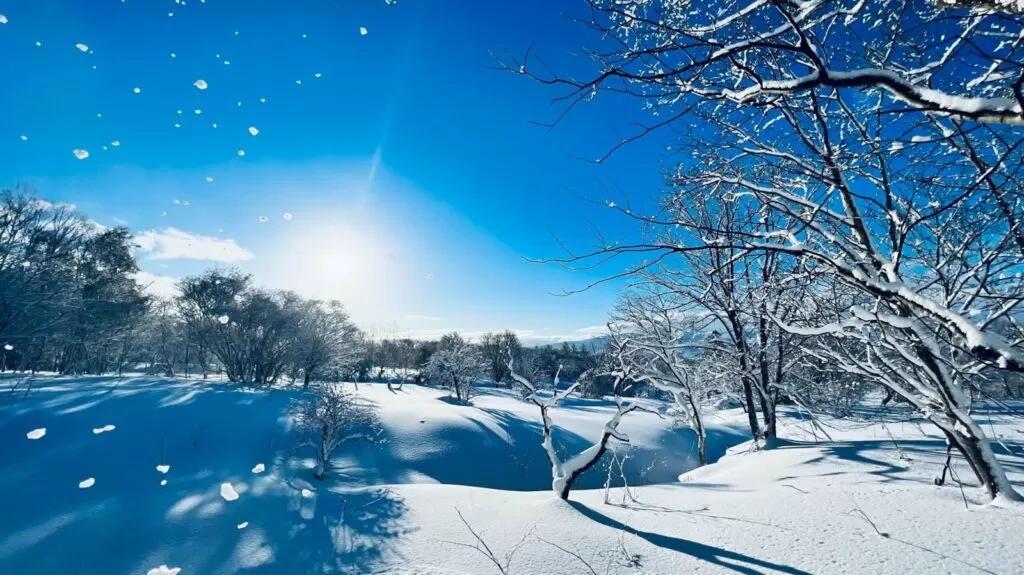
With night skiing, you can keep skiing after dark. That makes for a day like this: see a snow-covered Mt. Yotei by day, soak in a hot spring in the evening, and rest at a Michi-no-Eki at night. The top page of the Niseko Tourism Association introduces the scenery of all four seasons, including “mountains covered in pure white snow” (Niseko Tourism Association, checked 2026-10-07).
Hopping between hot springs on a snowy day is one of winter’s pleasures. The Niseko Tourism Association’s “Niseko Yumeguri Pass” covers 14 facilities, is valid for 180 days from issue, and one pass can be shared by several people (Niseko Yumeguri Pass, checked 2026-10-07). Winter hours vary by facility, so look at nearby day-use baths in the Hokkaido Campervan Onsen Guide and check with each facility before you go.
With a campervan, you aren’t tied to a hotel’s breakfast time or checkout, and can move to match the first lift. If you move close to the slopes the night before, it’s easier to make it for early-morning powder. The place to dry wet gear and boots and the place to load your boards make a difference depending on the vehicle. How to load them is summarized by vehicle type in How to Load Skis and Snowboards.
- Whether overnight parking is allowed in a ski-slope parking lot depends on each facility’s rules, so always check with each ski resort
- After skiing, warming up at Yukichichibu or Michi-no-Eki Niseko View Plaza and then switching to overnight parking is an easy flow to set up
- Places nearby where you can park overnight in winter are checked one by one in Winter Overnight Parking at Six Major Ski Resorts
Even if skiing is not your goal, a snow-covered Mt. Yotei and Niseko Annupuri look quite different from summer or autumn. If you decide first whether you are going to ski or to look, choosing where to park overnight gets easier too.
Niseko ski resorts: opening dates, lift tickets and places to stay nearby in winter
- Niseko Grand Hirafu — opens Nov 28
- Niseko Village Ski Resort — opens Nov 28
Driving to Niseko in winter: what to watch for in a campervan
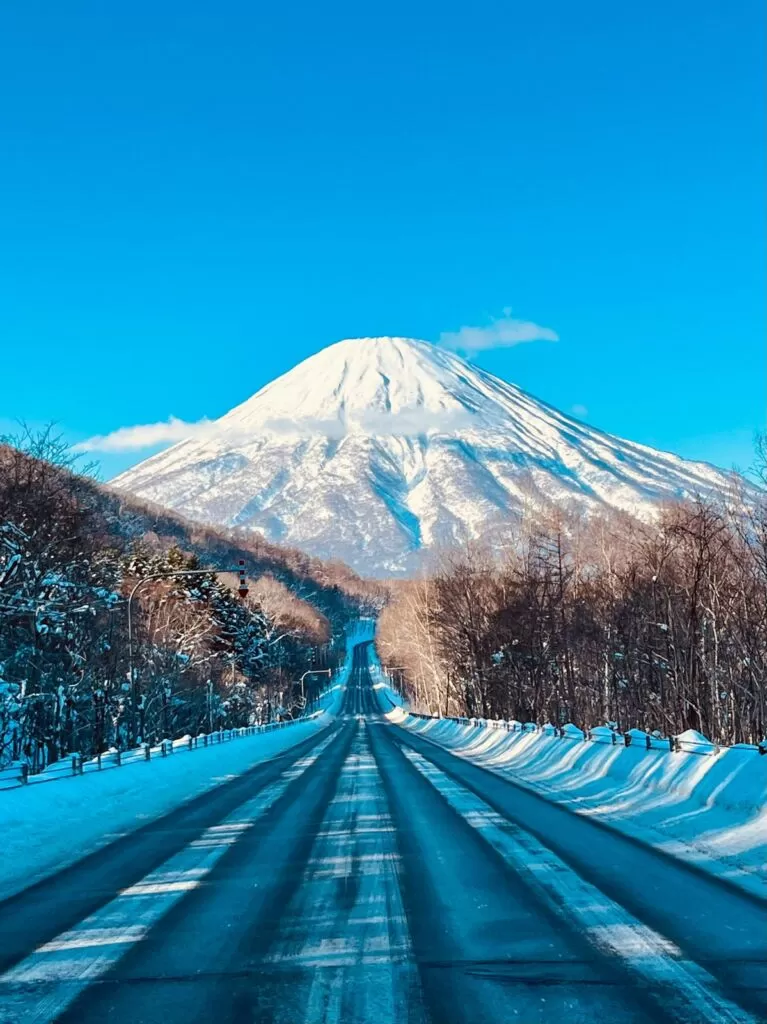
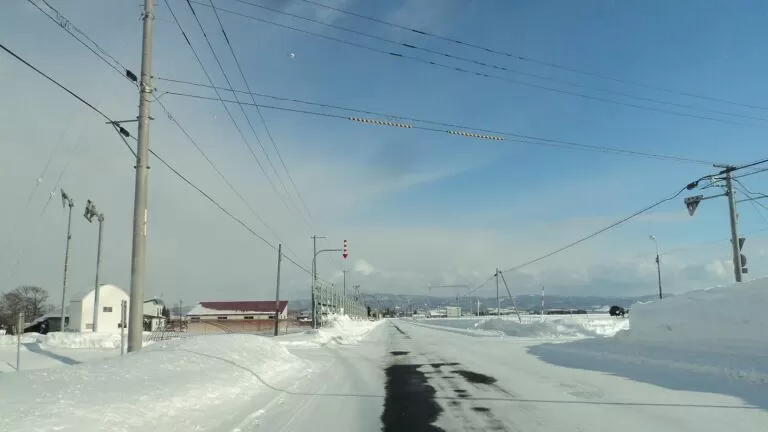
In winter, Niseko roads are packed snow and ice as a given. Sapporo’s normal minimum temperature in January is -6.4℃ (Japan Meteorological Agency normals, checked 2026-09-02; this is not an observation for Niseko). Monthly cold levels are in Hokkaido Winter Temperatures. Rental vehicles often come with studless tires as standard, but check them with your own eyes when you sign the contract.
- If the vehicle has an FF heater (kerosene type), it can keep the interior warm even while driving
- To prepare for a frozen windshield, allow 10–15 minutes for defrosting before leaving in the morning
- Sunset in Sapporo is 16:10 on January 1 and 16:24 on January 15 (National Astronomical Observatory of Japan, checked 2026-10-07). Niseko’s times are not in the list, so use Sapporo as a guide and get through mountain-pass sections before dark
- To prevent water pipes from freezing, ask the operator about heater use and draining procedures for overnight
Some roads close in winter. Prefectural Road 66, the Iwanai-Toya Line (Niseko Panorama Line), was closed for winter from October 24, 2025 to April 27, 2026 in the 2025-26 season. The Niseko Tourism Association also reports that Prefectural Road 58, the Kutchan-Niseko Line toward Goshiki Onsen, was closed from October 15, 2024 to May 23, 2025 (planned) in the 2024-25 season (Niseko Tourism Association, checked 2026-10-07). We have not been able to confirm the schedule for the 2026-27 season. For sections and dates, see Hokkaido Roads Closed in Winter.
If you are nervous about driving on snow, you can stick to central Kutchan and the area around the Michi-no-Eki on the first day and leave the mountain pass for the next day or later. For places to park overnight in winter, see 13 RV Parks and Michi-no-Eki Open for Overnight Parking in Winter; for worries about snowy roads and heating, see Before You Travel Hokkaido by Campervan in Winter. Leaving room to delay by a day depending on the weather lets you travel more safely.
What does a 1-night/2-day or 2-night/3-day plan look like?
For a 1-night/2-day trip, a realistic plan is to drive the expressway from New Chitose Airport to Kutchan on day one, see Mt. Yotei from Miyata Viewpoint Parking, wash off the day at Yukichichibu, and rest at Michi-no-Eki Niseko View Plaza at night. On day two, walk around the Niseko Annupuri trailhead in the morning and use the afternoon to get back to the airport. Don’t try to pack in too much travel and sightseeing; keeping to one theme per day lightens the driving load.
A 2-night/3-day trip gives you more breathing room. On day one, walk around the streets of Kutchan and Niseko and stock up on food; on day two, walk from Goshiki Onsen to the Niseko Annupuri trailhead to take in the air at Niseko Campground; and on day three, visit the viewpoints in the Kurokawa area before heading to the airport. The strength of 2 nights and 3 days is that you can fit in one bad-weather day without wrecking the plan.
If you are traveling with children, you can skip the hike and stick to the open-air baths at Yukichichibu and the farm-produce shop at the Michi-no-Eki. If you have a pet with you, decide roles in advance, such as taking turns on the hike or the day-use bath, so the pet isn’t left waiting in the vehicle for too long, and there will be no arguments on site.
Where to base yourself for shopping and meals in Niseko
On a campervan trip, where you get the day’s meals and the next morning’s water and food quietly matters a lot. The produce shop at Michi-no-Eki Niseko View Plaza stocks local vegetables, cheese, and dairy products, and the selection changes with the season. As mentioned above, hours change by season, so if you expect to arrive late, it’s safer to secure a supermarket in Kutchan first.
The Kutchan and Niseko area has many people who have moved there or are staying long term from overseas, and bakeries, cafés, and soba shops are scattered around. If you want something warm for breakfast the morning after an overnight stay, check the opening times of these shops the day before and your morning will go smoothly. Many shops close in winter, so narrow down your candidates to match the season you visit.
As for water supply and power, the full tank capacity differs by vehicle. Niseko is in a mountain area, and places with water facilities at night are limited, so check in advance with the rental company or the Michi-no-Eki on whether you can fill up with water there, so you won’t be caught off guard on site.
What to check when choosing a rental company
Niseko is a mountain area where nighttime temperatures drop more easily than in other parts of Hokkaido. Before signing a contract, check for an FF heater, the state of the studless tires, the water tank capacity, and whether one-way drop-off is possible. Renting at New Chitose Airport and returning there is the basic round-trip use, but with a company that supports one-way drop-off, it is also easier to plan routes that continue toward Hakodate or Sapporo.
If you are traveling with a pet, be sure to confirm at the booking stage whether the vehicle allows pets on board. Waterproof seat covers and odor-control measures around the seats differ by company. Low-price plans can include older vehicles, so don’t decide on price alone; check the heating equipment and the vehicle’s model year as well to avoid trouble on site.
When booking, also check the insurance coverage, the deductible, and the cancellation policy. Niseko’s weather changes easily, so knowing in advance how far the company will accommodate cancellations or schedule changes due to bad weather keeps you from panicking when you have to decide on the day.
A surprising number of problems can be prevented with a single phone call before departure. For the three points of equipment, rates, and cancellation policy, don’t decide from the text on a booking site alone; ask the person in charge directly before you decide.
Once you have the positions of the Mt. Yotei viewpoints, the Michi-no-Eki, and the hot springs in your head, Niseko routes are easier to plan than you might expect. Decide on one view to see on day one, then work backward to choose your base and where to park overnight. If you stay flexible enough to reorder things while watching the weather forecast, you’ll end up with an itinerary that doesn’t strain you.
Frequently asked questions (FAQ)
Q1: What is Niseko like?
It is an area surrounded by Mt. Yotei (elevation 1,898m) and the Niseko mountain range, where winter is about powder-snow skiing and summer is about alpine flowers and hiking on Mt. Yotei. The Niseko Tourism Association says that of 10 spring-quality categories, Niseko has 7 (checked 2026-10-07).
Q2: Can I drive to a place with a view of Mt. Yotei?
Yes. The best-known spots are the “Niseko Miyata Viewpoint Parking” along Route 5 and the Kurokawa-area Mt. Yotei viewpoint 1.8km beyond it. Both have parking space, and they are about 8–10 minutes by car from JR Niseko Station.
Q3: Can I get close to Niseko Annupuri without hiking?
You can drive up to the trailhead. Goshiki Onsen and Niseko Campground (typically open from early June to late October), both next to the trailhead, are reachable by car, so you can feel the mountain air without hiking. Reaching the summit requires a hike.
Q4: What are the rates and hours for “Yukichichibu” at Niseko Yumoto Onsen?
As confirmed in July 2026, hours are 10:00–19:00 (subject to change in winter), admission is ¥900 for adults and ¥300 for children, and it is closed on Tuesdays (or the following day if Tuesday is a holiday). These can change, so call (0136-58-2328) before you visit.
Q5: Where can I park a campervan overnight in Niseko?
The parking lot at Michi-no-Eki Niseko View Plaza is a candidate. It has a 24-hour restroom and Wi-Fi, and is intended for napping and resting. However, camping activities such as setting out a table are prohibited, so use it strictly within the limits of resting.
Q6: How long does it take to drive a campervan from New Chitose Airport to Niseko?
By OSRM calculation, it is 119.7km and 106 minutes of driving from New Chitose Airport to near Michi-no-Eki Niseko View Plaza (no snow, no breaks, calculated 2026-10-07). In winter, travel time increases with road conditions, so allow 30 minutes to 1 hour of margin on your return day.
Q7: When do Niseko’s ski resorts open for the 2026-27 season?
Niseko Tokyu Grand Hirafu is open from November 28, 2026 to May 5, 2027 (planned), with night skiing from December 12, 2026 to March 22, 2027 (planned) (official site, checked 2026-10-07). For the other three areas, we could not confirm schedules on their official sites.
Q8: Can I drive a campervan in Niseko in winter?
Yes. Many vehicles come with an FF heater and studless tires as standard, but check when you sign the contract. Some roads close in winter, such as the Niseko Panorama Line (Prefectural Road 66), so check the sections in the road-closure article and allow time for defrosting in the morning.
Next pages to read
- When Do Hokkaido’s Ski Resorts Open for the 2026-27 Season?
- Six Major Ski Resorts: Where Can You Park Overnight Nearby in Winter?
- Hokkaido Roads That Close in Winter
- Hokkaido Campervan Winter Travel Guide
- A 10-Day Winter Hokkaido Itinerary
Book a Campervan in Hokkaido
Moving Inn New Chitose Airport supports English booking and offers airport transfers.
Pick a campervan by what matters to you.
Rent at New Chitose Airport
See only the rental bases in Chitose, where the airport is.