Not Just Sapporo Snow Festival: Winter Trip Ideas Across Hokkaido, and the Campervan Option
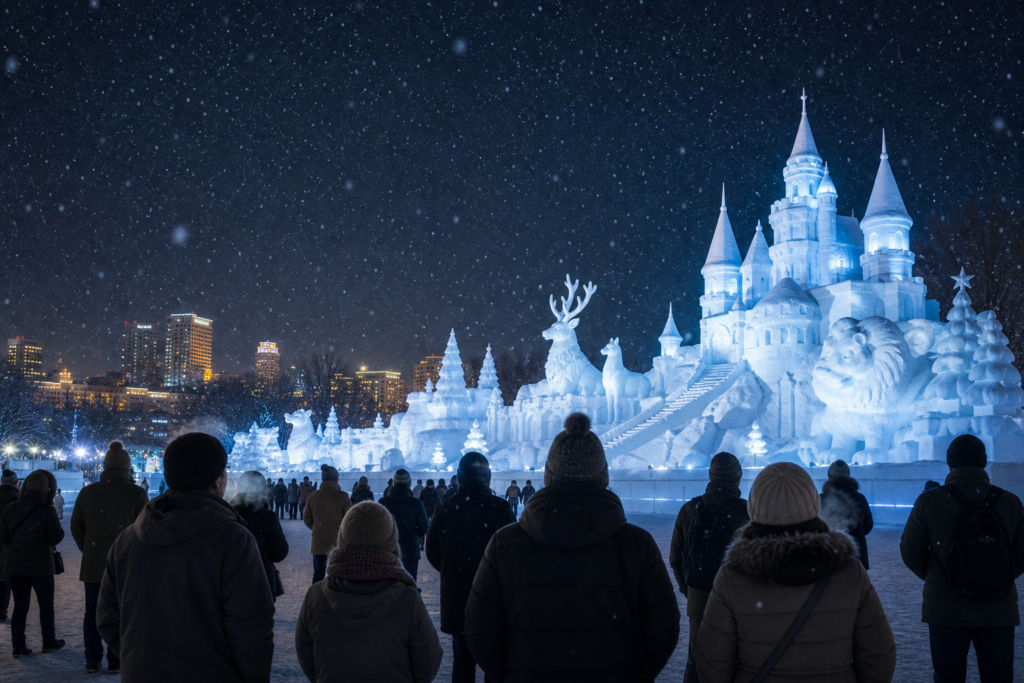
The 2026 Sapporo Snow Festival (the 76th, February 4–11) drew 2,539,000 visitors. That’s up 212,000 from the previous year, the highest since the pandemic, and the 5th-highest attendance on record (Sapporo Snow Festival Executive Committee results announcement, confirmed 2026-09-04). The next event, the 2027 Sapporo Snow Festival (the 77th), runs 8 days, from Thursday, February 4 through Thursday (national holiday), February 11, 2027. It takes place across the same 3 venues as before: the Odori venue (Nishi 1-chome to Nishi 11-chome), the Tsudome venue, and the Susukino venue (Executive Committee event overview, confirmed 2026-09-04).
This chart lines up the Executive Committee’s and various outlets’ announcements by year. 2019’s 2.73 million remains the record, and after dropping to 1.75 million in 2023, attendance climbed back over 3 years: 2.389 million in 2024, 2.327 million in 2025, and 2.539 million in 2026. Keeping in mind that 2.5 million people gather over 8 days will make the later sections on lodging and transportation easier to follow.
Let’s also look at who’s attending. In the City of Sapporo’s most recent published visitor survey (2023, the 73rd festival), 53.1% were Sapporo residents, 13.5% were Hokkaido residents from outside Sapporo, 19.1% came from outside Hokkaido, and 14.2% came from overseas. Add the last two together and roughly 1 in 3 visitors comes from outside Hokkaido (City of Sapporo Economic and Tourism Bureau, Tourism Event Economic Impact Survey Report, confirmed 2026-09-04; the City of Sapporo’s public pages have no equivalent survey for 2025 or 2026, so this 2023 figure is the most recent published data).
This article is written for that “1 in 3.” The first half covers the Sapporo Snow Festival itself — dates, venues, how to see it, and how cold it gets. The second half covers just how much there is to see across Hokkaido in winter once you’re done with the festival, and what happens when you try to get around by train, bus, rental car, and hotel. At the end, we touch on how people who combine lodging and transportation into one actually spend their trip.
Tap a dot on the map to see its name here.
Tap a dot to see its name and a link to where it appears in this article. Dot positions are based on each facility’s address or officially published location. Lakes and expressways are from OpenStreetMap data.
When and where is the 2027 Sapporo Snow Festival? Dates and the 3 venues
It's 8 days, from Thursday, February 4 through Thursday (National Foundation Day), February 11, 2027. The first day is a Thursday, the last day (the 11th) is a national holiday, and there's only one weekend within the period, the 6th (Saturday) and 7th (Sunday). Congestion concentrates on weekends and holidays every year without fail, which is why many people aim for a weekday afternoon, or the first or second day.
The 3 venues each have a distinct character. The Odori venue spans Odori Park — which cuts east-west through central Sapporo — from Nishi 1-chome to Nishi 11-chome, and is the stage for the giant snow sculptures, citizen-made snow sculptures, and the nighttime illumination and projection mapping. The Susukino venue, one subway stop from Odori in the entertainment district, is lined with ice sculptures and is best seen at night. The Tsudome venue, at and around the Higashi Ward sports facility "Tsu Dome," centers on hands-on activities like snow slides; it has an indoor rest area, making it a refuge for families with children or anyone who feels the cold. What's on offer and the operating hours at each venue change year to year, so check the official site before you go.
| Venue | Location | Main draw | Best time to visit |
|---|---|---|---|
| Odori venue | Odori Park, Nishi 1–11-chome | Giant & citizen snow sculptures, illumination | Both day (sculpture detail) and night (illumination) |
| Susukino venue | Susukino (1 subway stop from Odori) | Ice sculptures | Night |
| Tsudome venue | Higashi Ward, around Tsu Dome | Hands-on activities like snow slides, indoor rest area | Daytime, families with children |
Here's footage of the 2026 Odori venue on opening day. This STV News Hokkaido report gives you a feel for the scale of the sculptures and the crowd density in 42 seconds.
What's changing for 2027? A new logo and the snowman mascot SAPORON
A new concept: "A Festival of Gratitude for Snow"
On August 21, 2026, the Executive Committee unveiled the festival's first-ever logo mark and official character. The logo is described as reframing snow — away from "snow as a nuisance" — toward "a festival that evolves to share in and give thanks for the value of snow," embodying the new concept "A Festival of Gratitude for Snow – Blessed by the Snow" (Executive Committee announcement, confirmed 2026-09-04).
The character is a snowman named SAPORON
The character's name is SAPORON. Modeled on a yeti, the setting is a being that has protected the snow deep in the mountains. It's set to appear in venue decorations, on the official site, and on merchandise. You can see images of the logo and character on the official announcement page. Since 2027 will be "the first Snow Festival with a logo and a character," spotting where SAPORON turns up around the venues is one way to enjoy it.
Here's coverage from announcement day. The Hokkaido Shimbun's Doshin video news covers the new logo and SAPORON in one minute.
How many days do you actually need for the Snow Festival? A realistic look at routing and timing
The short answer: a single day is enough if all you want is the 3 venues. The Odori venue runs in a straight line from Nishi 1-chome to Nishi 11-chome; walk end to end and back and you've seen all the sculptures. Seeing the nighttime illumination means returning to Odori again after sunset, so splitting it as "Odori and Tsudome by day, Odori and Susukino by night" fills out a full day from morning to evening.
The problem comes after that. Most people who travel to Hokkaido for the Snow Festival build a trip of 2 nights or more. With half a day eaten up by the flight each way, you're left with 1 or 2 real sightseeing days. Spend one of those on the festival, and it's common for people to spend the remaining day simply walking around the city of Sapporo. That's still a perfectly enjoyable trip — but Hokkaido, at this time of year, has things 2–3 hours' drive from Sapporo that can only be seen in that same week as the festival. The next section lays those out.
- Morning: Odori venue, from Nishi 1-chome to Nishi 11-chome. Daylight is the best light for seeing the sculptures' detail
- Midday: Eat around Odori Park. Food stalls inside the venue tend to have long lines, so using the underground mall a short walk away helps
- Afternoon: Move to the Tsudome venue (a shuttle bus often runs from Sakaemachi Station on the subway's Toho Line in most years — check the official schedule). Families with children tend to spend the most time here
- After sunset: Return to the Odori venue for the illumination and projection mapping
- Evening: Ice sculptures at the Susukino venue. With restaurants clustered here, it's a natural place to head straight to dinner
Here's an overhead view of the whole venue. Shot by drone by the City of Sapporo's official channel at the 70th festival (2019), it gives you a sense of just how long a straight line Odori Park really is.
How cold does it get? Day and night call for completely different clothing
In early February, Sapporo routinely sees daytime temperatures drop below 0°C. Location-by-location, month-by-month low temperatures are covered in our article on winter temperatures across 11 points in Hokkaido, so here we'll stick to how to think about what to wear.
What actually chills you at the Snow Festival isn't the time you spend walking — it's the time you spend standing still. Taking photos in front of a sculpture, waiting for the illumination, standing in line for the shuttle bus — this "not moving" time adds up outdoors. You might be fine walking around in a down jacket, hat, and gloves during the day, but while you're waiting for the nighttime illumination, the cold creeps up from your feet. Bring insulated boots or stick-on toe warmers for inside your shoes, and something that covers your neck.
The other issue is slipping underfoot. The walkways in Odori Park get packed down into ice, and people fall even in ordinary city winter boots. Slip-on ice grips for the soles of your shoes are sold at shops and convenience stores around Sapporo Station and Odori, so you can buy them after you arrive and still be fine. How to walk and drive on snow and ice is covered in our article on winter driving in Hokkaido.

How much is there to see around Sapporo after the Snow Festival?
Snow Festival week is also when winter events pile up across Hokkaido. The reason is simple: regions time their events for when snow and ice are at their most reliable. Below are winter highlights reachable by car from Sapporo, either as a day trip or with one overnight. As of this writing (2026-09-04), the Sapporo Snow Festival is the only 2027 event whose official dates we could confirm; the rest are described based on typical past years, with details deferred to each linked article and official site.
About 1 hour from Sapporo: Lake Shikotsu and Otaru
The Lake Shikotsu Ice Festival lines up ice sculptures made by spraying lake water, lit up in color at night. In 2027 it runs from Saturday, January 30 to Tuesday, February 23, 10:00–20:00 with illumination from 16:30–20:00, according to the official site, overlapping with the start of Snow Festival week. Dates, parking, and winter access are covered in our Lake Shikotsu Ice Festival article (confirmed there 2026-08-29). Otaru's Snow Light Path lines the canal and the former Temiya rail line site with candlelight; in 2027 it's scheduled for Saturday, February 6 to Saturday, February 13, according to the Otaru Tourism Association (lighting hours not yet announced as of this writing; in 2026 it ran 17:00–21:00) — a quiet, dim venue that's the opposite of the Snow Festival's sculptures. Details in our Otaru Snow Light Path article (confirmed there 2026-08-28).
2–3 hours from Sapporo: Asahikawa, Biei, Niseko, Noboribetsu, Lake Toya
The Asahikawa Winter Festival runs in the same early-February window as the Snow Festival and is another major snow event in Hokkaido. The 2027 edition (the 68th) is scheduled for Saturday, February 6 to Thursday, February 11 — 6 days that nearly overlap with the Sapporo Snow Festival. Giant snow sculptures rise from the Ishikari River floodplain, alongside a world ice-sculpting competition. Venue access is covered in our Asahikawa Winter Festival article (confirmed there 2026-08-29). Biei's Blue Pond is illuminated in winter, with light shining onto the snow-covered pond. Niseko draws domestic and international ski crowds this time of year; even without skiing, the onsen and dining make it worth an overnight. Noboribetsu and Lake Toya are onsen towns roughly 2 hours south of Sapporo, a classic overnight stop before or after the festival. Noboribetsu's winter event is covered in our Noboribetsu Hell Festival article.
3.5+ hours from Sapporo: Sounkyo, Lake Shikaribetsu, drift ice, Hakodate
From here on, you're adding 1–2 overnights rather than a day trip. Further into the mountains from Asahikawa, Sounkyo's Ice Waterfall Festival typically runs from late January to early March. In 2027 it's scheduled for Saturday, January 23 to Sunday, March 7, according to the official site. It's a walkable structure of ice buildings made by spraying and freezing water on the gorge's slopes, covered in our Sounkyo Ice Waterfall Festival article alongside winter overnight-parking information (confirmed there 2026-08-29). On frozen Lake Shikaribetsu in Tokachi, an ice-and-snow village called "Shikaribetsu-ko Kotan" appears each winter. In 2027 it runs from Thursday, January 28 to Sunday, March 14, with a season pass priced at ¥600 (elementary-school age and up), according to the official Shikaribetsu-ko Kotan site (confirmed 2026-09-08). It comes complete with an ice bar and an open-air hot spring on the ice. Along the Okhotsk coast — Abashiri, Monbetsu, Shiretoko — drift ice typically reaches shore from late January to early March. The Japan Meteorological Agency's 1981–2010 30-year average for Abashiri puts the first sighting of drift ice on January 21, first shore contact on February 2, and the sea clearing of ice around March 20 — and even these averages shift year to year (Hokkaido Okhotsk Drift Ice Museum, confirmed 2026-09-08). Check the latest drift-ice reports just before you go if you're planning around it. How to view the ice, sightseeing boats, and getting around by car are covered in detail in our drift ice and campervan article. Hakodate, in the opposite direction from Sapporo, offers winter night views, the morning market, and an overnight at Yunokawa Onsen. Which direction to extend your trip before or after the festival is easier to decide once you know which airport — Obihiro, Kushiro, Abashiri, or Hakodate — you'll be flying home from.
How far can you go from Sapporo? Sorting by distance and season
Let's reorder the destinations from the previous section by distance from Sapporo and a rough winter travel-time estimate. Planning around summer travel times will always fall apart in winter, so the times in the table below build in extra margin on the assumption of winter road conditions. Distances are approximate values via major roads; actual travel time varies considerably with weather and road surface. Always check the latest travel time on a map app before you leave.
| Destination | Distance from Sapporo (approx.) | Winter travel-time estimate | Winter highlight / typical timing | Related article |
|---|---|---|---|---|
| Otaru | ~40km | ~1 hour | Snow Light Path (Feb 6–13, 2027, planned) | Otaru Snow Light Path |
| Lake Shikotsu | ~60km | ~1.5 hours | Ice Festival (Jan 30–Feb 23, 2027) | Lake Shikotsu Ice Festival |
| Niseko | ~100km | ~2 hours | Skiing, onsen (Dec–Mar) | — |
| Noboribetsu | ~110km | ~2 hours | Onsen, snow scenery at Jigokudani | Noboribetsu Hell Festival |
| Lake Toya | ~110km | ~2.5 hours | Onsen, snowy views of the lake and Mt. Yotei | — |
| Asahikawa | ~130km | ~2.5 hours | Asahikawa Winter Festival (Feb 6–11, 2027), Asahiyama Zoo's winter opening | Asahikawa Winter Festival |
| Biei | ~150km | ~3 hours | Winter illumination at the Blue Pond | — |
| Sounkyo | ~220km | ~4 hours | Ice Waterfall Festival (Jan 23–Mar 7, 2027, planned) | Sounkyo Ice Waterfall Festival |
| Lake Shikaribetsu | ~190km | ~3.5 hours | Shikaribetsu-ko Kotan (Jan 28–Mar 14, 2027) | — |
| Hakodate | ~250km | ~4.5 hours | Winter night views, morning market, Yunokawa Onsen | — |
| Monbetsu | ~270km | ~5 hours | Drift ice (avg. first shore contact ~Feb 2, varies by year) | Drift ice |
| Abashiri | ~350km | ~6 hours | Drift ice (same as above) | Drift ice |
| Shiretoko Utoro | ~410km | ~7 hours | Drift ice (same as above) | Drift ice |
Here's how to sort the table into an itinerary, in 3 tiers.
- Add on the festival day itself (half a day): Otaru or Lake Shikotsu at night. See the festival by day, then move to one or the other in the evening
- Add 1 overnight (1 day): Asahikawa Winter Festival, Noboribetsu/Lake Toya onsen, Niseko, Biei. Leave Sapporo in the morning, stay 1 night, and return
- Add 2+ overnights (2+ days): Sounkyo, Lake Shikaribetsu, drift ice, Hakodate. Rather than returning to Sapporo, a one-way itinerary flying home from Obihiro, Memanbetsu, Hakodate, or similar is easier to build
Sample itineraries by number of days are in our Hokkaido model course article, and winter-specific trip planning is covered in our winter trip guide.
What happens if you try to get around by train and bus?
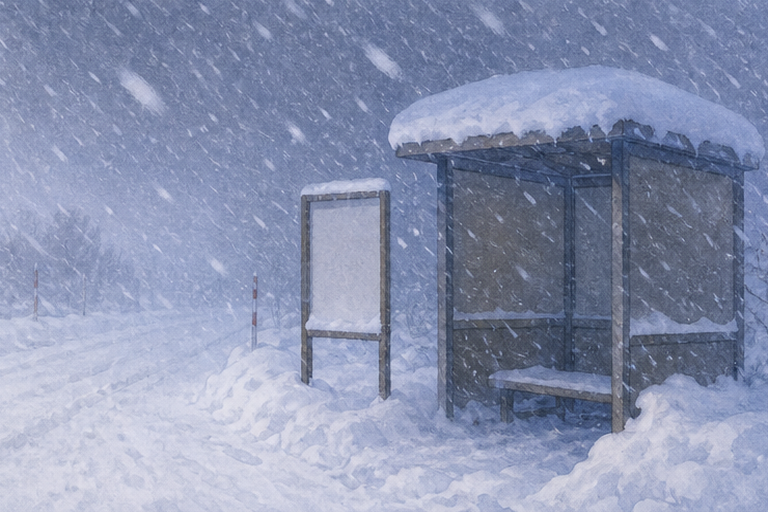
Cities like Sapporo, Otaru, Asahikawa, and Hakodate are connected by JR limited express trains and intercity buses. The problem starts beyond that. Lake Shikotsu, Sounkyo, Lake Shikaribetsu, Biei's Blue Pond, and the drift-ice coastline are all far from any station, local bus service is infrequent, and winter adds cancellations and delays on top. You're often left without a way back after the nighttime illumination or candlelight event ends, which tends to force the decision to book a hotel locally after all. Check timetables and service status on JR Hokkaido's and each bus company's official sites again on the morning of departure.
| Destination | Basic public-transit route | Winter difficulty |
|---|---|---|
| Otaru | JR rapid train direct from Sapporo | The Snow Light Path venue is walkable from the station. Few difficulties |
| Lake Shikotsu | Local bus from Chitose Station or New Chitose Airport | Infrequent buses; hard to get back after the nighttime illumination |
| Asahikawa | JR limited express or intercity bus | Winter Festival venue is walkable from the station, but Asahiyama Zoo needs a city bus transfer |
| Sounkyo | Local bus from Asahikawa | Infrequent service. Seeing the Ice Waterfall Festival illumination assumes staying overnight in Sounkyo |
| Biei / Blue Pond | JR from Asahikawa, then local bus or taxi from Biei Station | Almost no public transit matches the illumination hours |
| Lake Shikaribetsu | Local bus from Obihiro | Infrequent service; over half a day from Sapporo via Obihiro |
| Abashiri / Monbetsu | Limited express from Sapporo (Abashiri) or intercity bus (Monbetsu) | The drift-ice coastline is far from the station; you also need transport to the sightseeing-boat dock |
| Noboribetsu / Lake Toya | JR limited express to Noboribetsu or Toya Station, then local bus | Buses to the onsen town run infrequently; many visitors use hotel shuttle service instead |
At this point, some people think "driving would solve this." That's true, but winter driving in Hokkaido comes with several assumptions that don't apply in summer — visibility in blizzards, black ice, how early it gets dark, following distance. Our article on common worries before driving in winter Hokkaido answers, one by one, the concerns first-timers tend to have.
Can you actually book a hotel during Snow Festival week? Is it expensive?
In a city where 2.539 million people gather over 8 days, lodging isn't going to be at its usual price or availability. The City of Sapporo's survey found that visitors from outside Hokkaido who stayed overnight in Sapporo spent ¥45,343 per person in the city — 3.5 times the ¥12,888 spent by day-trippers. That's how much more an overnight trip drives spending (same City of Sapporo survey, 2023, 73rd festival, confirmed 2026-09-04). Overseas visitors spent ¥107,599 per person, reflecting their longer stays.
In practice, hotels within walking distance of the venues fill up early, and prices rise on whatever rooms are left. We won't list individual hotel rates here — search Sapporo for the first week of February on a booking site and compare the same hotel's mid-January rate, and you'll see the gap for yourself. There are 3 ways to handle it.
- Book early: Snow Festival dates are announced the summer before (2027's dates were announced in July 2026). Lock in a room as soon as the announcement drops
- Stay outside Sapporo: around New Chitose Airport, in Otaru, or at the Noboribetsu/Lake Toya onsen towns. Commuting to the venues by train or car opens up more lodging options
- Make your vehicle your lodging: the approach covered in the next section, combining lodging and transportation into one. Spend the night in an onsen town or a Michi-no-Eki parking lot rather than near the venue itself
If you're planning around a rental car and hotels, how do the costs break down?
Anyone who decides to venture beyond Sapporo usually first considers renting a car and changing hotels every night. Costs break into 3 parts — vehicle, lodging, and transport-and-meals — and more people means more hotel rooms, while more days means more nights' lodging. Winter rental cars come with studless tires as standard, but snow-removal equipment and winter coverage terms vary by company, so check those at booking time.
| Cost item | Rental car + hotels | Campervan |
|---|---|---|
| Vehicle | Rental car fee. Check whether winter rates and winter tires are included | Campervan rental fee. Check whether it includes heating for sleeping in the vehicle (an FF heater) and bedding |
| Lodging | Nights × rooms. Sapporo lodging gets more expensive during Snow Festival week | No lodging cost in principle. Instead you need to check usage fees and whether you're welcome at wherever you spend the night (an RV park, an onsen parking lot, a Michi-no-Eki) |
| Transport | Fuel, tolls, parking | Fuel (more, given the larger vehicle), tolls, parking. The taller body won't fit in some multi-story parking structures |
| Meals | Mostly eating out | You can cook in the vehicle. Being able to make something hot yourself matters a lot in winter |
| Time | Your itinerary is bound by check-in and check-out | You can travel at night and be on-site first thing in the morning — an advantage for "morning light" subjects like drift ice or the Blue Pond at dawn |
| Best group size | Cheaper for 1–2 people. Once you need 2 rooms for 4+ people, lodging costs balloon | Once 3–4+ people fit in one vehicle, the per-person cost drops |
If you're going with rental car + hotels, narrow the checks down to 3 things: whether winter tires and winter coverage are included in the rate; whether a Sapporo hotel is available on your desired dates during Snow Festival week; and whether lodging is actually available on-site for the days you venture further out. If that third one falls through, you end up with an out-and-back itinerary from Sapporo, and Sounkyo or the drift ice drop off your schedule.
How many places to sleep in a vehicle have we actually confirmed for winter?
Once you've decided to make your vehicle your lodging, the next question is where you can actually spend the night. Checking our own directory of Hokkaido overnight-parking-related sites (368 locations with coordinates, including 99 Michi-no-Eki and 60 RV parks, as of 2026-09-08), we can only confirm whether winter overnight parking is accepted at 1 of the 60 RV parks. The other 59 are listed as “unknown” — you'd need to check with each facility directly, by phone or on its official site.
Near Lake Shikotsu and Otaru, candidates include Teine Sanroku (about 10km from central Sapporo), Sapporo Koganeyu Sakura RV Park (about 15km), and Ebetsu RV Park (about 12km), but our directory lists winter operating status as “unknown” for all of them. AKAIGAWA TOMO PLAYPARK, the closest certified RV park to Otaru (about 13km away, in Akaigawa Village), is confirmed closed for winter (early November through late April), per our article on Otaru-area RV parks (confirmed there 2026-08-11). In other words, as far as we've found so far, there's no RV park near Otaru you can reliably use in winter. Near Asahikawa, the Michi-no-Eki Asahikawa (about 2km from Asahikawa Station) has a large flat parking lot and is open year-round, but there's no explicit statement that it accepts overnight parking, per our Asahikawa Winter Festival article (confirmed there 2026-08-29).
We've confirmed 99 Michi-no-Eki across Hokkaido, but being open year-round and welcoming overnight vehicles are two different things, and here too we're waiting on facility-by-facility confirmation. The honest answer is that there's no single answer to “where can I sleep in winter.” Once you've picked a destination, whether it's an RV park or a Michi-no-Eki, the only reliable approach is to contact the facility directly before you leave and confirm both winter operation and whether overnight parking is accepted.
Some people actually travel this way: combining lodging and transport into one
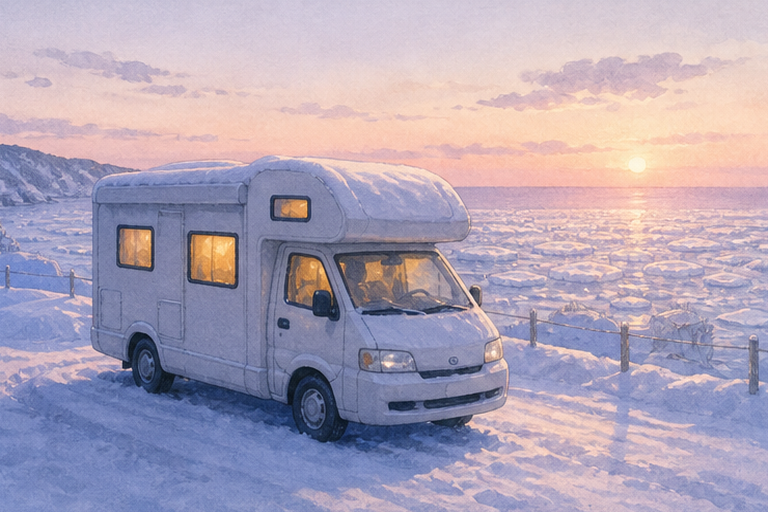
If you've read this far and recognized 3 walls — "can't get a room," "no way back after the nighttime event," "an out-and-back from Sapporo means you can't get far" — here's a different way to travel: rent a campervan and combine lodging and transportation into one. It might seem surprising that this comes up in an article about the Snow Festival, but it's a pattern people who want to see the Snow Festival and drift ice on a single trip have used for a while, and we've covered it before in our article on touring the Snow Festival and drift ice over Chinese New Year.
Concretely, it plays out like this. Pick up the vehicle at New Chitose Airport, and see the Snow Festival by day and night on day 1. Long-term parking right near the venues is limited, so it's realistic to leave the vehicle on the outskirts and take the subway in (for finding parking and overnight-friendly bases nearby, see our article on parking and overnight bases around the Snow Festival venues). Rather than hunting for a room in Sapporo that night, drive toward Lake Shikotsu or Otaru, see the Ice Festival or the Snow Light Path, soak in a nearby onsen, and sleep at a parking area or RV park you've confirmed will accept you. The next morning, see the ice sculptures with nobody else around, then head straight for Asahikawa or Noboribetsu. On day 3, see the Sounkyo Ice Waterfall Festival through its illumination, stay the night there, then set out early the next morning for the Okhotsk coast. Catch the drift ice first thing in the morning, and fly home from Memanbetsu Airport. This is a one-way route you couldn't build with an out-and-back trip to Sapporo, and it doesn't require booking a hotel in advance.
- Day 1: Pick up at New Chitose Airport, see the Sapporo Snow Festival by day and night. In the evening, head toward Lake Shikotsu, soak in an onsen, and stay overnight
- Day 2: The Lake Shikotsu Ice Festival in the morning, move to Asahikawa for the Asahikawa Winter Festival, then head into Sounkyo in the evening for the Ice Waterfall Festival illumination, staying overnight in Sounkyo
- Day 3: Depart early for the Okhotsk coast. See the drift ice at Abashiri or Monbetsu, then return the vehicle at Memanbetsu Airport or head back to Sapporo
- Alternative (southern route): Day 1 the Snow Festival, evening at Otaru's Snow Light Path; day 2 Niseko or Lake Toya; day 3 Noboribetsu Onsen on to Hakodate, returning the vehicle at Hakodate Airport
A quick note on cost. A campervan's daily rental fee runs higher than an ordinary rental car, and it burns more fuel too. Even so, if you're traveling as a group of 4, that's 2 hotel rooms' worth of cost disappearing every night, so the gap narrows once your trip stretches past 3 nights. The answer changes with group size and trip length, so we won't call it "cheap" here. What you need for winter overnight parking and how to handle the nighttime cold is covered in our winter trip guide and our New Year winter trip article; how to find places you can stay overnight and confirm you're welcome is covered in our winter driving article. Note that overnight use of Michi-no-Eki or onsen parking lots is handled differently facility by facility, so check the official guidance, and if there's none, call ahead before you use one.
Parking and overnight bases around the Snow Festival venues
Where to leave your vehicle and how to spend the night if you're visiting the Snow Festival by campervan.
Read the parking & overnight bases articleIf you're curious, you can rent one at New Chitose Airport
For anyone interested in traveling this way, here's a quick note on where to rent. Hokkaido's campervan rental bases are concentrated around New Chitose Airport, and several offer shuttle pickup from the airport. One example is JAPAN ROAD TRIP's New Chitose Airport branch, which carries a wide selection centered on Camroad-based cabcons. The New Chitose Airport branch alone has 20+ vehicles, with rates starting in the ¥19,000–24,000 range per day, mostly larger vehicles suited to families or groups that sleep more people. It's about a 5-minute free shuttle ride from bus stop 30 at the airport (all confirmed 2026-09-04; vehicle count and rates change seasonally, so check the official vehicle listing for the latest). The same site also handles overnight-parking-spot bookings, so it's a good fit if you want to arrange "lodging and transport in one" through a single point of contact. Details on this base are on our JAPAN ROAD TRIP New Chitose Airport branch page, and comparisons with other companies are in the cost section of our model course article. Another option is Moving Inn's New Chitose Airport branch, which offers HiAce-based vancons and SUVs set up for overnight parking, with rates from ¥15,400 per 24 hours and a free airport shuttle (confirmed 2026-09-05). It's a good option if you want a smaller vehicle than a cabcon for winter roads; check the base page and the official site for the latest vehicle types and rates.
JAPAN ROAD TRIP New Chitose Airport Branch
Check vehicle types, rates, shuttle service, and winter equipment on the base page.
View the base pageFrequently Asked Questions
When are the 2027 Sapporo Snow Festival dates?
It's 8 days, from Thursday, February 4 through Thursday (national holiday), February 11, 2027. The venues are the Odori, Tsudome, and Susukino sites (Sapporo Snow Festival Executive Committee event overview, confirmed 2026-09-04). Check the official site for each venue's operating hours.
Is anything new for the 2027 Snow Festival?
The festival's first official logo mark and official character, "SAPORON," were unveiled in August 2026 and are set to appear in venue decorations and merchandise from 2027. The concept is "A Festival of Gratitude for Snow – Blessed by the Snow." Details are on the Executive Committee's announcement page (confirmed 2026-09-04).
How many days do you need to see the Snow Festival?
A single day is enough even splitting the 3 venues between day and night. From day 2 onward, you can use the time for sightseeing within Sapporo, or venture out to Otaru, Lake Shikotsu, Asahikawa, Noboribetsu, or elsewhere nearby.
How cold is Sapporo in early February, and what should I wear?
It's a time of year when daytime temperatures routinely fall below 0°C. Build around a down jacket, hat, and gloves, and add insulated boots, toe warmers, and slip-on sole grips for the time spent waiting for the nighttime illumination. Location-by-location temperatures are in our winter temperature article.
Are there other winter events nearby around the same time as the Snow Festival?
The Lake Shikotsu Ice Festival (Jan 30–Feb 23, 2027), Otaru's Snow Light Path (Feb 6–13, 2027, planned), the Asahikawa Winter Festival (Feb 6–11, 2027), Sounkyo's Ice Waterfall Festival (Jan 23–Mar 7, 2027, planned), and Shikaribetsu-ko Kotan (Jan 28–Mar 14, 2027) all run through a window that includes early February, when the Snow Festival is held. Drift ice on the Okhotsk coast reaches shore, on average, in early February (Japan Meteorological Agency average, confirmed 2026-09-08). Dates shift from year to year, so check each official site right before you leave.
What winter destinations can I reach from Sapporo as a day trip?
Otaru (~40km) and Lake Shikotsu (~60km) are close enough to add on the evening of your festival day. Asahikawa, Noboribetsu, Lake Toya, Niseko, and Biei take 2–3 hours, so adding 1 overnight gives you breathing room. Plan on 2+ overnights for Sounkyo, Lake Shikaribetsu, the drift ice, or Hakodate. Winter travel times swing considerably with weather.
Can you get around winter Hokkaido using only trains and buses?
Cities like Sapporo, Otaru, Asahikawa, and Hakodate are connected by limited express trains and intercity buses. Lake Shikotsu, Sounkyo, Lake Shikaribetsu, the Blue Pond, and the drift-ice coastline are all far from any station, and in winter, infrequent local bus service and cancellations become obstacles. Check timetables in advance for your way back after a nighttime event.
Can you book a Sapporo hotel during Snow Festival week?
Hotels within walking distance of the venues fill up early and prices climb. The 3 ways to handle it: book as soon as dates are announced (the summer before), stay somewhere other than Sapporo — around New Chitose Airport, Otaru, or Noboribetsu — or make your vehicle your lodging. Compare individual rates directly on a booking site.
What should I check before booking a rental car for winter Hokkaido?
Three things: whether winter tires and winter coverage are included in the rate; whether a Sapporo hotel is available during Snow Festival week; and whether lodging is actually available on-site for the days you venture further out. If that third one falls through, you end up with an out-and-back itinerary from Sapporo, and farther destinations drop off your schedule.
If I visit the Snow Festival by campervan, where do I park?
Long-term parking right near the venues is limited, so it's realistic to leave the vehicle on the outskirts and take the subway in. Rather than hunting for a room in Sapporo, many people head to an onsen town or RV park around Lake Shikotsu or Otaru for the night. Details on parking and overnight-friendly bases are in our article on parking around the Snow Festival venues.
Can you sleep in your vehicle at an RV park or Michi-no-Eki in winter?
It depends on the facility. In our directory of 60 RV parks, only 1 has confirmed winter overnight-parking status; the other 59 are unknown. Some, like AKAIGAWA TOMO PLAYPARK near Otaru, are confirmed closed for the winter. A Michi-no-Eki being open year-round doesn't necessarily mean overnight parking is welcome either — once you've picked a destination, contact the facility directly before you leave (survey as of 2026-09-08).
Can I rent a campervan at New Chitose Airport?
Yes. Several rental bases around New Chitose Airport offer shuttle pickup; one example, JAPAN ROAD TRIP's New Chitose Airport branch, is about a 5-minute free shuttle ride from bus stop 30 at the airport and carries 20+ vehicles (confirmed 2026-09-04). Check the base page and official site for the latest rates, vehicle types, and winter equipment.
Where to go next
- Sapporo Snow Festival × Campervans | Parking and Overnight Bases Around the Venues
- Hokkaido Campervan Winter Trip Guide | Drift Ice, the Snow Festival, and Cold-Weather Prep
- The Complete Guide to Drift Ice × Campervan Rental | Abashiri, Monbetsu, Shiretoko
- Hokkaido Winter Temperatures | Low Temperatures from November–February and Overnight-Parking Gear
- Before You Travel Winter Hokkaido by Campervan | Snowy Roads, Ice, Heating, and Overnight-Parking Concerns
- Hokkaido Campervan Model Courses | Plans and Cost Estimates by Number of Days
Book a Campervan in Hokkaido
Moving Inn New Chitose Airport supports English booking and offers airport transfers.

![Monbetsu Drift Ice Festival 2027 [Feb 11–14]: Dates, Ice Sculptures, Garinko-go Icebreaker, Parking and Access by Campervan](https://hokkaido-campingcar.jp/wp-content/uploads/2026/10/monbetsu-hl999-768x576.jpg)
![Hokkaido New Year Weather and What to Wear | Sapporo, Hakodate, Asahikawa, Obihiro Mornings and Evenings, and Heavy-Snow Years [2026-27]](https://hokkaido-campingcar.jp/wp-content/uploads/2026/10/hokkaido-new-year-holiday-weather-eyecatch-768x432.webp)
![Hokkaido Illumination 2026-27 [Dates]: Sapporo Starts Nov 20, Plus Otaru, Asahikawa, Obihiro & Hakodate for Campervan Trips](https://hokkaido-campingcar.jp/wp-content/uploads/2026/10/hokkaido-illumination-2026-eyecatch-768x432.webp)
![What to Do in Tokachi in Winter: Dog Sledding, Snowshoeing, the Shikaribetsu Ice Village, and Staying at Kitanomori [2027]](https://hokkaido-campingcar.jp/wp-content/uploads/2026/10/tokachi-winter-dogsled-1-768x432.jpg)