Sounkyo Ice Waterfall Festival 2027: Dates, Highlights, Fees, and Getting There from Asahikawa by Bus or Car
Sounkyo Hyoubaku Matsuri 2027 runs Jan 23–Mar 7. 2026 hours, ¥1,000 fee, highlights, Asahikawa bus and car access, free parking and winter overnight tips.
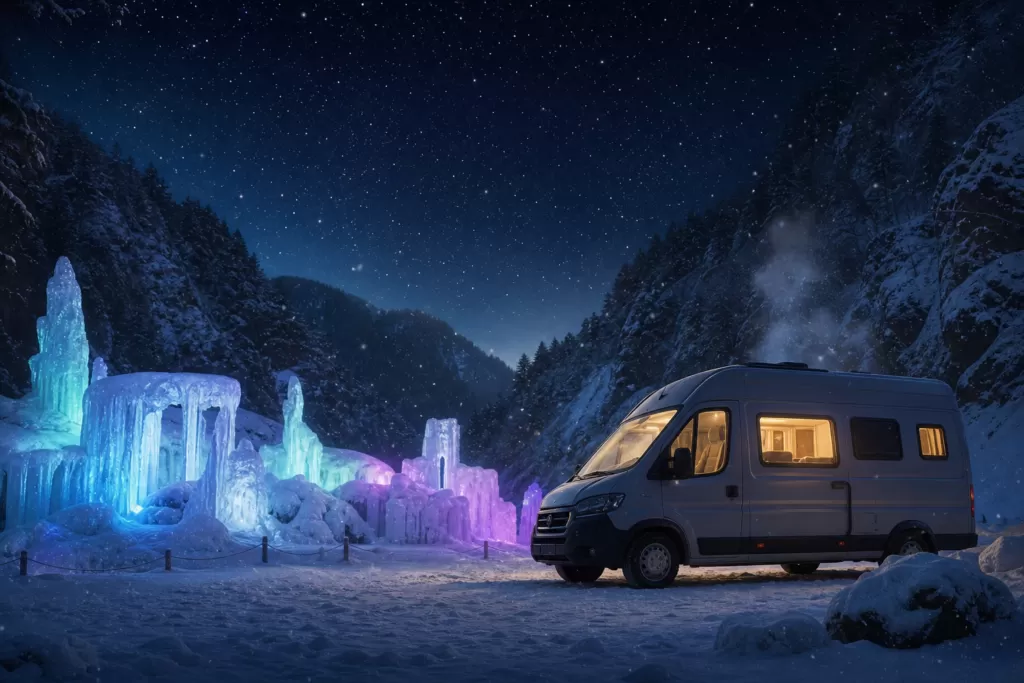
The 2027 Sounkyo Onsen Hyoubaku Matsuri (Ice Waterfall Festival, 52nd edition) runs from Saturday, January 23 to Sunday, March 7. The official site has announced only the dates for the next edition. Opening hours and the donation fee (admission) are not posted yet (Sounkyo Onsen Hyoubaku Matsuri official site, checked 2026-10-07).
This article builds on the official information for the most recent edition, the 51st in 2026. It covers what you can see, what time to go, what it costs, and how to get there from Asahikawa. Read the 2027 details with the expectation that they may change once announced. Information on overnight parking comes in the second half.
Going to the Sounkyo Ice Waterfall Festival?
- Where to rent: Rent a campervan at Asahikawa Airport. Sounkyo is 66 km from Asahikawa on Route 39, or about 110 minutes by bus.
- Where to stay: If you stay until closing at 21:30, sleep in the onsen town rather than driving the icy road at night.
Compare Hokkaido campervan rentals
Base yourself at New Chitose Airport and compare rates, vehicle types, and pickup locations all in one place.
Compare rental companies & vehicle types →When is the Sounkyo Ice Waterfall Festival 2027? About six weeks, Saturday, January 23 to Sunday, March 7
The official site shows: “Next edition: 52nd Hyoubaku Matsuri, dates 2027.1.23 (Sat) – 3.7 (Sun).” The previous 51st edition ran from Saturday, January 24 to Sunday, March 8, 2026, so the festival again starts on a Saturday and ends on a Sunday (Sounkyo Onsen Hyoubaku Matsuri official site, checked 2026-10-07).
| Edition | Period | Hours and donation fee |
|---|---|---|
| 51st (2026) | Saturday, January 24 – Sunday, March 8 | Weekdays 17:00–21:30; weekends and holidays 11:00–21:30 (last entry 21:15). Donation fee ¥1,000. Actual results |
| 52nd (2027) | Saturday, January 23 – Sunday, March 7 | Dates only announced. Hours and donation fee to be announced |
The long run makes this a festival that fits easily into a flexible itinerary. It slots into the same trip as the Sapporo Snow Festival or the Asahikawa Winter Festival, and the second half of this article touches on how to line them up.
What time should you go? In 2026 it opened at 17:00 on weekdays and 11:00 on weekends and holidays
For the 51st edition, hours were 17:00–21:30 on weekdays and 11:00–21:30 on weekends and holidays, with last entry at 21:15 on both (Sounkyo Onsen Hyoubaku Matsuri official site, checked 2026-10-07). The 2027 hours have not been announced.
Daytime entry is possible only on weekends and holidays. On weekdays the festival opens at 17:00, which in a Hokkaido winter is already dark. If you want to see the ice structures before sunset, choose a weekend or holiday.
The official pages we checked did not list exact times for the nightly fireworks or the lighting. If you are aiming for the evening, confirm on the official site or with the Sounkyo Tourist Association (01658-2-1811, weekdays 8:30–17:30) in the week you go.
Where is the venue? A special site in Sounkyo Onsen, with numbered attractions
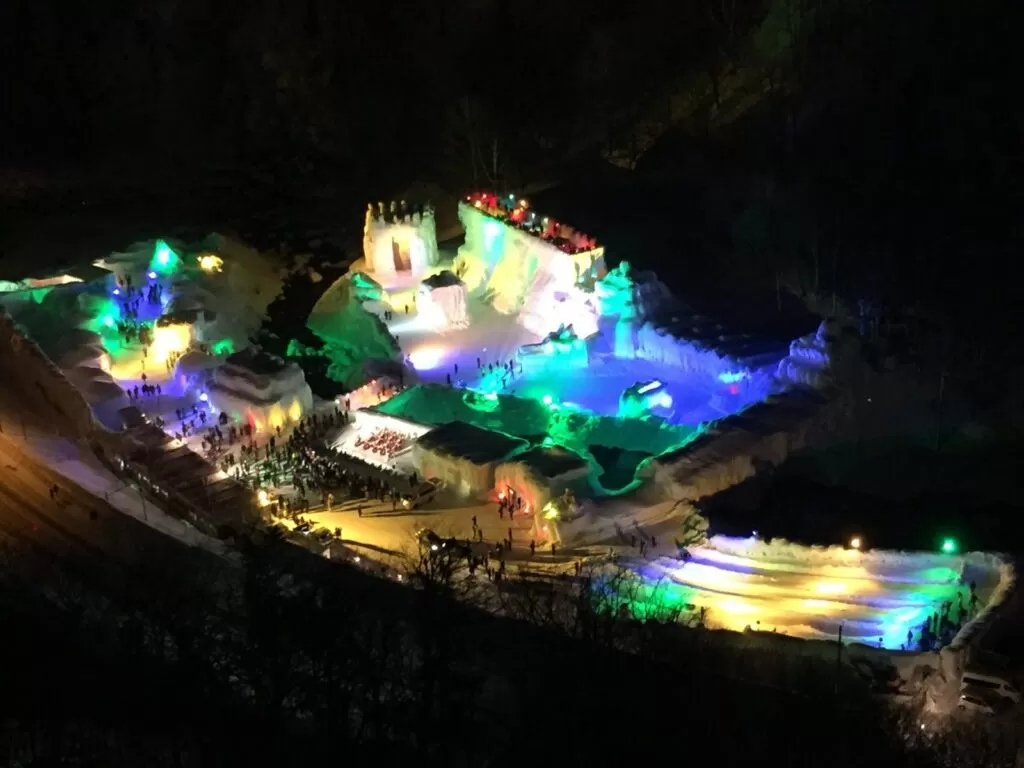
The venue is a special site in Sounkyo Onsen, Kamikawa Town. The official site map lists 10 attractions, from (1) the main ice structure to (10) the tube slider, along with sponsor booths (Sounkyo Onsen Hyoubaku Matsuri official site, Venue Map & Highlights, checked 2026-10-07).
| No. | Attraction (51st edition) |
|---|---|
| 1 | The White Core Daisetsu (main ice structure) |
| 2 | Hyoubaku Shrine + Ice Fall Process Gallery |
| 3 | Photo House |
| 4 | HYOBAKU icon |
| 5 | Stage |
| 6 | Event House |
| 7 | Interactive program |
| 8 | Ice BAL |
| 9 | Rest area |
| 10 | Tube slider |
The venue is inside the hot-spring town, so you can walk in from the parking lot. The official site gives a walking time of 5 minutes after getting off the bus.
What are the ice buildings? The Mt. Kurodake ice structure, Hyoubaku Shrine, and the Extreme Cold Certificate
The star is the main ice structure, “The White Core Daisetsu.” Modeled on Mt. Kurodake in the Daisetsuzan range, a symbol of Sounkyo, it has a tunnel where icicles of all sizes hang overhead. From the observation deck up the stairs, you can see the whole site (official venue map, checked 2026-10-07).
At Hyoubaku Shrine, marked by a torii gate, the “Hyoubaku-style” way to pray is to stick your offering coin onto the ice spirit. Inside the shrine there is also a photo gallery showing how an ice waterfall forms. The theme of the 51st edition was “Carrying this feeling into the future” (official site, checked 2026-10-07).
Photo lovers have two spots. One is the “HYOBAKU icon,” which the official site calls the number one photo spot. The other is the Photo House, where taking a commemorative photo earns you an “Extreme Cold Certificate” valid for that night only (official site, checked 2026-10-07).
Ice structures at the sponsor booths are named after the sponsoring companies. At the 51st edition, besides Columbia, there were travel companies written in Traditional Chinese (such as 永安旅遊 and 旅遊家). It shows that the festival draws travelers from overseas.
What happens at night? A stage, digital art, and sake in an ice room
The official pages we checked did not describe the lighting or illumination at the venue at night. Evening events include local taiko drumming, Ainu dance, and a fireworks countdown on the snow stage (5) (official venue map, checked 2026-10-07). The official site had no day-by-day list of what happens when.
The digital art (7), where images move in response to your movements, is an exhibit that adults and children can both enjoy. Ice BAL (8) is a place to drink sake from Kamikawa Taisetsu Brewery in an ice room. Decide where you will sleep first so that you do not drive after drinking.
The rest area (9) has a wood stove and sells hot drinks, light snacks such as fried chicken, and local specialties of Kamikawa Town. Inside the venue, the places to warm up again are here and your own vehicle.
On fireworks days, expect crowds and get in early to move around more easily.
How much does it cost? A ¥1,000 donation fee, and ¥500 for 15 minutes on the tube slider
The donation fee for the 51st edition was ¥1,000. The tube slider (10) is a rental at the office next to the rest area, ¥500 for 15 minutes (Sounkyo Onsen Hyoubaku Matsuri official site, Venue Map, checked 2026-10-07).
The 2027 donation fee and slider price have not been announced. Prices change in some years, so check the official site before you go. Prices for food and drink at Ice BAL and the rest area were not on the official pages.
How cold is it, and what should you wear? Sounkyo sits in mountains at 540 m, and snow is deep from January to March
The official site says the venue is very cold and asks visitors to come in warm clothes and non-slip shoes. The rest area at the venue also sells gloves and traction aids (Sounkyo Onsen Hyoubaku Matsuri official site, checked 2026-10-07).
The AMeDAS station at Sounkyo has no normal values for temperature. Using Asahikawa, the nearest large city, as a guide (Japan Meteorological Agency 1991–2020 normals), the average daily high and low are -3.2°C and -12.1°C in late January, -3.0°C and -13.1°C in early February, and 0.7°C and -8.6°C in early March. These are typical-year guides, not a forecast for the day.
The Sounkyo observation point is at 540 m elevation, in the mountains. The Asahikawa point is in the city (Japan Meteorological Agency list of observation points, checked 2026-10-07).
Snow depth normals exist for Sounkyo. The maximum snow depth is 102 cm in January, 121 cm in February, and 126 cm in March (Japan Meteorological Agency, monthly normals for Sounkyo, checked 2026-10-07). The venue is on ice and packed snow, so the soles of your shoes are the top priority.
With a campervan, you can put on extra layers before heading to the venue and return to the vehicle to rest when you get cold. Temperatures and gear are covered in our article on Hokkaido winter temperatures.
How do you get to Sounkyo from Asahikawa? About 110 minutes by bus, or 66 km on Route 39 by car
By car, you finish on Route 39 from any direction. The official site gives these distances: 205 km from Sapporo, 66 km from Asahikawa, 25 km from Kamikawa, 90 km from Kitami, 122 km from Obihiro, and 242 km from Kushiro.
From Kamikawa-Sounkyo IC on the Asahikawa-Mombetsu Expressway, it is 25 km on Route 39, about 30 minutes, and there is free parking (Sounkyo Tourist Association access page, festival official access page, checked 2026-10-07).
By public transport, the Dohoku Bus takes about 110 minutes from Asahikawa to Sounkyo and about 35 minutes from Kamikawa. By JR, the limited express takes 1 hour 25 minutes from Sapporo to Asahikawa and 45 minutes from Asahikawa to Kamikawa, and no train runs from Kamikawa to Sounkyo (Tourist Association access page, checked 2026-10-07).
The festival’s official site says to board the Dohoku Bus at “Kamikawa Mori no Terrace Bus Touch” in front of JR Kamikawa Station, get off at “Sounkyo Onsen,” and walk 5 minutes. Bus times have changed since July 2026, so check the Dohoku Bus timetable before you ride.
If you are coming from outside Hokkaido, Asahikawa Airport is the nearest entry point. For how to pick up a campervan there, see How to rent a campervan at Asahikawa Airport.
The canyon road along the Ishikari River assumes packed snow and ice in midwinter. A heavy campervan needs a longer braking distance than a regular car. Avoid long drives after dark and plan to arrive while it is light. The safe approach is to keep each day’s driving within this site’s guideline of “200 km and 9 hours of driving” (this is not an official standard).
Some sections of the mountain roads over from Kitami and Obihiro close because of the weather. For the list of roads that close in winter and the detours, see Hokkaido roads that become impassable in winter.
What about parking if you drive? It is free, but there are fewer spaces in winter
The festival’s official site points visitors to free parking (official access page, checked 2026-10-07). The number of spaces and the locations were not on the official pages.
Sounkyo Onsen has a facility called the “Sounkyo multi-story car park” (its name appears in a notice from the Sounkyo Tourist Association). A campervan often cannot fit under the height limit of a multi-story car park (we could not confirm the height limit of this facility), so you need to go by the actual vehicle height, including any roof carrier or antenna. Check the posted height limit on site, and if your vehicle does not fit, look for a flat lot.
Winter parking lots have the usual snow-country issues: plowed snow piles reduce the number of spaces, and the lines are hidden under snow. Whether spaces are open on weekend and holiday nights depends on snowfall and time of day, so this article does not make a claim. It helps to arrive early and decide in advance that, if the lot is full, you will switch to a lot on the edge of the hot-spring town and walk.
Where to stay in Sounkyo? The hot-spring town, and what to check first for winter overnight parking
Sounkyo is the largest hot-spring town in the Daisetsuzan area, with a row of lodgings (Sounkyo Tourist Association, checked 2026-10-07). If you stay until the festival closes at 21:30, it is safer to stay in the hot-spring town than to drive home on a frozen Route 39 at night.
If you are staying in a campervan, the rule is to book a facility that accepts overnight parking in winter in advance. Many campgrounds that you can use in the snow-free season close for winter.
Facilities confirmed to be open in winter are listed in 13 RV parks and Michi-no-Eki you can use for overnight parking in winter. If you cannot find one, switch to a plan that has you staying back toward Asahikawa. Avoid staying overnight in parking lots that do not explicitly accept it, because it gets in the way of overnight snow removal.
There are three points for cold-weather preparation. The fuel for an FF heater is your heating time, as it stands, so get close to a full tank by evening. Layered window insulation and winter bedding let you sleep even at double-digit sub-zero temperatures, but it is dangerous to enter the night with half-finished gear.
Never sleep with the engine running. If snowfall buries the muffler, exhaust gas can enter the cabin. Fresh water tanks and plumbing also freeze at this time of year, so at the booking stage confirm whether you will drain the water or whether the vehicle has freeze protection.
New Chitose Airport · Tokachi-Obihiro Airport
See Moving Inn campervans
Check vehicle types, rates, and availability on the official site.
See details at Moving Inn →What to do before and after the festival? The Asahikawa Winter Festival, Asahiyama Zoo, and the 10-day winter trip
The 2027 Asahikawa Winter Festival (68th edition) runs from Saturday, February 6 to Thursday, February 11 (a holiday), which falls within the Hyoubaku Matsuri period (Asahikawa Winter Festival official site, checked 2026-10-07). Asahikawa and Sounkyo are 66 km apart on Route 39, so you can combine them in one trip. For the venue and parking, see our article on the Asahikawa Winter Festival.
Asahiyama Zoo’s winter season for 2026-27 starts on Wednesday, November 11, 2026 (Asahikawa City Asahiyama Zoo, checked 2026-10-07). For bases in the area, see our Asahiyama Zoo guide.
The terrain around Sounkyo and the Kurodake Ropeway are covered in our Daisetsuzan and Sounkyo drive guide, and an example of lining up winter festivals in a single trip is in our 10-day winter Hokkaido model route.
Frequently asked questions (FAQ)
When is the Sounkyo Ice Waterfall Festival 2027?
The 2027 edition (52nd) runs from Saturday, January 23 to Sunday, March 7. Only the dates have been announced; hours and the donation fee have not (Sounkyo Onsen Hyoubaku Matsuri official site, checked 2026-10-07).
What time can you see it?
In 2026 it was 17:00–21:30 on weekdays and 11:00–21:30 on weekends and holidays (last entry 21:15). Wait for the announcement of the 2027 hours (official site, checked 2026-10-07).
Where is the venue?
It is a special site in Sounkyo Onsen, Kamikawa Town. If you come by bus, get off at “Sounkyo Onsen” and walk 5 minutes (official site, checked 2026-10-07).
What can you see?
In 2026 there was a main ice structure modeled on Mt. Kurodake in the Daisetsuzan range, Hyoubaku Shrine, digital art, a sake bar in an ice room, a tube slider, and more (official venue map, checked 2026-10-07).
Are there evening events?
The snow stage hosts local taiko drumming, Ainu dance, and a fireworks countdown. The official site has no day-by-day list, so check in the week you go (official site, checked 2026-10-07).
How much does it cost?
In 2026 the donation fee was ¥1,000 and the tube slider was ¥500 for 15 minutes. 2027 has not been announced (official site, checked 2026-10-07).
What should you wear?
Warm clothes and non-slip shoes. Gloves and traction aids are also sold at the rest area on site. The Asahikawa normals for early February are an average daily high of -3.0°C and low of -13.1°C, and Sounkyo is in the mountains at 540 m (official site and Japan Meteorological Agency, checked 2026-10-07).
How do you get there from Asahikawa?
By car it is 66 km on Route 39, and by Dohoku Bus about 110 minutes. By JR, the limited express takes 45 minutes from Asahikawa to Kamikawa, and from Kamikawa to Sounkyo you take a bus (Sounkyo Tourist Association, checked 2026-10-07).
Is there parking? Can a campervan park there?
The official site says there is free parking. Many vehicles cannot fit in the multi-story car park because of the height limit, so check your campervan’s actual height, and if it does not fit, use a flat lot (official site, checked 2026-10-07).
Can you stay overnight in a vehicle in Sounkyo in winter?
Yes, if you book a facility that accepts it in winter in advance. Many campgrounds that are open in the snow-free season close for winter, so if you cannot find one, switch to a plan that has you staying back toward Asahikawa.
Pages to read next
- 14 Hokkaido winter events on a map and a calendar of dates
- Asahikawa Winter Festival by campervan
- A 10-day model route around Hokkaido in winter
- Hokkaido roads that become impassable in winter
- Hokkaido winter campervan drive: the complete guide
Book a Campervan in Hokkaido
Moving Inn New Chitose Airport supports English booking and offers airport transfers.

![When and Where Can You See Harbor Seals at Cape Erimo? Kaze no Yakata Official Information, Viewing Season, and Windy-Day Notes [2026-27]](https://hokkaido-campingcar.jp/wp-content/uploads/2026/10/erimo-cape-lighthouse-768x511.jpg.webp)
![Where and Under What Conditions Can You See Diamond Dust in Hokkaido? How Cold a Morning It Takes, and Where It Appears [2026-27]](https://hokkaido-campingcar.jp/wp-content/uploads/2026/10/hokkaido-diamond-dust-nayoro-768x512.jpg.webp)
![Can You Drive to Hokkaido Jingu for Hatsumode? Parking, Crowds, and Where to Park and Walk [2027]](https://hokkaido-campingcar.jp/wp-content/uploads/2026/10/hokkaido-jingu-winter-torii-768x504.jpg.webp)
![Hokkaido Roads Over New Year [2026-27] | Expressway Sections Prone to Blizzard Closures, Forecast Congestion Days, No Holiday Discount, and New Chitose Airport Parking](https://hokkaido-campingcar.jp/wp-content/uploads/2026/10/hokkaido-winter-rural-road-edge-markers-768x432.jpg.webp)
![Where to See Sea Smoke (Kearashi) in Hokkaido: Rumoi’s Ogon-misaki and the Morning Conditions [2026-27]](https://hokkaido-campingcar.jp/wp-content/uploads/2026/10/rumoi-kearashi-sea-smoke-768x511.jpg.webp)
![Geminid Meteor Shower 2026 in Hokkaido: Peak Around 23:00 on December 14, Sapporo Moonset 20:40, and Staying Warm in a Winter Campervan [2026]](https://hokkaido-campingcar.jp/wp-content/uploads/2026/10/geminids-2026-hokkaido-768x575.jpg.webp)