Chitose-Lake Shikotsu Ice Festival (Hyoto Matsuri) 2027: Dates, Illumination, Highlights, and Access from New Chitose Airport (Parking)
Chitose-Lake Shikotsu Ice Festival 2027: Jan 30–Feb 23, 10:00–20:00, lit from 16:30. ¥1,000 weekdays, ¥3,000 weekends. Sights, clothing, buses, parking, onsen.
Pick a campervan by what matters to you.
Rent in winter (Dec–Mar)
Companies that rent through winter, listed apart from those that close.
Rent at New Chitose Airport
See only the rental bases in Chitose, where the airport is.
Guide price
Moving Inn New Chitose Airport: HIACE van conversion from ¥22,000 per night. 20–30% off when booked 60–90 days ahead (official rate table, checked 15 Oct 2026).
Hokkaido ski resorts by campervan →
Before you book: with an International Driving Permit if your country is in the Geneva Convention (for example the US, Australia, Singapore); Taiwan, Switzerland, Germany, France, Belgium and Monaco need your licence plus a Japanese translation (Tokyo Metropolitan Police). Questions in English: Moving Inn on WhatsApp. Every roadside station (michi-no-eki) must have free 24-hour toilets, and Hokkaido has 128 of them (MLIT).
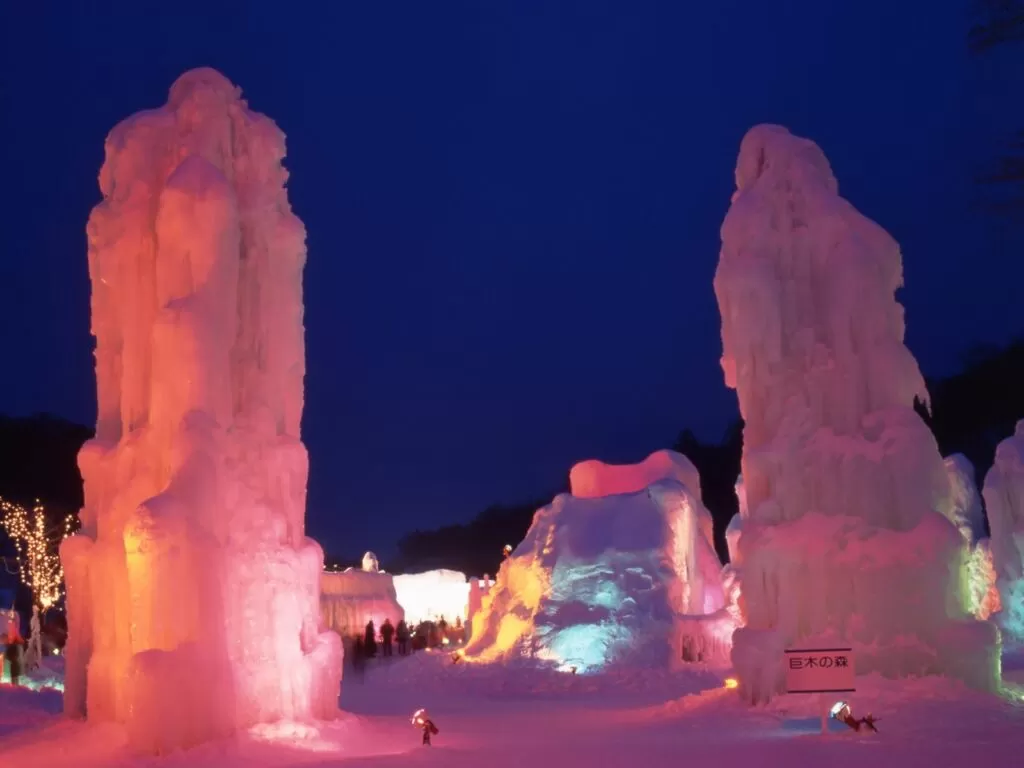
The 2027 Chitose-Lake Shikotsu Ice Festival (Hyoto Matsuri) runs for 25 days, from Saturday, January 30 to Tuesday, February 23 (public holiday). It is open 10:00–20:00, with the illumination from 16:30 to 20:00. The venue is Shikotsuko Onsen, and admission has been revised to ¥1,000 on weekdays and ¥3,000 on weekends and holidays for junior high school students and older (Chitose-Lake Shikotsu Ice Festival official website, checked 2026-10-07).
This article starts with the festival itself: how the ice sculptures are made, what differs between day and night, and what time to go. After that come how to get there from New Chitose Airport, parking and winter roads if you drive, and hot springs and places to stay. The venue is close enough to be a destination for your first day after leaving the airport in a campervan, so the later sections also cover how to think about overnight parking.
Going to the Lake Shikotsu Ice Festival?
- Where to rent: Moving Inn New Chitose Airport. About 40 minutes by car from New Chitose Airport to the venue.
- Where to stay: The official site says nothing about sleeping in your vehicle at the venue or lakeside; plan on an RV park open in winter (see below).
Compare Hokkaido Campervan Rentals
Base yourself at New Chitose Airport and compare rates, vehicle types, and pickup locations all in one place.
Compare rental companies and vehicles →When is the Lake Shikotsu Ice Festival 2027? 25 days, January 30 (Sat) – February 23 (Tue, holiday)
The event overview on the official website reads “Saturday, January 30 – Tuesday, February 23, 2027,” with a note that it may change depending on the weather (Chitose-Lake Shikotsu Ice Festival official website, checked 2026-10-07). The previous festival in 2026 ran from Saturday, January 31 to Monday, February 23 (public holiday). The 2026 overview published on the Chitose City official site also lists 10:00–20:00 for opening hours and 16:30–20:00 for the illumination, the same hours as 2027 (Chitose Sightseeing (Chitose City official), checked 2026-10-07).
| Edition | Dates | Hours and illumination | Admission (junior high school and older) |
|---|---|---|---|
| 2026 (last time, actual) | Sat, January 31 – Mon, February 23 (holiday) | 10:00–20:00, illumination 16:30–20:00 | ¥1,000 (free for elementary school students and younger) |
| 2027 (announced) | Sat, January 30 – Tue, February 23 (holiday) | 10:00–20:00, illumination 16:30–20:00 | Weekdays ¥1,000, weekends and holidays ¥3,000 (free for elementary school students and younger) |
Counting by the official fee categories, 10 of the 25 days in 2027 fall on weekends and holidays and 15 are weekdays (8 Saturdays and Sundays, plus 2 holidays: Thursday, February 11 and Tuesday, February 23; the author’s count). There are four weekends: January 30–31, February 6–7, February 13–14, and February 20–21, so if you want to avoid crowds, you can choose a weekday.
For the 2027 festival, this article covers only what has been posted on the official website. When more is announced, this article will be updated.
What kind of festival is it? An “ice art museum” made by spraying lake water
The official website describes it as a festival lined with ice objects of many sizes, made by spraying water from Lake Shikotsu through sprinklers so that it freezes. The official subtitle is “Ice Art Museum” (Chitose-Lake Shikotsu Ice Festival official website, checked 2026-10-07).
According to the Chitose Tourism Association, the ice sculptures begin with building the frames in late November. From late December, when the outside temperature drops below freezing, lake water is pumped up and sprayed onto the frames, and from January the spraying continues around the clock. The work is carried out mainly by about 10 people who work at Lake Shikotsu, including nature guides, himemasu (kokanee) fishermen, and a boat rental company (Chitose Kanko Navi (Chitose Tourism Association), checked 2026-10-07).
The first festival was held in January 1979, modeled on the Sounkyo Ice Falls Festival, with the aim of bringing visitors to Lake Shikotsu in winter, when tourists were few. The character 濤 in the name means “waves,” and it evokes the waves of Lake Shikotsu, which is considered Japan’s northernmost lake that does not freeze over. January 2026 was the 48th festival, and the association writes that more than 100,000 people visit every year (Chitose Kanko Navi, checked 2026-10-07).
What time should you go? Opens at 10:00, illumination from 16:30
The festival is open 10:00–20:00, and the illumination runs 16:30–20:00 (Chitose-Lake Shikotsu Ice Festival official website, checked 2026-10-07). Sunset comes early in Hokkaido in early February, and there are 3 hours 30 minutes from the start of the illumination to closing.
If you want to see both day and night, arriving around 15:00, walking around while it is still light, and then waiting for the lights makes an easy schedule. The official site does not give sunset times, so if you want to catch the moment the lights come on, judge by how dark the sky is when you are there.
Roads get crowded on weekend and holiday evenings. The Chitose Tourism Association expects traffic jams on weekend and holiday evenings and urges visitors to come early (Chitose Kanko Navi, checked 2026-10-07). The official website also links to an X (formerly Twitter) account that posts real-time information on congestion and more (Chitose-Lake Shikotsu Ice Festival official website, checked 2026-10-07).
After the festival closes for the night, there is a “Premium Time Ticket” for guests staying at Shikotsuko Onsen. Details are in the hot spring section.
What is different between day and night? Shikotsu Blue ice sculptures, and the illuminated night
According to the official website, by day the ice shines in a natural blue called “Shikotsu Blue,” and at night it is lit by lights of many colors (Chitose-Lake Shikotsu Ice Festival official website, checked 2026-10-07). The Chitose Tourism Association explains why the ice looks blue. Lake Shikotsu has few nutrients and little plankton, so it is very clear and light penetrates deep into the ice. Water absorbs red light easily and blue light less easily, so the light reflects many times inside the ice and the light that reaches your eyes is blue (Chitose Kanko Navi, checked 2026-10-07). It is not dyed ice; it is the color of the lake water itself.
On Lake Shikotsu’s water quality, the Chitose City official website writes that it ranked first in Japan 20 times in the Ministry of the Environment’s lake water quality survey (Chitose Sightseeing (Chitose City official), Lake Shikotsu area, checked 2026-10-07).
Three highlights: ice sculptures, Hyoto candy, and the snow-play venue next door
- Ice sculptures and venue: Every autumn, the production staff discuss which sculptures to make and how to lay out the venue. The shapes change from year to year (Chitose Kanko Navi, checked 2026-10-07)
- Hyoto candy (Hyoto ame): A post on the official Instagram on February 20, 2026 introduced it as a souvenir sold at the venue. It is a candy in a slightly deeper Shikotsu Blue, like a fragment of an ice sculpture (Instagram section of the Chitose-Lake Shikotsu Ice Festival official website, checked 2026-10-07)
- North Snowland in Chitose: The official website introduces it as a “collaboration venue.” You can try snow play such as a tube slider, ATV (4-wheel buggy) rides, snow rafting, and mini snowmobiles, and some activities are paid (Chitose-Lake Shikotsu Ice Festival official website, checked 2026-10-07). If you have children, it is a place to take a break after the ice sculptures
On warm days, access to part of the ice sculptures may be restricted. A post on the official Instagram on February 21, 2026 said that even on days when the daytime temperature is high and hard on the ice sculptures, the festival operates as usual, but because above-freezing temperatures were continuing, some areas were restricted for safety (Instagram section of the Chitose-Lake Shikotsu Ice Festival official website, checked 2026-10-07). If you go in late February, check the latest official information the day before.
As an experience, there is also a guided tour of the “Ice Art Museum” for groups. Guided by the production staff, you see the history of the festival, the frames of the ice sculptures, and the back sides of the ponds and walls. It lasts about 1 hour, for 5 to 30 people, costs ¥500 per person on top of admission, and requires a reservation at least 3 days in advance (Official guided tour information, checked 2026-10-07). The official information does not say whether individuals can join.
How much is admission? It changed to ¥1,000 on weekdays and ¥3,000 on weekends and holidays
Admission in 2027 is ¥1,000 on weekdays and ¥3,000 on weekends and holidays for junior high school students and older, and free for elementary school students and younger. You can pay with cash, major credit cards, or PayPay (Chitose-Lake Shikotsu Ice Festival official website, checked 2026-10-07).
The organizers announced the revision on July 2, 2026. Weekdays stay at ¥1,000, and weekends and holidays go from ¥1,000 last time to ¥3,000. The stated reasons are to ease congestion inside the venue and on the surrounding roads on weekends and holidays, and to put the increased operating costs toward creating works, staging, safety measures, and additional security staff (Notice of admission fee revision, checked 2026-10-07).
If you can choose your itinerary, a weekday costs one third as much. A campervan trip is not tied to hotel check-in times, so it suits a plan of arriving on a weekday evening and staying through the illumination.
How cold is it and what should you wear? In early February, Chitose’s average daily low is -13.8°C
The Japan Meteorological Agency’s AMeDAS Chitose normals (by ten-day period; these are typical values for an average year, not a forecast for the day) are as follows. The venue is on the shore of Lake Shikotsu, so the wind chill comes on top of these figures.
| Period | Normal daily high | Normal daily low |
|---|---|---|
| Late January | -1.1°C | -13.2°C |
| Early February | -1.3°C | -13.8°C |
| Mid-February | -0.1°C | -12.1°C |
| Late February | 0.7°C | -11.6°C |
The Chitose Tourism Association warns that the venue is on the lakeshore with nothing to block the wind, so windy days feel even colder. Wear underwear, a sweater or fleece, and a thick windproof outer layer (a hood is reassuring on snowy days). Cover your neck, wrists, and ankles, and add a hat or earmuffs. You can also use non-slip spikes on your shoe soles, but it is advised to take them off indoors and inside vehicles (Chitose Kanko Navi, checked 2026-10-07).
Winter temperatures by month, and how to stay warm when sleeping in your vehicle, are covered in the article on Hokkaido winter temperatures.
How do you get there from New Chitose Airport? About 40 minutes by car, or the reservation-only “Hyoto BLUE LINER” bus
According to the official website, it takes about 40 minutes by taxi from New Chitose Airport to the venue, at a fare of about ¥7,000. For car navigation, you are told to enter “Shikotsuko Onsen” (Chitose-Lake Shikotsu Ice Festival official website, checked 2026-10-07).
Driving routes
The Chitose Tourism Association’s guide gives about 30 minutes (25 km) from central Chitose via Hokkaido Route 16, about 40 minutes (30 km) from New Chitose Airport via National Route 36 and Hokkaido Route 16, and about 70 minutes (50 km) from central Sapporo via National Route 453 (Chitose Kanko Navi, checked 2026-10-07).
The “Hyoto BLUE LINER” shuttle bus
In 2027 as well, during the festival (January 30 – February 23), a shuttle bus (氷濤BLUE LINER, “Hyoto BLUE LINER”) connects the 1F of the domestic terminal building at New Chitose Airport, JR Chitose Station, and the Shikotsuko Onsen venue. There are 9 trips on the way out and 11 on the way back, with 45 seats per trip. It does not stop at the international terminal. It is operated by Sapporo Kanko Bus (011-206-0225, 9:00–18:00) (Sapporo Kanko Bus information page, checked 2026-10-07).
Reservations close at 20:30 the day before you ride, and same-day reservations are not possible. After booking, you cannot change the date or trip, and the cancellation fee is 100%. Admission is not included in the bus fare; you buy it at the ticket booth at the venue entrance (Sapporo Kanko Bus information page, checked 2026-10-07).
The fare was inconsistent between the official website and the operator’s page. The festival’s official site says “¥2,000 for junior high school students and older, ¥1,000 for elementary school students,” while the operator’s page says “¥2,000 one way, the same fare for adults and children” (Chitose-Lake Shikotsu Ice Festival official website, Sapporo Kanko Bus, checked 2026-10-07). If you are traveling with children, check the display on the booking screen. The 2027 timetable is posted as an image and could not be read as text. In 2026, there were 7 trips outbound from New Chitose Airport between 9:00 and 16:30 and 9 trips back from Shikotsuko Onsen between 11:30 and 19:30 (Chitose Kanko Navi, checked 2026-10-07). Check the 2027 times on the booking page.
Route buses and trains
According to the Chitose Tourism Association, Hokkaido Chuo Bus route buses connect New Chitose Airport (via Chitose Station) and Lake Shikotsu. It takes about 55 minutes from the airport to the terminus “Shikotsuko,” and about 44 minutes from JR Chitose Station. From Sapporo, it is 30 minutes to JR Chitose Station on the Rapid Airport train (Chitose Kanko Navi, checked 2026-10-07). Check times and fares on the Hokkaido Chuo Bus website.
What about parking if you drive? The official site gives no number of spaces, and the drive home at night is the hardest part on winter roads
I could not find the location, number of spaces, or fee of the parking lots in the event overview and access sections of the official website (Chitose-Lake Shikotsu Ice Festival official website, checked 2026-10-07). Because there are no official figures, none are given here. To find out how crowded it is on the day, check the X account for traffic information mentioned above, or contact the Lake Shikotsu National Park Management Council (0123-23-8288).
If you are going in a large vehicle, choose a way of moving that avoids the busy hours. Traffic jams are expected on weekend and holiday evenings, so entering on a weekday during the day, seeing the ice sculptures in daylight, and then waiting for the lights to come on makes it easier to avoid parking and return-trip congestion.
Roads that close in winter are listed in the article on Hokkaido roads that become impassable in winter. However, the roads to Lake Shikotsu (Hokkaido Route 16 and National Route 453) are not included in that article.
What to watch for in a campervan on the Lake Shikotsu shore in winter
- Longer braking distances: The vehicle’s weight means you need to brake earlier and keep a wider gap than in a passenger car. Avoid abrupt steering, braking, and acceleration
- The drive home after the 20:00 closing is the coldest: Road surfaces that softened during the day refreeze at night. Drive assuming the road is worse than on the way in
- Crosswinds and visibility: Tall vehicles are easily pushed by wind, and visibility drops in blowing snow. On a day with a storm forecast, don’t stick to your plan; switching to the bus is also an option
- Studless tires: Check each vehicle’s winter equipment with the rental company when you book
For winter driving in general, see the complete guide to winter campervan driving. If you are uneasy about snowy roads, you can also leave your vehicle in central Chitose and take the Hyoto BLUE LINER round trip.
Any hot springs nearby? If you stay at Shikotsuko Onsen, there is the after-closing Premium Time
The official website says there are hot springs with different water qualities around the venue, and that across Lake Shikotsu there is also Marukoma Onsen, which has an open-air bath overlooking the lake. Some facilities accept day-use bathing, and warming up in a hot spring after the ice sculptures before heading home is recommended (Chitose-Lake Shikotsu Ice Festival official website, checked 2026-10-07). The official site has no list of which facilities allow day use or their hours, so call the place you want to use by the day before. Day-use hot springs across Hokkaido are in 98 day-use hot springs in Hokkaido.
For overnight guests, there is a “Premium Time Ticket.” It lets you enter the Ice Art Museum from 20:15 to 21:15, after the regular closing. The same ticket also lets you see the daytime venue from 10:00 to 12:00 the next day. In 2027 it is on sale on weekdays from Monday, February 1 to Thursday, February 18, with Thursday, February 11 (holiday) excluded, and the price is ¥1,500 per person (admission included) (Official Premium Time Ticket information, checked 2026-10-07).
The tickets are handled by 8 facilities: Marukoma Onsen Ryokan, Shikotsuko Tsuruga Resort Spa Mizu no Uta, Kyukamura Shikotsuko, Shikotsuko Daiichi Hotel SuizanTei, Lakeside Villa Suimeikaku, Shikotsuko Tsuruga Bessho Ao no Za, Amenohi to Yuyake, and Shikotsuko Tsuruga Bessho Koharu no Sho. Some facilities do not sell stay plans that include the ticket. The phone numbers are in the official ticket information.
Can you fit the festival into your first day after renting a car at New Chitose Airport? What about overnight parking?
It takes about 40 minutes by car from New Chitose Airport to the venue (Chitose-Lake Shikotsu Ice Festival official website, Chitose Kanko Navi, checked 2026-10-07). You can go in the afternoon of the day you pick up your campervan at the airport, and if you do your shopping and refueling in central Chitose before heading to the lakeshore, you won’t be caught short on site. You can compare bases and vehicle types near the airport in the article on campervan rentals from New Chitose Airport.
Whether you can stay overnight in your vehicle at the venue or on the lakeshore is not stated on the official website (Chitose-Lake Shikotsu Ice Festival official website, checked 2026-10-07). After the lights, once the festival closes (20:00), the road surface is already refreezing, so heading back to central Chitose and continuing the next day makes a safer plan for the first day of a winter trip. How comfortable overnight parking is in deep winter depends on whether you have heating such as an FF heater, so check the equipment with the rental company before you book. Places where you can stay in winter are listed in 13 RV parks and Michi-no-Eki where you can overnight in winter.
New Chitose Airport / Tokachi-Obihiro Airport
See Moving Inn Campervans
Check vehicle types, rates, and availability on the official site.
See details at Moving Inn →What to do before and after the festival? Otaru Snow Light Path, Sapporo Snow Festival, and the 10-day winter route
The 2027 Ice Festival runs from January 30 to February 23. The Sapporo Snow Festival and the Otaru Snow Light Path are held at about the same time. The Otaru Snow Light Path is covered in the Otaru Snow Light Path article, and Sapporo Snow Festival parking is covered in the Sapporo Snow Festival parking article.
An example of a 10-day winter trip around Hokkaido from New Chitose Airport is in the 10-day winter Hokkaido model route, and the dates of 14 winter events are in the map and calendar of 14 winter events. For Lake Shikotsu’s summer campgrounds, kayaking, and year-round overnight spots, see the Lake Shikotsu campervan guide.
Frequently Asked Questions (FAQ)
When is the Lake Shikotsu Ice Festival 2027?
It runs for 25 days, from Saturday, January 30 to Tuesday, February 23 (public holiday), 2027. It may change depending on the weather and other conditions (Chitose-Lake Shikotsu Ice Festival official website, checked 2026-10-07).
What kind of festival is it?
It is a festival lined with ice objects of many sizes, made by spraying water from Lake Shikotsu through sprinklers so that it freezes. The subtitle is “Ice Art Museum” (Chitose-Lake Shikotsu Ice Festival official website, checked 2026-10-07).
From what time can I go?
It is open 10:00–20:00, and the illumination runs 16:30–20:00. Traffic jams are expected on weekend and holiday evenings (Chitose-Lake Shikotsu Ice Festival official website, Chitose Kanko Navi, checked 2026-10-07).
What is different between day and night?
By day, the ice is blue, called Shikotsu Blue; at night, the ice sculptures are lit by lights of many colors. On warm days, some areas may be closed to entry (Chitose-Lake Shikotsu Ice Festival official website, checked 2026-10-07).
How much is admission?
It is ¥1,000 on weekdays and ¥3,000 on weekends and holidays for junior high school students and older, and free for elementary school students and younger. Cash, credit cards, and PayPay are accepted (Chitose-Lake Shikotsu Ice Festival official website, checked 2026-10-07).
What should I wear?
By the normals, early February in Chitose has an average daily high of -1.3°C and an average daily low of -13.8°C. You will need a thick windproof outer layer, a hat, gloves, and non-slip shoes (Japan Meteorological Agency, Chitose Kanko Navi, checked 2026-10-07).
How do I get there from New Chitose Airport?
It takes about 40 minutes by car and about 40 minutes by taxi (about ¥7,000). For the reservation-only shuttle bus “Hyoto BLUE LINER,” book by 20:30 the day before (Chitose-Lake Shikotsu Ice Festival official website, Sapporo Kanko Bus, checked 2026-10-07).
Is there parking?
I could not find the location, number of spaces, or fee of parking on the official website. For inquiries, call 0123-23-8288 (Chitose-Lake Shikotsu Ice Festival official website, checked 2026-10-07).
Can I use a hot spring nearby?
The official website says there are hot springs with different water qualities around the venue, and that some facilities accept day-use bathing. Please check with the place you want to use beforehand (Chitose-Lake Shikotsu Ice Festival official website, checked 2026-10-07).
Can I stay overnight in my vehicle near the venue?
Whether overnight parking is allowed at the venue or on the lakeshore is not stated on the official website. The road surface freezes after closing, so a plan to return to central Chitose is safer (Chitose-Lake Shikotsu Ice Festival official website, checked 2026-10-07).
Can I combine it with other winter festivals?
It is held at the same time as the Sapporo Snow Festival and the Otaru Snow Light Path. You can check how the dates overlap in the winter events list, and there is also a 10-day model route starting from New Chitose Airport.
What to read next
- 14 Hokkaido winter events on a map and date calendar
- Otaru Snow Light Path by campervan
- A 10-day model route around winter Hokkaido
- Hokkaido roads that become impassable in winter
- Lake Shikotsu campervan guide
Book a Campervan in Hokkaido
Moving Inn New Chitose Airport supports English booking and offers airport transfers.
Pick a campervan by what matters to you.
Rent in winter (Dec–Mar)
Companies that rent through winter, listed apart from those that close.

![When and Where Can You See Harbor Seals at Cape Erimo? Kaze no Yakata Official Information, Viewing Season, and Windy-Day Notes [2026-27]](https://hokkaido-campingcar.jp/wp-content/uploads/2026/10/erimo-cape-lighthouse-768x511.jpg.webp)
![Where and Under What Conditions Can You See Diamond Dust in Hokkaido? How Cold a Morning It Takes, and Where It Appears [2026-27]](https://hokkaido-campingcar.jp/wp-content/uploads/2026/10/hokkaido-diamond-dust-nayoro-768x512.jpg.webp)
![Can You Drive to Hokkaido Jingu for Hatsumode? Parking, Crowds, and Where to Park and Walk [2027]](https://hokkaido-campingcar.jp/wp-content/uploads/2026/10/hokkaido-jingu-winter-torii-768x504.jpg.webp)
![Hokkaido Roads Over New Year [2026-27] | Expressway Sections Prone to Blizzard Closures, Forecast Congestion Days, No Holiday Discount, and New Chitose Airport Parking](https://hokkaido-campingcar.jp/wp-content/uploads/2026/10/hokkaido-winter-rural-road-edge-markers-768x432.jpg.webp)
![Where to See Sea Smoke (Kearashi) in Hokkaido: Rumoi’s Ogon-misaki and the Morning Conditions [2026-27]](https://hokkaido-campingcar.jp/wp-content/uploads/2026/10/rumoi-kearashi-sea-smoke-768x511.jpg.webp)
![Geminid Meteor Shower 2026 in Hokkaido: Peak Around 23:00 on December 14, Sapporo Moonset 20:40, and Staying Warm in a Winter Campervan [2026]](https://hokkaido-campingcar.jp/wp-content/uploads/2026/10/geminids-2026-hokkaido-768x575.jpg.webp)