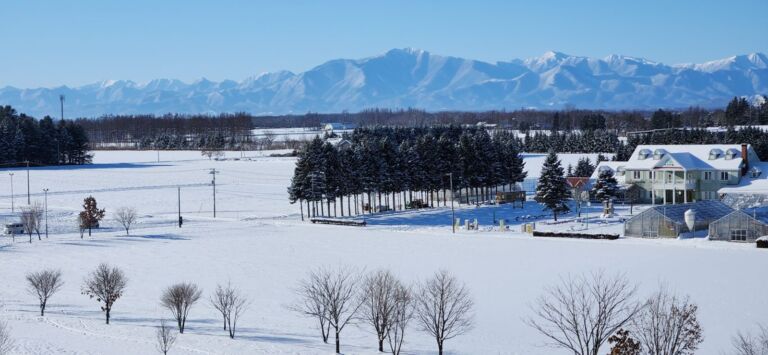
Where You Can Legally Park and Sleep in a Campervan in Hokkaido in Winter
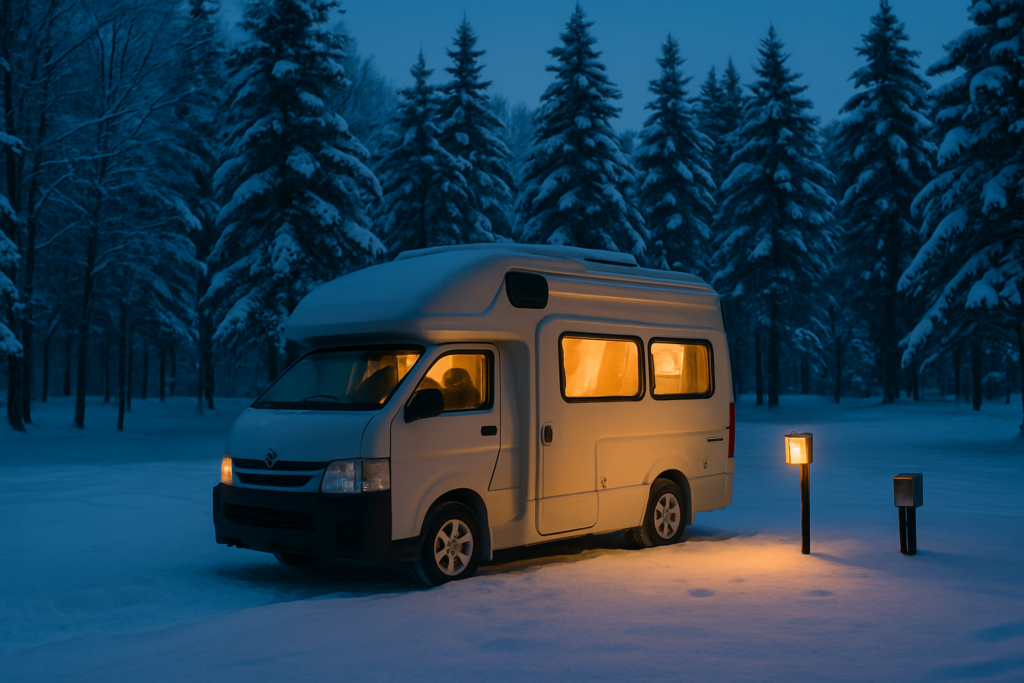
If you are planning a winter campervan trip in Hokkaido, the first question that comes up in almost every enquiry we get is not about the vehicle — it is “where are we actually allowed to sleep?” It is a fair question, and the honest answer has more nuance than most itineraries admit. There are three categories of place people park overnight here: michi-no-eki (roadside rest stations), ski resort car parks, and RV parks. Only one of those is built to have you stay the night. This piece walks through what each one actually is, what we could confirm about the RV parks that stay open through winter, and what we still could not confirm — so you can plan around facts rather than assumptions.
Tap a dot on the map to see its name here.
Tap a dot to see its name and a link to where it appears in this article. Dot positions are based on each facility’s address or officially published location. Lakes and expressways are from OpenStreetMap data.
Michi-no-eki are rest stops, not campsites — but people sleep in them anyway
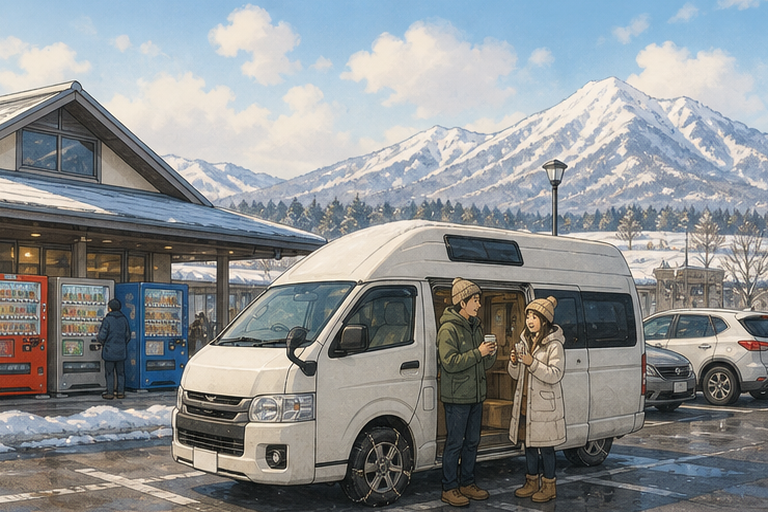
A michi-no-eki is a roadside station: a public rest area with parking, toilets, and usually a shop or vending machines, open to any driver. Legally and functionally, it is a place to stop for a short break, not a lodging facility. Almost none of them give explicit permission to stay overnight, and the ones we have checked describe themselves the same way — a rest stop for drivers, not a campsite.
That said, the reality on the ground is different from the signage. One traveller who spent two months living out of a van across Japan's michi-no-eki reported never once being asked to move on, and noted that plenty of Japanese drivers were doing exactly the same thing — a single occupied vehicle for the night is common, not unusual. The unwritten etiquette that comes with it is consistent across the accounts we have seen: park without blocking anyone, don't run a generator or make noise after dark, don't put out chairs or awnings, and leave with no visible trace that you stayed at all.
We are not going to tell you this is illegal, because in most cases nobody will stop you — and we are not going to tell you it is a sanctioned place to sleep, because it isn't one. Both things are true at once. If your priority is certainty rather than probability, book a site that is actually built for overnight guests, which is what the rest of this article covers.
Why ski resort parking lots are the wrong place to park for the night
If your trip is built around chasing snow, it is tempting to assume you can just park at the base of a resort and sleep there before first lifts. Don't plan around that. Resort car parks set their own rules, and most of them do not permit overnight sleeping — some post it explicitly, others simply clear or gate the lot overnight, and the policy can differ from one resort to the next and even from one season to the next at the same resort. We have not audited every resort in Hokkaido individually, and we are not going to state a blanket rule either way beyond this: treat a resort car park as day parking unless the resort itself tells you otherwise, and confirm with the resort directly before you rely on one for a night's sleep. Book a proper site — an RV park, campground, or hotel — and drive to the lifts in the morning instead.
RV parks are built for winter guests — here's what's actually confirmed open
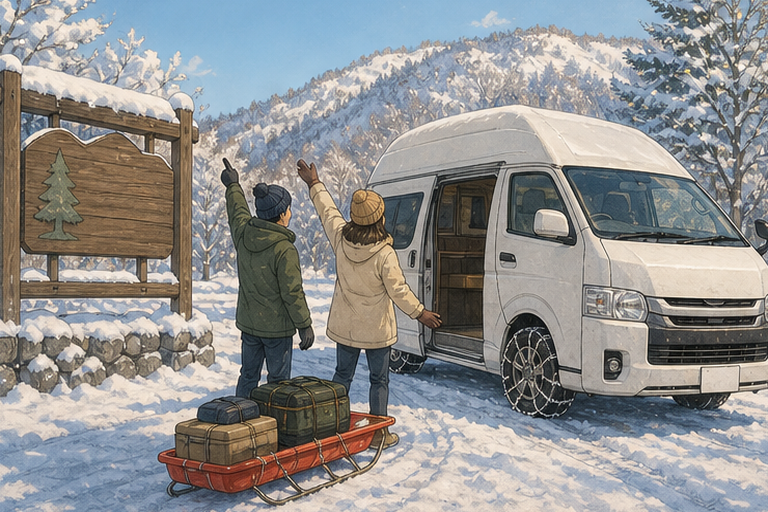
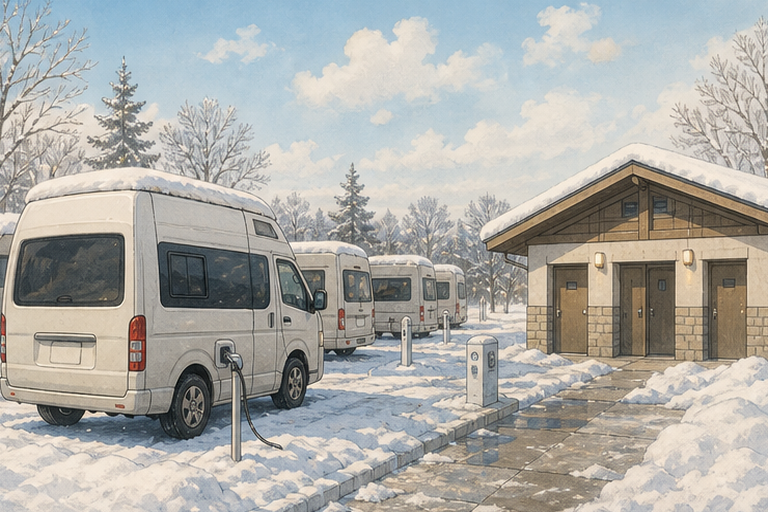
An RV park is the opposite case: a facility whose entire purpose is overnight vehicle stays, usually with power hookups, a toilet block, and sometimes water and a sink. This is the category worth planning around in winter, because it is the only one where "yes, you can sleep here" is the facility's actual business rather than a courtesy nobody enforces.
We checked thirteen RV parks and campgrounds across Hokkaido against their own published information on 8 September 2026. Four confirmed they operate through winter with real detail behind the claim; two are partial (open, but with one service switched off); five publish a winter closure outright; and two we could not determine at all, both of them members-only facilities rather than public RV parks. Here is what we found for the ones that are actually open in winter.
| Facility | Area | Winter status | Power | Toilet | Water | Checked |
|---|---|---|---|---|---|---|
| RV Park Kutchan | Kutchan, next to Niseko | Confirmed open — "operating year-round without a day off" | Yes, all 17 sites | Not confirmed | Not confirmed | 2026-09-08 |
| RV Park Johnny Base | Asahikawa | Confirmed open — winter conditions must be confirmed by phone | Not confirmed | Not confirmed | Not confirmed | 2026-09-08 |
| RV Park Tokachi Wakka no Mori | Shimizu, Tokachi | Confirmed open — the clearest winter operation of the thirteen | Yes | Yes, heated year-round | Yes, groundwater, warm year-round | 2026-09-08 |
| RV Park Akan Tancho no Sato | Kushiro | Confirmed open — "no days off, open year-round" | Yes, 15A sites | Yes, 24 hours | None (no water supply at any season) | 2026-09-08 |
| Auto Resort Tomakomai Arten | Tomakomai | Partial — general sites open, premium sites close Nov–Mar | Not confirmed | Not confirmed | Not confirmed | 2026-09-08 |
| RV Park Shiretoko Kiyosato Ueneusaru Midori | Kiyosato | Partial — power and toilet run, water is switched off in winter | Yes | Yes | No — off in winter | 2026-09-08 |
Notice how much of that table still reads "not confirmed" even for the facilities we are calling open. That is deliberate. A facility can be genuinely open in winter and still not publish whether the power runs, the toilet is heated, or the water pipes are protected from freezing. We are not filling those gaps with a guess — we are marking them so you know exactly what to ask about before you book.
What "confirmed" and "not confirmed" mean, and why it matters in January
"Confirmed open" means the facility's own site, or its listing on Japan's official RV park directory, states in writing that it operates through winter, and we checked that statement on 8 September 2026. It does not mean we verified the power, toilet, and water independently, and it does not mean those services are guaranteed to be running the day you arrive. "Not confirmed" is not a warning that something is broken — it means the information simply is not published anywhere we could find it.
This distinction matters more in Hokkaido winter than almost anywhere else in Japan. RV Park Akan Tancho no Sato itself warns that on-site temperatures can drop below minus twenty degrees Celsius. A facility that is technically "open" with a frozen tap or a powered-down toilet block is a very different night than one running at full service — and the only way to know which you'll get is to ask directly.
Two new options we checked, and why we're still cautious about them
Two facilities came up as alternatives once we found that several original stops on our winter routes were closed. Sapporo Jozankei Nature Village, near Jozankei Onsen, publishes a closure calendar that keeps it operating through December and January with only occasional maintenance closures, and its own guidance mentions hauling gear in by sled in winter — a detail that only makes sense if winter guests are expected. RV Park Abashiri Bay, on the Okhotsk coast, is listed on Japan's official RV park directory with year-round hours, paid power, a 24-hour toilet, and free water.
Neither is a clean "yes" without a caveat. Jozankei Nature Village's calendar tells us it stays open, but we could not confirm whether power, water, or toilets run in winter, or whether it has campervan-specific bays at all. Abashiri Bay states year-round operation, but the facility opened in September 2025 and, as of this writing, has not yet been through a full winter — "year-round" is its stated policy, not a track record. Both are worth a phone call before you build a night around either one.
Before you book: the phone call you shouldn't skip
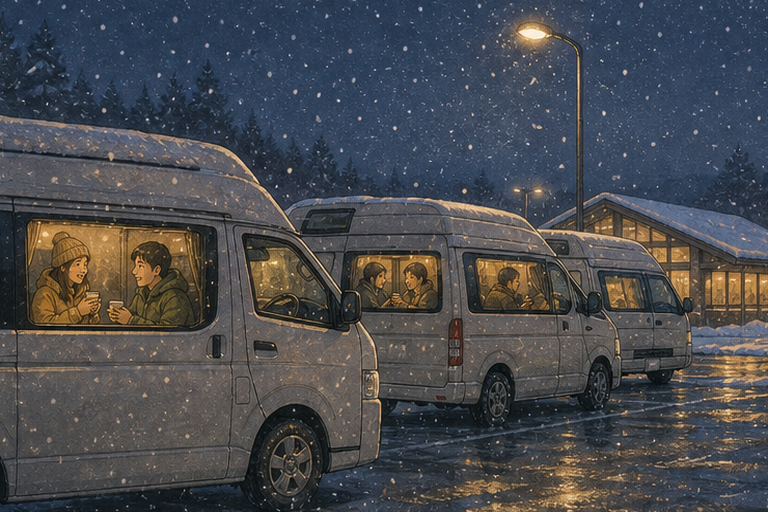
Every facility in this article, including the ones we could confirm as open, has a detail that only surfaces by phone. Johnny Base publishes that winter rates and conditions must be confirmed by telephone before you arrive. Ueneusaru Midori is run by a guiding company, and the gate is locked when staff are away — turning up without an arranged time means you cannot get in. Abashiri Bay takes bookings through its website only, and the cutoff is 11am on the day you want to stay, with no phone reservations. None of this is unusual for winter operations in a region where conditions genuinely change what a facility can offer — it is simply the reason a five-minute call before you set off is worth more than anything in this table.
If you want the full route this table comes from — driving distances, timing, and the six-night loop we built around these confirmed facilities — see our winter campervan Hokkaido route guide. For the general legal picture on sleeping in a parked vehicle in Japan, see is it legal to sleep in your car in Japan, and for RV parks across the island beyond winter, see our Hokkaido RV park guide. If you are flying into New Chitose and want to compare vehicles before you book, Moving Inn's New Chitose Airport counter has a comparison of its HiAce CA, LX and KAR models.
Frequently asked questions
Is it OK to sleep overnight at a michi-no-eki?
A michi-no-eki is a rest stop for drivers, not a lodging facility, and it does not give you permission to stay the night. In practice, many travellers do stop overnight there without being asked to move on, and Japanese drivers do the same. Both facts are true together: it is common, and it is not an authorised place to sleep. If you want certainty rather than probability, book an RV park instead.
Can I sleep with the engine running to stay warm?
Rules on idling vary by area, and a running engine outside someone's window at 2am is exactly the kind of thing that erodes goodwill at a rest stop or car park. Follow whatever local signage and rules apply where you park, and plan around not needing the engine at all: a campervan with a working FF diesel heater keeps the cabin warm on a fraction of the fuel and without the engine running, which is the setup worth asking your rental operator about by name.
Are the toilets open 24 hours in winter?
Where we could confirm it, yes — RV Park Akan Tancho no Sato and RV Park Shiretoko Kiyosato Ueneusaru Midori both publish 24-hour toilet access through winter. For several other facilities in this article, winter toilet operation is simply not published anywhere we could find, which is why those cells in our table say "not confirmed" rather than "yes."
Does power or water still work in winter?
It depends on the facility, and this is the detail most often missing from public information. RV Park Tokachi Wakka no Mori confirms both power and warm, freeze-protected water year-round. RV Park Shiretoko Kiyosato Ueneusaru Midori keeps power on but switches water off for winter. RV Park Akan Tancho no Sato has no water supply at any season, winter or summer. For the rest, we could not find a published answer — ask directly before you book.
Do I need to book ahead?
Yes, and the method varies by facility. Johnny Base takes phone reservations and requires a call to confirm winter conditions and pricing before you arrive. RV Park Abashiri Bay only accepts bookings through its website, with a same-day cutoff of 11am — it does not take phone reservations. RV Park Shiretoko Kiyosato Ueneusaru Midori is fully reservation-based because the site is run by a guiding company and is locked when staff are not on hand. Check the reservation method for your chosen facility rather than assuming you can just show up.
Book a Campervan in Hokkaido
Moving Inn New Chitose Airport supports English booking and offers airport transfers.

![Monbetsu Drift Ice Festival 2027 [Feb 11–14]: Dates, Ice Sculptures, Garinko-go Icebreaker, Parking and Access by Campervan](https://hokkaido-campingcar.jp/wp-content/uploads/2026/10/monbetsu-hl999-768x576.jpg)
![Hokkaido New Year Weather and What to Wear | Sapporo, Hakodate, Asahikawa, Obihiro Mornings and Evenings, and Heavy-Snow Years [2026-27]](https://hokkaido-campingcar.jp/wp-content/uploads/2026/10/hokkaido-new-year-holiday-weather-eyecatch-768x432.webp)
![Hokkaido Illumination 2026-27 [Dates]: Sapporo Starts Nov 20, Plus Otaru, Asahikawa, Obihiro & Hakodate for Campervan Trips](https://hokkaido-campingcar.jp/wp-content/uploads/2026/10/hokkaido-illumination-2026-eyecatch-768x432.webp)
![What to Do in Tokachi in Winter: Dog Sledding, Snowshoeing, the Shikaribetsu Ice Village, and Staying at Kitanomori [2027]](https://hokkaido-campingcar.jp/wp-content/uploads/2026/10/tokachi-winter-dogsled-1-768x432.jpg)