Driving in Japan: Left-Side Rules, Stop Signs, Hokkaido Winter
First time driving in Japan? Left-side rules, Stop signs, railroad crossings, speed limits, drink-driving penalties, winter yabane poles and accident contacts.
See companies that rent in winter
Pick a campervan by what matters to you.
Rent in winter (Dec–Mar)
Companies that rent through winter, listed apart from those that close.
Rent at New Chitose Airport
See only the rental bases in Chitose, where the airport is.
Guide price
Moving Inn New Chitose Airport: HIACE van conversion from ¥22,000 per night. 30% off when booked 90 days ahead, 20% off at 60 days (official site, checked 20 Nov 2026).
Hokkaido ski resorts by campervan →
Before you book: with an International Driving Permit if your country is in the Geneva Convention (for example the US, Australia, Singapore); Taiwan, Switzerland, Germany, France, Belgium and Monaco need your licence plus a Japanese translation (Tokyo Metropolitan Police). Questions in English: Moving Inn on WhatsApp. Every roadside station (michi-no-eki) must have free 24-hour toilets, and Hokkaido has 128 of them (MLIT).
If this is your first time driving in Japan, there are four things to learn first. You drive on the left. You must come to a complete stop at a “Tomare” (Stop) sign. You stop once at a railroad crossing even when no alarm is sounding. Drunk driving is prohibited, and people who lend a car or ride along are punished too. On roads without signs, the maximum speed is 60 km/h on ordinary roads with a center line and 30 km/h on residential roads without a center line (from September 1, 2026).
Whether to take the wheel yourself in winter Hokkaido comes down to two questions: can you learn these traffic rules, and are you confident on snowy roads? The first has a limited number of items, and what appears as-is in the National Police Agency’s English materials is enough. The second is left to the Q&A for first-time snow drivers; this article checks the numbers and signs. License requirements (an International Driving Permit and a Japanese translation) are covered in the article on whether you can rent with a foreign license.
The figures and rules in this article were written after reading National Police Agency materials, the text of the Order for Enforcement of the Road Traffic Act, and pages from the Hokkaido Regional Development Bureau and the Civil Engineering Research Institute for Cold Region on 2026-11-12. Penalties and figures can be revised, so also check the National Police Agency’s latest guidance before you leave.
Compare Hokkaido Campervan Rentals
Base yourself at New Chitose Airport and compare rates, vehicle types, and pickup locations all in one place.
Compare rental companies and vehicles →Japan drives on the left. Visitors from right-hand countries slip most easily right after a turn
Japan drives on the left, keeping to the left side of the road. Australia and Singapore also drive on the left like Japan, while the United States drives on the right. Drivers used to right-hand traffic easily drift into the right-hand lane right after turning at an intersection.
The National Police Agency also warns that people sometimes drive on the right side after turning at intersections and similar places (National Police Agency “Follow the rules and drive safely in Japan”, checked 2026-11-12).
Another thing to remember is the color of the center line. The National Police Agency’s multilingual leaflet says that where the center line is yellow, you may not cross over to the right side to overtake (National Police Agency “Traffic Rules in Japan”, checked 2026-11-12).
Leaving the airport or pulling out of a parking lot onto the road is also a single “right after a turn” moment. For the first hour of the trip, ask your passenger to call out “left, left”; it makes a mistake easier to notice. If you are new to driving a campervan itself, also read 7 points where campervan driving trips people up to get a feel for vehicle width and blind spots.
Must you always stop at a “Tomare” (Stop) sign? Does it come with English “STOP”?
At a place with a sign reading “Tomare” (Stop), come to a complete stop, check left and right for safety, and then proceed (National Police Agency “Follow the Rules for Safe Driving in Japan”, checked 2026-11-12). Slowing down and rolling through is not enough.
English “STOP” appears on some signs and not on others. According to a National Police Agency notice, an amendment to the ordinance that took effect on July 1, 2017 added a design with “STOP” beneath the Japanese word “Tomare”. The conventional design with Japanese characters only was not abolished and remains valid today.
When a sign is newly installed or replaced, the design with English letters is in principle used (National Police Agency Notice Hei-Ki-Hatsu No. 5 (April 21, 2017), checked 2026-11-12).
In other words, both signs mean the same thing, and both are mixed together on the road. The absence of the word “STOP” does not mean you need not stop. The same notice added a design with “SLOW” to the 徐行 (Joko, “Slow”) sign. Joko means proceeding at a speed from which you can stop immediately, and National Police Agency material gives a guideline of 10 km/h or less (same material, checked 2026-11-12).
Where do you stop at railroad crossings, crosswalks, and intersections?
In Japanese driving, signs are not the only places you stop. National Police Agency English materials list these three (National Police Agency “Follow the rules and drive safely in Japan”, checked 2026-11-12).
- Railroad crossings: Stop completely even when no alarm is sounding, and check that no train is coming before crossing
- Crosswalks and intersections: If a pedestrian is about to cross, stop and give way. Pedestrians always have priority
- Right turns at intersections: Let vehicles going straight and vehicles turning left go first
Railroad crossings are also written into the text of the Road Traffic Act. Stop just before the crossing (just before the stop line, if there is one), and proceed after checking for safety. You may not enter while the barrier is coming down or is down, or while the alarm is sounding (Road Traffic Act, Article 33, checked 2026-11-12).
For drivers from right-hand traffic countries, the feel of a right turn is the reverse of Japan’s. In Japan, a right turn crosses the oncoming lane. While oncoming vehicles going straight are coming, wait with your turn signal on. The National Police Agency leaflet also says to wait with the turn signal flashing until pedestrians and oncoming vehicles have passed (National Police Agency “Traffic Rules in Japan”, checked 2026-11-12).
What should you watch at traffic lights? How red, yellow, arrows, and flashing signals work
The basics of traffic lights are to stop at red and go at green. The National Police Agency’s “Traffic Lights and Road Signs” organizes them by whether you may cross the stop line (National Police Agency “Traffic Lights and Road Signs”, updated December 26, 2023, checked 2026-11-12).
| Signal | What vehicles do (summary of the original) |
|---|---|
| Green | May go straight, turn right, or turn left |
| Yellow | Must not cross the stop line. However, if the light turns yellow when you are so close to the stop line that you cannot stop safely, you may continue |
| Red | Must not cross the stop line |
| Green arrow | Even when the light is yellow or red, you may proceed in the direction of the arrow |
| Flashing red | Make a temporary stop at the stop line |
| Flashing yellow | Proceed, paying attention to other traffic |
At a red light you cannot go straight or turn right or left (National Police Agency “Follow the Rules for Safe Driving in Japan”, checked 2026-11-12). Only while an arrow is displayed may you proceed in that direction. When the arrow disappears, follow the original signal.
What is the speed limit? The numbers for roads without signs and for expressways
Where a sign or road marking shows a maximum speed, that number is the maximum speed. The unit is km/h. Roads where none is shown have a statutory speed limit, and from September 1, 2026, the limit on residential roads without a center line dropped from 60 km/h to 30 km/h (Osaka Prefectural Police Headquarters guidance, National Police Agency poster, checked 2026-11-12).
| Road | Maximum speed without a sign (motor vehicles) |
|---|---|
| Ordinary roads with a center line or lanes established by road signs, etc. | 60 km/h |
| Ordinary roads where the two directions are separated by fences, etc. | 60 km/h |
| Motor-vehicle-only roads | 60 km/h |
| Ordinary roads that fit none of the three above (residential roads without a center line) | 30 km/h (from September 1, 2026) |
| Main carriageways of national expressways, etc. (ordinary motor vehicles and semi-medium-size motor vehicles) | 100 km/h |
On a residential road with a 40 km/h sign, the maximum speed is 40 km/h, not 30 km/h. The National Police Agency poster urges drivers to travel at a safe speed that suits the road, weather, and visibility, even within the maximum speed (National Police Agency poster, checked 2026-11-12).
In winter Hokkaido, there are days when this “safe speed” is lower than the number on the sign. The judgment of when to stop, based on road surface and visibility, is summarized in how to tell a blizzard from black ice. Expressway tolls can be checked in the quick-reference table of Hokkaido expressway tolls.
What are the rules for seat belts, child seats, smartphones, and alcohol?
All four are items on which the National Police Agency publishes English materials. Here are the figures in one table.
| Item | Rule |
|---|---|
| Seat belts | Fasten them in every seat, including the rear seats. If a rear-seat passenger is not belted on an expressway, the driver gets 1 violation point |
| Child seats | Driving with a child under 6 years old who is not in a child seat is prohibited by law |
| Mobile phone (hand-held use) | Imprisonment of up to 6 months or a fine of up to ¥100,000; 3 violation points |
| Mobile phone (caused a traffic hazard) | Imprisonment of up to 1 year or a fine of up to ¥300,000; 6 violation points |
| Driving while intoxicated | Imprisonment of up to 5 years or a fine of up to ¥1,000,000. License revocation, disqualification period of 3 years |
| Driving under the influence of alcohol (breath alcohol of 0.25 mg per liter or more) | License revocation, disqualification period of 2 years |
| Driving under the influence of alcohol (0.15 mg or more and less than 0.25 mg) | License suspension of 90 days |
With drunk driving, it is not only the person who drove who is punished. According to National Police Agency material, people who provide a vehicle or alcohol to a driver, and people who rode in the same vehicle, are also subject to punishment. People who served the alcohol and passengers face imprisonment of up to 3 years or a fine of up to ¥500,000 when the driver drove while intoxicated (National Police Agency “Eradication of Drinking and Driving”, checked 2026-11-12).
If you plan to drink in an onsen town in the evening, choose a way of staying where the car does not move that day.
You must not talk on a mobile phone or gaze at its screen while driving. If you truly need to, stop in a safe place before using it (National Police Agency “Stop Using Your Smartphone…”, checked 2026-11-12). It is safest to enter your destination into the navigation before departure. For choosing a child seat when traveling with children, see the article on child seats in campervans.
What are the rows of arrows along the roadside in winter Hokkaido, and the “chain” sign?
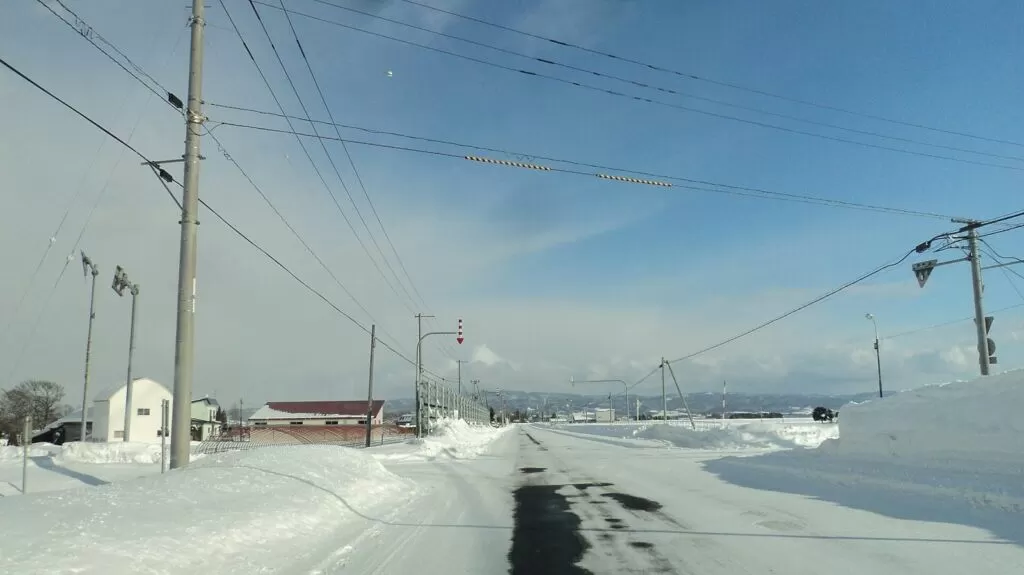
Driving national highways in winter Hokkaido, you will see rows of poles topped with arrows along the edge of the road. They are commonly called yabane (arrow-shaped snow poles; officially “fixed delineator posts”). They are placed continuously along the roadside to make the road easier to see in blowing or falling snow and to show the width that will be plowed. The usual spacing is about 80 m (Civil Engineering Research Institute for Cold Region “Northern Road Navi”, the institute’s blowing-snow countermeasures manual, checked 2026-11-12).
On a stormy day, these yabane also serve as a guide to visibility. The Civil Engineering Research Institute for Cold Region explains that when three or more poles are visible, traffic flows much as usual; when only two are barely visible, drivers slow down; and when only one is barely visible, traffic crawls (Northern Road Navi, checked 2026-11-12). When you can see only two poles, it is a signal to think about whether to go on.
The other sign relates to tire chains. The National Police Agency’s list of signs includes a regulatory sign meaning that vehicles without tire chains may not pass (National Police Agency “Traffic Lights and Road Signs”, checked 2026-11-12).
Whether the car you rent has winter tires, and from when, can be checked in the article on winter tire changeover timing; the drive type, in the article on whether you need 4WD.
Mountain passes that close in winter are covered in detail in the winter road closures article, and Ezo deer running onto the road in the article on collisions with Ezo deer.
Who do you contact after an accident, a breakdown, or a road problem?
If an accident happens, report it to the police (110) even if no one is hurt. If someone is injured, give first aid, call an ambulance (119), and also contact the police (110). Failing to report an accident or to help an injured person carries heavy penalties and administrative sanctions such as license revocation (National Police Agency “Follow the Rules for Safe Driving in Japan”, checked 2026-11-12).
| Situation | Who to contact / what to do |
|---|---|
| Accident (whether or not anyone is hurt) | Police 110 |
| Someone is injured | Give first aid, and call emergency 119 and police 110 |
| Vehicle breakdown or running out of fuel | Stop in a place where you do not obstruct other traffic, and contact roadside assistance such as JAF (Japan Automobile Federation) |
| Potholes, broken signs, broken guardrails | Road Emergency Hotline #9910 (24 hours; calls from landlines, mobile phones, and PHS are free) |
#9910 is the number for notifying the road administrator of road abnormalities, and the Hokkaido Regional Development Bureau advises contacting the police (110) about accidents (Hokkaido Regional Development Bureau “Road Emergency Hotline”, checked 2026-11-12).
When you stop because of a breakdown, turn on the hazard lights or similar at night, and on ordinary roads, even in the daytime, place a stopped-vehicle warning sign or open the trunk to show that you have stopped (National Police Agency “What to Do in Case of Vehicle Trouble, etc.”, checked 2026-11-12). With a rental car, first check the contact number you are given when you pick it up. If you may need to refuel at night, the article on where to refuel at night will help.
A checklist if you are unsure whether to make it a drive-yourself trip
Here is what we have covered so far, rearranged as material for deciding. If you can say “yes” to every item, then as far as traffic rules go, you can proceed with a drive-yourself trip.
- You are confident you can enter the left lane even after turning at an intersection (right after the turn is where mistakes happen)
- You can come to a complete stop every time at a “Tomare” sign, including signs without English “STOP”
- At a railroad crossing, you can stop once even when no alarm is sounding
- You read the numbers on signs as km/h, and you know that a residential road without signs is 30 km/h
- You do not drink on days you drive, and you know that passengers and people who serve alcohol are also punished
- If there is a child under 6, you can prepare a child seat
- You have checked, before renting, which type of license you need and whether a translation is required
- You have checked winter road surface and visibility judgments in other materials
If items remain that you are unsure about, read the relevant article before booking, and also check with the company you will rent from. For winter snow roads, starting from the article collecting worries about winter campervan trips lets you look things up by type of worry.
New Chitose Airport · Tokachi-Obihiro Airport
See Moving Inn Campervans
Check vehicle types, rates, and availability on the official site.
View details at Moving Inn →Frequently asked questions (FAQ)
Does Japan drive on the right or the left?
On the left. Drivers used to right-hand traffic easily drift into the right-hand lane after turning at an intersection, so take care (National Police Agency “Follow the rules and drive safely in Japan”, checked 2026-11-12).
Do “Tomare” (Stop) signs come with English “STOP”?
Some do and some do not. From July 1, 2017, a design with “STOP” beneath “Tomare” was added. The conventional design with Japanese characters only is also still valid, so both exist. Both are signs that require a complete stop (National Police Agency notice, checked 2026-11-12).
At a railroad crossing, do I not need to stop if no alarm is sounding?
You stop. National Police Agency material says to stop completely even when no alarm is sounding and to cross after checking that no train is coming (National Police Agency, checked 2026-11-12).
What is the speed limit in Japan?
If there is a sign, that number is the maximum speed. On roads without one, it is 60 km/h on ordinary roads with a center line, 30 km/h on residential roads without a center line (from September 1, 2026), and 100 km/h on the main carriageways of national expressways for ordinary and semi-medium-size motor vehicles (Order for Enforcement of the Road Traffic Act, checked 2026-11-12).
How are smartphones and drinking treated while driving?
While driving, even just holding and using a phone carries imprisonment of up to 6 months or a fine of up to ¥100,000. With drunk driving, people who provided the car and passengers are also punished (National Police Agency, checked 2026-11-12).
What are the arrow-like things lined up along the edge of the road?
They are fixed delineator posts, commonly called yabane (arrow-shaped snow poles). They make the road easier to see in blowing or falling snow and show the width that will be plowed. They are usually lined up at intervals of about 80 m (Civil Engineering Research Institute for Cold Region, checked 2026-11-12).
Who do I contact if I cause an accident?
The police (110), whether or not anyone is hurt. If someone is injured, also call an ambulance (119). For potholes or broken signs, use the Road Emergency Hotline #9910 (National Police Agency, Hokkaido Regional Development Bureau, checked 2026-11-12).
Pages to read next
- Can you rent a Hokkaido campervan with a foreign license? | A complete guide to required documents and procedures by nationality
- For first-time snow drivers in Hokkaido | What if you slide, what if you get stuck, and do you need 4WD?
- When to stop on winter Hokkaido roads | How to tell blizzards, whiteouts, and black ice
- When are winter tires changed in Hokkaido? Guidelines for 8 cities including Sapporo, Asahikawa, Obihiro, and Hakodate
- Hokkaido roads that close in winter | Closure periods and spring opening dates for Shiretoko Pass and others
Featured image: A road and yabane in winter Hokkaido (January 2012). Photo: Sgroey / Wikimedia Commons / CC BY-SA 4.0
Book a Campervan in Hokkaido
Moving Inn New Chitose Airport supports English booking and offers airport transfers.
Pick a campervan by what matters to you.
Rent in winter (Dec–Mar)
Companies that rent through winter, listed apart from those that close.