Winter Campervan Trip to Shibetsu and Nayoro: Snowscapes and Hot Springs in Dohoku [2026 Edition]
A winter campervan guide to Shibetsu and Nayoro: JMA snow-depth data, Nayoro's rare sun pillar phenomenon, hot springs in both towns, and the winter driving restrictions rental companies impose in Dohoku.
Pick a campervan by what matters to you.
Rent in winter (Dec–Mar)
Companies that rent through winter, listed apart from those that close.
Rent at New Chitose Airport
See only the rental bases in Chitose, where the airport is.
Guide price
Moving Inn New Chitose Airport: HIACE van conversion from ¥22,000 per night. 20–30% off when booked 60–90 days ahead (official rate table, checked 15 Oct 2026).
Hokkaido ski resorts by campervan →
Before you book: with an International Driving Permit if your country is in the Geneva Convention (for example the US, Australia, Singapore); Taiwan, Switzerland, Germany, France, Belgium and Monaco need your licence plus a Japanese translation (Tokyo Metropolitan Police). Questions in English: Moving Inn on WhatsApp. Every roadside station (michi-no-eki) must have free 24-hour toilets, and Hokkaido has 128 of them (MLIT).
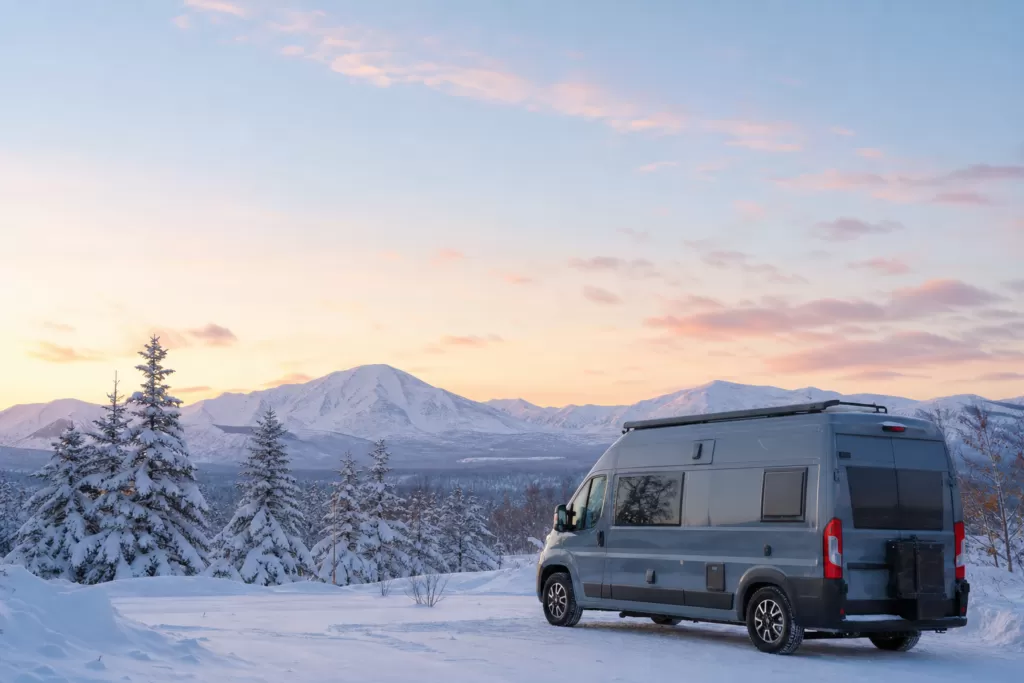
Winter Campervan Trip to Shibetsu and Nayoro: Snowscapes and Hot Springs in Dohoku [2026 Edition]
According to Japan Meteorological Agency normals (1991–2020, a 30-year statistical period), Nayoro’s maximum snow depth averages 93 cm in January, 105 cm in February, and 103 cm in March. Asahikawa, also in the Dohoku region, sees only 18 cm, 17 cm, and 18 cm respectively — about a fifth of Nayoro’s depth (JMA normals for Nayoro, JMA normals for Asahikawa, checked 2026-08-25). Drive just an hour north from Asahikawa along National Route 40, and you enter a completely different snow world — that’s winter in the Dohoku region.
This article covers the winter route from Asahikawa to Shibetsu and Nayoro, the “sun pillar” phenomenon unique to Nayoro, hot springs in Shibetsu and Nayoro, places to park overnight, and — most importantly — the winter driving conditions imposed by rental campervan companies that you should check first. Summer activities in the Dohoku area are covered in our Dohoku, Bifuka, and Nayoro Campervan Guide (cool-climate drives, the trolley train, sunflower fields). The same Nayoro shows a completely different face depending on the season.
Can you drive a campervan to Shibetsu and Nayoro in winter? What to confirm first
Short answer: Shibetsu and Nayoro sit along National Route 40 (the main road connecting Asahikawa and Wakkanai) and are on a major route that gets plowed even in winter. Whether you can actually visit with a rental campervan, though, is a separate question. As our Dohoku, Bifuka, and Nayoro Campervan Guide notes in its FAQ, “many rental campervan companies prohibit or restrict driving in the Dohoku region during winter” — some companies restrict driving to the region entirely during the winter months. Shibetsu and Nayoro are closer to Asahikawa than Bifuka or Otoineppu and their main roads are plowed more frequently, but whether a company restricts the area at all varies by company, so checking this in advance is essential before finalizing your itinerary.
Here are the three points worth confirming before booking.
- Whether there’s a winter driving-area restriction: ask specifically, “Can I drive toward Shibetsu and Nayoro?” — naming the actual place names, since companies interpret “Dohoku” differently.
- Whether the company closes for winter: some companies close entirely from December through March (we confirmed in our studless tire timing guide that some locations do close for winter).
- When studless tires get fitted: confirm with each vehicle whether the switch to winter tires will be done by your rental date.
Skip this one phone call and set off anyway, and you risk being told at the counter on the day, “this area is off-limits,” throwing off your whole itinerary. If you want to compare rental companies across Hokkaido side by side, our Comprehensive Guide to Hokkaido Campervan Rental Companies links out to each company’s official site.
Compare Hokkaido campervan rentals
Base yourself at New Chitose Airport and compare rates, vehicle types, and pickup locations all in one place.
Compare rental companies →Winter route and travel time from Asahikawa to Shibetsu and Nayoro
According to the Shibetsu Tourism Association, it takes about 1 hour 10 minutes from Asahikawa to Shibetsu via National Route 40, or about 30 minutes via the Doo Expressway (from Asahikawa-Kita IC to Shibetsu-Kenbuchi IC) (Shibetsu Tourism Association — access, checked 2026-08-25). From Shibetsu to Nayoro is about 24 km combining National Route 40 and the Nayoro-Bifuka Road, and from Asahikawa to Nayoro is roughly 72 km, or a bit over an hour, by road distance (Asahikawa Development and Construction Department materials on the Nayoro-Bifuka Road, checked 2026-08-25).
| Segment | Approx. distance | Approx. time |
|---|---|---|
| Asahikawa → Shibetsu (Route 40) | ~48 km | ~1 hr 10 min |
| Asahikawa → Shibetsu (Doo Expressway) | – | ~30 min |
| Shibetsu → Nayoro (Route 40 / Nayoro-Bifuka Road) | ~24 km | ~30 min |
| Asahikawa → Nayoro | ~72 km | ~1 hr+ |
The distances look short on paper, but in winter Dohoku, road conditions can change the moment you leave a built-up area. Bridges and shaded curves are especially prone to icing, and on a clear morning with strong radiative cooling, black ice can form. Use the Michi-no-Michi Navi’s Michi-no-Michi Anshin Guide to check road conditions before and during your drive (Michi-no-Michi Navi — Michi-no-Michi Anshin Guide, run by the Civil Engineering Research Institute for Cold Region and the Hokkaido Development Bureau, checked 2026-08-25). General winter driving basics are covered in our Complete Guide to Winter Campervan Driving in Hokkaido.
Watching the sun pillar in Nayoro: conditions and viewing tips
The biggest reason Nayoro draws attention in winter is the “sun pillar” phenomenon. The Nayoro City Resettlement Promotion Council describes the conditions as “temperature at or below -10°C, no wind, and clear skies,” occurring “in the early morning or evening during January and February” (Nayoro City Resettlement Promotion Council — winter living feature, checked 2026-08-25). Nayoro’s average temperatures in January and February are -8.6°C and -8.0°C respectively, with average daily lows of -14.7°C and -14.9°C (JMA normals for Nayoro, cited above, checked 2026-08-25), so these conditions themselves aren’t unusual for a Dohoku winter.
Suggested viewing spots include the areas near the first and second lift bases and the Giant Course at Nayoro Piyashiri Ski Resort, with the best times generally 7–9 a.m. after sunrise and 4–5 p.m. right after sunset (Nayoro City Resettlement Promotion Council, cited above, checked 2026-08-25). That said, the same site notes it’s a phenomenon “impossible to predict, and even locals rarely see it.” You can’t count on seeing it on demand, so a realistic approach is to treat it as a bonus if it happens, using a campervan’s mobility to be ready for an early departure.
Nayoro Onsen Sunpillar: warming up at a hot spring next to the ski slopes
Nayoro Piyashiri Ski Resort, the sun pillar viewing spot, is home to a hot spring facility that shares its name: “Nayoro Onsen Sunpillar.” Renovated in 2022, it lets you soak right after skiing or sledding (Nayoro Piyashiri Ski Resort official site, checked 2026-08-25). Since it’s seasonal, only operating during the snow season, check the official site for the latest hours and rates before visiting (as of this check on 2026-08-25, details for the 2025–26 season were linked from the site).
For campervan travelers, the appeal is being able to complete a full day in one spot: park at the ski resort lot, spend the day playing in the snow, soak in the hot spring in the evening, and once the sun sets, stay warm in the vehicle while waiting for the next morning’s sun pillar. Whether large vehicles can park, and how well the lot gets plowed in winter, varies by year, so it’s worth confirming on-site or by phone (01654-2-1180).
Hotel Utsukushinoyu Onsen in Shibetsu: day baths from early morning to late night
In Shibetsu, “Hotel Utsukushinoyu Onsen” offers day-use bathing. Its main bath is open from 6 a.m. to 1 a.m. the next day — a long window — with admission at ¥750 for adults, ¥220 for elementary schoolers, and free for preschool children (Hotel Utsukushinoyu Onsen official site, checked 2026-08-25). It has both an open-air bath fed directly from the source and an indoor bath, and sits within 10 minutes’ drive of JR Shibetsu Station and Shibetsu-Kenbuchi IC — a convenient stop on your first day driving in from Asahikawa, or for a soak before heading toward Nayoro.
Being able to bathe from 6 a.m. is a quietly big advantage for winter driving in Dohoku: you can wait out the early-morning hours when mountain passes are most likely to be icy, relaxing in the hot spring until road conditions ease up. Shibetsu also has other day-bath facilities such as “Shibetsu Inn Suigetsu” and “Hinata Hoyo Center (Hinata Onsen).” Hours and closing days can change, so check each facility’s official information before visiting.
Hitsuji to Kumo no Oka: Genghis Khan barbecue and indoor exhibits, open through winter
“Hitsuji to Kumo no Oka” (Hill of Sheep and Clouds), the tourist facility built around Shibetsu’s symbolic Suffolk sheep, sits on a hill west of central Shibetsu and includes a restaurant, a World Sheep Museum, and a wool-weaving workshop. The restaurant, “Hitsujikai no Ie” (Shepherd’s House), stays open through winter (October–March) from 11 a.m. to 3 p.m. (closed Wednesdays and over the New Year holidays), though the outdoor barbecue house closes for winter (Hitsuji to Kumo no Oka official site, checked 2026-08-25). Genghis Khan barbecue is served at indoor seating, so whether you’ll see sheep grazing outdoors depends on the season and weather. Check the official site for the winter exhibit status before visiting.
Being on a hilltop, you get views over the snow-covered Shibetsu basin on a clear day. It’s not a flashy tourist spot, but it’s a good size for a 1–2 hour stop before or after waiting for the sun pillar in Nayoro.
Skiing and sledding at Nayoro Piyashiri Ski Resort
Nayoro Piyashiri Ski Resort’s 2025–26 season is scheduled to run from December 13, 2025, through March 22, 2026 (Nayoro Piyashiri Ski Resort official site, checked 2026-08-25). It’s open 9 a.m. to 4:30 p.m. on weekdays, with night skiing on weekends, and lift tickets can be purchased online. There’s also a slope for kids to sled on, making it a manageable size for families without ski experience who just want to play in the snow. Since it’s a seasonal operation, check the official site for the latest operating days, rates, and snow conditions before visiting.
Michi-no-Eki Nayoro and Michi-no-Eki Hitsuji no Machi Samurai Shibetsu: hubs for overnight parking and shopping
Shibetsu has “Michi-no-Eki Hitsuji no Machi Samurai Shibetsu,” and Nayoro has “Michi-no-Eki Nayoro,” both along National Route 40 and useful as shopping and rest stops. Things to watch for at a Michi-no-Eki in winter are the overnight parking rules and reduced parking space due to snow. It’s not unusual for plowed parking areas to be narrower than usual, or for lighting to be sparse at night. Always check the facility’s rules on whether long-term parking or overnight parking is allowed, and park where you won’t get in the way of snow-clearing work.
For shopping, Nayoro has several supermarkets, so it’s efficient to handle your shopping there while traveling from Shibetsu to Nayoro. As for fuel, the town centers of Shibetsu and Nayoro both have multiple gas stations that stay open in winter, though some close on Sundays and holidays — it’s safer to make it a rule to fill up at the next station once you’re down to half a tank.
New Chitose Airport / Tokachi-Obihiro Airport
Rent the “Cresson Journey” cab-conversion camper
Base yourself at New Chitose Airport and travel all across Hokkaido by campervan (please confirm winter Dohoku driving conditions at booking).
See details at Moving Inn →Gear and cold-weather prep for winter driving in Dohoku
Winter in the Shibetsu/Nayoro area — as shown by Nayoro’s January average of -8.6°C and average low of -14.7°C — is a season where your cold-weather gear determines how comfortable the trip actually is (JMA normals for Nayoro, cited above, checked 2026-08-25). Here’s a checklist of the minimum essentials.
- A full layered cold-weather outfit (outer shell, inner layers, gloves, hat, winter boots)
- Confirm how to use the vehicle’s FF heater in advance (fuel consumption and how it works are covered in What Is an FF Heater in a Campervan?)
- Freeze-prevention for the water and drain tanks (confirm with the rental company what to do if they freeze)
- A snow brush and de-icer spray (check at pickup whether these are already in the vehicle)
- A phone charger or power bank (a safety measure for when you don’t have access to power)
Even with the right gear, unease about the driving itself is a separate issue. Concerns about braking on icy roads, following distance, and similar driving worries are addressed individually in our Guide to Resolving Your Worries Before a Winter Campervan Trip in Hokkaido.
Sample winter campervan itineraries for Shibetsu and Nayoro
Since the driving distance within Shibetsu and Nayoro is short, you can cover the highlights even in a 1-night, 2-day trip. If you’d like more breathing room, a 2-night, 3-day trip leaves margin for waiting out bad weather.
| Duration | Sample plan |
|---|---|
| 1 night, 2 days | Day 1: Asahikawa → Shibetsu (Hitsuji to Kumo no Oka, Utsukushinoyu Onsen) → overnight parking in Nayoro. Day 2: chase the sun pillar early morning → Piyashiri Ski Resort and Nayoro Onsen Sunpillar → return to Asahikawa. |
| 2 nights, 3 days | Day 1: Asahikawa → Shibetsu (overnight at Utsukushinoyu Onsen). Day 2: Shibetsu → Nayoro (sledding at Piyashiri Ski Resort → overnight at Nayoro Onsen Sunpillar). Day 3: chase the sun pillar early morning → shop at a Michi-no-Eki → return to Asahikawa. |
Since sun pillars tend to appear early in the morning, staying the night before on the Nayoro side cuts down your travel time that day. On a day that looks like it’s turning stormy, rather than forcing yourself to stick to the schedule, it helps to confirm at booking time how much flexibility you have to shift your dates by a day — that’s the kind of flexible movement that suits a winter Dohoku trip.
Frequently asked questions
Q: Can I visit Shibetsu and Nayoro in winter with a rental campervan?
It depends on the company. Some companies restrict or prohibit driving in the Dohoku region entirely during winter, so before booking, ask specifically whether driving toward Shibetsu and Nayoro is allowed, naming the actual place names. Some companies also close entirely for winter. If you want to compare companies across Hokkaido, our Comprehensive Rental Company Comparison Guide links to each official site.
Q: How different is the snow depth between Shibetsu and Nayoro?
Per JMA normals, Nayoro’s maximum snow depth averages 93 cm in January, 105 cm in February, and 103 cm in March. Shibetsu’s AMeDAS observation point has no normal-value data for snow depth, so a direct comparison isn’t possible, but average temperatures are nearly identical (January average: -8.5°C in Shibetsu, -8.6°C in Nayoro), suggesting the two areas share a similar climate zone (JMA normals for Nayoro/Shibetsu, checked 2026-08-25).
Q: Am I guaranteed to see the sun pillar?
No. It only occurs in the early morning or evening in January and February, when temperature, wind, and sky conditions (below -10°C, no wind, clear skies) all line up, and the Nayoro City Resettlement Promotion Council itself notes that even locals rarely see it. You can’t count on seeing it on demand — the realistic approach is to use a campervan’s mobility to get up early and treat it as a bonus if it happens.
Q: Which hot spring do you recommend, Shibetsu or Nayoro?
It depends on what you need. Hotel Utsukushinoyu Onsen in Shibetsu, open from 6 a.m. to 1 a.m., suits waiting out the icy early-morning hours before crossing a mountain pass. Nayoro Onsen Sunpillar, next to Piyashiri Ski Resort, suits combining skiing, sledding, and sun pillar viewing all in one spot. Since both are seasonal, check each official site for hours and rates before visiting.
Q: How many nights is ideal?
Since Shibetsu and Nayoro are only about 24 km apart, you can cover the main spots — Hitsuji to Kumo no Oka, the hot springs, and sun pillar viewing — even in a single overnight trip. If you’d like margin for bad weather, or want to spend more time skiing and sledding at Piyashiri Ski Resort, a 2-night, 3-day trip is recommended.
Q: Are there particular spots to watch out for on winter roads in Dohoku?
Bridges, tunnel entrances/exits, and shaded curves can be icy even when the roads in town look dry. Be especially careful on clear mornings, when radiative cooling is strongest. Check road conditions before and during your drive using the Michi-no-Michi Navi’s Michi-no-Michi Anshin Guide. General winter driving basics are covered in detail in our Complete Guide to Winter Campervan Driving in Hokkaido.
Q: What’s different about visiting Shibetsu and Nayoro in summer versus winter?
Summer in the neighboring Bifuka/Nayoro area centers on cool-climate escapes, the trolley train, sunflower fields, and river play (see our Dohoku, Bifuka, and Nayoro Campervan Guide). Winter flips that entirely — deep snowscapes, the sun pillar phenomenon, ski resorts, and hot springs take center stage, with almost none of the same activities carrying over. The same place turning into an entirely different trip by season is part of what makes Dohoku interesting.
Book a Campervan in Hokkaido
Moving Inn New Chitose Airport supports English booking and offers airport transfers.
Pick a campervan by what matters to you.
Rent in winter (Dec–Mar)
Companies that rent through winter, listed apart from those that close.

![When and Where Can You See Harbor Seals at Cape Erimo? Kaze no Yakata Official Information, Viewing Season, and Windy-Day Notes [2026-27]](https://hokkaido-campingcar.jp/wp-content/uploads/2026/10/erimo-cape-lighthouse-768x511.jpg.webp)
![Where and Under What Conditions Can You See Diamond Dust in Hokkaido? How Cold a Morning It Takes, and Where It Appears [2026-27]](https://hokkaido-campingcar.jp/wp-content/uploads/2026/10/hokkaido-diamond-dust-nayoro-768x512.jpg.webp)
![Can You Drive to Hokkaido Jingu for Hatsumode? Parking, Crowds, and Where to Park and Walk [2027]](https://hokkaido-campingcar.jp/wp-content/uploads/2026/10/hokkaido-jingu-winter-torii-768x504.jpg.webp)
![Hokkaido Roads Over New Year [2026-27] | Expressway Sections Prone to Blizzard Closures, Forecast Congestion Days, No Holiday Discount, and New Chitose Airport Parking](https://hokkaido-campingcar.jp/wp-content/uploads/2026/10/hokkaido-winter-rural-road-edge-markers-768x432.jpg.webp)
![Where to See Sea Smoke (Kearashi) in Hokkaido: Rumoi’s Ogon-misaki and the Morning Conditions [2026-27]](https://hokkaido-campingcar.jp/wp-content/uploads/2026/10/rumoi-kearashi-sea-smoke-768x511.jpg.webp)
![Geminid Meteor Shower 2026 in Hokkaido: Peak Around 23:00 on December 14, Sapporo Moonset 20:40, and Staying Warm in a Winter Campervan [2026]](https://hokkaido-campingcar.jp/wp-content/uploads/2026/10/geminids-2026-hokkaido-768x575.jpg.webp)