Complete Beginner’s Guide to Campervan Travel | From First Steps to Hokkaido Adventure
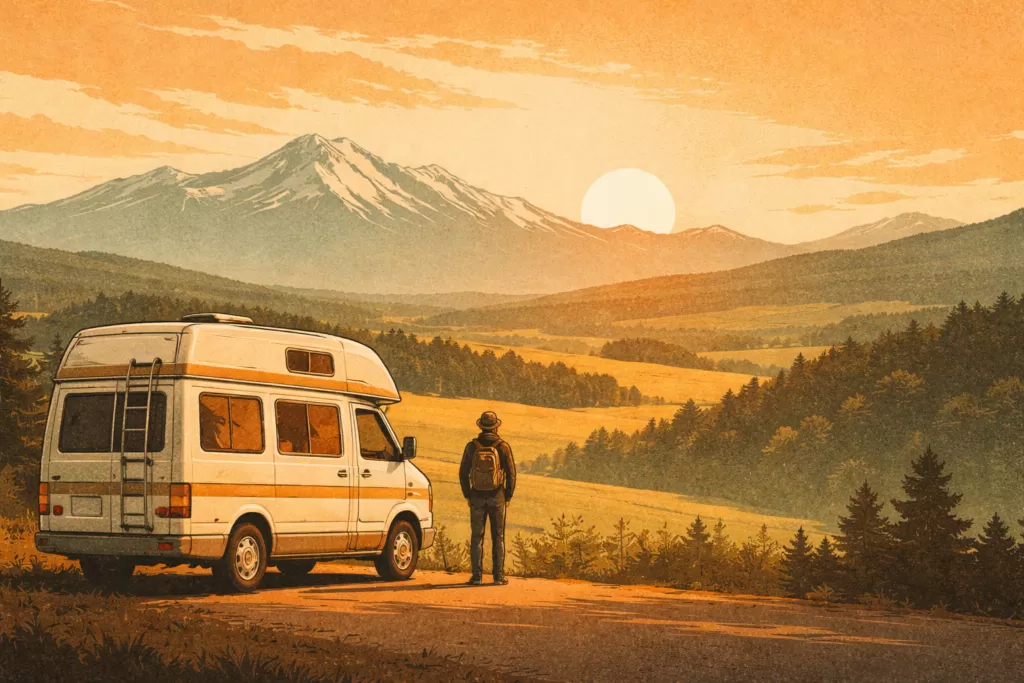
In recent years, campervan travel has become incredibly popular. The freedom to go wherever you want, perfect for creating family memories, and surprisingly affordable — these are just some of the reasons why many people are considering their first campervan experience.
However, most beginners have questions and concerns: “Do I need a special campervan license?” “Is driving difficult?” This guide covers everything you need to know.
In this article, we cover all the essential knowledge before starting your campervan journey across 8 key themes. From basics to practical tips, we provide all the information you need to confidently enjoy a Hokkaido campervan trip. Use this as your first step.
3 Reasons Why Campervan Travel is So Appealing
There are three main reasons beginners choose campervan travel. Understanding these benefits will transform your motivation for the entire trip.
The Freedom to Travel on Your Own Terms
The biggest appeal of a campervan is the freedom to choose where you sleep. Without being tied to hotel or guesthouse reservations, you can decide your destination at your own pace, or linger as long as you like at a place you love. Waking up surrounded by Hokkaido’s majestic nature is an experience beyond words. Flexibility in the face of sudden weather changes — enjoying the view from inside the vehicle — is another major advantage.
Perfect for Creating Family Memories
A campervan lets your family maintain their private space while cherishing time together. Whether moving, resting, or while the kids sleep, you’re always together in the same environment, naturally leading to more conversations. In this “special journey” unlike anything else, you’ll experience even deeper family bonds. Your photos and videos will capture more genuine smiles than a typical sightseeing trip.
Surprisingly Affordable Travel Costs
The total cost for a 2-day, 1-night campervan trip for a family of four is approximately ¥30,000–50,000. Compared to hotel stays for the same period, which can cost ¥40,000–60,000 for accommodation alone, a campervan offers superior freedom and cost efficiency. If you prepare meals inside the vehicle, you can also reduce dining costs, making the trip even more economical.
As you can see, campervan travel is a choice where multiple benefits overlap for beginners. So, what do you need to prepare to get started? The next section covers how to choose your vehicle type. Be sure to also check the Hokkaido Campervan Rental Guide.
New Chitose Airport / Tokachi-Obihiro Airport
Rent the Cabcon “Cresson Journey”
Base yourself at New Chitose Airport and compare rates, vehicle types, and pickup locations all in one place.
See details at Moving Inn →Beginner’s Guide | Choosing the Right Campervan Type
Campervans come in different types. Understanding the characteristics of each and choosing the right type for beginners will greatly affect the comfort of your trip.
What is a Cab Conversion (Cabcon)
A cab conversion is a large campervan built by converting the cargo bed of a truck. It offers very high livability, close to the comfort of home. However, as it is 3.8–4m or more in height, you need to be careful about tunnel and parking garage height restrictions. The driving difficulty is also high, making it unsuitable for beginners. Depending on its gross vehicle weight, a regular license may not be enough (a regular license obtained on or after March 12, 2017 covers vehicles under 3.5 tonnes), so it’s best considered an option after multiple campervan travel experiences.
What is a Van Conversion (Bancon) and Why It’s Beginner-Friendly
A van conversion is a campervan built by converting existing vans such as the HiAce. Its size is close to a regular vehicle, and with a height of about 2.8–3m, you’ll rarely have trouble with regular parking lots or tunnels. The ride is comfortable, and campervan fuel efficiency is relatively good. Most importantly, it can be driven with a regular license, and operations like reversing and cornering are relatively easy. As it balances livability and ease of driving, it’s the most recommended type for beginners.
What is a Kei Camper
A kei camper is a compact campervan built by converting small trucks or wagons. It’s maneuverable and has excellent fuel efficiency. It’s a beginner-friendly option for those who want to travel casually, as it can handle narrow roads and limited spaces at campsites. However, the living space is limited, making it unsuitable for long stays for a family of four. It’s suited for 1–2 person trips or short stays of 1–2 nights.
| Type | Livability | Driving Difficulty | Beginner-Friendly | Key Features |
|---|---|---|---|---|
| Cab Conversion | High | Hard | ✕ | Truck-based, large, height restrictions |
| Van Conversion | Medium | Easy | ◎ | HiAce-based, balanced |
| Kei Camper | Low | Easy | ○ | Maneuverable, great fuel economy |
For a first campervan experience, a van conversion is the most recommended. For more details, see the Campervan Type Comparison Guide.
License Requirements for Driving a Campervan
The license required to drive a campervan varies by vehicle type. This is an important point for beginners to confirm first.
A Regular License is OK
For van conversions and kei campers, you can drive with a regular automobile license. A regular license obtained on or after March 12, 2017 covers vehicles with a gross vehicle weight under 3.5 tonnes; heavier cab conversions over 3.5 tonnes require a semi-medium or medium license (a regular license obtained between June 2, 2007 and March 11, 2017 covers under 5 tonnes, and one obtained on or before June 1, 2007 covers under 8 tonnes). For vehicles under 3.5 tonnes, there’s no need to obtain a new license. However, if you’re an infrequent driver, we recommend practicing driving a few times beforehand to get used to the size of a campervan.
Optional Certifications for Beginners
No additional certifications are basically required, but taking the following types of training can make your trip safer. For example, campervan driving courses offered by rental shops let you learn campervan driving tips hands-on. If you’re anxious about driving for the first time, we highly recommend using such training. See the Campervan License Guide for details.
The Rental Process | 4 Simple Steps
The process of renting a campervan is actually quite simple. It’s completed in just 4 steps.
Step 1: Reserve by Desired Date and Vehicle Type
Select your desired dates and vehicle type from the rental shop’s website and make a reservation. It takes about 5 minutes. With your driver’s license and credit card information, you can easily reserve. At this stage, you don’t need to finalize your travel plans — just deciding on approximate dates is fine.
Step 2: Vehicle Pickup at Rental Shop (Including Orientation)
Visit the rental shop on your reserved date. Present your ID (driver’s license) at the reception and proceed with the contract. Afterward, spend about 30 minutes to 1 hour receiving a vehicle explanation from staff. They will explain everything you need for your trip: how to use the bed, shower, toilet, and cooking equipment. If you have any concerns, don’t hesitate to ask questions.
Step 3: Enjoy Your Trip
Your campervan journey begins! Enjoy Hokkaido’s vast scenery while progressing at your own pace. Stop wherever you want, or spend a night at a wild camping spot if you have time — move freely.
Step 4: Return (Full Tank of Gas, etc.)
At the end of your trip, return the vehicle to the rental shop. The rule is to return with a full tank of gas. A quick clean of the interior is also appreciated. Staff will check the vehicle condition upon return, and if there are no problems, the process is complete. Credit card charges are processed automatically.
As you can see, the rental process itself is very simple. For more details, please refer to the Hokkaido Campervan Rental Guide.
5 Key Points for First-Time Drivers
Campervans are larger than regular cars, so extra care is needed when driving for the first time. Keep these 5 key points in mind.
Never Forget Height Restrictions (Tunnels & Parking Garages)
Campervans have considerable height. Van conversions are about 2.8–3m, and kei campers are 2.0m or lower under the kei car standard. Particular caution is needed for tunnels, multi-story parking garages, gas stations, and convenience store parking. Research height restrictions at your destination in advance, or always watch for signs while driving. You can also use smartphone apps to check passage height restrictions beforehand.
Minimize Reversing, Prioritize Forward Movement
Campervans are large, making reversing difficult. When choosing a parking spot, prioritize places that can be handled with forward-only movement without the need to reverse. If reversing is necessary, having staff or family members guide you greatly improves safety. Take your time, go slowly, and confirm as you maneuver.
Slow Down for Curves — Essential
Campervans have a high center of gravity, increasing the risk of rollover in curves compared to regular vehicles. Especially on sharp curves and mountain roads, slow down more than usual. A good guideline is to drive about 10–15 km/h below the posted speed limit.
Be Aware of Inner Wheel Difference When Turning Left
Due to the campervan’s size, there is significant inner wheel difference when turning left. Especially at small intersections and on narrow roads, there’s a risk of hitting curbs, utility poles, or parked cars. Before turning left, ensure there’s sufficient space and check your mirrors thoroughly before turning.
Monitor Fuel and Secure Refueling Stops
Campervan fuel efficiency is lower than regular vehicles. Van conversions get about 8–10 km/L. Some areas of Hokkaido have few gas stations, so research refueling spots in advance for peace of mind (see also kei camper rentals in Hokkaido).
For packing lists and driving preparation, see the Campervan Packing List for detailed information.
Beginner’s 2-Day, 1-Night Model Itinerary in Hokkaido
So what kind of itinerary is suitable for beginners? Here we suggest a 2-day, 1-night model course departing from Sapporo.
Sample Sapporo Departure Route
Departing Sapporo at 8am, head first toward Otaru. Take your time visiting Otaru Canal and historic buildings as you travel. On Day 1, find a wild camping spot near Otaru and spend the night gazing at the sea. On Day 2 morning, enjoy the sunrise over the sea, then drive toward Shakotan Peninsula. After visiting scenic spots like Cape Kamui, return to Sapporo in the afternoon. The total driving distance is about 150km, with a pace suitable for beginners.
Otaru to Shakotan Options
From Sapporo to Otaru is about 60km, and from there to the tip of Shakotan Peninsula is about 80km. You could spend half a day in Otaru on Day 1, then move to the campsite at night; or depart Sapporo in the morning, skip Otaru, and focus on touring Shakotan. The beauty of campervan travel is that you can flexibly change plans depending on weather and mood.
Driving Time and Rest Break Guidelines
For beginners, aim for 3–4 hours of driving per day. Beyond that, fatigue reduces safety. Take 10–15 minute breaks for every 30 minutes of driving. Hokkaido is vast, so it’s tempting to drive long distances, but in campervan travel, it’s far more important to “enjoy the journey including the travel process” than to “arrive at the destination.” Stay relaxed and maintain a leisurely pace.
Campervan Travel Cost Estimate | ¥30,000–50,000 for 2 Days, 1 Night
The actual cost of the trip is what beginners are most concerned about. Below is a cost breakdown for a 2-day, 1-night trip for a family of four.
| Item | Cost |
|---|---|
| Rental fee (2 days, 1 night) | ¥20,000–30,000 |
| Gas | ¥2,000–3,000 |
| Food | ¥5,000–10,000 |
| Stops & other | ¥3,000–5,000 |
| Total | ¥30,000–48,000 |
Rental Fee (2 Days, 1 Night)
The rental fee for a van conversion for 2 days and 1 night is typically ¥20,000–30,000. Kei campers may be slightly cheaper. Prices tend to rise during busy periods (Golden Week, summer vacation, autumn foliage season), so check in advance.
Gas Costs
For the Sapporo–Otaru–Shakotan course (about 150km), gas costs are about ¥2,000–3,000. Assuming about 9 km/L fuel efficiency for a van conversion, you’d need 16–17 liters for 150km. At ¥160 per liter, that’s about ¥2,560–2,720.
Food Costs
Food costs vary greatly depending on whether you eat out or cook. With supermarket ingredients cooked in the vehicle, ¥2,000–3,000 per day is sufficient. If eating out mainly, budget ¥5,000–8,000. For a family of four over 2 days and 1 night, ¥5,000–10,000 total is a good estimate.
Stops & Other
Budget about ¥3,000–5,000 for sightseeing admission fees, hot spring fees, parking fees, etc. Hokkaido has many free scenic spots, so with some planning, you can reduce this further.
For detailed pricing information, see the Campervan Rental Price Guide.
Common Beginner Mistakes and Solutions
Finally, here are common mistakes beginners actually experience, and their solutions. Knowing these in advance can prevent problems before they happen.
“Missed height restriction” → Use a Pre-check App
One of the most common beginner mistakes is missing height restrictions. The solution is to check your planned route on a map before driving and research tunnel and building height restrictions. Google Maps has a feature that displays height restrictions along your route. Make it a habit to check in advance.
“Didn’t know how to set up the tent” → Ask at the Orientation
Many beginners struggle with setting up the tent or awning (sun shade) that comes with the campervan. At the rental orientation, ask staff to show you how to set it up, and try setting it up yourself — this way you won’t have trouble during your trip.
“Couldn’t figure out the toilet” → Read the Manual, Ask Staff
Campervan toilets are different from regular toilets. Understanding tank capacity, how to use them, and how to dispose of waste from portable toilets is important. Get a thorough explanation at the orientation, and don’t hesitate to ask if you’re unsure.
“Had trouble finding gas” → Refuel Frequently
Hokkaido is vast and gas stations can be far apart. Rather than scrambling to find one when the warning light comes on, we recommend filling up whenever you reach half a tank.
“Got tired in traffic” → Plan with Plenty of Margin
One common beginner pitfall is packing the schedule too tightly. Being unfamiliar with driving means things take longer than expected. In campervan travel, keeping your schedule relaxed with a theme of “taking it easy” and not cramming in too many plans is key.
Regarding insurance, please check the Campervan Insurance Guide before departure. Being prepared for any unexpected trouble gives you peace of mind.
If you’re considering a campervan trip with children, check the Complete Guide to Family Hokkaido Travel for preparation tips and precautions.
Conclusion: Beginners Should Especially Enjoy Campervan Travel
In this article, we covered all 8 key themes that beginners need to know before starting campervan travel.
- 3 appeals of campervan travel
- How to choose a vehicle type (van conversion for beginners)
- About driving licenses
- The 4 rental steps
- 5 key driving tips for first-timers
- 2-day, 1-night Hokkaido model itinerary
- Cost estimate (¥30,000–50,000)
- Common mistakes and solutions
A campervan is not a “difficult vehicle” for beginners — it’s a “new travel style.” With solid preparation and consultation with rental shop staff, you can have a safe and enjoyable trip.
Time spent with your family in the majestic nature of Hokkaido. Such a special experience will become a precious memory in your life. We hope you’ll consider campervan travel as your next adventure.
New Chitose Airport / Tokachi-Obihiro Airport
Rent the Cabcon “Cresson Journey”
Base yourself at New Chitose Airport and compare rates, vehicle types, and pickup locations all in one place.
See details at Moving Inn →Book a Campervan in Hokkaido
Moving Inn New Chitose Airport supports English booking and offers airport transfers.

![When and Where Can You See Harbor Seals at Cape Erimo? Kaze no Yakata Official Information, Viewing Season, and Windy-Day Notes [2026-27]](https://hokkaido-campingcar.jp/wp-content/uploads/2026/10/erimo-cape-lighthouse-768x511.jpg.webp)
![Where and Under What Conditions Can You See Diamond Dust in Hokkaido? How Cold a Morning It Takes, and Where It Appears [2026-27]](https://hokkaido-campingcar.jp/wp-content/uploads/2026/10/hokkaido-diamond-dust-nayoro-768x512.jpg.webp)
![Can You Drive to Hokkaido Jingu for Hatsumode? Parking, Crowds, and Where to Park and Walk [2027]](https://hokkaido-campingcar.jp/wp-content/uploads/2026/10/hokkaido-jingu-winter-torii-768x504.jpg.webp)
![Hokkaido Roads Over New Year [2026-27] | Expressway Sections Prone to Blizzard Closures, Forecast Congestion Days, No Holiday Discount, and New Chitose Airport Parking](https://hokkaido-campingcar.jp/wp-content/uploads/2026/10/hokkaido-winter-rural-road-edge-markers-768x432.jpg.webp)
![Where to See Sea Smoke (Kearashi) in Hokkaido: Rumoi’s Ogon-misaki and the Morning Conditions [2026-27]](https://hokkaido-campingcar.jp/wp-content/uploads/2026/10/rumoi-kearashi-sea-smoke-768x511.jpg.webp)
![Geminid Meteor Shower 2026 in Hokkaido: Peak Around 23:00 on December 14, Sapporo Moonset 20:40, and Staying Warm in a Winter Campervan [2026]](https://hokkaido-campingcar.jp/wp-content/uploads/2026/10/geminids-2026-hokkaido-768x575.jpg.webp)